Trentino-Alto Adige · Bolzano
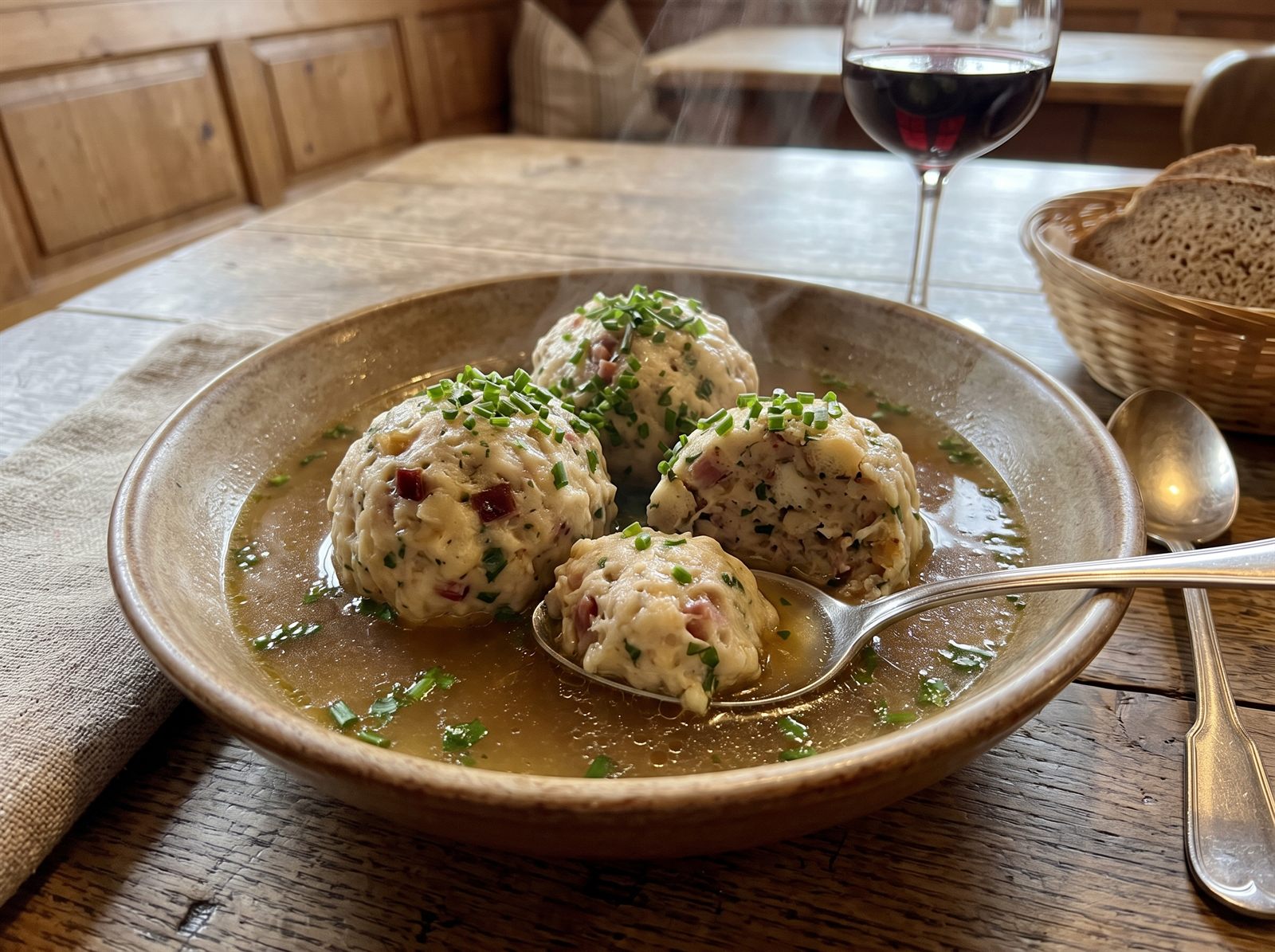
Canederli in brodo
Speck and bread dumplings in broth
Large dumplings of stale bread, speck and milk, served in clear broth — the Tyrolean way to use yesterday's bread.
- Course
- Primo piattoSoup
- Serves
- 4
- Hands-on
- 34 min
- Cooking
- 30 min
- Resting
- 20 min+
La provenienza
Where this recipe comes from
Known as Knödel in German-speaking South Tyrol and canederli in Trentino, these dumplings are the emblem of a mountain kitchen that wastes nothing. Speck Alto Adige, the cured ham that flavours them, is a PGI.
There is no official recipe; Trentino and South Tyrol sources agree on the essentials — stale homemade bread soaked in milk and egg, speck, and as little flour as possible — and serve them in broth or ‘asciutti’, with melted butter, Parmigiano and sage.
- Provenance
- Documented traditionA regional tradition documented in cookbooks and local practice, with no single official text.
- Defined by
- Tyrolean tradition
- Reference
- Made with Speck Alto Adige PGI
Ingredienti
Ingredients
Equipment
- Large bowl
- Small frying pan for the onion
- Wide pan for simmering the dumplings, and a saucepan for the serving broth
- Slotted spoon
Preparazione
Method
About 1¼ hours: 30 minutes for the bread to soak, a test dumpling, then 15 minutes of gentle simmering. Use bread that is one or two days old.
- 34 minhands-on
- 30 mincooking
- 20 minresting, at least
The mixture
-
Hands-on 10 min
Cut the stale bread into cubes of about 1 cm and the speck into a 5 mm dice. Put them in the large bowl.
-
Hands-on 5 minHeat medium-low
Soften the chopped onion in a knob of butter over medium-low heat for about 5 minutes, without colouring, and add it to the bowl with the chives and parsley.
-
Hands-on 3 min
Beat the eggs with the milk and pour them over the bread. Toss well so every cube is moistened.
-
Rest 20–30 min
Cover and leave for 20–30 minutes so the bread absorbs the liquid evenly.
Check The bread is soft right through, with no dry centres, and no liquid pooling at the bottom.
-
Hands-on 3 min
Add the flour and knead briefly with your hands until the mixture holds together. Season lightly — the speck is already salty.
Tip Too much flour makes heavy, gummy dumplings. Add only enough for the mixture to hold.
Shaping and cooking
-
Cooking 15 min
Bring a wide pan of salted water to a gentle simmer. Shape one dumpling and cook it for 15 minutes. If it starts to fall apart, add a spoonful of flour to the mixture; if it is dense, add a splash of milk.
Tip The test saves the whole batch: bread varies, and so does how much liquid it takes.
-
Hands-on 10 min
With wet hands, shape 8 compact dumplings the size of a tangerine — about 6 cm across, roughly 70 g each — pressing so there are no cracks.
Check Smooth, compact balls with no loose cubes on the surface.
-
Cooking 15 minTemp 90 °C–95 °CHeat low — barely simmering
Lower them into the simmering water and cook for about 15 minutes, keeping the water just below the boil, 90 °C–95 °C.
Check They have risen to the surface and are firm right through when cut.
Tip Cooking them in water rather than the serving broth keeps the broth perfectly clear.
-
Hands-on 3 min
Meanwhile heat the broth. Lift the dumplings out with the slotted spoon and serve two per bowl in hot broth, with chopped chives — or drained, with melted butter, Parmigiano and sage.
The essentials, for cooks who know the dish. Switch to Detailed for quantities, temperatures, times and checks at every step.
Tap a step to mark where you are. Timers keep running while you scroll.
Errori comuni
Common mistakes
- Boiling them hard — they fall apart. Keep the water at a gentle simmer.
- Adding too much flour: it makes the dumplings heavy and gummy. Use only enough to bind.
Fuori dall'Italia
Cooking it outside Italy
- If speck is unavailable, use smoked prosciutto-style ham.