Marche · Ascoli Piceno
Olive all'ascolana
Stuffed fried olives of Ascoli
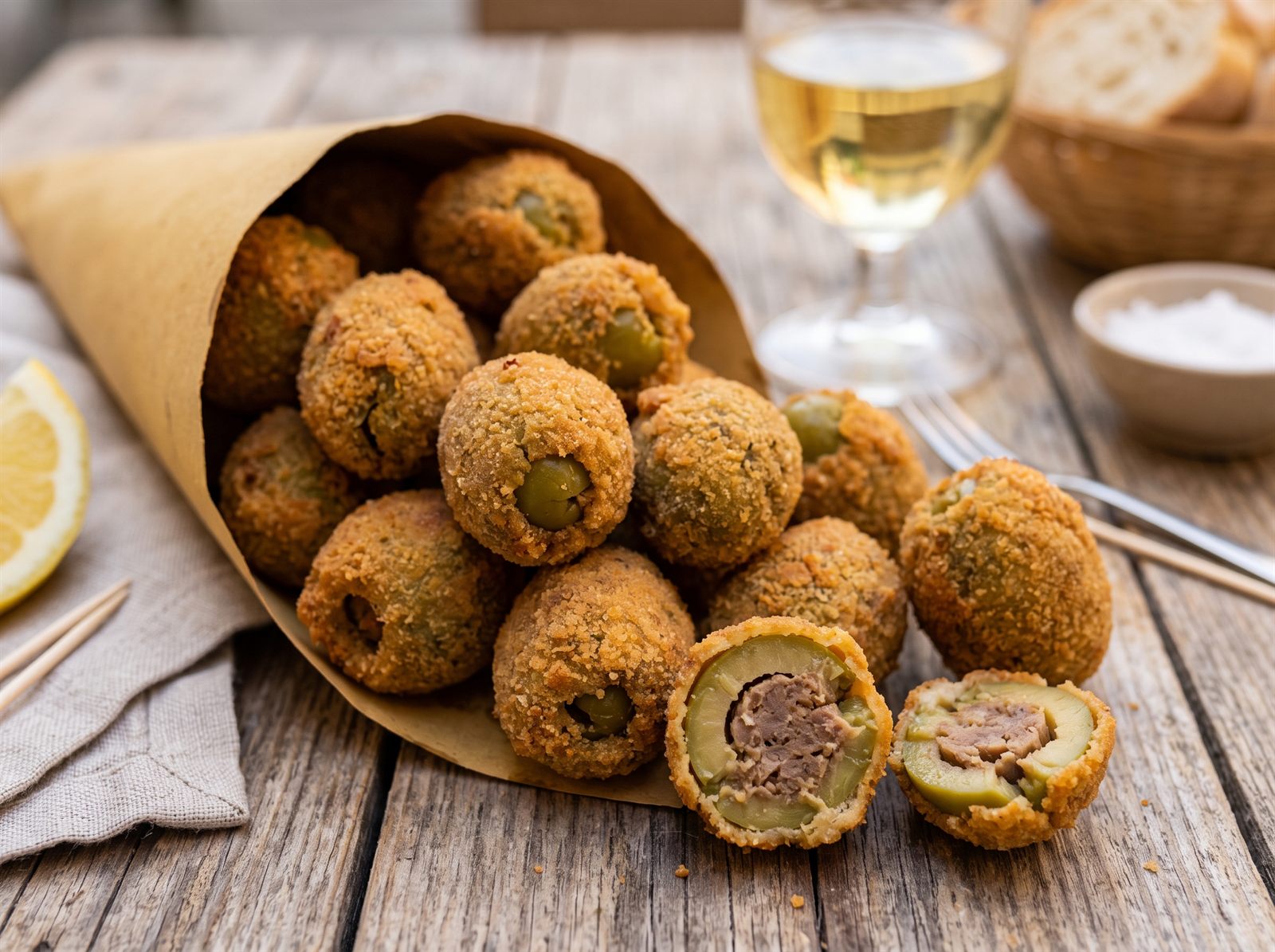
Large green Ascolana Tenera olives stuffed with beef and pork, breaded and fried — protected by the PDO ‘Oliva Ascolana del Piceno’.
- Course
- AntipastoStarter
- Serves
- 6
- Hands-on
- 1 h 36 min
- Cooking
- 58 min
- Resting
- 1 h+
La provenienza
Where this recipe comes from
The Ascolana Tenera olive is big, mild and tender. Its PDO, registered by the European Union in 2005, covers both the olives in brine and the stuffed olive, and it is the stuffing that the specification describes in detail: mature beef and pork from the production area, with a little chicken or turkey allowed, cooked with the classic soffritto and white wine, then bound with egg and aged cheese.
Tradition places the meat stuffing in the nineteenth century, in the kitchens of Ascoli's noble families. Today a kilo of PDO stuffed olives holds between 60 and 95 olives; the minimum was lowered from 65 in the 2025 amendment, so that the largest olives can still be used.
- Provenance
- EU-codifiedThe dish itself is protected by an EU specification (TSG, PDO or PGI) that fixes how it is made.
- Defined by
- European Union
- Reference
- PDO ‘Oliva Ascolana del Piceno’ — Regulation (EC) No 1855/2005; specification amended in 2025, 2005
Ingredienti
Ingredients
For the filling
To finish
Equipment
- Heavy pan with a lid, for the meats
- Meat grinder with a fine plate, or a food processor
- Small, sharp, pointed knife for the spiral cut
- Three shallow dishes for flour, egg and breadcrumbs
- Deep pan or fryer, a frying thermometer and a slotted spoon
- Kitchen scale
Preparazione
Method
About 3 hours in all: an hour to cook the meats slowly, time for the filling to cool and firm, about an hour to pit and stuff 60 olives, and 15 minutes of frying. The filling can be made the day before.
- 1 h 36 minhands-on
- 58 mincooking
- 1 hresting, at least
The filling
-
Official textHands-on 10 minHeat medium-high
Cut the beef, pork and chicken into chunks of about 3 cm. Heat the olive oil and/or lard in the heavy pan over medium-high heat and brown the meat on all sides for about 10 minutes.
-
Official textHands-on 5 minHeat medium
Add the finely chopped onion, carrot and celery and let them soften with the meat for 5 minutes, stirring.
-
Official textCooking 45 min – 1 hHeat low, covered
Pour in the white wine and let it bubble for 2–3 minutes, then salt lightly, cover and cook on low heat until the meat is completely tender, 45–60 minutes. Add a few spoonfuls of water if the pan dries out.
Check The meat breaks apart when pressed with a fork, and very little liquid is left in the pan.
-
Rest 30 min
Let the meat cool for about 30 minutes. Lift it out of the pan, leaving the excess fat behind.
-
Official textHands-on 10 min
Mince the meat finely through the grinder or in the food processor. Mix in the eggs, the grated cheese and a grating of nutmeg, plus any of the optional flavourings (a little lemon zest is the most common), until you have a firm, even paste.
Check The paste holds its shape when rolled into a ball. If it is crumbly, add a little more egg; the specification allows 2–4 eggs per kilo of filling.
-
Rest 30 minTemp 4 °C
Cover the filling and refrigerate it for at least 30 minutes, until firm. Cold filling is much easier to wrap.
Pitting and stuffing
-
Hands-on 5 min
Drain the olives. If they taste very salty, rinse them briefly in cold water. Pat them dry.
-
Official textHands-on 30 min
Holding an olive between thumb and finger, cut into the flesh down to the stone and turn the olive against the knife so you cut a continuous spiral from top to bottom, keeping the flesh in a single strip. Discard the stone.
Tip This is the traditional hand method. The 2025 specification also allows olives slit lengthways and pitted by machine.
-
Official textHands-on 20 min
Roll a ball of filling of about 5–7 g and wrap the spiral of olive flesh around it, pressing gently so it takes back the shape of a whole olive.
Check The finished, coated olive weighs between about 10 and 17 g: the specification allows 60–95 stuffed olives per kilo, and at least 40% of the weight must be olive.
Coating and frying
-
Official textHands-on 15 min
Roll each olive in flour, tapping off the excess, then in beaten egg, then in fine breadcrumbs. The coating should be light, just enough to cover.
Tip Leave the coated olives in the fridge for 15 minutes before frying: the coating sets and does not come away in the oil.
-
Cooking 10 minTemp 170 °CHeat medium-high, then adjust to hold the temperature
Heat at least 5 cm of oil in the deep pan to 170 °C, checking with the thermometer.
-
Official textCooking 3–4 minTemp 165 °C–175 °C
Fry about ten olives at a time for 3–4 minutes, turning them, until evenly golden. Keep the oil between 165 °C and 175 °C.
Check Deep golden all over. The filling is already cooked, so you only need to heat it through and crisp the coating.
Tip Too many olives at once drop the oil temperature: they absorb oil and turn greasy.
-
Hands-on 1 min
Lift them out with the slotted spoon, drain on kitchen paper for a minute and serve hot.
The essentials, for cooks who know the dish. Switch to Detailed for quantities, temperatures, times and checks at every step.
Tap a step to mark where you are. Timers keep running while you scroll.
Errori comuni
Common mistakes
- Making the filling with equal parts of beef, pork and chicken: the specification asks mostly for beef and pork, with chicken or turkey at no more than 10%.
- Using small or firm olives — they cannot be cut and wrapped around the filling.
- A thick, heavy crust: the specification asks for a light coating.
Fuori dall'Italia
Cooking it outside Italy
- Large green olives such as Castelvetrano can stand in for Ascolana Tenera — the result is olives ‘all'ascolana’ in style, not the PDO product.
- Grana Padano or Pecorino Romano both count as aged grated cheese if Parmigiano is hard to find.