Emilia-Romagna · Bologna
Ragù alla bolognese
Bolognese meat ragù
The slow meat ragù of Bologna, in the updated version the Accademia Italiana della Cucina deposited with the city's Chamber of Commerce in 2023.
- Course
- SugoSauce
- Serves
- 6
- Hands-on
- 26 min
- Cooking
- 2 h 25 min
- Resting
- 10 min+
La provenienza
Where this recipe comes from
Every family in Bologna has its own ragù, which is exactly why the Accademia Italiana della Cucina fixed a reference version. It first deposited the recipe with the Bologna Chamber of Commerce on 17 October 1982; on 20 April 2023, after work by a dedicated study committee, it deposited an updated text that replaces the 1982 one.
The 2023 recipe drops the requirement for ‘cartella’ (beef skirt), now hard to find, in favour of collagen-rich forequarter cuts, and accepts a good stock cube for the broth. It allows a few variants: about 60% beef with 40% pork (loin or coppa), meat chopped by knife, rolled pancetta instead of fresh, and a hint of nutmeg. It can also be enriched with chicken livers, hearts and gizzards, crumbled sausage, peas added at the end, or soaked dried porcini.
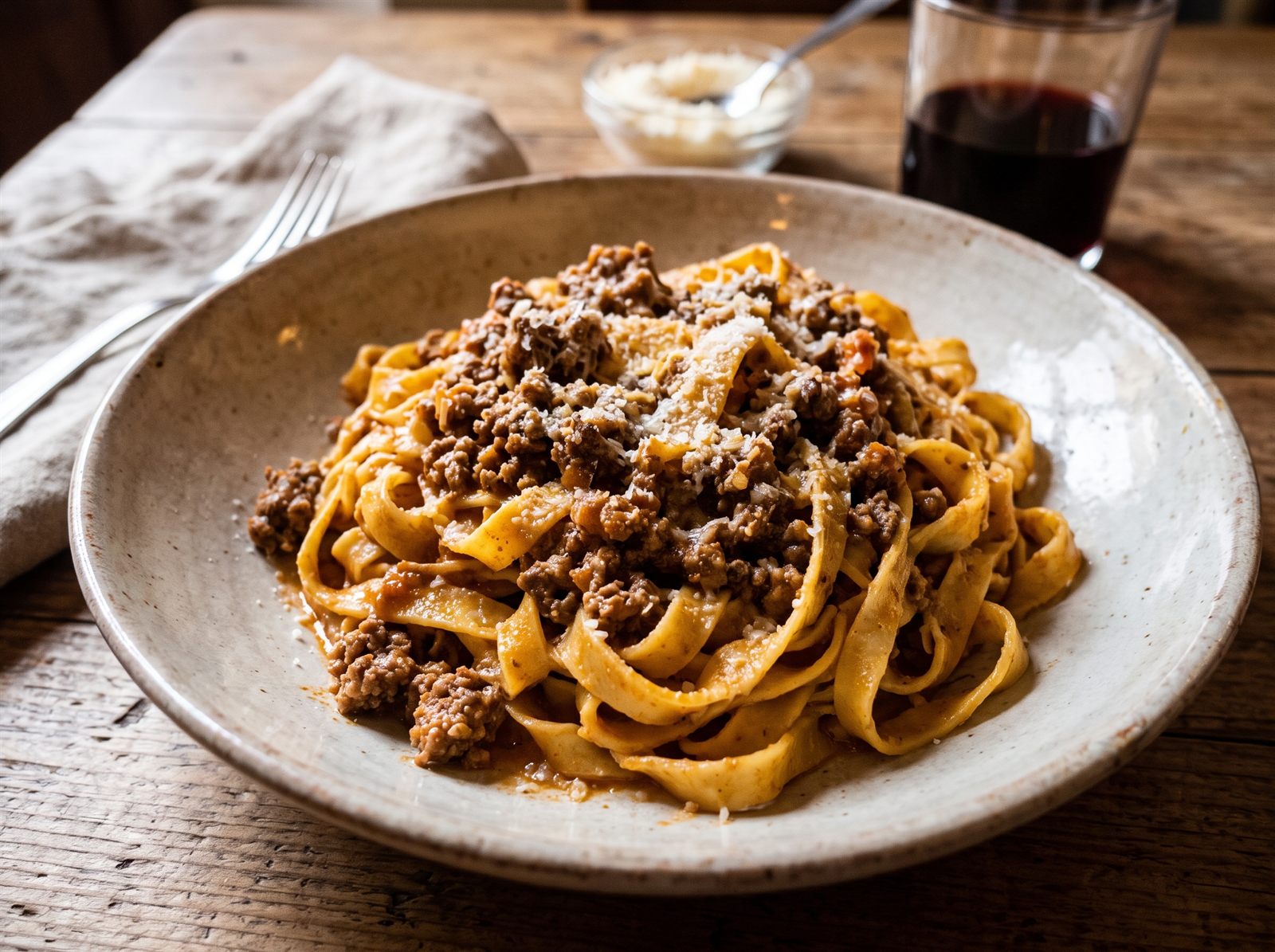
It is a meat sauce with a little tomato, not a tomato sauce with a little meat. By Bolognese tradition — not part of the deposited text — it is served with fresh egg tagliatelle.
- Provenance
- Deposited recipeAn official recipe filed with an Italian Chamber of Commerce or a notary by a recognised culinary body.
- Defined by
- Accademia Italiana della Cucina
- Reference
- Updated recipe deposited with the Chamber of Commerce of Bologna (replacing the 1982 text), 2023
Ingredienti
Ingredients
Equipment
- Heavy pan 24 cm–26 cm across, with a lid: aluminium, enamelled cast iron, or earthenware — the deposited recipe's choice
- Wooden spoon
- Sharp knife and board — the pancetta and vegetables are chopped by hand, not in a mixer
- Kitchen scale, and a small pan to keep the broth hot
Preparazione
Method
About 3 hours, almost all of it slow, unattended simmering. Ragù is even better the next day: make it the day before, cool it quickly and reheat it gently.
- 26 minhands-on
- 2 h 25 mincooking
- 10 minresting, at least
Preparation
-
Official textHands-on 15 min
Weigh every ingredient. Chop the pancetta by hand into a fine dice of about 3 mm. Chop the onion, carrot and celery the same size — about 60 g of each. Keep the broth hot in a small pan on the back of the stove.
Tip The deposited recipe says not to use a mixer: it turns the vegetables to a watery pulp that stews instead of softening.
The base
-
Official textHands-on 5 minHeat medium-low
Put the pancetta in the pan with a drizzle of olive oil over medium-low heat and let its fat melt slowly, stirring, for about 5 minutes. It should turn translucent, not brown.
-
Official textCooking 10 minHeat medium-low
Add the chopped onion, carrot and celery and let them soften slowly, stirring often with the wooden spoon, for about 10 minutes.
Check The vegetables are soft and glossy and the onion is translucent. It must never catch or smell burnt — the deposited text is explicit about this.
-
Official textCooking 10 minHeat medium-high
Raise the heat to medium-high, add the minced beef and break it up with the spoon. Cook it for about 10 minutes, stirring, until the liquid it releases has evaporated and the meat sizzles in the fat.
Check No liquid left in the pan, the meat crackles, and it has lost its raw pink colour.
Tip The deposited text also accepts the modern technique: brown the meat well in a separate pan, on its own, then add it to the vegetables.
-
Official textCooking 5 minHeat medium-high
Pour in the glass of wine (about 150 ml) and let it bubble until it has evaporated completely — about 5 minutes.
Check Hold your face over the pan: you can no longer smell wine, only meat.
-
Official textHands-on 2 min
Stir in the tomato paste and the passata (200 g) and mix well, then add a cup of hot broth (about 250 ml).
The long simmer
-
Official textCooking 1 hHeat lowest — a lazy bubble every few seconds
Lower the heat to the minimum, cover the pan and let the ragù cook very gently. Stir every 15–20 minutes and add a ladle of hot broth (about 100 ml) whenever it looks dry.
Tip Always add the broth hot: cold liquid stops the cooking and toughens the meat.
-
Official textHands-on 2 min
Halfway through, pour in the glass of whole milk (about 150 ml) and stir. Let it be absorbed completely before adding any more broth.
Tip The milk is optional in the 2023 text, but recommended as an old tradition: it softens the acidity of the tomato and makes the ragù silkier.
-
Official textCooking 1–2 hHeat lowest
Keep the ragù covered on the lowest heat for another hour — up to two, depending on taste and the cuts used — still stirring every 15–20 minutes and adding hot broth as needed.
Check The ragù is a deep orange colour, rich and creamy, the meat completely tender, with a thin film of fat on the surface.
-
Official textHands-on 2 min
Only now, at the end, taste and season with salt and black pepper. The pancetta is salty, so you may need very little.
-
Rest 10 min
Take the pan off the heat and let the ragù rest, covered, for 10 minutes so the flavours settle.
Tip To serve it the next day, cool it quickly — below 20 °C within 2 hours — refrigerate it, and reheat gently with a spoonful of broth.
Tip By Bolognese tradition — not part of the deposited text — ragù is served with fresh egg tagliatelle: about 100 g per person, tossed in the pan with the sauce.
The essentials, for cooks who know the dish. Switch to Detailed for quantities, temperatures, times and checks at every step.
Tap a step to mark where you are. Timers keep running while you scroll.
Errori comuni
Common mistakes
- Using veal, pork only, or smoked pancetta — the deposited recipe rules them out.
- Adding garlic, rosemary, parsley or other herbs and spices (a hint of nutmeg is the only one allowed).
- Using brandy instead of wine, or flour to thicken.
- Making it tomato-heavy: the tomato seasons the meat, it is not the base.
- Rushing it. Two hours on a gentle simmer is the minimum.
Fuori dall'Italia
Cooking it outside Italy
- If you cannot find Italian pancetta, use unsmoked bacon — never smoked, which the recipe explicitly excludes.
- ‘Cartella’ is beef skirt (diaphragm). Outside Italy, ask your butcher for shin, chuck or brisket, or mix them.