Emilia-Romagna · Castelfranco Emilia
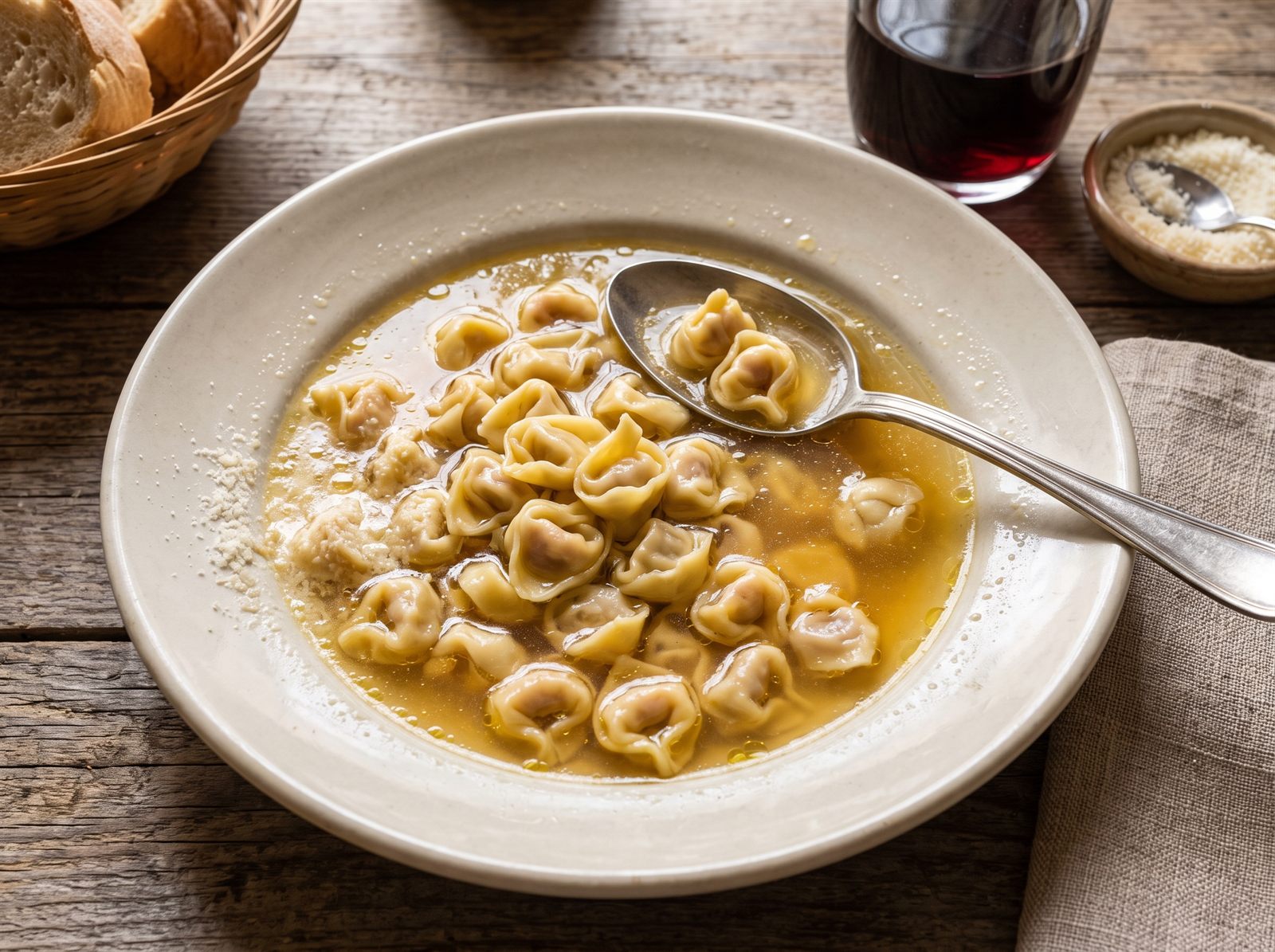
Tortellini in brodo
Tortellini in meat broth
Tiny pork-filled pasta from the land between Bologna and Modena, served in a clear meat broth — in the recipe the Dotta Confraternita del Tortellino deposited in 1974.
- Course
- Primo piattoPasta & rice
- Serves
- 10
- Hands-on
- 4 h 48 min
- Cooking
- 4 h 13 min
- Plan
- 3 days
La provenienza
Where this recipe comes from
Bologna and Modena both claim the tortellino. A legend places its birth in Castelfranco Emilia, halfway between the two, where an innkeeper is said to have shaped the pasta after the navel of a sleeping Venus — a story, not a document.
The documents are more recent. On 7 December 1974 the Dotta Confraternita del Tortellino and the Bologna delegation of the Accademia Italiana della Cucina deposited ‘Tortellini in brodo di carne’, written by Maria Lanzoni Grimaldi, with the Bologna Chamber of Commerce. On 15 April 2008 the Confraternita added a second deed describing the classic tortellino: its shape, its filling, the thickness of the pasta and a finished weight of 5 grams.
In October 2026 the Confraternita deposited a dedicated broth recipe. As reported in the press, it uses half a capon at least five months old, a kilo of beef, a beef femur bone, onion, carrots, celery, half a tomato and a rind of 24-month Parmigiano Reggiano, cooked slowly for four hours. The recipe below follows the 1974 text until the official broth text is published.
Broth is the classic way to serve them. The Confraternita also accepts tortellini ‘alla panna’, provided the cream is fresh, skimmed from milk — never industrial cream.
- Provenance
- Deposited recipeAn official recipe filed with an Italian Chamber of Commerce or a notary by a recognised culinary body.
- Defined by
- Dotta Confraternita del Tortellino with the Accademia Italiana della Cucina
- Reference
- Recipe deposited with the Chamber of Commerce of Bologna; further deeds in 2008 (the tortellino) and 2026 (the broth), 1974
Ingredienti
Ingredients
To season the pork loin (two days ahead) · doesn't change with servings
For the filling (about 1,000 tortellini) · doesn't change with servings
For the pasta · doesn't change with servings
For the broth
To serve
Equipment
- Kitchen scale accurate to 1 g, and a probe thermometer
- Heavy-based frying pan about 24 cm across, for the pork loin
- Meat grinder with a fine plate (3 mm–4.5 mm holes), or a food processor
- Stockpot of at least 8 l, a skimmer, a fine sieve and a piece of muslin
- Large wooden pastry board and a long rolling pin (traditionally 80 cm–100 cm)
- Sharp knife or plain pastry wheel, and a ruler for the first few squares
- Trays lined with clean cotton cloths, lightly floured
- Fine grater for the nutmeg and the Parmigiano
Preparazione
Method
Start two days ahead. Day 1: season the pork loin, then leave it in the fridge for 48 hours. Day 2: cook the loin and make the filling, which must rest for at least 12 hours; make the broth the same day, so its fat can set and be lifted off. Day 3: make and roll the pasta, shape the tortellini — allow 3–4 hours for 1,000 by hand, far less with help — and cook them in 3–4 minutes. The filling and pasta make about 1,000 tortellini, enough for four meals: the broth is for one meal for ten, and the rest of the tortellini freeze well.
- 4 h 48 minhands-on
- 4 h 13 mincooking
- 3 daysfrom start to table
Two days ahead — season the pork loin
This step follows the Confraternita's own method for the loin: the seasoning flavours the meat, then is wiped off before cooking.
-
Hands-on 10 min
Weigh the loin and the salt (1.5% of the meat's weight: 4.5 g for 300 g). Mix the salt with the pepper, the chopped rosemary and the crushed garlic, and rub the mixture all over the meat.
Tip Weighing the salt as a percentage of the meat makes the result identical every time, whatever the size of your piece.
-
Rest 2 daysTemp 4 °C
Wrap the loin tightly in film or put it in a sealed container and leave it on the bottom shelf of the fridge, at 4 °C, for two days. Turn it once halfway.
The day before — the filling
-
Hands-on 5 min
Take the loin out of the fridge 30 minutes before cooking. Wipe off the garlic and rosemary completely with kitchen paper — they would burn in the butter and leave bitter specks in the filling.
-
Official textCooking 25–30 minTemp 68 °CHeat medium-low — the butter should foam, never smoke
Melt the butter in the heavy pan over medium-low heat until it foams. Add the loin and cook it slowly, turning it every 5 minutes so every side colours evenly to light gold, until the centre reaches 68 °C. A 300 g piece about 6 cm thick takes 25–30 minutes.
Check Probe the thickest part: 68 °C. The juices run clear and the surface is golden, not dark brown.
Tip ‘Rosolato al burro’ means lightly golden. A dark crust tastes bitter once it is ground into the filling.
-
Rest 1 h
Let the loin cool on a plate at room temperature for 30 minutes, then put it in the fridge, with the prosciutto and mortadella, for another 30 minutes. Cold meat grinds into a clean paste instead of smearing.
-
Hands-on 15 min
Grate the Parmigiano finely (450 g) and the whole nutmeg (about 5 g). Cut the loin, prosciutto and mortadella into cubes of about 2 cm.
Tip A whole nutmeg is the deposited quantity, and it is right: it seasons about 1.6 kg of filling.
-
Official textHands-on 15 min
Pass the loin, prosciutto and mortadella through the grinder twice with the fine plate, or pulse them in a food processor in batches until they form a fine, even paste. Keep the meat cold — below 10 °C — so the fat does not separate.
Check No visible pieces of meat or fat; the mixture looks like a smooth, pale pink paste.
-
Official textHands-on 3–5 min
Beat the eggs and add them to the meat with the Parmigiano and the nutmeg. Knead by hand for 3–5 minutes until completely even.
Check Squeeze a little in your fist: it holds its shape, feels compact and barely sticks to your hand.
Tip Do not add salt. The prosciutto, mortadella and Parmigiano season it fully; taste a teaspoon fried in a pan if in doubt.
-
Official textRest 12–24 hTemp 4 °C
Press film directly onto the surface and leave the filling in the fridge at 4 °C for at least 12 hours. The Confraternita recommends a full day: the flavours blend and the filling firms up, which makes shaping much easier.
The day before — the broth
Make the broth on the same day as the filling. Chilled overnight, its fat sets on top and can be lifted off cleanly.
-
Official textCooking 30–40 minHeat medium
Put the beef and the half hen in the stockpot with 4 litres of cold water. Heat over medium heat so that it comes to the boil slowly, in about 30–40 minutes.
Tip Starting cold draws the flavour out of the meat and lets the proteins rise gradually as foam you can skim, for a clearer broth.
-
Official textHands-on 10 min
As the water approaches the boil, grey foam rises. Lift it off with the skimmer, repeatedly, until the surface stays clean — about 10 minutes.
Check The surface is clear, with only small drops of fat.
-
Official textHands-on 2 min
Add the celery, carrot and onion, and about 20 g of coarse salt to start. You will adjust it at the end, once the broth has reduced.
-
Official textCooking 3 hTemp 90 °C–95 °CHeat lowest — barely trembling
Lower the heat until the surface barely trembles — 90 °C–95 °C, never a rolling boil — and set the lid ajar. Simmer for at least 3 hours.
Check The broth is clear and golden and the beef is tender. A rolling boil would emulsify the fat and make it cloudy.
Tip The October 2026 broth deposit, as reported, simmers for four hours and lets the broth rest for 30 minutes before straining it through a cloth.
-
Hands-on 10 min
Lift out the meats (they make an excellent ‘bollito’ with green sauce) and the vegetables. Pass the broth through the sieve lined with damp muslin. Taste and adjust the salt. Expect about 3 litres.
-
Rest 8 hTemp 4 °C
Stand the pot in a sink of iced water and stir until the broth is below 20 °C, then refrigerate overnight. Next day, lift off the solid fat on top, leaving a few flecks for flavour.
Tip Cooling broth quickly — below 20 °C within 2 hours — keeps it safe.
The day — the pasta
-
Hands-on 10 min
Heap the flour on the board and make a wide well. Break the eggs into it (about 550 g without shells, at room temperature) and beat them with a fork, drawing in flour from the inner wall little by little until the mixture is too stiff to stir.
Tip The ratio is one large egg per 100 g of flour. Eggs vary: if the dough stays crumbly, add a teaspoon of water at a time; if it sticks, add flour a spoonful at a time.
-
Hands-on 10–15 min
Knead with the heel of your hand, folding and turning, for 10–15 minutes until the dough is smooth, elastic and evenly yellow.
Check Press a finger into it: the dent springs back slowly. The surface looks satin-smooth and does not stick to your hands.
-
Rest 30 min
Wrap the dough in film and leave it at room temperature for 30 minutes. The gluten relaxes, so the dough rolls out thin without shrinking back.
-
Official textHands-on 15 min
Work with a quarter of the dough at a time, keeping the rest wrapped. On the wooden board, roll it out with the long rolling pin, turning the sheet a quarter turn every few strokes, until it is very thin — about 0.6 mm.
Check Hold the sheet up to the light: you can see the shadow of your hand through it.
Tip Roll and shape one sheet at a time: a sheet left uncovered dries in 10–15 minutes and then will not seal.
Tip A pasta machine works (second-thinnest setting), but the rolling pin and wooden board leave a slightly rough surface that holds the broth better.
The day — shaping the tortellini
-
Official text
Trim the sheet and cut it into squares of 3 cm a side with the knife or pastry wheel. Use a ruler for the first rows until your eye is set.
-
Official text
Put a small ball of filling — about 1.5–2 g, the size of a hazelnut — in the centre of each square. The deposited quantities give about 1.6 g of filling per tortellino for 1,000 pieces.
Tip Roll a tray of filling balls before you start cutting: shaping goes twice as fast.
Tip Weigh your first ten tortellini. For reference, the Confraternita's 2008 deed gives a finished weight of 5 g each.
-
Official text
Fold each square in half diagonally so the edges meet exactly, and press them together firmly, pushing out any air around the filling.
Check No air pocket around the filling — trapped air makes tortellini burst in the broth.
-
Official textHands-on 3–4 h
Hold the triangle with the long side towards you, wrap it around the tip of your index finger and overlap the two corners of the long side. Press the corners together firmly so the pasta seals and the tortellino keeps its shape.
Check The corners are stuck firmly and the ring holds when you slide it off your finger.
Tip The time shown is for all 1,000 tortellini, cutting, filling, folding and wrapping, by one person. Two or three people at the board — the Bolognese way — cut it to an hour or so.
Tip If the pasta has started to dry and will not stick, touch the corners with a slightly damp fingertip — no more.
-
Official textRest 30 min – 1 h
As they are ready, set the tortellini on the floured cloth-lined trays in a single layer, not touching. Leave them at room temperature for 30–60 minutes so the surface dries slightly and they hold their shape when cooked.
Tip To keep the rest: freeze the trays for 1 hour, then transfer the tortellini to bags. Cook them straight from frozen, adding 1–2 minutes.
The day — cooking and serving
-
Official textCooking 15 min
Heat the strained, skimmed broth in a wide pan. For ten people you need about 2.5–3 litres — about 250 ml per bowl.
-
Official textCooking 3–4 minHeat medium — a gentle boil, not a rolling one
Slip the tortellini into the boiling broth a handful at a time — about 25 per person — and let them cook over medium heat, at a gentle boil, for 3–4 minutes.
Check They float, and the pasta at the folded corners is tender when you bite one.
Tip A fierce boil tears the tortellini open. Fresh ones are ready soon after they float.
-
Official textHands-on 3 min
Ladle the tortellini and broth into warmed bowls and serve piping hot, with plenty of freshly grated Parmigiano Reggiano at the table.
Tip Warm the bowls with hot water first: the broth should arrive at the table steaming.
The essentials, for cooks who know the dish. Switch to Detailed for quantities, temperatures, times and checks at every step.
Tap a step to mark where you are. Timers keep running while you scroll.
Errori comuni
Common mistakes
- Rolling the pasta too thick — the deposited recipe asks for a very thin sheet.
- Skipping the rest: the filling needs at least 12 hours in the fridge.
- Boiling the broth hard: it turns cloudy and greasy. It should barely tremble for at least 3 hours.
- Serving them ‘alla panna’ with industrial cream. If you serve them with cream rather than broth, the Confraternita asks for fresh cream skimmed from milk.
Fuori dall'Italia
Cooking it outside Italy
- ‘Doppione’ is a traditional Bolognese cut for boiling; outside Italy, brisket or shin gives a similar broth.
- Look for mortadella labelled ‘Mortadella Bologna PGI’ and for Parmigiano Reggiano PDO — both are named in the recipe.