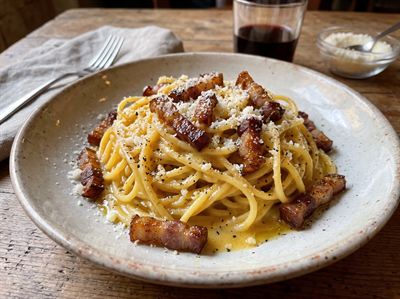
Lazio · Amatrice
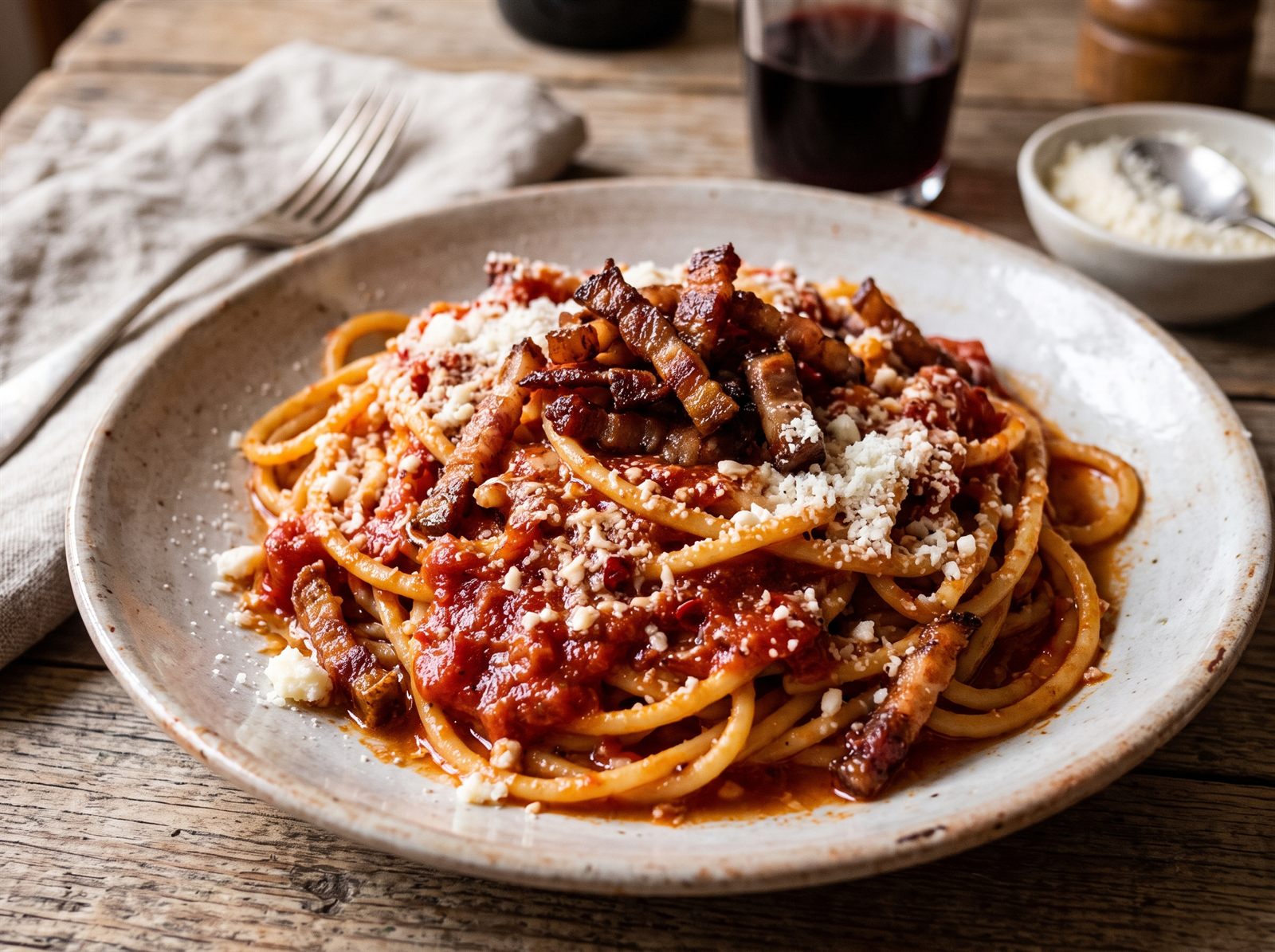
Spaghetti all'amatriciana
Pasta with guanciale and tomato, from Amatrice
Guanciale, tomato, white wine and chilli, finished with pecorino — protected by the EU since 2020 as ‘Amatriciana Tradizionale’.
- Course
- Primo piattoPasta & rice
- Serves
- 4
- Hands-on
- 10 min
- Cooking
- 32 min
La provenienza
Where this recipe comes from
Since March 2020 ‘Amatriciana Tradizionale’ has been an EU Traditional Speciality Guaranteed. The specification protects the sauce: cured pork jowl (guanciale) making up 18–30% of it, tomato 69–81%, a touch of olive oil, white wine, salt and chilli or pepper — and, explicitly, no garlic, onion or pork belly.
According to the registered text, the dish began with the shepherds of the Monti della Laga, who carried cured guanciale and flour on their months-long migrations with the flocks. Tomatoes were added in the early nineteenth century, when Amatrice belonged to the Kingdom of Naples, and people from Amatrice who moved to Rome made the sauce famous there.
The town of Amatrice had already fixed its own recipe in 2015, the source of the quantities below, and each summer it celebrates the dish with the Sagra degli Spaghetti all'Amatriciana.
- Provenance
- EU-codifiedThe dish itself is protected by an EU specification (TSG, PDO or PGI) that fixes how it is made.
- Defined by
- European Union
- Reference
- Traditional Speciality Guaranteed ‘Amatriciana Tradizionale’ — Implementing Regulation (EU) 2020/395, 2020
- Sources
- Commission Implementing Regulation (EU) 2020/395 — ‘Amatriciana Tradizionale’ entered in the register of TSGs (EUR-Lex)
- EU Official Journal C 393, 20 November 2019 — the full ‘Amatriciana Tradizionale’ specification (EUR-Lex)
- Arsial, Lazio's agriculture agency — ‘Amatriciana Tradizionale STG’, the EU recognition (Italian)
Ingredienti
Ingredients
Equipment
- Frying pan, ideally iron, wide enough to toss the pasta in
- Large pot for the pasta
- Kitchen scale
Preparazione
Method
About 45 minutes. The sauce takes 30–40 minutes; put the pasta water on when the tomato goes into the pan, and everything comes together at the same time.
- 10 minhands-on
- 32 mincooking
The sauce
This follows the EU specification's method for the sauce served straight away.
-
Official textHands-on 5 min
Remove the rind and cut the guanciale into strips about 1 cm wide and 0.5 cm thick.
Tip Keep the strips the same size so they cook evenly: thin ones burn before thick ones render.
-
Official textCooking 8–10 minHeat low
Put the guanciale in the pan with the teaspoon of olive oil over low heat. Let it cook gently until the foam it gives off has dried up and the fat runs clear — about 8–10 minutes.
-
Official textHands-on 2 min
Add the splash of white wine (about 50 ml) and let it evaporate, 1–2 minutes.
-
Official textHands-on 1 min
When the strips are golden, lift them out with a slotted spoon and set them aside, leaving the fat in the pan.
Check Golden and crisp at the edges, still slightly soft in the middle.
Tip Taking the guanciale out keeps it crisp while the tomato cooks.
-
Official textCooking 10–20 minHeat high
Pour the tomato into the same pan, add salt and the chilli and/or black pepper, bring to the boil and cook on high heat for 10–20 minutes, stirring now and then, until the sauce is creamy.
Check The sauce has thickened and turned glossy, with the fat emulsified into it.
-
Official textCooking 5–10 minHeat medium
Put the guanciale back into the sauce and cook for another 5–10 minutes.
The pasta
-
Cooking 9–11 min
Meanwhile bring 5 l of water to the boil, salt it lightly (about 8 g per litre — the guanciale and pecorino are salty) and cook the spaghetti until just al dente, a minute less than the packet says.
Check Bite a strand: a thin, pale thread of firm pasta remains at the centre.
-
Official textHands-on 2 min
Drain the pasta, add it to the pan and toss it in the sauce over the heat for a minute. Serve at once, grating the pecorino over each plate.
Tip The specification recommends Pecorino di Amatrice or Pecorino Romano PDO from Lazio, grated over the dish.
The essentials, for cooks who know the dish. Switch to Detailed for quantities, temperatures, times and checks at every step.
Tap a step to mark where you are. Timers keep running while you scroll.
Errori comuni
Common mistakes
- Adding onion or garlic: the EU specification excludes both.
- Using pancetta or bacon instead of guanciale — the specification names pork belly as excluded.
- Drowning it in oil: the guanciale gives the fat; the specification allows less than 1% olive oil.
Fuori dall'Italia
Cooking it outside Italy
- Guanciale is now sold by Italian delis abroad. If you cannot find it, unsmoked pancetta makes a good pasta — but not an amatriciana.