Lazio · Roma
Spaghetti alla carbonara
Roman carbonara
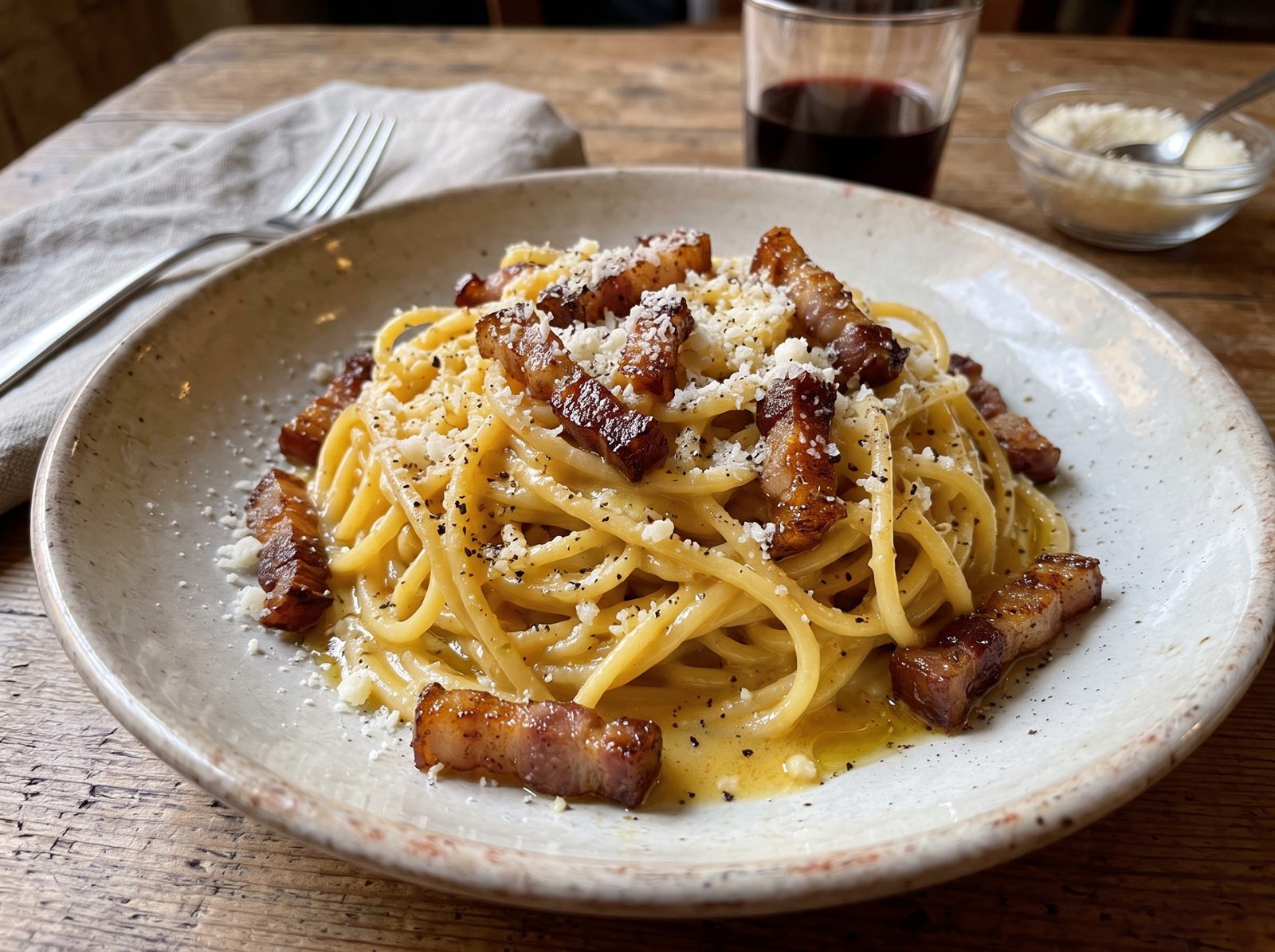
Guanciale, egg, Pecorino Romano and black pepper — the Roman carbonara as it is made today, and the most argued-about pasta in Italy.
- Course
- Primo piattoPasta & rice
- Serves
- 4
- Hands-on
- 16 min
- Cooking
- 16 min
La provenienza
Where this recipe comes from
Carbonara is younger than most people think, and its history is now well researched. It first appears in print in 1950, in the newspaper La Stampa, as a dish loved by American soldiers in post-war Rome. The first published recipe came out in Chicago in 1952; the first Italian one, in the magazine La Cucina Italiana in August 1954, used pancetta, Gruyère and garlic. Guanciale appears in Luigi Carnacina's ‘La grande cucina’ in 1960, and the Roman version took its present shape in the decades that followed.
The popular story that it was invented by the ‘carbonari’, the charcoal burners of the Apennines, has no documentary support. There is no official recipe: what follows is today's Roman standard, on which Romans agree — the sauce is an emulsion of egg and cheese, set by the heat of the pasta, never by the flame.
- Provenance
- Documented traditionA regional tradition documented in cookbooks and local practice, with no single official text.
- Defined by
- Roman culinary tradition
- Reference
- First printed in 1950; first Italian recipe in 1954
Ingredienti
Ingredients
Equipment
- Large frying pan, wide enough to toss the pasta
- Large pot for the pasta
- Bowl and fork or small whisk for the egg cream
- Probe thermometer (useful the first few times)
Preparazione
Method
About 25 minutes. Everything happens in the last two minutes: have the egg cream ready and the guanciale off the heat before the pasta is drained.
- 16 minhands-on
- 16 mincooking
Preparation
-
Hands-on 10 min
Remove the rind and cut the guanciale into strips about 1 cm wide and 0.5 cm thick. Bring 4 l of water to the boil and salt it lightly — about 6 g per litre, as the guanciale and pecorino are salty.
-
Hands-on 3 min
Whisk the yolks and the whole egg with most of the grated pecorino (about 50 g) and plenty of black pepper into a thick cream. Leave it at room temperature.
Tip Eggs straight from the fridge cool the pasta too much; the cream should be at room temperature.
Cooking
-
Cooking 8–10 minHeat medium-low
Put the guanciale in the cold, dry pan over medium-low heat and cook it for 8–10 minutes, until the fat has melted and the edges are crisp. Turn off the heat.
Check Golden and crisp at the edges, translucent fat in the pan.
-
Cooking 8–10 min
Cook the spaghetti until just al dente, a minute less than the packet says. Before draining, keep a cup of the cooking water.
-
Hands-on 1 min
Drain the pasta into the pan with the guanciale, still off the heat, and toss it for about 30 seconds until every strand is coated in the fat. Let it cool for a few seconds more.
-
Hands-on 1 minTemp 65 °C–70 °C
Pour in the egg cream and toss vigorously, adding the cooking water a tablespoon at a time, until the sauce turns into a glossy cream. The eggs should thicken at about 65 °C–70 °C: above that they scramble.
Check A glossy, pourable cream coating every strand, with no scrambled bits.
Tip If the sauce stays thin, set the pan over a pot of simmering water and keep tossing for a few seconds. If it starts to set, add a splash of cooking water at once.
-
Hands-on 1 min
Serve immediately with the remaining pecorino and more black pepper.
The essentials, for cooks who know the dish. Switch to Detailed for quantities, temperatures, times and checks at every step.
Tap a step to mark where you are. Timers keep running while you scroll.
Errori comuni
Common mistakes
- Adding cream, garlic, onion or parsley.
- Mixing the eggs in over the flame: they scramble.
- Using Parmigiano only. Pecorino Romano gives the sharp, salty backbone.
Fuori dall'Italia
Cooking it outside Italy
- If you use pancetta, choose unsmoked. Smoked bacon makes a different (if pleasant) dish.