Sardegna · Ogliastra
Culurgionis d'Ogliastra
Sardinian potato and cheese ravioli
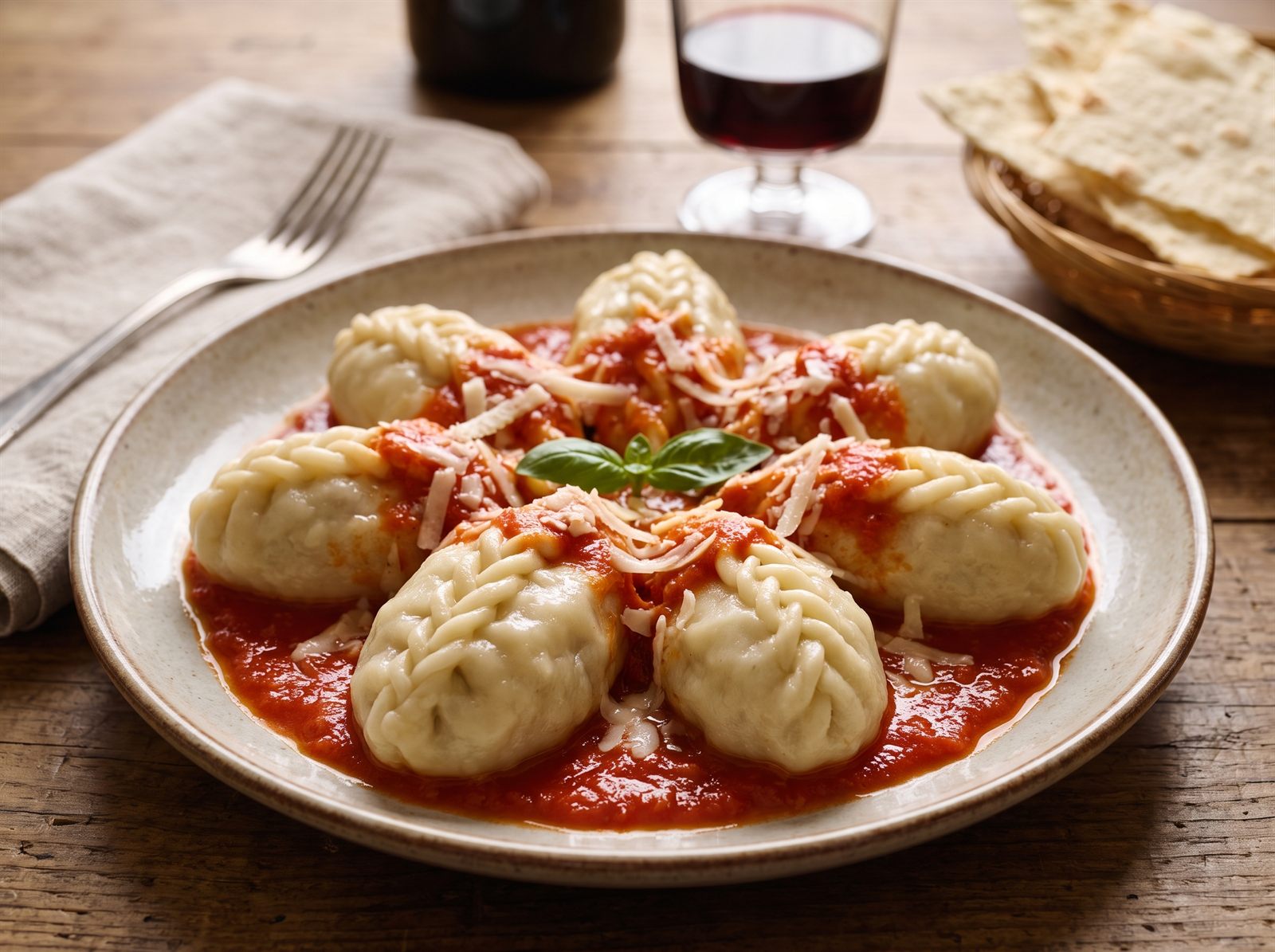
Potato and cheese ravioli closed by hand with a pleated seam like an ear of wheat — a PGI of the Ogliastra area of eastern Sardinia.
- Course
- Primo piattoPasta & rice
- Serves
- 4
- Hands-on
- 1 h 36 min
- Cooking
- 45 min
- Resting
- 1 h 45 min+
La provenienza
Where this recipe comes from
‘Culurgionis d'Ogliastra’ is a Protected Geographical Indication, registered by the European Union in 2016. The specification describes a little bundle of pasta, 20–33 grams, filled with potato and a blend of cheeses and closed by hand with at least ten pinches, alternately left and right, into a seam that looks like an ear of wheat — the ‘spighitta’.
The filling is mostly potato, with a mix of cheeses: casu axedu, a fresh, sour Sardinian cheese, and pecorino or other sheep's, goat's or cow's milk cheeses. Mint, garlic, basil or onion may be added; mint and garlic are the classic choice. The culurgionis are made in the villages of Ogliastra, the mountainous area of eastern Sardinia, and by tradition in neighbouring Esterzili, Sadali and Escalaplano.
By tradition — not part of the specification — they were made to honour the dead in early November, the wheat-ear seam being a wish for a good harvest. The specification was amended in 2019; this recipe follows the registered text.
- Provenance
- EU-codifiedThe dish itself is protected by an EU specification (TSG, PDO or PGI) that fixes how it is made.
- Defined by
- European Union
- Reference
- PGI ‘Culurgionis d'Ogliastra’ — Regulation (EU) 2016/1729, 2016
Ingredienti
Ingredients
For the dough
For the filling
To serve
Equipment
- Large pot for the potatoes, and a potato ricer
- Kitchen scale
- Rolling pin, or a pasta machine
- Round cutter of about 8 cm, or a glass
- Floured tray and a cloth
Preparazione
Method
About 3 hours: boil the potatoes and make the filling first, so it has time to cool and firm while the dough rests. Closing the culurgionis by hand is the long part — about 40 pieces, a minute or two each until your fingers learn the pleat.
- 1 h 36 minhands-on
- 45 mincooking
- 1 h 45 minresting, at least
The filling
-
Cooking 25–35 minHeat medium, at a steady simmer
Put the unpeeled potatoes in cold salted water, bring to the boil and cook for 25–35 minutes, depending on size.
Check A knife slides into the centre of the largest potato with no resistance.
-
Hands-on 3 minHeat low
While the potatoes cook, warm the olive oil (or lard) very gently with the crushed garlic for 2–3 minutes, without letting it colour, then take it off the heat.
Tip Mint and garlic are optional in the specification, but they are the classic flavour of Ogliastra.
-
Official textHands-on 10 min
Peel the potatoes while still hot and pass them through the ricer. Mix in the two cheeses, the flavoured oil and the chopped mint until completely even.
Check By weight, potato should be 60–80% of the filling and cheese 10–25%, as the specification requires — with these quantities, about 80% and 15%.
Tip Taste it now: the pecorino is salty, so the filling rarely needs extra salt.
-
Rest 1 hTemp 4 °C
Spread the filling in a dish, cover and let it cool completely, then refrigerate it for at least an hour. A cold, firm filling is the secret of a clean seam.
The dough
-
Official textHands-on 5 min
Mix the semolina, flour and salt, rub in the lard, then add the warm water (about 40 °C) little by little, working it in with your fingers.
-
Hands-on 10 min
Knead for about 10 minutes until the dough is smooth, firm and elastic.
Check Smooth surface, no dry patches, and the dough does not stick to your hands.
-
Rest 30 min
Wrap the dough and let it rest at room temperature for 30 minutes.
Shaping
-
Hands-on 15 min
Roll the dough out to about 1.5 mm — thin, but not transparent — and cut discs of 8 cm. Keep the discs you are not using covered so they do not dry.
-
Hands-on 10 min
Roll the cold filling into balls of 12–14 g, about the size of a walnut.
Check With a disc of about 9 g, each finished culurgionis weighs 21–23 g — inside the specification's 20–33 g, with a pasta-to-filling ratio between 0.5 and 2.
-
Official textHands-on 40 min – 1 h
Lay a disc in the palm of one hand with a ball of filling in the centre and fold the disc gently around it. Starting at the bottom, pinch the edges together with thumb and index finger, alternately from the left and from the right, at least ten times, working up to the top so the seam looks like an ear of wheat. Pinch the tip closed.
Check The seam is tight from bottom to top, with no gaps, and the culurgionis stands up by itself.
Tip The specification requires the seam to be made strictly by hand, with at least ten closures.
Tip If the edges no longer stick, touch them with a barely damp fingertip.
-
Rest 15–30 min
Set the culurgionis on a floured tray, not touching, and leave them for 15–30 minutes so the surface dries slightly.
Tip To keep them, freeze them on the tray, then bag them; cook from frozen, adding 2 minutes.
Cooking and serving
-
Cooking 15 min
Bring a large pot of water to the boil — about 4 l for 40 pieces — and salt it (about 10 g per litre).
-
Cooking 5–6 minHeat medium — a gentle boil
Slip the culurgionis in and cook them at a gentle boil for 5–6 minutes, until they float, then one minute more.
Check They float, and the pasta at the seam is tender.
-
Hands-on 3 min
Lift them out with a slotted spoon and serve with a simple tomato and basil sauce and grated pecorino — the usual way in Ogliastra, though the specification does not prescribe it.
The essentials, for cooks who know the dish. Switch to Detailed for quantities, temperatures, times and checks at every step.
Tap a step to mark where you are. Timers keep running while you scroll.
Errori comuni
Common mistakes
- Using only one cheese: the specification asks for a blend, typically fresh sour casu axedu with aged pecorino.
- Overfilling — the seam cannot close and they burst while cooking.
- Closing them with a fork or a mould: the wheat-ear seam is made strictly by hand.
Fuori dall'Italia
Cooking it outside Italy
- Casu axedu is almost impossible to find outside Sardinia; a fresh, tangy goat's cheese is the closest substitute.
- Pecorino Sardo or Fiore Sardo are worth seeking out; Pecorino Romano is much saltier.