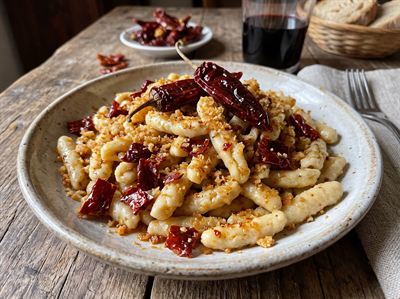
Matera, Basilicata
Pane di Matera
Matera's durum wheat bread
Matera's durum wheat bread, protected since 2008: re-milled semola and a lievito madre begun from fresh fruit, shaped by hand into a cornetto or a tall loaf, stamped on top and baked long for a thick crust, as its PGI specification sets.
- Course
- Pizze e PaniPizza & Bread
- Serves
- 10
- Hands-on
- 45 min
- Cooking
- 1 h 15 min
- Resting
- 5 h 50 min+
In breve
In short
Also called Pane di Matera IGP, cornetto materano and Matera bread.
- Only durum wheat (re-milled semola or semolato), water, salt, a little fresh yeast and a lievito madre begun from fresh, ripe fruit.
- For every 1 kg of semola: 200 g–300 g of lievito madre, 20 g–30 g of salt, 750 ml–850 ml of water and 5 g–10 g of yeast.
- Kneaded for 25–35 minutes, rested twice, shaped by hand into a cornetto or a tall loaf and stamped on top, then baked with no further rise.
- A long bake, at least an hour even for a 500 g loaf, with the oven opened for the last 15–30 minutes: a crust at least 3 mm thick.
La provenienza
Where this recipe comes from
Pane di Matera is the bread of Matera and its province, in Basilicata, made with the semola of durum wheat, part of it grown on the clay hills of the province. Every peasant house once had a stone mortar to grind its own grain. Families kneaded their bread at home, with a lievito madre begun from fresh fruit, and carried it to public ovens dug into the rock; after about three hours tall, round loaves the colour of gold came out, each known by the initials of the head of the family, pressed in before baking. Until 1950 those marks were made with wooden stamps, many of which are kept in Matera's national archaeological museum, the Museo Domenico Ridola. In 1857 Pietro Antonio Ridola counted eleven ovens in the town. By custom the dough also took three knife cuts, for the Holy Trinity, and the loaf is said to have grown tall so that more could go into the oven without touching. Its long, uneven outline is often likened to the bare hills of the Murgia that face the Sassi.
It has been a PGI since 2008, and its specification, amended in 2018, is the recipe: re-milled semola or semolato of durum wheat only, at least a fifth of it from old varieties grown in the province, such as Cappelli; a lievito madre started from fresh, ripe fruit; for every 100 kg of semola, 20–30 kg of lievito madre, 2–3 kg of salt, 75–85 litres of water and 0.5–1 kg of fresh yeast; 25–35 minutes of kneading, two short rests, a cornetto or a tall loaf shaped by hand and stamped MT on top, and a long bake in a wood-fired or indirectly heated oven, opened for the last 15–30 minutes to let the steam out. Only bread made in the province of Matera under the specification may be called Pane di Matera. The specification is written for bakeries and gives no oven temperature and no hand method for the shape: this page scales it to one loaf of about 1 kg, within its ranges, bakes it on a stone in a home oven, and marks its own numbers as Our guide.
- Provenance
- The dish itself is protected by an EU specification (TSG, PDO or PGI) that fixes how it is made.
- Defined by
- European Union
- Reference
- PGI ‘Pane di Matera’, Regulation (EC) No 160/2008; specification amended by Regulation (EU) 2018/124
- Sources
- Gazzetta Ufficiale n. 30 of 6 February 2018, pages 33–36: the PGI specification as amended by Regulation (EU) 2018/124 (Italian)
- EU Official Journal C 305 of 15 September 2017: the application to amend the PGI, with the amended single document (EUR-Lex, Italian)
- Commission Implementing Regulation (EU) 2018/124, approving the amendment (EUR-Lex, Italian)
- EU Official Journal C 128 of 9 June 2007: the summary of the application to register the PGI (EUR-Lex, Italian)
- Qualigeo: Pane di Matera IGP, the product sheet of the Fondazione Qualivita (Italian)
- Italia.it: the bread of Matera, on Italy's official tourism portal (Italian)
- Gambero Rosso: the best bakeries of Basilicata (Italian)
- Wikipedia: Pane di Matera, for its history (Italian)
Ingredienti
Ingredients
To start the lievito madre, one to two weeks ahead (doesn't change with servings)
Each feed, until the lievito madre is ready (doesn't change with servings)
On baking day: the lievito madre for the dough (doesn't change with servings)
The dough (doesn't change with servings)
Equipment
- Stand mixer with a dough hook: the specification kneads by machine, for 25–35 minutes
- Kitchen scale accurate to 1 g
- A glass jar with a lid, to soak the fruit
- A graduated food container for the lievito madre: a tall measuring jug, or a straight-sided jar marked with the level
- A warm place that holds 26 °C–30 °C (a proving box, or the oven switched off with only its light on) and a thermometer to check it
- A wooden board or tray and clean cotton cloths
- A bread stamp with your initials (optional)
- A baking stone or steel, a peel or an upturned baking tray, and baking paper
- Probe thermometer
- Wire rack
Preparazione
Method
Start the lievito madre one to two weeks ahead: two days to soak the fruit, 10–12 hours for the first dough to double, then a feed each time it doubles, until it rises in 3–4 hours. Baking day takes 8–9 hours, most of it waiting: 3–4 hours for the refreshed lievito madre to double, about 30 minutes of kneading, 30 minutes in the bowl (switch the oven on now), a first shaping and 30 minutes more under a cloth, then shape and stamp, about 75 minutes in the oven and at least 2 hours to cool. The quantities make one loaf of about 1 kg.
- 45 minhands-on
- 1 h 15 mincooking
- 5 h 50 minresting, at least
One to two weeks ahead: the lievito madre, from fruit
The specification begins its lievito madre with fresh fruit. These steps take days and need no clock-watching: the times are in the text, and the totals at the top count only baking day. If you already keep a firm lievito madre, see ‘Cooking it outside Italy’ below.
-
Official text
Leave the pulp of fresh, ripe fruit to macerate in water.
Check Small bubbles rise when you tilt the jar, and it smells fruity and faintly of wine. If mould grows on the surface, throw it away and start again.
Tip Our guide: crush the grapes with their skins, or chop the figs, put them in the jar with the water, close the lid loosely and leave it somewhere warm, 26 °C–30 °C, as for the next steps.
Tip Two days, about 48 hours, is the usual maceration.
Tip Our guide: rinse the fruit only briefly, and choose unsprayed fruit if you can: the yeasts that start the lievito madre live on the skins.
-
Official text
Make an elastic dough with the semola and the fruit pulp macerated in water.
Check Firm, smooth and elastic: it springs back when pressed and does not stick to your hands.
Tip Our guide: the specification soaks the fruit in 2.5–3 litres of water per kilo of semola but does not say how much of it goes into the dough. Here the pulp goes into the semola with about 60 ml of its water, a little more only if the dough will not come together, and the rest is left over: the dough should be firm, like the feeds, which take half their weight in water.
Tip Our guide: knead it for a few minutes on the board.
-
Temp 26 °C–30 °COfficial text
Put the dough in a graduated food container and wait until it has doubled in volume, 10–12 hours at 26 °C–30 °C.
Check The top has reached twice the starting mark, domed, with bubbles against the sides of the container.
-
Official text
Knead it again, adding semola equal to its weight and half its weight in water.
Check A firm, smooth dough again; mark the new level on the container.
Tip Our guide: keep 100 g of it and add 100 g of semola and 50 ml of water, as in the ingredients; throw the rest away, or the container would soon overflow.
-
Temp 26 °C–30 °COfficial text
Repeat these feeds several times, until you have a dough that rises in 3–4 hours. The lievito madre is then ready.
Check It doubles within 3–4 hours of a feed at 26 °C–30 °C, domed and full of bubbles, with a clean, mildly sour smell.
Tip Our guide: feed it each time it has doubled. At first that may take half a day, so about twice a day; it can take a week or more to rise in 3–4 hours.
Tip Our guide: once it is ready, keep it in the fridge in a closed jar between bakes, and feed it once a week if you are not baking.
Baking day, morning: the lievito madre for the dough
-
Hands-on 5 minOfficial text
Make the lievito madre for the dough by adding water and semola to part of the ready lievito madre. This can be repeated at most three times before it goes into the dough.
Check A firm, smooth dough, in the graduated container with its level marked.
Tip Our guide: 100 g of lievito madre, 100 g of semola and 50 ml of water, the same proportions as the feeds. That makes 250 g: 150 g for the dough and 100 g to keep for the next bake.
-
Rest 3–4 hTemp 26 °C–30 °C
Cover it and leave it at 26 °C–30 °C until it has doubled, 3–4 hours.
Check Doubled, domed and full of bubbles.
Tip Straight from the fridge it may be slow. If it has not doubled in 4 hours, refresh it once more in the same way: the specification allows three refreshes at most.
-
Hands-on 2 minOfficial text
Keep a portion of this lievito madre in the fridge, above freezing, for the next day's baking.
Tip Our guide: weigh out 150 g for the dough; the rest, about 100 g, goes into the fridge in a closed jar for your next bake, enough for the next refresh.
Tip Our guide: if a week goes by without baking, take it out and feed it: 100 g of it with 100 g of semola and 50 ml of water, left to double at 26 °C–30 °C before it goes back in the fridge.
The dough
-
Hands-on 25–35 minOfficial text
Put all the ingredients in the mixer and knead for 25–35 minutes. The time can vary with the quantity of dough.
Check Smooth, elastic and silky, it comes away from the sides of the bowl, and a piece stretched between your fingers thins to a film before it tears. A probe in the dough reads 26 °C–28 °C.
Tip Our guide: the semola first, then the water with the yeast crumbled into it, the lievito madre in pieces and the salt. Keep the mixer on low speed throughout and scrape down the bowl once or twice.
Tip Our guide: the long kneading warms the dough, so the water goes in cool, at about 20 °C. If the dough passes 28 °C, or the mixer's motor runs hot, stop for a few minutes and let them cool.
-
Rest 25–35 minOfficial text
Leave the dough to rise in the bowl for 25–35 minutes, so that it rises evenly.
Check A little puffy and relaxed. It has not doubled, and need not.
Tip Our guide: cover the bowl with a cloth and keep it somewhere warm.
Tip Our guide: switch on the oven now, at 250 °C, with the baking stone on the lowest shelf. It needs about an hour to heat through.
-
Hands-on 5 minOfficial text
Weigh out the preform and give it a first shaping by hand.
Check A smooth, loose log, seam underneath.
Tip Our guide: the whole batch, about 1.3 kg, makes one preform. The specification weighs 600 g of dough for a 500 g loaf, so a preform of about 1.2 kg, give or take 10%, bakes into a loaf of about 1 kg.
Tip Our guide: on a lightly floured board, fold the edges into the middle and roll the dough over into a loose, thick log.
-
Rest 25–35 minOfficial text
Leave the preform to rest for 25–35 minutes in a suitable wooden or stainless steel container, covered with a cloth.
Check Relaxed: a finger pressed in leaves a dent that fills back slowly.
Tip Our guide: at home, a floured wooden board or tray, with a clean cotton cloth over the dough.
Shaping and stamping
-
Hands-on 5 minOfficial text
Give the preform, by hand, the characteristic shape of Pane di Matera: a cornetto, or a tall loaf.
Check A tall, tight loaf, long and gently arched like a horn, its surface smooth and taut.
Tip Our guide for the cornetto, long and slightly convex: press the preform gently into a thick rectangle, roll it up tightly from a long side into a tall log, seam underneath, then bend it a little into an arc.
Tip Set it on a sheet of baking paper on the peel or the upturned tray, ready for the oven.
-
Hands-on 1 minOfficial text
Stamp the top with a pressure stamp bearing the letters MT, in capitals.
Check A clear, deep mark on the top of the loaf.
Tip MT is the mark of the protected loaf, made under the specification in the province of Matera. At home, do as Matera's families did and stamp your own initials, pressing firmly so the mark survives the oven.
Baking
-
Hands-on 2 minOfficial text
With no further rise, put the loaf in the oven: a wood-fired oven, or one heated indirectly.
Tip Our guide: slide it, on its paper, onto the hot stone and close the door. A home oven heated through, with a stone, stands in for the floor of a wood-fired oven.
-
Cooking 55 minTemp 200 °C–250 °COfficial text
The baking time depends on the size of the loaf and on the oven: from at least an hour for a 500 g loaf to four and a half hours for 10 kg.
Check After 55 minutes the crust is a deep golden brown all over.
Tip Our guide: 15 minutes at 250 °C, then turn the oven down to 200 °C for 40 minutes, and slide the baking paper out from under the loaf at that point: many papers are rated only to about 220 °C. With the next step, a 1 kg loaf bakes for about 75 minutes, longer than the hour the specification sets as the least for a 500 g loaf.
-
Cooking 20 minTemp 200 °COfficial text
For the last 15–30 minutes of baking, open the oven door to let out the steam made during baking.
Check A dark golden-brown crust at least 3 mm thick, with a slightly burnt smell; the loaf sounds hollow when tapped underneath, and a probe in the centre reads at least 96 °C.
Tip Our guide: 20 minutes for a 1 kg loaf, with the door held open a crack by the handle of a wooden spoon.
-
Rest 2 h
Lift the loaf onto a wire rack and leave it to cool for at least 2 hours before cutting.
Check Cool to the touch all over, the crust crisp. Sliced, the crumb is straw yellow, with irregular holes of many sizes, under a crust at least 3 mm thick.
Tip The crumb goes on setting as it cools: cut too soon, it is gummy.
The essentials, for cooks who know the dish. Switch to Detailed for quantities, temperatures, times and checks at every step.
Press “I’m here” on the step you are on, and again when it is done.Tap the pin on the step you are on, and the tick when it is done. Timers keep running while you scroll.
Da sapere
Good to know
- KeepingConservazione
- Wrapped in a linen cloth and kept in a dry place, a loaf of about a kilo stays good for about seven days, and one of 10 kg for about fourteen. It is at its best freshly baked; it is also eaten as bruschetta with tomato, oil and oregano, and in vegetable soups, hot and cold, such as cialledda. Source
- VariantsVarianti
- The tall loaf: The specification's other shape: tall and compact, with soft marks on its sides where it touched the loaves beside it in the oven. Source
- Smaller and larger loaves: The specification allows loaves from 500 g to 10 kg, from preforms of 600 g to 12 kg. They bake for at least an hour at the small end and for up to four and a half hours at the large. Source
Errori comuni
Common mistakes
- Letting the shaped loaf rise again before baking. The specification goes straight from shaping and stamping to the oven.
- Using soft wheat flour: the specification allows only durum wheat, as re-milled semola or semolato.
- Starting the dough before the lievito madre is ready: the specification counts it ready only once it rises in 3–4 hours.
- Taking the loaf out too soon. The crust should be a deep golden brown, at least 3 mm thick, with a slightly burnt smell.
- Cutting it while hot: the crumb is still setting.
Fuori dall'Italia
Cooking it outside Italy
- Semola rimacinata is durum wheat semolina milled a second time into a fine yellow flour. Look for ‘semola rimacinata’ or ‘re-milled durum wheat semolina’; the coarse semolina sold for puddings is not the same.
- Fresh yeast is sold in small compressed cubes. If you can only find instant dried yeast, use a third of the weight, about 2 g.
- Out of the season for grapes and figs, any fresh, ripe fruit will do: the specification asks only for ripe, fresh fruit.
- If you already keep a firm lievito madre, fed with its own weight of flour and half its weight in water, you can use it from the baking-day refresh, fed with semola. The specification's own, though, is begun with fruit.