Altamura, Puglia
Pane di Altamura
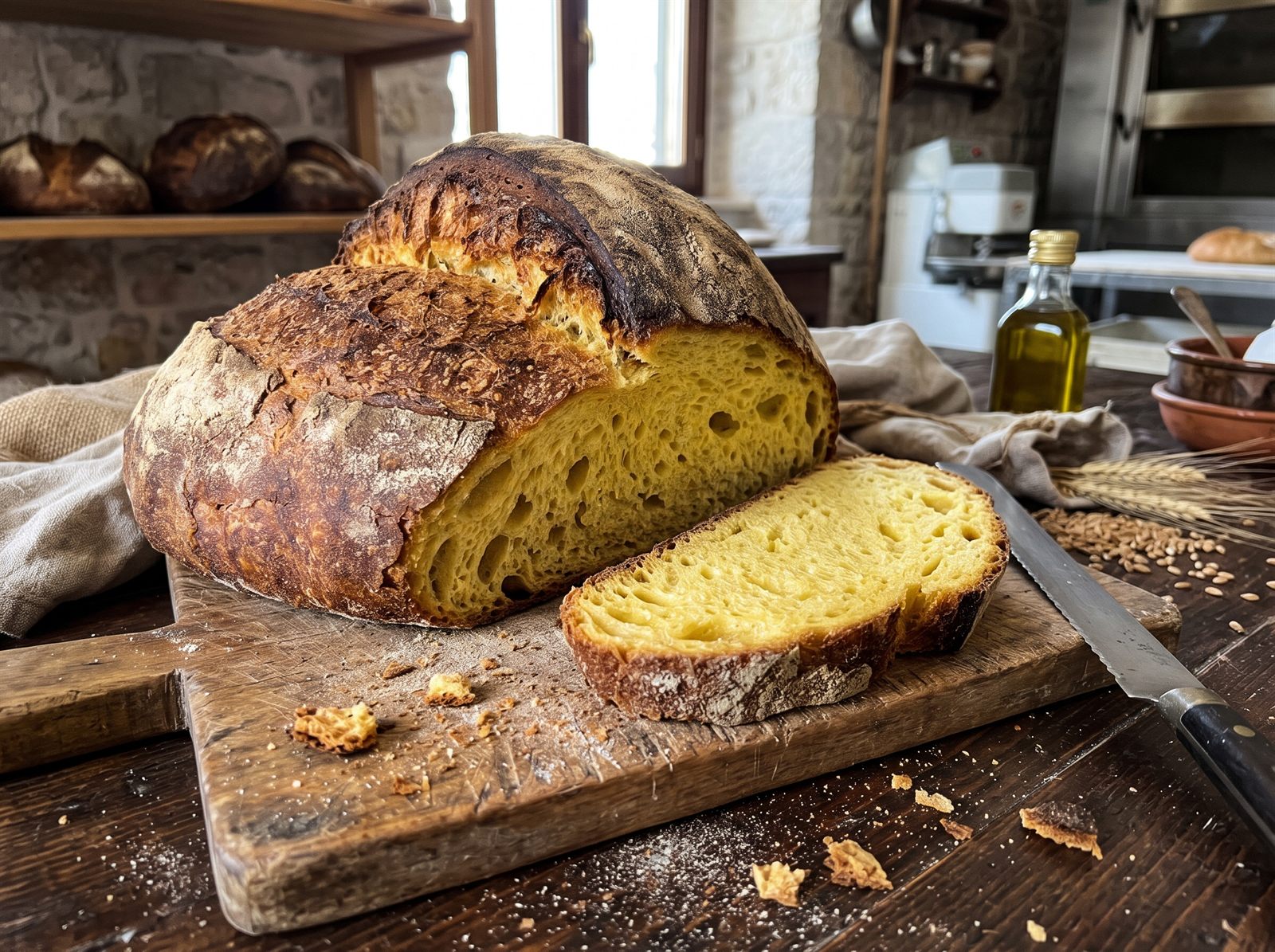
Altamura's durum wheat bread
Altamura's bread of re-milled durum wheat semolina, lievito madre, sea salt and water, shaped twice by hand and baked for an hour, as its PDO specification has set since 2003.
- Course
- Pizze e PaniPizza & Bread
- Serves
- 12
- Hands-on
- 55 min
- Cooking
- 1 h 5 min
- Resting
- 13 h 15 min+
In breve
In short
Also called Altamura bread, Pane di Altamura DOP, Pane di Altamura PDO, u sckuanète and pane accavallato.
- Vegetarian
- Vegan
- Re-milled durum wheat semolina, lievito madre, sea salt and water: nothing else, and no brewer's yeast.
- For every 1 kg of semola: 200 g of lievito madre, 20 g of sea salt and about 600 ml of water at 18 °C.
- Kneaded for 20 minutes, rested at least 90, then shaped twice by hand, with rests of 30 and at least 15 minutes.
- Baked for an hour in an oven that reaches 250 °C, then left at least 5 minutes with the door open so the crust dries and crisps.
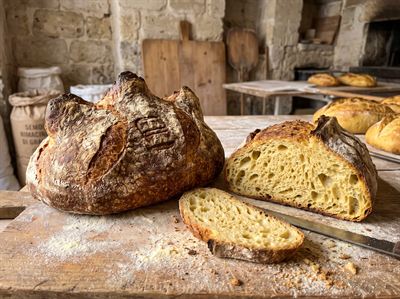
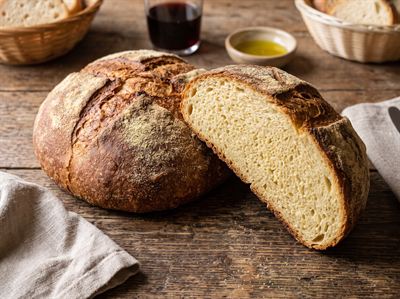
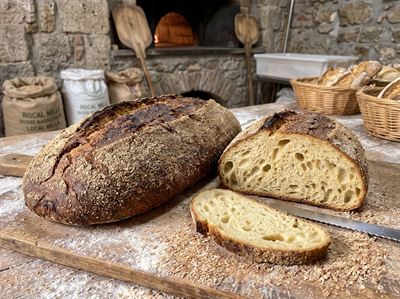
- A loaf of at least 500 g, tall and folded or low, with a crust at least 3 mm thick and a straw-yellow crumb.
La provenienza
Where this recipe comes from
Pane di Altamura is the bread of the Murgia uplands of Puglia, where growing wheat and keeping sheep were long the main living. Families kneaded big loaves at home and took them to the public ovens, since baking bread at home was forbidden on pain of a fine; the baker stamped each loaf with the initials of the head of the family. The bread was made to last, for the peasant farmers and shepherds who spent a week or a fortnight in the farms of the uplands, living on bread with salt and oil, soaked in boiling water. Altamura's municipal statutes of 1527 record the duty on its ovens, and the specification traces a first mention of the Murgia's bread to Horace's journey of 37 BC, told in his Satires. Stale, it still goes into the area's bread dishes, such as pancotto and cialledda, hot or cold.
It has been a PDO since 2003, under Commission Regulation (EC) No 1291/2003, and its specification fixes the bread: re-milled semolina of durum wheat grown and milled in Altamura, Gravina in Puglia, Poggiorsini, Spinazzola and Minervino Murge, at least 80% of it from the Appulo, Arcangelo, Duilio and Simeto varieties; a lievito madre refreshed at least three times; for every 100 kg of semola, 20 kg of lievito madre, 2 kg of sea salt and about 60 litres of water at 18 °C; 20 minutes of kneading, three rests, and an hour in an oven that reaches 250 °C. The loaf weighs at least 0.5 kg, tall and folded (u sckuanète) or low (a cappidde de prèvete, the priest's hat), with a crust at least 3 mm thick. Only bread made in those five towns under the specification may be sold as Pane di Altamura. After the drought of 2024, a temporary amendment allowed any durum wheat of the area until 31 July 2025; the rule on varieties applies again. This page scales the specification to one loaf from 1 kg of semola. Made with semola you can buy, it is a home version, not the PDO, and it changes only what a home kitchen cannot do: a stand mixer or your hands instead of the bakery's mixer, a home oven kept shut for the first 15 minutes (the bakery's stays open) and then lowered to 220 °C, rests that may run longer than the specification's minimums, and one loaf baked alone, never touching another.
- Provenance
- The dish itself is protected by an EU specification (TSG, PDO or PGI) that fixes how it is made.
- Defined by
- European Union
- Reference
- PDO ‘Pane di Altamura’, Commission Regulation (EC) No 1291/2003; specification as registered in 2003 (a temporary amendment of 2025 ran until 31 July 2025)
- Sources
- EU Official Journal L 181 of 19 July 2003: Commission Regulation (EC) No 1291/2003, registering the PDO, with the main elements of its specification (EUR-Lex, Italian)
- EU Official Journal L 181 of 19 July 2003: Commission Regulation (EC) No 1291/2003 (EUR-Lex)
- EU register eAmbrosia: the full specification of the PDO on file, as sent by the Italian Ministry of Agriculture in 2004 (Italian)
- EU register eAmbrosia: the temporary amendment PDO-IT-0136-TEMP01 of 25 March 2025, in force until 31 July 2025 (Italian)
- Consorzio per la tutela del Pane di Altamura DOP: recipes with stale Pane di Altamura (Italian)
- Qualigeo (Fondazione Qualivita): Pane di Altamura DOP, product sheet (Italian)
Ingredienti
Ingredients
Makes one loaf of about 1.5 kg: 12 servings
For the lievito madre: each of the three refreshments
For the dough (one loaf)
Equipment
- Kitchen scale and a thermometer, for the water at 18 °C
- A lidded container for the lievito madre
- A large bowl, or a stand mixer with a dough hook (the bakeries use a mixer with plunging arms)
- A thick cotton cloth, such as a heavy tea towel
- A baking stone or steel, or a heavy baking tray, at least 30 cm across
- A peel or a flat board, and baking paper
- Probe thermometer
- A wooden board for the loaf to cool on
Preparazione
Method
One long day, mostly waiting, and you need an active sourdough starter. Refresh it three times with semola, 3–4 hours each, so about 9–12 hours from the first refreshment; then 25 minutes to weigh and knead, 1½–3 hours of first rest, two shapings with rests of 30 minutes and 15–60 minutes (heat the oven during these), an hour and 5 minutes in the oven, and at least 2 hours of cooling before you cut it. You need about 1.3 kg of semola in all (1 kg for the dough, 300 g for the refreshments), plus a little for dusting. The quantities make one loaf of about 1.5 kg.
- 55 minhands-on
- 1 h 5 mincooking
- 13 h 15 minresting, at least
The lievito madre: three refreshments
The specification builds the lievito madre with at least three refreshments of durum wheat semola and water, and uses it at a fifth of the weight of the semola: 200 g for this loaf. Start from an active sourdough starter of your own.
-
Hands-on 5 min
Weigh 100 g of your active starter into a bowl and knead it with 100 g of semola and 50 ml of water into a smooth, firm ball. Put it in a lidded container and mark its level on the side.
Check A smooth, firm ball, with its level marked.
Tip Our guide: with half as much water as semola the starter is firm, a pasta acida; a liquid starter turns firm over the three refreshments.
Tip Our guide: any active sourdough starter will do to begin; three refreshments with durum semola make it the durum lievito madre the specification asks for.
-
Rest 3–4 hTemp NaN
Leave it, covered, at about 26 °C until it has doubled, 3–4 hours.
Check It stands at twice its mark, domed, full of small holes inside, and smells pleasantly sour.
Tip Our guide: if it takes much longer, the starter is weak: refresh it again the same way before you go on.
-
Hands-on 5 min
Take 100 g of the risen starter and knead it again with 100 g of semola and 50 ml of water, and mark the level. Keep what is left as your own starter, or discard it.
Check A smooth, firm ball, with its level marked.
-
Rest 3–4 hTemp NaN
Leave it, covered, at about 26 °C until it has doubled, 3–4 hours.
Check It stands at twice its mark, domed and full of small holes.
-
Hands-on 5 min
Once more, knead 100 g of the risen starter with 100 g of semola and 50 ml of water, and mark the level. This one becomes the lievito madre for the dough.
Check A smooth, firm ball, with its level marked.
-
Rest 3–4 hTemp NaN
Leave it, covered, at about 26 °C until it has doubled, 3–4 hours. Of its 250 g, 200 g go into the dough; keep the rest for your next bake.
Check Doubled within 3–4 hours: it is ready to use.
The dough
The specification's dough, for every 100 kg of semola: 20 kg of lievito madre, 2 kg of sea salt and about 60 l of water at 18 °C. Here it is scaled to one loaf from 1 kg of semola.
-
Hands-on 5 minTemp NaNOfficial text
For the semola, weigh 20% of its weight in lievito madre, 2% in sea salt and about 60% in water, and bring the water to 18 °C.
Check The water reads 18 °C on the thermometer.
Tip Our guide: for 1 kg of semola, 200 g of lievito madre, 20 g of sea salt and about 600 ml of water.
Tip Our guide: cool tap water with a little water from the fridge, or warm it, until it reads 18 °C.
-
Hands-on 20 minOfficial text
Combine the lievito madre, semola, sea salt and water and knead for 20 minutes. The specification kneads in a mixer with plunging arms.
Check A smooth, elastic, pale yellow dough that no longer sticks to your hands; a piece stretched between your fingers makes a thin film that lets light through.
Tip Our guide: break the lievito madre into small pieces in about 550 ml of the water and let them soften for a few minutes, then add the semola and the salt. Add the last 50 ml only if the dough feels stiff: the specification's water is about 60%, not exactly.
Tip Our guide: at home, use a stand mixer with the dough hook at low speed, or knead by hand on the board, pushing the dough away with the heel of your hand and folding it back.
Tip Our guide: about 1.8 kg of firm dough is a heavy load for a home mixer: if the motor labours, knead it in two halves, or finish it by hand.
-
Rest 1 h 30 min to 3 hTemp NaN–NaNOfficial text
Cover the dough with a thick cotton cloth, so that it rises at an even temperature, and leave it for at least 90 minutes.
Check It has grown by about half, is domed and soft, and a floured finger leaves a dent that fills slowly.
Tip Our guide: leave it in the bowl under a folded heavy tea towel, at about 24 °C–26 °C.
Tip Our guide: 90 minutes is the specification's minimum. A home starter is often slower than a bakery's: give it up to 3 hours, and go by the check.
Shaping, twice by hand
-
Hands-on 5 minOfficial text
Weigh the dough and shape it by hand, so that the mass gathers into its natural fibrous skin.
Check A tight ball with a smooth, taut surface that holds its shape.
Tip Our guide: the dough weighs about 1.8 kg. On an unfloured board, fold its edges into the middle, turn it over, then draw it towards you with cupped hands a few times until the surface is taut.
-
Hands-on 2 minTemp NaN
Put a baking stone, steel or heavy baking tray on a rack in the lower third of the oven and heat it to 250 °C, the temperature the specification's oven must reach. It needs at least 45 minutes, so start it now.
Check By the time the loaf goes in, the oven shows 250 °C and has been heating for at least 45 minutes.
-
Rest 30 minOfficial text
Leave the shaped dough for 30 minutes.
Tip Our guide: cover it with the cotton cloth so that it does not dry.
-
Hands-on 5 minOfficial text
Shape the dough again by hand into u sckuanète, the tall folded loaf, folding the dough from either side into the centre.
Check A tall oval loaf, its two sides overlapping along the top (it rests the other way up, and is turned back before baking).
Tip Our guide: press the ball gently into an oval about 3 cm–4 cm thick, fold one long side to the middle, then fold the other over it so the edges overlap, and press lightly along the join.
Tip Our guide: lay it, overlap down, on the cotton cloth dusted with semola, so that turning it over before baking brings the overlap on top.
-
Rest 15 min to 1 hOfficial text
Leave the loaf to rest for at least 15 minutes.
Check It has grown by about a third, and a floured finger leaves a dent that springs back slowly.
Tip Our guide: 15 minutes is the specification's minimum; at home it usually takes 30–60 minutes under the cloth. Go by the check.
Tip Our guide: if the oven has not yet had its 45 minutes, let the loaf rest on until it has.
Baking for an hour
-
Hands-on 2 minTemp NaNOfficial text
Turn the loaf over and, with a light press of your hand on one side, slide it into the oven, which must have reached 250 °C.
Tip Our guide: turn it over onto a sheet of baking paper on a peel or a flat board, so the overlap is on top, then slide it, paper and all, onto the hot stone.
Tip Our guide: add no steam: the specification bakes the first part with the oven open.
Tip The official texts differ on whether the tall loaves bake touching, with soft ‘kissed’ sides, or apart; one loaf at home bakes alone, with a crust all round.
-
Cooking 15 minTemp NaN
Bake for 15 minutes at 250 °C with the door shut. The specification bakes these first 15 minutes with the oven's mouth open; a home oven, with no masonry to hold its heat, cools at once with its door open, so here the home version departs from it.
Check The loaf has risen, and its crust has set and is starting to colour.
-
Cooking 45 minTemp NaNOfficial text
Then bake for another 45 minutes with the oven closed.
Check Browned all over, the base sounds hollow when tapped, and a probe in the centre reads about 96 °C–98 °C.
Tip Our guide: turn the oven down to 220 °C for these 45 minutes. The specification asks only that the oven reach 250 °C; held at 250 °C for the full hour, a home oven can burn the crust of a loaf this size.
Tip Our guide: the specification asks for a crust at least 3 mm thick; if yours is pale and thin, give it a few minutes more.
-
Cooking 5 minOfficial text
Leave the oven door open for at least 5 minutes, to let the steam out so that the crust dries and turns crisp.
Tip Our guide: switch the oven off first, and leave the loaf where it is.
-
Hands-on 1 minOfficial text
Take the loaf out of the oven and lay it on a wooden board.
-
Rest 2 h
Leave it on the board until completely cool, at least 2 hours, before you cut it.
Check The base is cool to the touch. Cut, the crumb is straw-yellow, with holes of even size, under a crust at least 3 mm thick.
Tip Our guide: a large loaf goes on setting as it cools; cut warm, the crumb is gummy.
The essentials, for cooks who know the dish. Switch to Detailed for quantities, temperatures, times and checks at every step.
Press “I’m here” on the step you are on, and again when it is done.Tap the pin on the step you are on, and the tick when it is done. Timers keep running while you scroll.
Da sapere
Good to know
- WhenQuando
- It is made and sold all year round. Source
- KeepingConservazione
- It keeps for several days in a cool, dry place, staying fresh and fragrant. Source
- VariantsVarianti
- A cappidde de prèvete (priest's hat): The specification's second shape: a loaf lower than the folded one, baked so that its sides touch no other loaf. Source
Errori comuni
Common mistakes
- Raising it with brewer's yeast: the specification makes it only with lievito madre.
- Using soft wheat flour or coarse semolina: it is made with re-milled durum wheat semolina alone.
- Cutting the rests short: the specification asks for at least 90 minutes after kneading, 30 after the first shaping and at least 15 after the second, and at home the first and last usually need longer.
- Taking it out too soon: it bakes for a full hour, and its crust must be at least 3 mm thick.
- Cutting it hot: leave the loaf to cool on its board first.
Fuori dall'Italia
Cooking it outside Italy
- Only bread made in Altamura, Gravina in Puglia, Poggiorsini, Spinazzola and Minervino Murge, from semola of durum wheat grown and milled there, is Pane di Altamura. Anywhere else, the same method with semola you can buy makes a home version, not the PDO.
- Look for semola rimacinata di grano duro, sold in English as re-milled durum wheat semolina: it is fine, like flour, unlike the coarse semolina sold for pasta and puddings. A semola milled in the Murgia from local durum wheat is the nearest to the protected one.
- The specification raises the bread only with lievito madre. If you have no sourdough starter, a piece from a bakery that keeps one can begin your three refreshments.
- The specification uses the area's mains drinking water; at home, any drinkable tap water at 18 °C will do.
- The bakeries' ovens are preferably fired with wood or gas and heated indirectly; an oven heated directly by its fire must burn oak. A home oven with a baking stone is the home version.