Enna, Sicilia
Pagnotta del Dittaino
Durum wheat loaf of the Dittaino valley
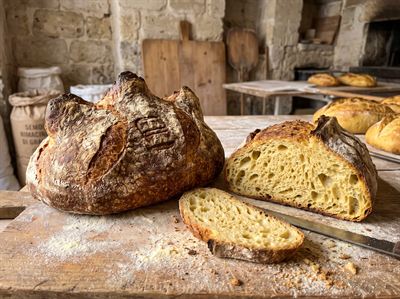
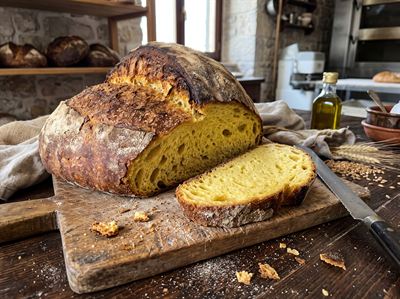
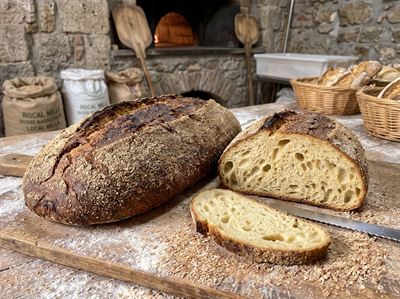
The round loaf of the Dittaino valley in inland Sicily: re-milled durum wheat semola, lievito naturale, water and salt, proved warm and baked with a burst of steam, as its PDO specification has set since 2009.
- Course
- Pizze e PaniPizza & Bread
- Serves
- 10
- Hands-on
- 42 min
- Cooking
- 45 min
- Resting
- 9 h 15 min+
In breve
In short
Also called Pagnotta del Dittaino DOP, Pagnotta del Dittaino PDO and Dittaino bread.
- Vegetarian
- Vegan
- Re-milled durum wheat semola, water, lievito naturale and salt: nothing else, and no brewer's yeast.
- For every 1 kg of semola: 580 ml–700 ml of water, 150 g–180 g of lievito naturale and 15 g–20 g of salt.
- The lievito naturale: one part lievito madre, two of semola, one of water, kneaded and cut into four; three pieces mature about 5 hours.
- Kneaded 12 minutes to 26 °C–27 °C, shaped into a 1.2 kg ball, proved 2–3 hours at 30 °C–32 °C, baked 40–60 minutes at 230 °C with steam.
- A round loaf of at most 1.1 kg, with a crust 3 mm–4 mm thick and a pale yellow crumb with fine, compact, even holes.
La provenienza
Where this recipe comes from
Pagnotta del Dittaino is the bread of the inland hills of Sicily crossed by the Dittaino, a tributary of the Simeto, in the provinces of Enna and Catania. Durum wheat has long been grown there on clay soils without irrigation, and over the years it was the only crop that could give the farming families work and a fair income. Here bread has always been made from durum wheat, unlike other parts of Italy, which used soft wheat flour. Pliny the Elder told how Ceres taught people who had lived on acorns to grind grain, in Attica and in Sicily. The story goes, as the specification tells the myth, that the gate of the underworld opened at Lake Pergusa, in the area of Enna, and that Demeter, goddess of the harvest, came out of it to bring the earth four months of growth each year. Barberis called Enna the city sacred to bread. The old Sicilian home loaf, as the specification recalls it, was round, about a kilo, some 20 cm across and 7 cm high, kneaded from sifted semola with u criscenti (the sourdough), warm water and salt, with a crust that was not very crisp and a fine, even crumb.
It has been a PDO since 2009, under Commission Regulation (EC) No 516/2009, and its specification, amended by Regulation (EU) No 613/2014 and printed in the Gazzetta Ufficiale in June 2014, is the recipe. It fixes the semola, of durum wheat grown in seventeen comuni, fourteen in the province of Enna and three in that of Catania, at least 70% of it from named varieties such as Simeto and Duilio; the lievito madre and its daily refreshment; the proportions of water, lievito naturale and salt; and every stage from kneading to baking, with the times and temperatures this page follows. Only bread made in the area under the specification may be sold as Pagnotta del Dittaino. The specification is written for bakeries, and no home recipe of it was found, so this page computes one loaf from 670 g of semola inside its ranges: the quantities are ours and untested. Made with semola you can buy, it is a home version, not the PDO, and it changes only what a home kitchen cannot do: your own sourdough starter in place of the producers' lievito madre, which the specification builds on particular strains of yeast and lactic bacteria isolated from the area's sourdoughs; a stand mixer or your hands in place of the plunging-arm mixer; a warm box for the proving; and a home oven with a baking stone and a tin of boiling water for the steam.
- Provenance
- The dish itself is protected by an EU specification (TSG, PDO or PGI) that fixes how it is made.
- Defined by
- European Union
- Reference
- PDO ‘Pagnotta del Dittaino’, Commission Regulation (EC) No 516/2009; specification amended by Regulation (EU) No 613/2014 and printed in the Gazzetta Ufficiale n. 146 of 26 June 2014
- Sources
- Gazzetta Ufficiale n. 146 of 26 June 2014, pages 14–19: the PDO specification as amended by Regulation (EU) No 613/2014 (Italian)
- Ministry of Agriculture (MASAF): the specification of the PDO, from its list of bakery specifications (Italian)
- Commission Implementing Regulation (EU) No 613/2014, approving the amendment, with the consolidated single document (EUR-Lex, Italian)
- Commission Regulation (EC) No 516/2009, registering the PDO (EUR-Lex, Italian)
- EU Official Journal C 283 of 7 November 2008: the application to register the PDO, with its single document (EUR-Lex, Italian)
- Qualigeo (Fondazione Qualivita): Pagnotta del Dittaino DOP, product sheet (Italian)
Ingredienti
Ingredients
For the lievito madre: each refreshment (doesn't change with servings)
For the dough (one loaf) (doesn't change with servings)
Equipment
- Kitchen scale accurate to 1 g
- Probe thermometer, for the water, the dough, the warm place and the loaf
- A small lidded jar for the lievito madre, and a straight-sided jar or measuring jug for the lievito naturale
- A large bowl, or a stand mixer with a dough hook (the bakeries use a mixer with plunging arms)
- A warm place that holds 30 °C–32 °C, with room for the loaf to grow, about 25 cm across and 14 cm high: a proving box, or a large cool box or microwave oven (switched off) with a jug of just-boiled water
- A flat board or large plate that fits the warm place, for the loaf to prove on
- A large bowl to cover the loaf, if it proves outside a closed box
- A baking stone or steel, or a heavy baking tray
- A metal roasting tin for the steam, and a kettle
- Baking paper, and an upturned baking tray or a peel
- Wire rack
Preparazione
Method
Baking day takes about 10½–12 hours, most of it waiting, and you need an active sourdough starter. In the morning refresh it and let three pieces of it mature for at least 5 hours as the lievito naturale; then about 20 minutes to weigh and knead, 15 minutes of rest, a few minutes to shape, 2–3 hours of proving at 30 °C–32 °C (heat the oven after the first hour), 45–60 minutes in the oven and at least 2 hours of cooling. If your starter has been in the fridge, or is a soft one, refresh it once a day for one or two days first. You need 750 g of semola for the loaf and its lievito, plus 80 g for each earlier refreshment. The quantities make one round loaf of about 1 kg; they are ours, computed inside the specification's ranges, and untested, so go by the checks.
- 42 minhands-on
- 45 mincooking
- 9 h 15 minresting, at least
One or two days before: a lively lievito madre
The specification raises the bread with lievito naturale taken from a lievito madre refreshed about every 24 hours. Start from an active sourdough starter of your own. If it is firm and was refreshed within the last day, go straight to baking day. This step takes days and needs no clock-watching: the totals at the top count only baking day.
-
Once a day, for one or two days, knead 40 g of your starter with 80 g of semola and 40 ml of water for about 10 minutes, into a firm, smooth ball. Keep 40 g of it, covered, at room temperature until the next day; discard the rest, or bake with it.
Check Within about 5 hours of a refreshment, at about 26 °C, it has roughly doubled, domed and full of small holes, with a clean, mildly sour smell: it is ready for baking day.
Tip Our guide: these are the specification's proportions, one part of lievito madre to two of semola and one of water, so the starter becomes firm, with half as much water as semola.
Tip Our guide: between bakes, keep the madre in a closed jar in the fridge and refresh it once a week; take it out one or two days before you bake.
Baking day, morning: the lievito naturale
-
Hands-on 12 minOfficial text
Knead one part of lievito madre with two parts of semola and one of water, for about 10 minutes.
Check A firm, smooth ball that no longer sticks to your hands.
Tip Our guide: 40 g of lievito madre, 80 g of semola and 40 ml of water, kneaded by hand on the board: 160 g in all.
-
Hands-on 3 minOfficial text
From the mass, make four rising pieces. One is the madre, to be refreshed again after about 24 hours; the other three are the lievito naturale for the dough.
Check Three pieces, 120 g in all, in a straight-sided jar with the level marked; the fourth set aside.
Tip Our guide: weigh out three pieces of 40 g for the dough; what is left, about 40 g, is the madre. Keep it in a small lidded jar for tomorrow's refreshment, or in the fridge until your next bake.
-
Rest 5 hTemp 26 °COfficial text
Leave the three pieces to mature for about 5 hours before they go into the dough.
Check Roughly doubled, domed and full of small holes, with a pleasantly sour smell.
Tip Our guide: keep them covered at about 26 °C, and give them at least 5 hours, even if they look ready sooner. In a cooler kitchen they take longer: go by the check.
The dough
Here the specification's proportions are computed for one loaf, inside its ranges. The quantities are ours and untested, so go by the checks.
-
Hands-on 5 minTemp 30 °COfficial text
Weigh the semola, water, lievito naturale and salt: for every 100 kg of semola, 58 l–70 l of water, 15 kg–18 kg of lievito naturale and 1.5 kg–2 kg of salt. The water varies with the gluten and moisture of the semola, the lievito naturale with the room temperature.
Check The water reads about 30 °C.
Tip Our guide: for this loaf, 670 g of semola, 410 ml of water (61%), 120 g of lievito naturale (17.9%) and 12 g of salt (1.8%).
Tip Our guide: water at about 30 °C brings the kneaded dough to the 26 °C–27 °C the specification asks for. In a cold kitchen use it a little warmer, in a hot one a little cooler.
Tip Our guide: the specification's ranges are for adjusting. If the dough is too stiff to knead smooth, add water a spoonful at a time, up to 470 ml in all (70%), and pinch the ball back to 1.2 kg when you shape it. In a kitchen hotter than about 28 °C, the lievito naturale can go down to 100 g (15%); then use 430 ml of water (64%), so that the ball still weighs at least 1.2 kg.
-
Hands-on 12–15 minOfficial text
Knead for about 12 minutes; the specification uses a mixer with plunging arms. The freshly made dough must be at 26 °C–27 °C.
Check Smooth, firm but supple, and no longer sticky; a piece stretched between your fingers thins to a film before it tears. A probe in the dough reads 26 °C–27 °C.
Tip Our guide: break the lievito naturale into the water, then add the semola and the salt. With a stand mixer and its dough hook, about 3 minutes on low speed, then the speed your mixer's manual gives for kneading dough, to 12 minutes in all; by hand, push the dough away with the heel of your hand and fold it back, for 12–15 minutes.
Tip Our guide: below 26 °C the dough rises more slowly, so let the proof run towards its 3 hours; above 27 °C it will be ready sooner, towards 2 hours, and next time use the water a little cooler. The specification also sets the fresh dough's acidity, pH 5–5.3, which only a meter can measure; at home, go by the temperature and the feel.
-
Rest 15 minOfficial text
Leave the dough to rest in the bowl for about 15 minutes.
Check Slightly relaxed and a little softer.
Tip Our guide: cover the bowl with a cloth so the surface does not dry.
Shaping and proving
-
Hands-on 5 minOfficial text
Shape the dough by hand into a sphere of 1.2 kg, give or take 20 g.
Check The ball weighs 1.2 kg–1.2 kg, round and tight, with a smooth, taut skin.
Tip Our guide: the whole dough, about 1.2 kg, makes the one ball; if it weighs more than 1.2 kg, pinch off the excess.
Tip Our guide: on an unfloured board, fold the edges into the middle, turn the dough seam down, then draw it towards you with cupped hands, turning it a little each time, until the skin is taut.
-
Hands-on 1 minOfficial text
Set the ball on a smooth, even surface that can be washed and sanitised, so that no stray yeasts or bacteria spoil the rise led by the natural yeasts.
Check Seam down, in the middle of the paper, with room all round to grow.
Tip Our guide: a sheet of baking paper on a flat board or a large plate that fits your warm place. The loaf proves on its paper and goes into the oven on it.
-
Rest 1 hTemp 30 °C–32 °COfficial text
Leave it to prove at 30 °C–32 °C and 58–63% humidity, for 120–180 minutes in all.
Check It has begun to swell, and its skin is still soft and dry to the touch.
Tip Our guide: a proving box, or a large cool box or microwave oven, switched off, with a jug of just-boiled water beside the loaf; renew the water when the thermometer drops below 30 °C. The loaf needs room to grow, about 25 cm across and 14 cm high.
Tip Our guide: in a closed box the hot water keeps the air moist; outside one, cover the loaf loosely with a large upturned bowl. Either way its skin should neither dry nor get wet: the home stand-in for the specification's humidity.
Tip Our guide: after the first hour, heat the oven (next step) and leave the loaf proving.
-
Hands-on 2 minTemp 230 °C
Put a baking stone, steel or heavy baking tray on a shelf in the lower third of the oven and a metal roasting tin on the oven floor, and heat the oven to 230 °C, the specification's baking temperature. It needs at least 45 minutes.
Check By the time the loaf goes in, the oven shows 230 °C and has been heating for at least 45 minutes.
Tip Our guide: if the floor of your oven is its heating element, put the roasting tin on the lowest shelf instead.
-
Rest 1–2 hTemp 30 °C–32 °C
Leave it to prove for another 60–120 minutes, until it has risen fully.
Check Grown by about half or more, domed and soft; a floured fingertip pressed in leaves a dent that springs back slowly and not completely.
Tip Our guide: 120 minutes in all is the specification's shortest proof and 180 its longest: go by the check within them.
Tip Our guide: if the loaf is ready before the oven has had its 45 minutes, leave it covered until it has.
Tip Our guide: if at 180 minutes in all it has not grown by about half, bake it anyway: 180 minutes is the specification's longest proof. Next time, refresh the starter once more the day before, and keep the proof at 32 °C.
Baking with steam
-
Hands-on 2 minTemp 230 °COfficial text
When it has risen fully, put the loaf in the oven at 230 °C. At the start of baking its surface is struck with steam, which gives the crust its particular colour.
Check The loaf on the stone, a burst of steam from the tin, and the door shut within a few seconds.
Tip Our guide: slide the paper with the loaf onto an upturned baking tray or a peel, then onto the hot stone; pour about 100 ml of boiling water into the hot roasting tin and shut the door at once. Keep your face and hands clear of the steam.
Tip Our guide: the specification bakes in a wood or gas oven heated indirectly; a home oven with a stone and a tin of boiling water is the home version.
Tip Our guide: make no cut; the specification mentions none.
-
Cooking 20 minTemp 230 °C
Bake for 20 minutes at 230 °C, then slide the baking paper out from under the loaf.
Check Risen and round, its crust set and starting to colour.
Tip Our guide: many baking papers are rated only to about 220 °C; once the crust has set, the loaf no longer needs it.
-
Cooking 25–40 minTemp 230 °COfficial text
Bake at 230 °C for 40–60 minutes in all.
Check Deep golden brown all over, the base sounds hollow when tapped, and a probe in the centre reads 96 °C–98 °C.
Tip Our guide: about 50 minutes in all for this loaf. Check from 45 minutes, and do not go past 60, the specification's longest bake.
-
Rest 2 hOfficial text
After baking, let the loaf cool.
Check Cool to the touch, and about 1 kg, under the specification's 1.1 kg. Cut, the crust is 3 mm–4 mm thick and firm rather than crackly; the crumb is pale yellow, with fine, compact, even holes, and springs back quickly and fully when pressed.
Tip Our guide: on a wire rack, for at least 2 hours before you cut it: a large loaf goes on setting as it cools, and cut warm, its crumb is gummy.
The essentials, for cooks who know the dish. Switch to Detailed for quantities, temperatures, times and checks at every step.
Press “I’m here” on the step you are on, and again when it is done.Tap the pin on the step you are on, and the tick when it is done. Timers keep running while you scroll.
Da sapere
Good to know
- KeepingConservazione
- The protected loaf keeps its aroma, flavour and freshness for five days from the day it is made, and up to 10 days in a cool, dry place. It is a bread for bruschetta and for the table, with cheese and cured meats, or sliced with oil, oregano and tomato. Source
Errori comuni
Common mistakes
- Adding brewer's yeast: the specification's dough is semola, water, lievito naturale and salt only.
- Using soft wheat flour or coarse semolina: it is made with re-milled durum wheat semola alone.
- Using the lievito naturale too soon: give it at least 5 hours after the refreshment, even if it looks ready.
- Proving it in a cool kitchen: the specification proves at 30 °C–32 °C for 2–3 hours, and in the cool the loaf rises far more slowly.
- Baking it without steam: the specification steams the loaf at the start of baking, for the colour of its crust.
- Cutting it hot: leave it to cool on a rack first.
Fuori dall'Italia
Cooking it outside Italy
- Only bread made in the seventeen comuni of the area, fourteen in the province of Enna and three in that of Catania, from durum wheat grown there and under the specification, is Pagnotta del Dittaino. Anywhere else, the same method with semola you can buy makes a home version, not the PDO.
- Look for semola rimacinata di grano duro, sold in English as re-milled durum wheat semolina: it is fine, like flour, unlike the coarse semolina sold for pasta and puddings.
- The producers' lievito madre is built on particular strains of yeast and lactic bacteria isolated from the area's sourdoughs, which the specification names. A home starter cannot contain them; refreshed with semola as here, it makes the home version.
- The specification's ovens are wood or gas, heated indirectly, with steam at the start of baking; a home oven with a baking stone and a tin of boiling water stands in.