Recco, Liguria
Focaccia di Recco col formaggio
Recco's cheese focaccia
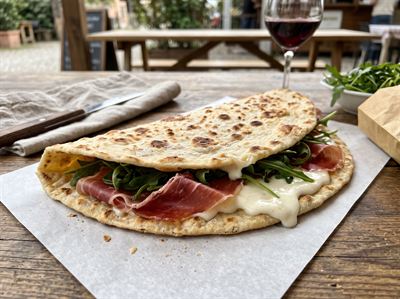
Recco's focaccia, a PGI since 2015: two sheets of unleavened dough, stretched thinner than a millimetre around walnut-sized pieces of fresh, creamy cheese and baked very hot for a few minutes.
- Course
- Pizze e PaniPizza & Bread
- Serves
- 4
- Hands-on
- 1 h 11 min
- Cooking
- 14 min
- Resting
- 1 h 15 min+
In breve
In short
Also called focaccia col formaggio, focaccia al formaggio di Recco and Recco cheese focaccia.
- Vegetarian
- No yeast: strong soft wheat flour, water, extra virgin olive oil and fine salt, kneaded soft and smooth and rested at least 30 minutes.
- Two sheets stretched by hand thinner than 1 mm, the top one almost transparent, with no holes torn in them.
- Walnut-sized pieces of fresh, soft, creamy cow's-milk cheese, which melts without stringing, bubbling or releasing whey.
- Edges pressed to seal, top pinched open for the steam, then baked at 270 °C–320 °C for 4–8 minutes, hotter below than above.
- Sold only freshly baked: the specification rules out part-baking, freezing and any other preserving.
La provenienza
Where this recipe comes from
Recco is a small town on the Riviera di Levante, and its focaccia is unlike any other in Liguria: there is no yeast in the dough, and it is two sheets stretched as thin as a veil with fresh cheese between them. Historians of gastronomy, as the specification tells it, trace it to the Saracen raids, when people fled inland and lived on what they had most of: cheese, flour and a little oil. In 1875 the historian L. T. Belgrano mentioned it, as ‘scribilta’, in his ‘Vita privata dei genovesi’. It was long made only for All Saints' Day and given away, until at the end of the 1800s a group of Recco's restaurateurs and bakers spread it beyond the feast; menus of the early 1900s already offered it to tourists as the town's speciality. Today Recco alone makes about 2 million portions a year.
It has been a PGI since 2015, and its specification, last amended in 2024, fixes it: soft wheat flour with a strength (W) above 300, or Manitoba flour; water, extra virgin olive oil and fine salt; a fresh, soft, creamy cheese of pasteurised cow's milk with no added cream; two sheets stretched by hand to less than 1 mm; and 4–8 minutes in an oven at 270–320 °C, hotter below than above. It may be round, square or rectangular, and is less than 1 cm high at the edge. Only a focaccia made this way in Recco, Avegno, Sori or Camogli may carry the name. The specification names no cheese, only its qualities: in Recco it is usually crescenza, and stracchino is also used. Recco's focaccia consortium publishes doses for one round tray 60 cm across, about ten portions: 500 g of strong flour, 50 g of olive oil and 1 kg of fresh cheese, with the water and salt left to judgement. Without those two amounts it cannot be followed to the gram, so this page follows a complete home recipe within the specification's rules, for two 30 × 40 cm trays. It is lighter on cheese: 500 g over the two trays, against the consortium's 1 kg on a tray a little larger than both together.
The consortium itself says a home focaccia can follow the specification with two differences only: a home oven bakes cooler and dries the focaccia, and the right cheese is essential (its own is made only for its members). Most home ovens reach only about 250–270 °C, while the specification bakes at 270–320 °C, so this page bakes at the oven's maximum, on the lowest shelf nearest the bottom element, for about 7–8 minutes; if your oven reaches 270 °C, your bake is within the specification's range. Made anywhere but those four towns, it is a cheese focaccia, never Focaccia di Recco.
- Provenance
- The dish itself is protected by an EU specification (TSG, PDO or PGI) that fixes how it is made.
- Defined by
- European Union
- Reference
- PGI ‘Focaccia di Recco col formaggio’, Commission Implementing Regulation (EU) 2015/39; specification amended in 2024 (OJ C/2025/473)
- Sources
- Camera di Commercio di Genova, the PGI's control body: the production specification, consolidated text of September 2024 (Italian)
- EU Official Journal C/2025/473 of 22 January 2025: the approved amendment of the specification, with the single document (EUR-Lex, Italian)
- Commission Implementing Regulation (EU) 2015/39, registering the PGI (EUR-Lex, Italian)
- Consorzio Focaccia col formaggio di Recco, the protection consortium: the production method, an extract of the specification with doses (Italian)
- Dissapore: focaccia al formaggio, the recipe (Italian)
- Gambero Rosso: the history of the focaccia di Recco, with a Recco focacceria's recipe (Italian)
- USDA Food Safety and Inspection Service: Leftovers and Food Safety (archived copy of 29 May 2025)
Ingredienti
Ingredients
Dough (doesn't change with servings)
Filling and finish (doesn't change with servings)
Equipment
- Two aluminium baking trays 30 cm × 40 cm
- Kitchen scale
- Large bowl and a sieve for the flour
- Rolling pin
- A clean cotton or linen cloth
- Small sharp knife or scissors, to trim the edges
- Oven thermometer, to know how hot your oven really gets
- Pastry brush and a thin spatula
Preparazione
Method
About 2 hours 45 minutes: 20 minutes to make the dough, an hour's rest while the oven heats, 15 minutes for the divided balls to relax, about 25 minutes to stretch, fill and seal the first tray and 7–8 minutes to bake it. Serve it at once, then make and bake the second tray the same way, about 30 minutes more.
- 1 h 11 minhands-on
- 14 mincooking
- 1 h 15 minresting, at least
The dough
-
Hands-on 3 min
Sift the flour into a large bowl, pour in three quarters of the water (about 200 g) and mix until it comes together into a rough dough.
-
Hands-on 5 min
Knead until the dough holds together and starts to feel elastic, then add the salt and the remaining water (about 70 g) a little at a time, kneading until each addition is absorbed.
Tip The salt goes in once the dough has formed, not at the start.
-
Hands-on 3 min
When the dough is smooth and even, pour in the oil in a thin stream, a little at a time, kneading until each addition is absorbed before you add more.
Tip Poured in all at once, the oil can undo the work done so far.
-
Hands-on 10 minOfficial text
Work the flour, water, oil and salt together, by hand or by machine, until the dough is soft and smooth.
Check Pull off a small piece and stretch it between your fingertips: it should open into a thin, translucent film without tearing.
Tip Our guide: about 10 minutes by hand; by hand, knead a few minutes longer than you would by machine.
-
Hands-on 1 minHeat maximum, top and bottom heat, no fan
Put a shelf in the lowest position and turn the oven on to its maximum, with conventional top and bottom heat and no fan. It needs at least 30 minutes to heat through; it can heat for the whole of the rest.
Check An oven thermometer on the lowest shelf shows the oven's maximum, ideally 270 °C or more.
Tip Our guide: on the lowest shelf the tray is nearest the bottom element, so the oven is hotter below than above, as the specification asks. A fan would even the heat out.
-
Rest 1 hOfficial text
Leave the dough to rest for at least 30 minutes at room temperature, covered with a cloth of natural fabric or in a food container.
Tip Our guide: an hour. The gluten relaxes and the dough will then stretch very thin without tearing.
-
Hands-on 3 minOfficial text
Divide the dough into the portions you need, keeping it clean.
Tip Our guide: four equal portions of about 180 g, two for each tray. Shape each into a ball and keep them under the cloth.
-
Rest 15 min
Leave the balls under the cloth for 15 minutes before you roll the first. Freshly rounded, the dough springs back; rested, it stretches thin without tearing.
Check A ball pressed flat with your palm stays flat instead of shrinking back.
The first focaccia
-
Hands-on 1 minOfficial text
Grease the baking tray with extra virgin olive oil.
Tip Our guide: about a tablespoon, brushed over the base and the rim.
-
Hands-on 2 minOfficial text
Take a portion of dough and roll it out.
Check An even disc about 1 cm thick.
Tip Our guide: with the rolling pin, to about 1 cm thick. Dust the surface lightly with flour only if the dough sticks.
-
Hands-on 5 minOfficial text
Widen the dough by hand with a rotating movement, your hands under the sheet, until it is thinner than 1 mm, taking care not to tear holes in it.
Check Thinner than 1 mm all over, so thin that the shadow of your hand shows through it, with no holes, and a little larger than the tray.
Tip Our guide: lift the disc onto your closed fists and let its weight hang; turn it, working at the edge, so the whole sheet thins out evenly.
-
Hands-on 1 minOfficial text
Lay the sheet in the oiled tray.
Tip Our guide: let the edge hang over the rim of the tray all round; it holds the sheet at the tray's size.
-
Hands-on 3 minOfficial text
Spread the cheese over the sheet in small pieces the size of a walnut, so that they cover the surface evenly.
Check Pieces spread evenly over the whole sheet, with a little space between them.
Tip Our guide: 250 g for each tray, about 20–25 pieces, a little apart: they spread as they melt.
Tip Our guide: keep the pieces a finger's width back from the rim, so the two sheets can be pressed together there.
-
Hands-on 6 minOfficial text
Roll and stretch a second portion in the same way, to the same size, then keep working it until it is thin, almost transparent.
Check Almost transparent: your hands show through it, and it has no holes.
-
Hands-on 2 minOfficial text
Lay the second sheet over the cheese-covered base. Press the overlapping edges of the two sheets together to seal them, so that the cheese cannot run out while it bakes. Any excess dough may be cut away with a knife or another tool.
Check The two sheets are stuck together all the way round the rim.
Tip Our guide: press hard with your hands along the rim of the tray, then trim the dough hanging over the edge with a knife or scissors.
-
Hands-on 1 minOfficial text
With your fingers, pinch the top sheet in several places to open holes that let the steam from the cheese escape.
Tip Our guide: pinch them over the pieces of cheese, so the focaccia does not puff up in the oven.
-
Hands-on 1 minOfficial text
Drizzle a thin stream of extra virgin olive oil over the top and, if you like, sprinkle it with salt.
Tip Our guide: a light sprinkling of flaky sea salt.
Baking
-
Cooking 7–8 minTemp 250 °C–270 °CHeat maximum, lowest shelfOfficial text
Bake at 270 °C–320 °C for 4–8 minutes, until the top is golden with brown bubbles or streaks. The oven must be hotter below than above.
Check The top is golden with dark brown patches or streaks, the cheese shows melted and creamy through the holes, and the underside is amber yellow, not white: lift a corner with the spatula to see. At the edge it stands less than 1 cm high.
Tip Our guide: most home ovens stop at 250 °C–270 °C. At the maximum, on the lowest shelf, it takes about 7–8 minutes; if your oven reaches 270 °C or more, start checking at 4 minutes.
Tip Our guide: if the top is not yet golden with brown streaks at 8 minutes, give it another minute at a time.
Tip The hotter and shorter the bake, the creamier the cheese stays: that is why the oven goes to its maximum.
-
Hands-on 2 min
Slide the focaccia onto a board, cut it into pieces and serve at once, while the top is still crisp.
Tip Our guide: put any leftovers in the fridge, covered, within 2 hours, and eat them within 3 days; reheat them in a hot oven until piping hot, 75 °C at the centre.
The second focaccia
-
Hands-on 22 min
With the other two portions and the rest of the cheese, make the second focaccia exactly as the first: oil the tray, roll and stretch the base, lay it in, dot it with the cheese, stretch the top, cover, seal and trim, pinch the holes, oil and salt.
Check The same as the first: two whole sheets, sealed all round, with holes pinched over the cheese.
-
Cooking 7–8 minTemp 250 °C–270 °CHeat maximum, lowest shelf
Bake it as you baked the first, then cut it into pieces and serve it at once.
Check Golden top with dark brown streaks, amber underside, the cheese melted and creamy in the holes.
Tip Our guide: leftovers as for the first: covered, in the fridge within 2 hours, eaten within 3 days, reheated to 75 °C at the centre.
The essentials, for cooks who know the dish. Switch to Detailed for quantities, temperatures, times and checks at every step.
Press “I’m here” on the step you are on, and again when it is done.Tap the pin on the step you are on, and the tick when it is done. Timers keep running while you scroll.
Da sapere
Good to know
- WhenQuando
- Once made only for All Saints' Day and given away free, until Recco's restaurateurs and bakers spread it at the end of the 1800s. The town's Festa della focaccia, held in the last week of May since 1955, celebrates it. Source
- KeepingConservazione
- Eat it as soon as it comes out of the oven. The specification rules out part-baking, freezing and any other preserving before it is sold. Source
- VariantsVarianti
- On a wooden disc, without a tray: The specification's alternative: assemble it on a rimless wooden disc dusted with a thin layer of cornmeal, fold the edges of the two sheets over into a hem to seal them, and slide it into the oven, which may then be cooler than for the tray. Source
Errori comuni
Common mistakes
- Adding yeast, wine or sugar to the dough. It has none of them: it is only flour, water, olive oil and salt.
- Tearing the sheets as you stretch them. The specification asks for whole sheets, and the cheese escapes through any tear.
- A watery or sour cheese, such as prescinsêua, a curd too liquid and too acid for it. The specification asks for a creamy cheese that melts without stringing, bubbling or releasing whey.
- Thinning the cheese with milk, or using sheets of carasau bread in place of the dough. The cheese goes in as it is, in pieces, between two sheets of fresh dough.
- Baking on a high shelf or with the fan. The oven must be hotter below than above, so the base colours amber while the top browns.
- Baking it slowly in a moderate oven. It needs the highest heat you have, and as short a bake as that heat allows: the hotter and shorter the bake, the creamier the cheese stays.
Fuori dall'Italia
Cooking it outside Italy
- Flour strength (W) is rarely printed outside Italy: use a strong white bread flour (UK) or bread flour (US) with about 13% protein, or Manitoba flour, which the specification allows.
- Stracchino and crescenza are sold in Italian delicatessens. Any other cheese should be what the specification asks for: fresh, soft, white and creamy, with no holes, of pasteurised cow's milk, with no added cream, and melting without stringing, bubbling or releasing whey. On the label, look for about 21 g–24 g of fat and 13 g–15 g of protein per 100 g.