Langhe, Piemonte
Bonet
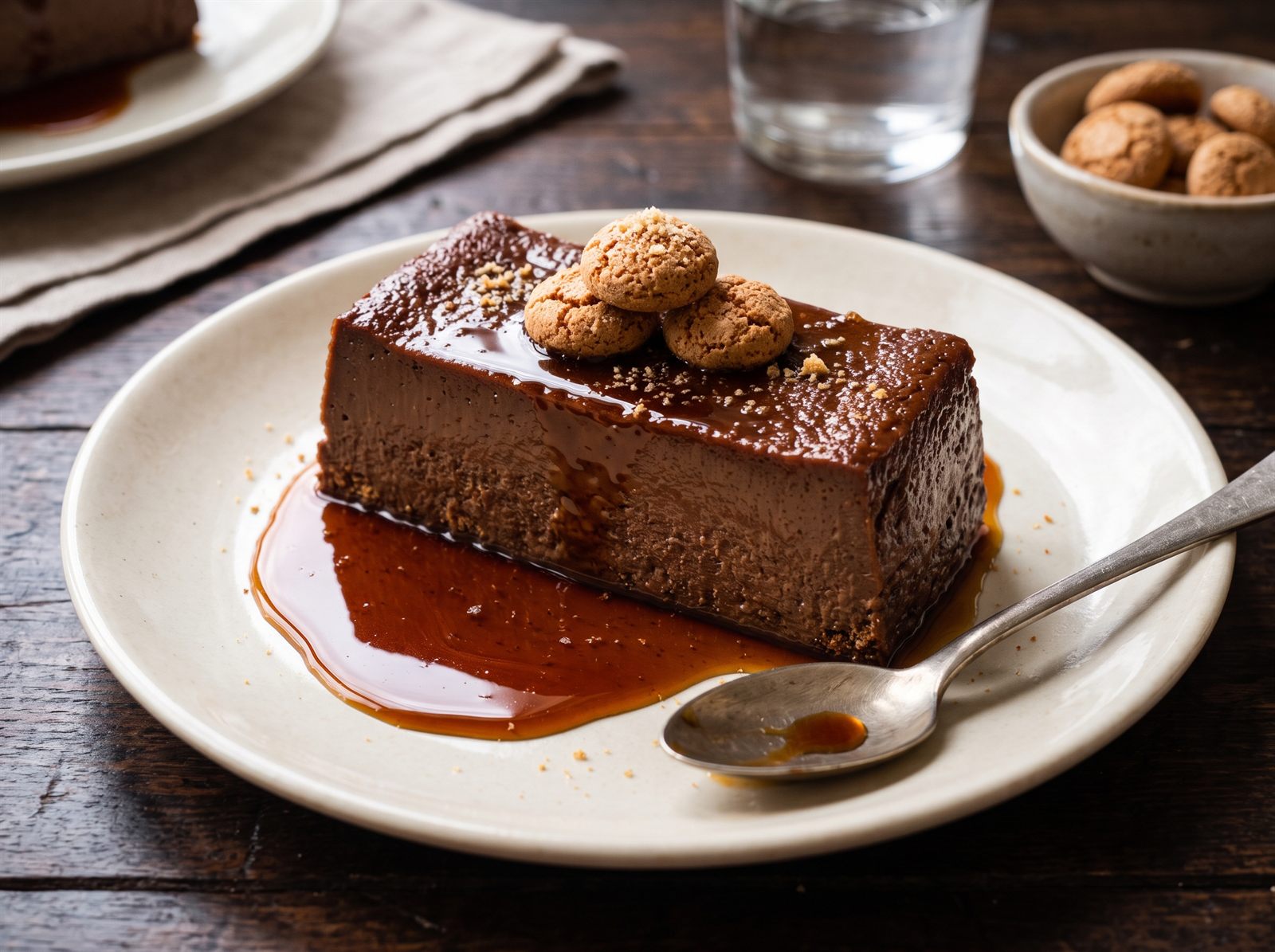
Piedmontese cocoa and amaretti custard with caramel
Piedmont's spoon dessert of eggs, milk, cocoa, crumbled dry amaretti and rum, baked slowly over caramel in a water bath and eaten cold; the Piedmont Region lists it among its traditional food products.
- Course
- DolciDesserts
- Serves
- 6
- Hands-on
- 26 min
- Cooking
- 1 h 5 min
- Resting
- 3 h 30 min+
In breve
In short
Also called bunet, bonèt and bonet piemontese.
- Vegetarian
- Eggs, whole milk, sugar, unsweetened cocoa, dry amaretti and rum, baked over a layer of caramel.
- Cocoa powder, never chocolate: the cocoa is what helps the bonet set.
- The eggs are only mixed with the whisk, never whipped: beaten-in air leaves small holes.
- Baked slowly in a water bath, then turned out so the caramel runs over the top, and eaten cold.
La provenienza
Where this recipe comes from
Bonet, bunet in Piedmontese, is a baked custard of eggs, milk, cocoa and crumbled amaretti, set over caramel and eaten cold. It is named after its mould: a bonèt is a round cap, and Piedmontese dictionaries of 1830 and 1859 also give the word for a tinned copper mould shaped like one. In the Langhe they tell another story, that it was named after the hat because it came last, just before the guests put theirs on to leave. One of the earliest written recipes, in an anonymous southern Piedmontese cookbook of 1822, is a cold custard of milk, yolks, chocolate and bitter almond served between courses. In 1846 Francesco Chapusot cooked it in a water bath in a caramel-lined mould, and by the end of the century amaretti and rum had joined it. From the great kitchens of Turin it reached the farmhouses of the Langhe, the Asti hills and the Monferrato, and from the 1930s the restaurants of the Langhe made it famous.
There is no official recipe. The Piedmont Region lists bonet among its traditional food products and describes how it is made, but gives no quantities. We compared the serious sources and publish the most widely recognised version. They agree on about four eggs to half a litre of milk, cocoa rather than chocolate, dry amaretti, a caramel-lined mould and a slow bake in a water bath, and most add a liqueur, usually rum. They differ on how much cocoa and amaretti go in, and on the oven, from 140–150°C for about an hour to 180°C for 45 minutes. This version is generous with amaretti and bakes low. One step is ours: the bonet goes into the fridge within two hours of leaving the oven, as any cooked egg custard should, and comes to the table cold.
- Provenance
- A regional tradition documented in cookbooks and local practice, with no single official text.
- Defined by
- Piedmontese tradition
- Reference
- Compared across 10 sources, listed below; this page publishes the most widely recognised version.
- Sources
- GialloZafferano: bonet (Italian)
- Piedmont Region, Piemonte Agri Qualità: bonet, a traditional food product (PAT), and its method, as archived in March 2025 (Italian)
- Protected Areas of the Piedmontese Po: bonet, a traditional food product (PAT) (Italian)
- Il Cucchiaio d'Argento: bonet (Italian)
- Italia.it, the national tourism portal: bonet, a Viaggio Italiano video recipe, quantities for eight (Italian)
- Scatti di Gusto: bonet, the recipe without secrets (Italian)
- la Repubblica: the Piedmontese bonet (Italian)
- Agrodolce: bonet, the history of the Piedmontese dessert (Italian)
- Dissapore: bonet (Italian)
- Wikipedia: bonet, its history (Italian)
Ingredienti
Ingredients
For the caramel
For the custard
To decorate
Equipment
- Metal loaf tin of 22 cm x 8 cm, holding about 1.2 l (not glass or ceramic: its base is warmed over a flame to turn it out)
- Wide ovenproof dish that holds the tin, for the water bath, and a kettle
- Small pan for the caramel
- Bowl, whisk and fine sieve
- Kitchen torch (optional), to loosen the caramel
- Serving plate or board
Preparazione
Method
5–6 hours from start to table, most of it waiting: half an hour of work, 50–60 minutes in the oven, up to 2 hours to cool and at least 2 hours in the fridge. It is easiest made the day before.
- 26 minhands-on
- 1 h 5 mincooking
- 3 h 30 minresting, at least
The caramel
-
Hands-on 8–12 minHeat medium
Pour the 50 g of water into a small pan, then the 150 g of sugar for the caramel. Heat it without stirring until it turns amber.
Check Clear, evenly amber, smelling of caramel and not of burning.
Tip Our guide: if it colours unevenly, swirl the pan gently rather than stirring.
Tip Taken too far, caramel turns bitter, and so does the bonet: if it burns, throw it away and start again.
-
Hands-on 1 min
Pour the caramel straight into the 22 cm x 8 cm loaf tin and set it aside.
Check A layer of caramel over the base of the tin. It sets as it cools.
Tip Some cooks tilt the tin, holding it with a cloth as it gets very hot, so the caramel also coats the sides.
The custard
-
Hands-on 2 min
Put the 4 eggs, the yolk and the 150 g of sugar in a bowl and mix them with a whisk.
Check Evenly mixed, with no streaks of white, and not foamy.
Tip Mix, do not whip: air beaten into the eggs leaves small holes and makes the bonet spongy.
-
Hands-on 4 min
Sift in the 35 g of cocoa, add a pinch of salt, then crumble in the 200 g of amaretti and stir.
Check No dry lumps of cocoa left.
Tip Our guide: crumble the amaretti with your hands into small pieces; they soften in the custard as it bakes.
-
Hands-on 3 min
Add the 2 tablespoons of rum, then pour in the 500 g of milk a little at a time, stirring after each addition.
Check A smooth, liquid custard with the amaretti through it.
-
Hands-on 1 min
Pour all of it into the caramel-lined tin.
Baking in a water bath
-
Cooking 15–20 minTemp 150 °C
Pull the oven shelf out a little and set the empty wide dish on it. Pour in boiling water from the kettle so that it will come 2 cm–3 cm up the sides of the tin, slide the shelf back and heat the oven to 150 °C, conventional (no fan).
Tip Our guide: a conventional oven takes 15–20 minutes to reach temperature with the water in it.
Tip Our guide: never carry a dish full of boiling water; fill it where it stands, in the oven.
-
Cooking 50 min to 1 hTemp 150 °C
When the oven is at temperature, open it and set the tin in the water bath. Bake for 50–60 minutes.
Check Give the tin a gentle shake: if the custard still moves a lot, bake it 10 minutes more and check again.
Tip Our guide: done, it trembles only slightly in the centre; it firms as it cools.
-
Hands-on 2 min
Pull the shelf out a little and, with oven gloves, carefully lift the tin out of the hot water. Turn off the oven and leave the dish of water inside to cool before you move it.
Tip Our guide: the water is near boiling; moving the full dish while it is hot is how cooks get scalded.
Cooling and serving
-
Rest 1 h 30 min to 2 h
Leave it at room temperature until it is no longer warm, for 2 hours at most from leaving the oven, then put it in the fridge.
Check No longer warm to the touch, or 2 hours have passed, whichever comes first.
Tip Our guide: 2 hours is the limit for any cooked egg dish out of the fridge. If it is still warm by then, it can finish cooling in the fridge.
-
Rest 2 h
Put it in the fridge for at least 2 hours, or overnight.
Check Cold right through and firm.
Tip Our guide: bonet is eaten cold, and chilling firms it so it turns out cleanly. Many cooks chill it for a few hours or a whole night.
-
Hands-on 3 min
Warm just the base of the tin for a few moments, with a kitchen torch or, very briefly, over a gas flame, without holding the flame close. Turn it out onto a board or serving plate.
Check It comes out whole, glossy with caramel.
Tip Our guide: if it does not come away, run a thin knife round the edge, or dip the base in hot water for a few seconds, and try again.
-
Hands-on 2 min
Decorate it with whole amaretti and serve it cold, in slices, with the caramel spooned over.
The essentials, for cooks who know the dish. Switch to Detailed for quantities, temperatures, times and checks at every step.
Press “I’m here” on the step you are on, and again when it is done.Tap the pin on the step you are on, and the tick when it is done. Timers keep running while you scroll.
Da sapere
Good to know
- WhenQuando
- In the farmhouses, where it arrived at the turn of the 20th century, it became the dessert of special occasions: the patron saint's feast, the conscripts' feast, weddings. Source
- KeepingConservazione
- It keeps 2–3 days in the fridge. Source
- VariantsVarianti
- With fewer amaretti and more cocoa: For the same half litre of milk and four eggs: 50 g of amaretti, 90 g of cocoa and 160 g of sugar in all, part in the custard and the rest in the caramel, and no liqueur. The milk is warmed, the eggs are whipped with part of the sugar until pale, and it bakes at 150 °C for about an hour and chills for at least 4 hours. Source
- Hotter and faster: The sugar melted dry until hazelnut blond, then loosened with a splash of water; the custard baked in a water bath at 180 °C for about 45 minutes and chilled for 2–3 hours. Source
- With hazelnuts, coffee or cognac: Depending on the area, hazelnuts of the Tonda Gentile delle Langhe variety or coffee are added, or cognac replaces the rum. Source
- With Fernet: A Langhe farmhouse version, with Fernet in place of the rum. After 1860 a few drops of Fernet were believed to make well water safe, and it was often the only spirit in the house. Source
- White bonet, alla monferrina: A version without cocoa, a kind of crème caramel of milk, eggs, amaretti and sugar, which some say came first. Source
- With cream and coffee: About a fifth of the liquid is cream, with coffee and vanilla, and it bakes at 140 °C–150 °C for about 50 minutes. Source
Errori comuni
Common mistakes
- Whipping the eggs into a foam: the air leaves small holes and a spongy bonet. Only mix them.
- Taking the caramel too far: it turns bitter. Stop at amber, and start again if it burns.
- Using chocolate instead of cocoa: the cocoa is what thickens the bonet.
- Soft amaretti: use the dry, crunchy kind.
- Taking it out while it still moves all over: give it 10 minutes more.
- Leaving it out for hours: it goes in the fridge within 2 hours of baking.
Fuori dall'Italia
Cooking it outside Italy
- Amaretti: the dry, crunchy biscuits, not soft amaretti.
- Cocoa: plain unsweetened cocoa powder, not drinking chocolate or melted chocolate.
- The rum can be replaced by amaretto liqueur, or by cognac, a traditional alternative in Piedmont.
- Copper bonet moulds are hard to find outside Piedmont: a loaf tin of about 22 cm does the job.