Bolzano, Trentino-Alto Adige
Strudel di mele
Apple strudel in hand-stretched dough
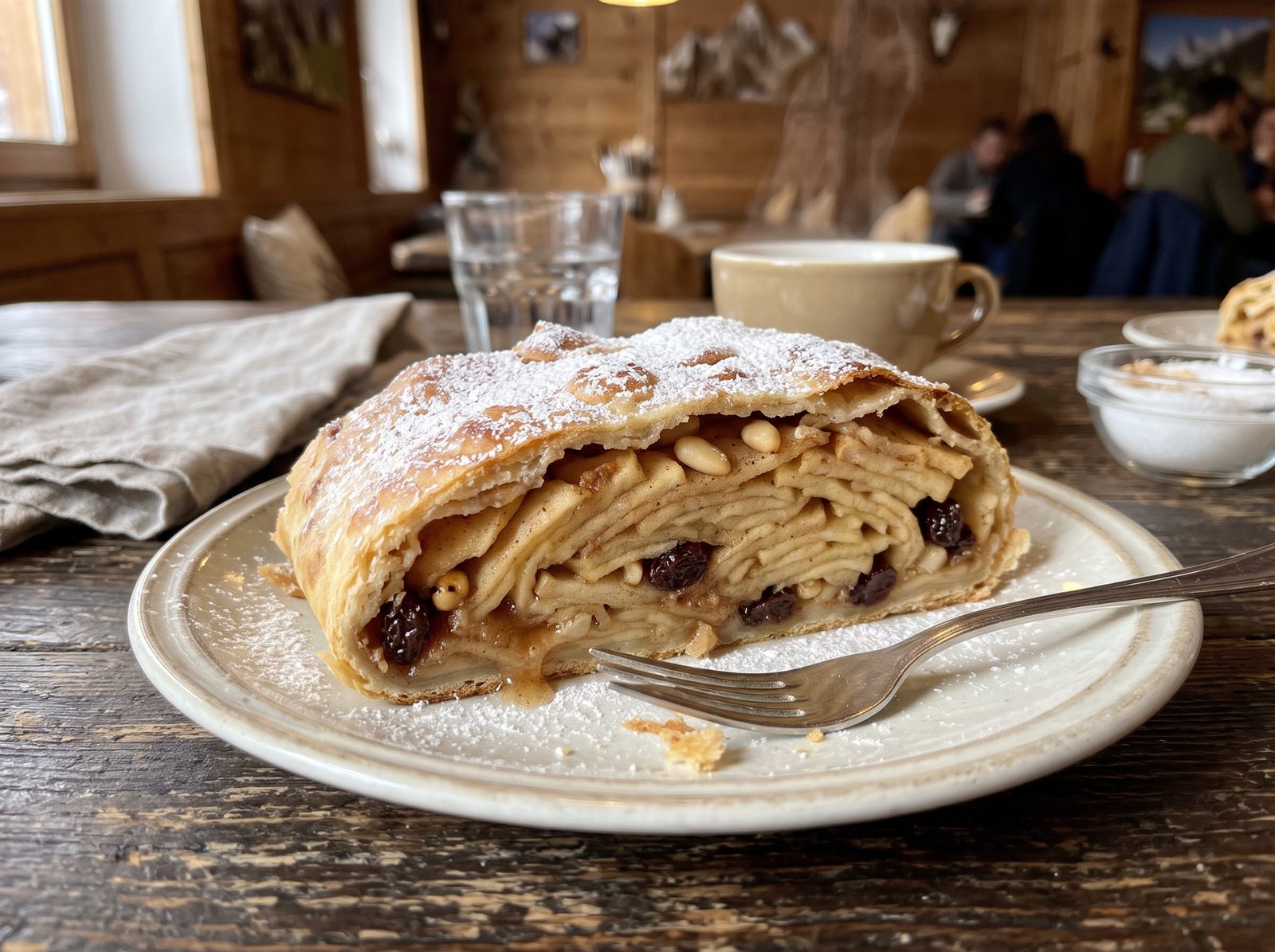
Apples, sultanas, pine nuts and buttered breadcrumbs rolled in a dough stretched by hand until you can see through it: South Tyrol's classic strudel, one of the Province of Bolzano's traditional food products.
- Course
- DolciDesserts
- Serves
- 4
- Hands-on
- 46 min
- Cooking
- 35 min
- Resting
- 35 min+
In breve
In short
Also called Apfelstrudel, apple strudel, strudel, strudel di mele con pasta tirata and Apfelstrudel mit Ziehteig.
- Vegetarian
- A plain dough of flour, lukewarm water, a little egg, oil and vinegar, rested, then stretched by hand on a floured cloth until you can see through it.
- Thin apple slices marinated in lemon juice and rum, laid on breadcrumbs toasted in butter, with sultanas, pine nuts, cinnamon and sugar.
- The filling covers one third; the rest of the sheet is brushed with melted butter, rolled up with the cloth and baked at 180 °C for 35 minutes.
- Made with butter, never margarine. Shortcrust and puff pastry make other strudels, though shortcrust is now the commonest in South Tyrol.
La provenienza
Where this recipe comes from
The name comes from an old German word for swirling water, as in a whirlpool, and points to the spiral of dough rolled round the filling. The paper-thin stretched dough probably came from the East and spread through Europe with the Ottoman conquests; Hungary's strudel makers became its masters, and from Hungary and the Balkans it passed into the cooking of the Habsburg lands. The oldest handwritten strudel recipe, for a milk-cream strudel, is in an anonymous cookbook of 1696, and in 1827 Anna Dorn's ‘Großes Wiener Kochbuch’ mentions a stretched apple strudel. Pellegrino Artusi gave a recipe too, warning that it comes out of the oven looking like an enormous leech, and promising that you will like the taste. Strudel is on Italy's national list of traditional food products for the Province of Bolzano, and the province's quality mark, set up by a provincial law of 2005, has rules for the apple strudel sold under it: the lean dough called pasta matta, shortcrust or puff pastry; butter, never margarine; and fresh apples from South Tyrol.
There is no official recipe. We compared the serious sources and publish the most widely recognised version. They share a lean dough of flour, water or milk and a little fat, rolled or pulled very thin; apples in thin slices with raisins, cinnamon and sugar, usually on a layer of breadcrumbs; the whole rolled up and baked. The classic South Tyrolean and Austrian recipes pull the dough by hand over a floured cloth until it is translucent, and that is the version here. The rest varies: some add egg, vinegar or grappa to the dough, some toast the breadcrumbs in butter and some use none, the sugar and raisins vary widely, and pine nuts and rum are not in every recipe. In South Tyrol about three quarters of apple strudels are now made with shortcrust; that version is among the variants. The recipe we follow gives no size for the sheet, no amounts of butter for the breadcrumbs or for brushing, and no number of servings: those are ours, worked out from the batch, and so is the optional dusting of icing sugar, which almost every other recipe adds.
- Provenance
- A regional tradition documented in cookbooks and local practice, with no single official text.
- Defined by
- South Tyrolean tradition
- Reference
- Compared across 11 sources, listed below; this page publishes the most widely recognised version.
- Sources
- IDM Südtirol, official South Tyrol tourism site: strudel di mele con pasta tirata, archived copy of 2016 (Italian)
- IDM Südtirol, official South Tyrol tourism site: Apfelstrudel mit Ziehteig, the same recipe, archived copy of 2016 (German)
- IDM Südtirol, official South Tyrol tourism site: strudel di mele con pasta frolla (Italian)
- IDM Südtirol, Qualità Alto Adige quality mark: South Tyrolean bread and apple strudel (Italian)
- Consorzio Melinda, apple growers of the Val di Non and Val di Sole: traditional apple strudel (Italian)
- GialloZafferano: strudel di mele (Italian)
- Dissapore: strudel di mele, la ricetta perfetta, by Rossella Di Bidino, 2017 (Italian)
- Pellegrino Artusi: ‘La scienza in cucina e l'arte di mangiar bene’, recipe 559, strudel (Project Gutenberg, 25th edition, Italian)
- Ministry of Agriculture of Austria (BMLUK): register of traditional foods, no. 177, Apfelstrudel, Milchrahmstrudel, Topfenstrudel (German)
- Ministry of Agriculture (MASAF): national list of traditional food products, 25th revision, 2025, Province of Bolzano (Italian)
- Autonomous Province of Bolzano, Marchio di Qualità Alto Adige (provincial law 12/2005): rules for bread and baked goods, apple strudel at 2.3, decree 4955/2025 (Italian)
Ingredienti
Ingredients
For the dough
For the filling
For brushing
To serve
Equipment
- Kitchen scale and measuring spoons
- Mixing bowl and a fork
- A large cotton cloth, such as an old tablecloth, about 90 cm × 90 cm, spread on a table you can reach from every side
- Rolling pin
- Frying pan, for the breadcrumbs
- Small pan and a pastry brush, for the butter
- Sharp knife or kitchen scissors, to trim the edges
- Baking tray and a wire rack
- Serrated knife, to slice
Preparazione
Method
About 2 hours from start to table, 35 minutes of it in the oven. Make the dough first; while it rests, heat the oven, toast the breadcrumbs and slice the apples. Stretching needs a table you can reach from every side and a large cotton cloth.
- 46 minhands-on
- 35 mincooking
- 35 minresting, at least
The dough
-
Hands-on 10 min
Beat the egg in a cup and measure out 30 ml. In a bowl, mix the flour with the lukewarm water, the measured egg, the oil, the salt and the vinegar. Turn it out onto the worktop and knead until smooth, about 10 minutes.
Check Smooth, silky and soft, and not at all sticky.
Tip The vinegar makes the dough stretch further without tearing.
-
Rest 20–30 min
Shape the dough into a ball, brush it all over with a few drops of oil and cover it with an upturned bowl. Leave it at room temperature for 20–30 minutes. Prepare the filling meanwhile.
Tip The longer it rests, the more easily it stretches: give it the full 30 minutes if you can.
The filling, while the dough rests
-
Hands-on 3 minTemp 180 °C
Heat the oven to 180 °C, static (top and bottom heat), with a shelf in the middle. Melt the butter for brushing in a small pan and brush a little of it over the baking tray. Keep the rest warm and liquid.
Tip The oven takes about 15 minutes to heat.
-
Hands-on 3–5 minHeat medium-low
Melt the 20 g of butter in the frying pan, add the breadcrumbs and toast them, stirring often, until lightly golden. Tip them onto a plate to cool.
Check Light gold and smelling toasted, not brown.
Tip The crumbs soak up the juice the apples release in the oven, so the thin dough stays crisp.
-
Hands-on 10 min
Peel and core the apples and cut them into thin slices, about 3 mm. Put them in a bowl with the lemon juice, the rum and the lemon zest and turn them over gently. Leave them while you stretch the dough.
Check Every slice is coated, so none turns brown.
Tip Slice them no earlier than this: left to stand longer, they give off their juice.
Stretching and filling
-
Hands-on 3 min
Spread the cotton cloth over the table and flour it well. Put the dough in the middle and roll it out with the rolling pin as thin as you can, into a long shape.
Check An even sheet, a few millimetres thick, that moves freely on the floured cloth.
-
Hands-on 5–10 min
Take off rings and watch. Flour the backs of your hands, slip them under the dough and pull it gently outwards from the centre towards the edges of the table, moving round it as you go, until the whole sheet is paper thin: at least 50 cm × 60 cm, up to about 70 cm × 70 cm. If your table is small enough, let the edges hang over its edge. Then cut off the thick rim all round with the knife or scissors.
Check You can see the pattern of the cloth through the dough, and it has no tears.
Tip Work with the backs of your hands, never your fingertips, which poke through.
Tip Edges hanging over the table hold the sheet and stop it shrinking back while you work.
Tip Thinness matters more than the exact size: stop as soon as the sheet is translucent.
-
Hands-on 3 min
Along the side of the sheet nearest you, scatter the toasted breadcrumbs over a third of it, leaving about 3 cm free at each end. Lift the apples out of their bowl, leaving any liquid behind, and spread them over the breadcrumbs. Scatter the sultanas, pine nuts, cinnamon and sugar over the apples.
Check An even band of filling over one third of the sheet, the rest bare.
-
Hands-on 2 min
Brush the bare two thirds of the dough with melted butter. Keep a little butter for the top.
Check The whole bare surface glistens.
-
Hands-on 3 min
Fold the free edges at each end over the filling. Lift the cloth on the filled side so that the strudel rolls over on itself, and keep lifting until all the dough is wrapped round the filling. Roll it off the cloth onto the buttered tray with the seam underneath. If it is longer than the tray, lay it diagonally or curve it into a horseshoe.
Check A neat roll, seam down, with both ends closed.
Tip A seam left on top opens in the oven.
-
Hands-on 1 min
Brush the whole surface of the strudel with melted butter, keeping about 15 g back if you mean to brush it as it bakes.
Baking and serving
-
Cooking 35 minTemp 180 °C
Bake in the middle of the oven at 180 °C for 35 minutes.
Check Light brown and crisp all over, and a skewer pushed into one end meets soft apple.
Tip If you like, brush it lightly twice while it bakes, and once more as it comes out, with the butter you kept back.
-
Rest 15 min
Slide the strudel onto the wire rack and leave it for about 15 minutes.
Check Still warm, but firm enough to slice cleanly.
-
Hands-on 3 min
Dust with icing sugar if you like, cut into thick slices with the serrated knife and serve warm, on its own or with whipped cream, vanilla sauce or vanilla ice cream.
The essentials, for cooks who know the dish. Switch to Detailed for quantities, temperatures, times and checks at every step.
Press “I’m here” on the step you are on, and again when it is done.Tap the pin on the step you are on, and the tick when it is done. Timers keep running while you scroll.
Da sapere
Good to know
- WhenQuando
- Made all year round. Source
- KeepingConservazione
- Under a glass cake dome for 1–2 days. It can also be frozen before baking, as long as none of its ingredients had been frozen before, and baked straight from the freezer. Source
- VariantsVarianti
- With shortcrust: For four: a shortcrust of 250 g flour, 125 g soft butter, 125 g icing sugar or sugar, an egg, a tablespoon of milk, a teaspoon of baking powder, vanilla sugar, lemon zest and salt, rested half an hour and rolled out to 40 cm × 26 cm. The filling: 600 g of apples with 50 g each of sugar and toasted breadcrumbs, 40 g sultanas, 20 g pine nuts, 2 tablespoons of rum, vanilla sugar, half a teaspoon of cinnamon and lemon zest. Brushed with beaten egg, decorated with the leftover pastry, baked at 180 °C for 35 minutes and dusted with icing sugar. Source
- With an oil and grappa dough: A Trentino version for ten: a dough of 150 g flour, 30 g hot water, 20 g corn oil, 10 g grappa and a pinch each of salt and sugar, rested about 20 minutes under a damp cloth. The filling, spread over the whole sheet: 4–5 Renetta apples, 150 g sugar, 25 g breadcrumbs with cinnamon and ground cloves, the grated zest of a lemon and 150 g raisins. Baked at 180 °C for about 50 minutes, cooled on a rack and dusted with icing sugar. Source
- Rolled out with a pin: For six: a dough of 130 g flour, a medium egg, 30 g water, a tablespoon of seed oil and a pinch of salt, rested an hour in the fridge and rolled out with a rolling pin to 35 cm × 45 cm on baking paper. The filling: 750 g Golden Delicious apples, 60 g sugar, 60 g breadcrumbs toasted in 30 g butter, 50 g raisins soaked in 2 tablespoons of rum, 25 g toasted pine nuts, a teaspoon of cinnamon and a lemon's zest. Baked in a static oven at 200 °C for about 40 minutes. Source
- With melted butter in the filling: Pellegrino Artusi's: 500 g of reinette apples, 85 g each of sultanas and sugar, the zest of a lemon and two or three pinches of cinnamon, with 100 g of melted butter poured over the filling (a little kept back for the outside), rolled in a sheet of 250 g flour worked with hot milk, a walnut of butter, an egg and a pinch of salt, rolled as thin as for taglierini. Source
Errori comuni
Common mistakes
- Kneading too little or cutting the rest short: the dough fights back and tears as you stretch it.
- Stretching with your fingertips: they poke holes. Work with the floured backs of your hands.
- Leaving out the toasted breadcrumbs: the apple juice soaks the thin dough and the bottom turns soggy.
- Pouring the marinade in with the apples: the extra liquid makes the dough wet. Leave it in the bowl.
- Baking it seam up: the seam opens in the oven.
Fuori dall'Italia
Cooking it outside Italy
- Any firm, slightly tart apple works; in Italy the usual choices are Renetta (reinette) and Golden Delicious.
- Type 00 is a fine soft-wheat flour: plain flour (all-purpose in the US) is the nearest equivalent.
- Sultanas are sold as golden raisins in the US.
- Icing sugar is powdered or confectioners' sugar in the US.