Val di Non, Trentino-Alto Adige
Tortel di patate
Grated potato fritters from Trentino's Val di Non
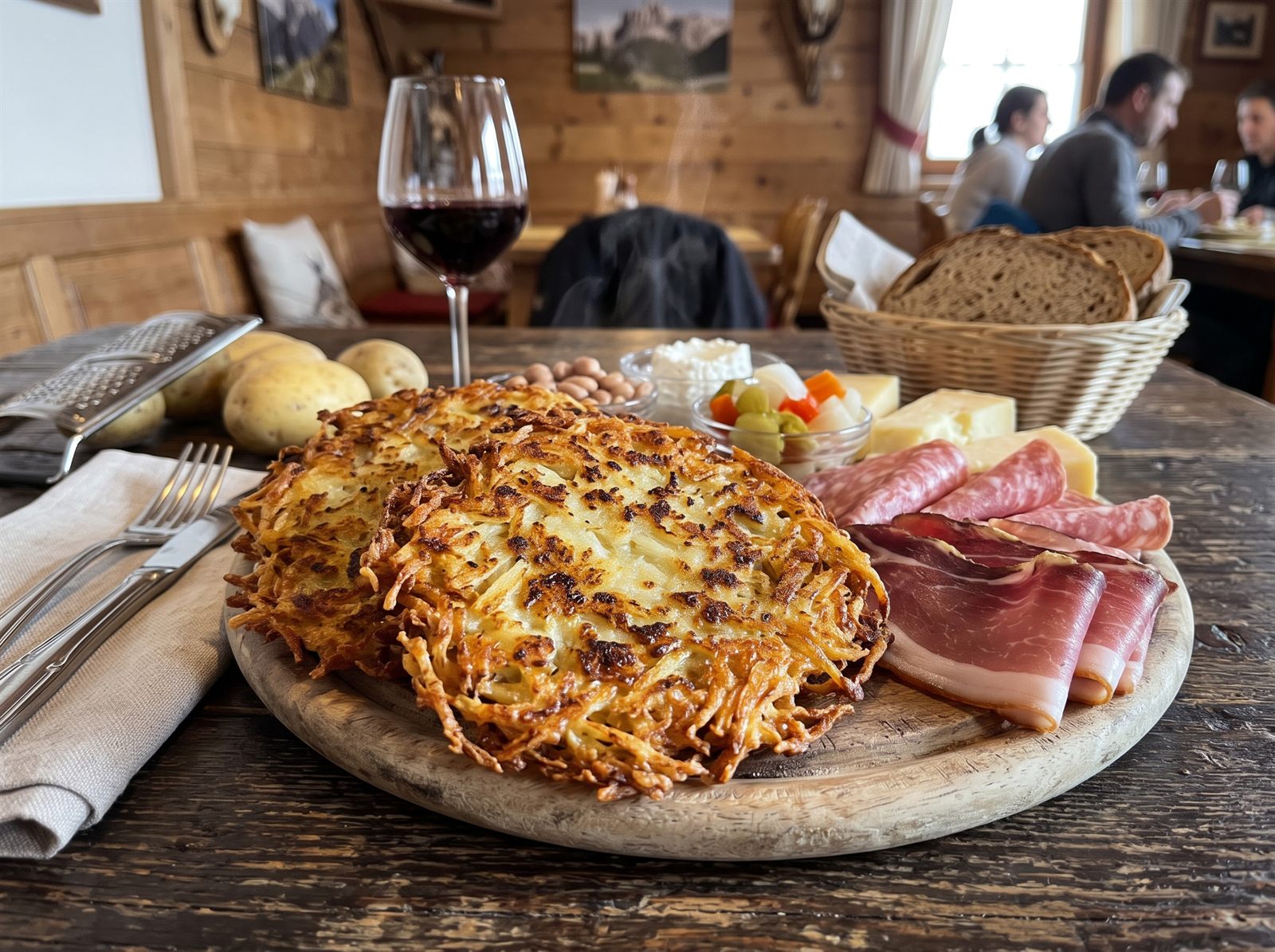
Fritters of raw potato, grated coarse, drained and bound with a little flour, fried crisp in hot oil: the famous dish of the Val di Non, in Trentino.
- Course
- SecondiMain Courses
- Serves
- 6
- Hands-on
- 1 h 4 min
- Cooking
- 5 min
- Resting
- 5 min+
In breve
In short
Also called tortel de patate, tortei de patate, tortei di patate and Trentino potato fritters.
- Vegetarian
- Vegan
- Raw white-fleshed potatoes, not new, peeled, grated coarse and drained of their water: 1 kg for six.
- The batter is only potato, two heaped tablespoons of flour, salt and pepper, mixed loosely, not packed down.
- Fried at once in spoonfuls spread to about 6 cm, in hot oil (olive oil on this page) at 170 °C, until golden and crisp on both sides.
- Served hot, piled in the middle of the table, with Trentino luganega, smoked mortandela and a medium-aged cheese.
La provenienza
Where this recipe comes from
Tortel de patate (tortei, in the plural) are fritters of raw grated potato, held together by a little flour and fried until crisp. They are the dish of the Val di Non, and are made all over Trentino, a little differently from one valley to the next. A poor dish of the everyday cooking of the past, from the days when people lived on soups and polenta, they are now enjoying a revival, and since 1998 a confraternity in Sporminore, in the valley, has worked to hand the recipe on. They are eaten in company: a tray piled high in the middle of the table, with cured meats, sausage and local cheeses, and often a salad of shredded cabbage and borlotti beans dressed with onion; the last one is often eaten sweet, with cranberry jam.
There is no official recipe. We compared seven sources and publish the most widely recognised version. They agree on the essentials: potatoes peeled and grated raw, bound with a few spoonfuls of flour, about three to the kilo at most, and seasoned with salt, fried as small fritters until golden and crisp, and served hot. Most recipes also drain off the water the grated potato gives. The fat varies: extra virgin olive oil here, lard or seed oil in other kitchens, and the same batter can be baked as a single cake. Some families add a little grated cheese, an egg or a drop of milk. The frying temperature, the size of each tortel and the times are ours, taken from the most detailed recipes, so that the result can be repeated. Trentino's mountain potato, grown above 450 metres, is itself one of the province's traditional products.
- Provenance
- A regional tradition documented in cookbooks and local practice, with no single official text.
- Defined by
- Val di Non and Trentino tradition
- Reference
- Compared across 7 sources, listed below; this page publishes the most widely recognised version.
- Sources
- Autonomous Province of Trento: tortel de patate, in its atlas of Trentino food products (Atlante dei prodotti agroalimentari del Trentino), 2012, p. 100 (Italian)
- Accademia Italiana della Cucina: torta e tortelli di patate, as made in the Val di Non, from its collection of regional recipes (Italian)
- Visit Val di Sole, the tourism board of the Sole, Peio and Rabbi valleys: tortei de patate, a recipe (Italian)
- Romagnoli F.lli, a potato company: the tortel recipe of the Confraternita della torta e del tortel di patate of Sporminore, on their blog, 2018 (Italian)
- Visit Val di Non, the valley's tourism board: tortel di patate, the Val di Non's famous potato cakes
- Visit Val di Non, the valley's tourism board: the recipe for the tortel di patate (Italian)
- Scatti di Gusto: ten typical dishes of Trentino-Alto Adige, 2020 (Italian)
Ingredienti
Ingredients
For the batter
For frying
Equipment
- Vegetable peeler and a bowl of cold water
- Box grater with large round holes (the coarse side)
- Fine sieve set over a bowl, and a spoon
- Mixing bowl and a tablespoon
- Frying pan of iron or with a non-stick base, 24 cm–26 cm across, and a lid within reach
- Digital probe thermometer
- Thin spatula (fish slice)
- Tray lined with kitchen paper, and a wire rack
Preparazione
Method
About 1¼ hours: 25 minutes to peel, soak, grate and drain the potatoes, a few minutes to mix the batter, then about 45 minutes to heat the oil, fry a test tortel and fry the rest in four or five batches. Mix the batter only when you are ready to fry.
- 1 h 4 minhands-on
- 5 mincooking
- 5 minresting, at least
The potatoes
-
Hands-on 8 min
Peel the potatoes and drop each one into a bowl of cold water as it is done.
Check No skin or eyes left on them.
-
Rest 5 min
Leave the peeled potatoes in the water for a few minutes, about 5, while you set out the grater, the sieve and the pan.
-
Hands-on 10 min
Take the potatoes out of the water one at a time and grate them on the coarse side of the box grater, the large round holes, into a bowl. Grate them by hand, not in a blender.
Check Coarse, wet shreds, with cloudy liquid starting to gather at the bottom of the bowl.
-
Hands-on 3 min
Tip the grated potato into the fine sieve over a bowl, press it lightly with the back of a spoon and let it drain for 2–3 minutes. Throw the liquid away.
Check Pressed lightly, the shreds give only a few drops.
Tip Yellow-fleshed potatoes give off more water than white ones: drain them for longer.
The batter
-
Hands-on 3 min
Put the drained potato back in the dry bowl, sprinkle over the two heaped tablespoons of flour, add salt and pepper and mix with a spoon. Do not press it down: the batter should stay loose.
Check Damp, loose shreds, lightly coated, with no dry flour showing; a spoonful holds together without being packed.
Tip If it turns brick-red as it waits, that is the raw potato oxidising: the flavour does not suffer. Fry it soon all the same, as it goes on giving off water.
Frying
-
Cooking 5–8 minTemp 170 °CHeat medium
Pour about 500 ml of the olive oil into the frying pan, for a layer about 1 cm deep, and heat it to 170 °C. Keep the rest of the oil for topping up.
Check With the probe tip in the oil, not touching the pan, the thermometer reads 170 °C. Without one, the test tortel in the next step sizzles steadily as soon as it goes in.
Tip Never leave hot oil unattended, and keep a lid within reach of the pan.
-
Hands-on 8 minTemp 170 °CHeat medium
Drop in a heaped tablespoon of batter and spread it with the back of the spoon into a round about 6 cm across. Fry it as in the next step, drain it, break it open and taste it. Add salt or pepper to the batter if it needs more.
Check Golden and crisp outside, soft and cooked through inside, and seasoned to your taste.
-
Hands-on 30–35 minTemp 170 °CHeat medium
Stir the batter, pouring off any liquid that has gathered. Drop in heaped tablespoons of it, four or five at a time with room between them, and spread each into a round about 6 cm across and less than 1 cm thick. After about 2 minutes, when a crust has formed underneath, nudge them gently with the spatula to free them; after about 2 minutes more, turn them, and fry them about 3 minutes on the second side. Lift them onto the paper-lined tray to drain. Stir the batter again before each batch.
Check Deep golden on both sides and crisp at the edges, the inside soft and no longer raw.
Tip Our guide: let the oil come back to 170 °C before each batch, and top it up from the oil you kept back when the layer gets thin.
Tip Keep them thin: a thick tortel browns outside before the middle is cooked.
-
Hands-on 2 min
Pile the tortei on a tray in the middle of the table and serve them at once, with luganega del Trentino, smoked mortandela of the Val di Non and a medium-aged Trentino cheese, as you like.
Tip Our guide: they are crispest straight from the pan. To bring them to the table together, keep each drained batch on a wire rack in the oven at 100 °C while you fry the rest.
The essentials, for cooks who know the dish. Switch to Detailed for quantities, temperatures, times and checks at every step.
Press “I’m here” on the step you are on, and again when it is done.Tap the pin on the step you are on, and the tick when it is done. Timers keep running while you scroll.
Da sapere
Good to know
- KeepingConservazione
- Eat them as soon as they are fried, while they are fragrant and crisp. Source
- VariantsVarianti
- Baked in the oven, as one cake: The same batter spread in a low round tin with extra virgin olive oil and baked at 180 °C–200 °C for at least 15 minutes, until golden. Source
- With lard in the frying oil: Fried in peanut oil a generous finger deep, with a tablespoon of lard melted into it, at about 170 °C. Source
- Sweet, with sugar or cranberry jam: To finish the meal, the final tortel of the batch becomes a dessert, topped with cranberry jam; in the past, children ate theirs dusted with sugar. Source
- With cheese, egg or milk: Some families add a handful of grated Trentingrana, an egg or a drop of milk to the batter. Source
Errori comuni
Common mistakes
- Leaving the potato water in the batter: drain it off, and pour off what gathers again before each batch.
- Packing the batter down or adding more flour: the tortei turn heavy. Mix it loosely, with only the flour given.
- Frying before the oil is hot: they soak it up. Wait for 170 °C before each batch.
- Crowding the pan: the oil cools and they run together. Four or five at a time.
- Frying them long before the meal: they lose their crispness. Fry them just before serving.
Fuori dall'Italia
Cooking it outside Italy
- Kennebec, the variety asked for here, is one of those grown in Trentino's mountains; elsewhere use any white-fleshed potato that is not new.
- Italian type 00 flour is plain (all-purpose) flour.
- Any extra virgin olive oil will do if Garda Trentino PDO is hard to find. Some cooks fry them in peanut or sunflower oil instead, sometimes with a spoonful of lard melted into it.
- Luganega del Trentino is a pork sausage, eaten fresh or cured; mortandela of the Val di Non is a slightly flattened ball of minced pork, smoked. Good cured meats and a medium-aged mountain cheese can stand in for them.