Milano, Lombardia
Cotoletta alla milanese
Milan's breaded veal chop, fried in butter
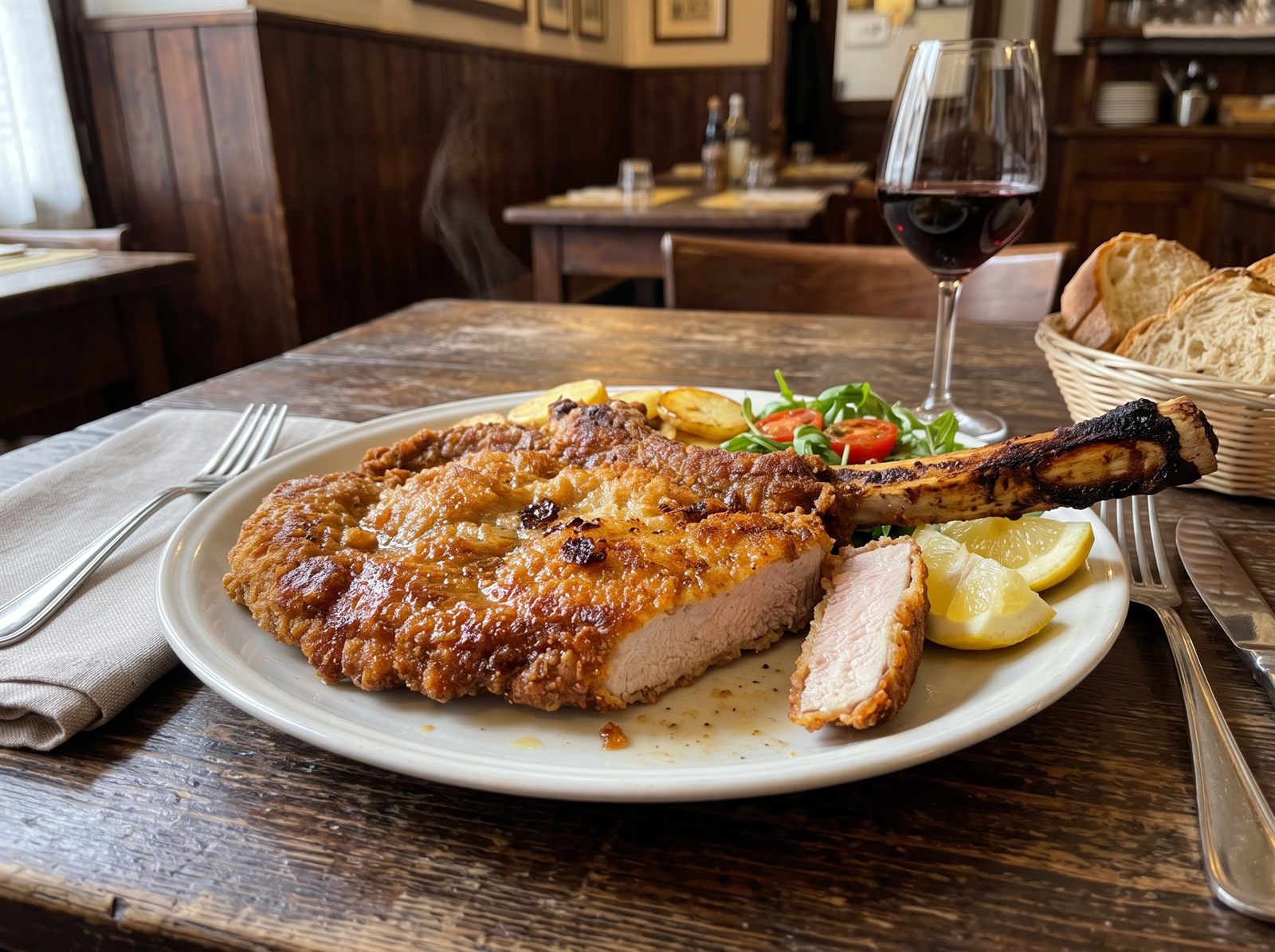
Milan's breaded veal chop: a bone-in rib chop cut as thick as the bone, dipped in egg and coarse breadcrumbs and fried slowly in butter, as the City of Milan's 2008 De.Co. recipe sheet sets it out.
- Course
- SecondiMain Courses
- Serves
- 4
- Hands-on
- 31 min
- Cooking
- 14 min
- Resting
- 3 min+
In breve
In short
Also called costoletta alla milanese, cutelèta, Milanese veal chop and veal Milanese.
- A bone-in veal rib chop, cut as thick as the bone: never pork or chicken, and never without its bone.
- Egg and coarse breadcrumbs only, pressed on with the palm of the hand; no salt on the meat until it is cooked.
- Fried in butter kept blond, never in oil: 7–8 minutes a side, all the chops in one layer.
- Salted on the serving dish and served with lemon wedges.
La provenienza
Where this recipe comes from
The costoletta, cutelèta in Milanese dialect, is a veal rib chop dipped in egg, coated in breadcrumbs and fried in butter, one of the great dishes of Milan. Its origins are disputed. Pietro Verri's history of Milan lists ‘lombolos cum panitio’ at a meal an abbot gave the monks of Sant'Ambrogio in 1134, but not all scholars accept that it was the same dish, and experts on the Middle Ages have since judged it closer to a scaloppina served with bread. A letter in which Field Marshal Radetzky is said to have praised the Milanese chop to Vienna is a legend: the city's own sheet repeats it, but no document proves it. What is certain is that the word cutelèta appears in Francesco Cherubini's Milanese dictionary of 1814, and that the first recipe called ‘alla milanese’ is in Giuseppe Sorbiatti's Gastronomia moderna, published in Milan in 1855.
In 2008 the City of Milan entered the dish in its register of De.Co. products, the municipal designation for the city's traditional foods, and attached a recipe sheet to the resolution. This page follows that sheet. It calls the dish costoletta, the ‘little rib’, and asks for four chops of the best veal, ideally from Brianza and from the rack, cut as thick as the bone, two eggs, coarse breadcrumbs freshly made from dry bread, and 100 g of butter, kept blond while the chops fry for seven or eight minutes a side, with salt only at the end. Many cooks now fry it in clarified butter, which is among the variants. A few things here are ours, not the sheet's: the chops taken out of the fridge before frying, the bone cleaned into a handle, a probe check and a 3-minute rest on a rack, so that the meat is cooked to at least 63 °C, the safe minimum for veal chops.
- Provenance
- A reference recipe set by a protection consortium or by the town the dish is named after.
- Defined by
- Comune di Milano (City of Milan)
- Reference
- De.Co. (Denominazione Comunale) recipe sheet for the Costoletta alla Milanese, attached to the City Council executive's resolution, 2008
- Sources
- City of Milan, Food Policy: the register of De.Co. food products, with the cotoletta alla milanese recognised in 2008 (Italian)
- City of Milan: the De.Co. recipe sheet for the Costoletta alla Milanese, attached to the 2008 resolution (copy hosted by Cucina Regionale Italiana, Italian)
- YesMilano, the city's promotion agency Milano & Partners: costoletta or cotoletta alla milanese, with a recipe for four (Italian)
- Scatti di Gusto: cotoletta alla milanese, the scientific recipe in five points (Italian)
- Dissapore: cotoletta alla milanese, the traditional recipe (Italian)
- Gambero Rosso: the true story of the costoletta alla milanese (Italian)
- Agenzia Dire: the Costoletta alla milanese day, 2016, from the Accademia Italiana della Cucina's press review (Italian)
- USDA Food Safety and Inspection Service: Leftovers and Food Safety, on cooking chops to a safe temperature and keeping leftovers
Ingredienti
Ingredients
Equipment
- Meat mallet and a small sharp knife
- Two wide, deep plates, for the egg and the breadcrumbs
- Wide, shallow frying pan that holds the four chops in one layer, at least 32 cm across (or two pans, with the butter divided between them)
- Tongs, or two forks
- A spoon, for basting
- Wire rack, or kitchen paper
- Probe thermometer
Preparazione
Method
About 50 minutes from start to table: about 25 to trim, flatten and bread the chops, then about 20 to heat the butter and fry them, all four together in one layer, and a few minutes to rest and serve.
- 31 minhands-on
- 14 mincooking
- 3 minresting, at least
Preparing the chops
-
Hands-on 10 min
Take the chops out of the fridge as you start, about 25 minutes before they go into the pan. On each chop, cut through the meat and fat around the end of the bone and push them back with your fingers towards the eye of the meat, leaving the end of the bone clean: it is the handle. Trim off any excess fat and sinews.
Check A clean bone handle, with the meat attached to it in one piece, like a flag on its pole.
Tip The butcher can do this for you: ask for the bones frenched.
-
Hands-on 5 minOfficial text
Cut into the membrane and fat around the outer edge of each chop, so it does not lift as it cooks, and flatten the chops with the meat mallet. Do not salt them now.
Check The chops lie flat and are still as thick as the bone.
Tip Our guide: cut into the edge in a few places, and beat only lightly, just enough to even the meat out: it must stay as thick as the bone, usually about 3 cm.
Tip Salt now would take away the meat's tenderness: the chops are salted only once cooked.
Tip Our guide: salt also draws out juices that loosen the crust.
Breading
-
Hands-on 3 minOfficial text
Put the eggs in a deep plate, still with no salt, and beat them well.
Tip Our guide: spread the breadcrumbs on a second wide plate, ready for the next step. Grate more than you think you need: each chop must lie in them and be covered completely.
-
Hands-on 8 minOfficial text
Dip the chops in the egg one at a time, all except the bone handle. Then coat the meat in the breadcrumbs, pressing with the palm of your hand so the crumbs stick well and do not come away while cooking.
Check An even coat of crumbs all over with no bare patches, and nothing falls off when you lift the chop by its bone.
Tip Our guide: turn each chop in the egg so both sides are wet, and let the excess drip off before the crumbs. Scatter more crumbs over the top, then press firmly all over.
Frying
-
Hands-on 3 minHeat medium-low, then mediumOfficial text
Heat the butter in the wide pan: it must not sizzle. Then turn the heat up a little.
Check The butter has melted and is just starting to foam, still pale and blond, not brown.
-
Cooking 7–8 minHeat mediumOfficial text
Keeping the butter blond all the time, lay the chops in it in a single layer and cook them for 7–8 minutes.
Check Lift a corner: the underside is an even, light gold.
Tip Our guide: if the butter starts to darken, lower the heat a little.
Tip Our guide: the meat by the bone cooks more slowly; now and then, spoon some of the hot butter over it.
-
Cooking 7–8 minHeat mediumOfficial text
Turn the chops and cook them for 7–8 minutes on the other side, so that they are soft and lightly golden.
Check Both sides lightly golden, the crust still attached and the meat soft when pressed. Inside it is white-pink: a probe in the thickest part, away from the bone, reads at least 63 °C.
Tip Our guide: turn them with tongs or two forks, without piercing the crust, and keep spooning butter over the meat by the bone.
Tip Our guide: if the probe reads under 63 °C, lower the heat a little and give each side another 1–2 minutes, keeping the butter blond, then check again.
-
Rest 3 min
Lift the chops onto a rack, or onto kitchen paper, and leave them for 3 minutes: the crust stays crisp underneath and the meat finishes cooking.
Serving
-
Hands-on 2 minOfficial text
Put the chops on a serving dish, salt them and garnish with the lemon wedges.
Tip Our guide: to eat them cold later, put them in the fridge, covered, within 2 hours of cooking, and eat them within 3 days.
The essentials, for cooks who know the dish. Switch to Detailed for quantities, temperatures, times and checks at every step.
Press “I’m here” on the step you are on, and again when it is done.Tap the pin on the step you are on, and the tick when it is done. Timers keep running while you scroll.
Da sapere
Good to know
- KeepingConservazione
- Very good cold, too. Source
- VariantsVarianti
- In clarified butter: The same recipe with 100 g of clarified butter: the chops go in as soon as it starts to foam, and are salted on top as soon as they are turned. Source
- Double breading: Dipped twice in egg and breadcrumbs, for a crisper, fuller crust (4 eggs and 300 g of crumbs for four), then fried in 300 g of clarified butter, 5 minutes a side. Source
- The first recipe ‘alla milanese’, 1855: Giuseppe Sorbiatti's, as the city's sheet quotes it: six chops prepared thin, dipped in beaten egg, coated in breadcrumbs, fried slowly on one side until blond, then turned and salted, and served two minutes later with their butter, the lemon on the side. Source
- Orecchia d'elefante: The chop beaten out very thin and wide, like an elephant's ear. Well made, it is much liked today, though it is a long way from the original. Source
Errori comuni
Common mistakes
- Salting the meat before cooking: it loses tenderness and the crust comes away. Salt only on the serving dish.
- Butter too hot. It must stay blond, never brown: lower the heat as soon as it darkens.
- Frying in oil, or using pork or chicken: the Milanese chop is veal, fried in butter.
- Taking the bone off: the city's De.Co. sheet says every chop must keep it.
- Not cutting into the edge: it lifts as it cooks and the chop no longer lies flat in the butter.
- Crumbs only laid on, not pressed: they come away in the pan.
Fuori dall'Italia
Cooking it outside Italy
- Ask the butcher for veal rib chops from the rack, bone in, cut as thick as the bone, with the bones frenched. Purists use only the first six chops of the loin, from milk-fed veal.
- Make the breadcrumbs yourself, coarse, from plain dry bread: shop crumbs are often fine or seasoned. Some chefs use panko instead.