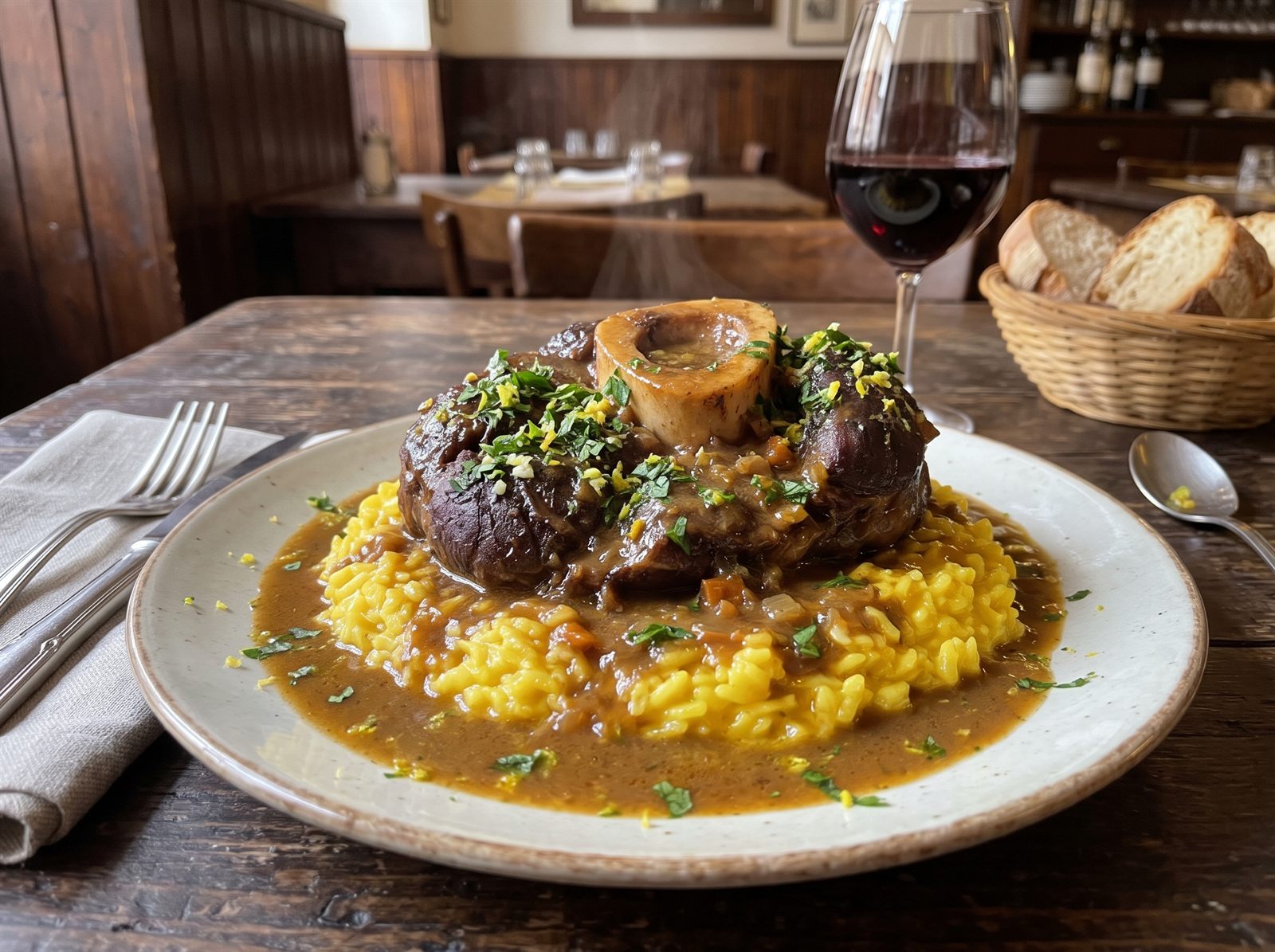
Milano, Lombardia
Ossobuco alla milanese
Braised veal shanks, Milanese style
Milan's braised veal shank, floured, browned in butter and cooked slowly in a little broth, then finished with a gremolada of lemon, parsley and anchovy: a De.Co. of the City of Milan since 2007.
- Course
- SecondiMain Courses
- Serves
- 4
- Hands-on
- 39 min
- Cooking
- 1 h 35 min
In breve
In short
Also called ossobuco, osso buco, ossibuchi alla milanese, òss büs and braised veal shanks.
- Slices of veal shank 4 cm thick, from the lower part of the hind leg, where the small bone is full of marrow.
- Floured and browned in butter with a little onion, then cooked covered with a little broth over low heat for about an hour and a half.
- Cooked in bianco, that is without tomato, or with one very small one at most; and with no wine.
- Finished with gremolada, lemon zest, parsley, anchovy and, if you like, garlic, chopped together and stirred in five minutes before serving.
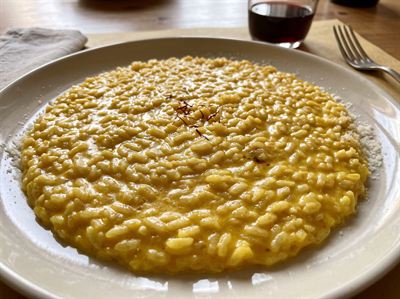
- Served with risotto alla milanese.
La provenienza
Where this recipe comes from
Ossobuco is Milan's braised veal: thick slices cut across the shank, each with a round of bone full of marrow in the middle. The name is Milanese dialect for a bone with a hole, and tradition has a long, thin spoon for the marrow, nicknamed the tax collector. Some date the recipe to eighteenth-century cookbooks; others find few traces before the nineteenth century, when Giuseppe Sorbiatti, cook to noble Milanese families, named it in 1879, and Pellegrino Artusi later gave it in his cookbook, warning that it was a dish best left to the Milanese. It was the Sunday dish of middle-class Milanese families.
On 14 December 2007 the City of Milan's executive gave ossobuco alla milanese a De.Co., its municipal designation, with the recipe on a sheet attached to the resolution. We have not been able to read the city's own sheet, so this page follows a published transcription of it, for four. Published accounts of the recipe differ slightly, on whether the garlic and the tomato are optional, so no step here is marked as the official text. The dish is cooked in bianco, without tomato or with a very small one at most, and with no wine: butter and a little onion, a ladle of broth, about an hour and a half over low heat, and the gremolada stirred in just before serving. Many cooks add white wine before the broth, and others celery, carrot and tomato: they are among the variants. The extra broth kept hot, the cuts in the skin and the turn halfway through are ours, so the slices lie flat and the pan never dries.
- Provenance
- A reference recipe set by a protection consortium or by the town the dish is named after.
- Defined by
- Comune di Milano (City of Milan)
- Reference
- De.Co. (Denominazione Comunale) recipe for ossobuco alla milanese, recognised by the city's executive (Giunta comunale) on 14 December 2007 (resolution P.G. 1034992/2007); read in a published transcription, as the city's own sheet could not be found
- Sources
- Ristorante La Tavernetta da Elio (ossobucoallamilanese.it): the De.Co. recipe, transcribed from the sheet attached to resolution P.G. 1034992/2007 (Wayback Machine copy, Italian)
- City of Milan, Food Policy: the register of De.Co. food products, with ossobuco recognised in 2007 (Italian)
- YesMilano, the city's promotion agency Milano & Partners: ossobuco, with a recipe (Italian)
- Accademia Italiana della Cucina: ossobuco alla milanese, from its recipe collection (Italian)
- Pellegrino Artusi: ‘La scienza in cucina e l'arte di mangiar bene’, recipe 358, osso buco (Project Gutenberg, 25th edition, Italian)
- Scatti di Gusto: ossobuco alla milanese, the scientific recipe, by Massimo D'Alma (Italian)
- La Cucina Italiana: ossobuco alla milanese (Italian)
- Giallo Zafferano: ossobuco alla milanese (Italian)
Ingredienti
Ingredients
For the ossobuco
For the gremolada
In reserve
Equipment
- Wide, heavy pan with a tight lid, about 28 cm across, to hold the four slices in one layer
- Small saucepan, to keep the broth hot, and a ladle
- Kitchen scissors or a small sharp knife
- Kitchen paper and a plate for the flour
- Tongs or a spatula, to turn the meat without piercing it
- Fine grater, chopping board and a large knife, for the gremolada
- Small spoons, for the marrow
Preparazione
Method
Make the meat broth beforehand: it takes about 6 hours, and the day before is best. If you serve the ossobuco with risotto alla milanese, make enough broth for the risotto too. On the day, about 2 hours: 15 minutes to prepare, 15 to brown, then about an hour and a half of slow cooking, during which you make the gremolada and, if you serve it, the risotto alla milanese (start it about 35 minutes before the end).
- 39 minhands-on
- 1 h 35 mincooking
Beforehand: the broth
This follows the City of Milan's De.Co. recipe in a published transcription. No step is marked as the official text, since we could not read the city's own sheet and the published accounts differ slightly; the times, heat levels and checks the text does not give are ours, some in tips marked ‘Our guide’.
-
Make the meat broth following its own recipe and strain it.
Tip Our guide: you need about 500 ml: a ladle for the pan, the rest kept hot in case the pan dries.
Preparing
-
Hands-on 2 minHeat low
Pour the broth into a small saucepan and keep it hot over low heat until the end.
Check Steaming, with a few small bubbles at the edge.
Tip Our guide: hot broth keeps the pan at a simmer when it goes in.
-
Hands-on 5 min
Pat the slices dry with kitchen paper. With scissors or the tip of a knife, cut through the thin skin that runs round the edge of each slice in three places, evenly spaced, without cutting into the meat.
Check Three short cuts in the skin of every slice.
Tip Our guide: the skin shrinks as it cooks; uncut, it pulls the slice into a curl and it browns unevenly.
-
Hands-on 5 min
Chop the quarter onion finely. If you use the tomato, peel it and chop it.
Check The onion is in small, even pieces.
Tip The De.Co. recipe calls the tomato not essential and keeps it to the minimum: Milanese cooking took to tomatoes later than most.
Tip Our guide: to peel it, cut a cross in the skin and plunge it into boiling water for 20–30 seconds.
Browning
-
Hands-on 5–7 minHeat medium-low
In the wide pan, cook the onion in the 50 g of butter until golden, stirring now and then.
Check The onion is soft and pale gold; the butter foams but does not brown.
-
Hands-on 2 min
Coat the slices lightly with flour on both sides, then tap them gently to shake off the excess.
Check A thin, even coat, with no dry patches or lumps of flour.
Tip Our guide: flour them only now, just before they go in: floured meat that waits turns damp and pasty.
-
Hands-on 6–8 minHeat medium
Put the slices in the pan and brown them on both sides, turning them without piercing them.
Check A thin golden crust on both sides; the onion golden, not dark.
Tip Our guide: push the onion to the edges first, then give each side 3–4 minutes. Turn them with tongs or a spatula, never a fork.
Tip Our guide: if the onion starts to darken, lower the heat a little.
Slow cooking
-
Hands-on 2 min
Pour in a little broth, the tomato if you use it, and salt.
Check The broth bubbles gently round the meat.
Tip Our guide: one ladle of the hot broth, about 150 ml, and only a light pinch of salt: the broth is salted, and so is the anchovy.
-
Cooking 1 h 30 minHeat low
Cover the pan and cook over low heat for about an hour and a half, until the slices look slightly glazed.
Check The slices look slightly glazed in a short sauce; the meat is tender and comes away from the bone at the touch of a fork.
Tip Our guide: keep it at the barest simmer. Turn the slices once halfway with tongs, and every 20 minutes or so lift the lid: if the bottom is nearly dry, add 2–3 tablespoons of the hot broth.
Tip Our guide: never let it boil hard: at a high heat the meat squeezes out its juices and turns tough and dry.
Tip Our guide: not tender yet? Give it 15–30 minutes more, with a spoonful of broth if needed.
-
Hands-on 10 min
While the meat finishes, grate the yellow zest of the lemon. Chop the parsley, the anchovy and, if you use it, the half clove of garlic together very finely with a knife, then mix in the zest.
Check A fine, damp, bright green mince, with no large pieces of anchovy or garlic.
Tip Our guide: rinse a salted anchovy, open it and pull out the bone before chopping.
Tip Our guide: make it in the last part of the cooking, not hours ahead, so it stays fresh and fragrant.
-
Cooking 5 minHeat low
Five minutes before serving, add the gremolada and mix well.
Check The sauce smells of lemon; the parsley is still green.
Tip Our guide: scatter it over the slices and into the sauce, stir the sauce gently round them and cover again for the last minutes.
-
Hands-on 2 min
Serve each slice with its sauce and with risotto alla milanese, and a small spoon for the marrow.
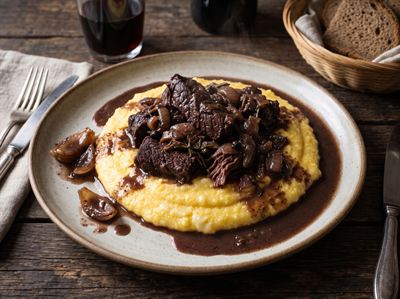
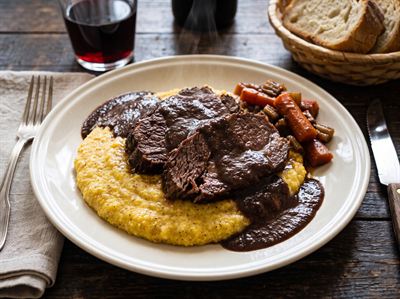
Tip It is also served on its own, or with polenta, mashed potatoes or buttered spinach.
The essentials, for cooks who know the dish. Switch to Detailed for quantities, temperatures, times and checks at every step.
Press “I’m here” on the step you are on, and again when it is done.Tap the pin on the step you are on, and the tick when it is done. Timers keep running while you scroll.
Da sapere
Good to know
- WhenQuando
- The Sunday dish of middle-class Milanese families. Source
- KeepingConservazione
- It keeps for a day in the fridge: cool it and put it in within 2 hours, in a shallow covered container, and bring it back to the boil (75 °C) before serving. Freezing is not recommended. Source
- VariantsVarianti
- With white wine: The version most widespread among cooks: the floured meat cooked long with butter and onion, then white wine, then meat broth a little at a time, with the gremolada at the end. Source
- With olive oil: Extra virgin olive oil with the butter or in its place, one of the few variations counted as accepted. Source
- With pancetta: Pancetta in the butter and onion. Source
- With tomato, celery and carrot: Artusi's version: one piece per person on a raw mince of onion, celery, carrot and butter, seasoned with salt and pepper; then butter worked into flour, to colour and bind the sauce, and water with tomato sauce or paste to finish the cooking. The sauce is strained, skimmed and scented with lemon peel cut small and a pinch of chopped parsley. Source
Errori comuni
Common mistakes
- Leaving the skin round the slices uncut: they curl as they cook.
- Piercing the meat to turn it: the De.Co. recipe turns the slices without piercing them.
- Cooking it at a boil: the meat toughens and dries. It cooks at a low heat, with liquid added a little at a time.
- Turning it into a red stew: the original recipe is cooked in bianco, without tomato, or with a very small one at most.
- Adding the gremolada early: it goes in five minutes before serving.
Fuori dall'Italia
Cooking it outside Italy
- Ask the butcher for veal shank cut across into osso buco slices 4 cm thick, from the lower part of the hind leg, where the bone is small and full of marrow.
- Whole salted anchovies are rinsed, opened and boned; two anchovy fillets in oil can replace one whole anchovy.
- Rice flour can replace wheat flour, for a gluten-free dish.
- Vegetable broth can replace meat broth; the sauce is less savoury.