Bologna, Emilia-Romagna
Brodo di carne
Bolognese capon and beef broth
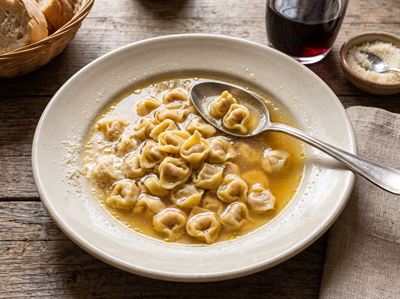
The broth of Bologna's tortellini: capon and beef simmered for four hours with vegetables and a rind of Parmigiano Reggiano, as the Dotta Confraternita del Tortellino deposited it in 2026.
- Course
- BasiBasics
- Serves
- 20
- Hands-on
- 37 min
- Cooking
- 4 h 30 min
- Resting
- 30 min+
In breve
In short
Also called brodo per tortellini, brodo di cappone and Bolognese meat broth.
- Gluten-free
- Half a capon at least five months old and beef doppione, with a beef femur bone, started in cold water.
- A browned onion, carrots, celery, half a ramato tomato and a rind of 24-month Parmigiano Reggiano.
- Simmered very slowly for four hours, skimmed often so it stays clear.
- Rested off the heat for half an hour, then filtered through a clean white cloth.
La provenienza
Where this recipe comes from
Bologna's tortellini have had a deposited filling since 1974 and a deposited description of their shape and pasta since 2008. The broth they are served in was the last part without a text. On 16 October 2026, after a historical and social study, the Dotta Confraternita del Tortellino deposited it too, as a notarial deed at the Chamber of Commerce of Bologna, signed by the notary Carlo Vico, a member of the Confraternita, by the Chamber's president Valerio Veronesi and by the Gran Prevosto Alberto Salvadori.
The deed itself has not been published. The recipe here follows the press reports of the deposit, which agree with one another: half a capon at least five months old, beef doppione and a femur bone, vegetables with a browned onion and half a tomato, and a rind of 24-month Parmigiano Reggiano, simmered very slowly for four hours, rested and filtered through a cloth. It is the broth for tortellini, and the meat broth Nonnario's other recipes call for.
- Provenance
- An official recipe filed with an Italian Chamber of Commerce or a notary by a recognised culinary body.
- Defined by
- Dotta Confraternita del Tortellino
- Reference
- Recipe deposited with a notary at the Chamber of Commerce of Bologna, 2026
- Sources
- Il Resto del Carlino: the broth recipe deposited on 16 October 2026, its method and permitted variations (Italian)
- VDG Magazine: the official broth for tortellini, its method and variations (Italian)
- Confcommercio Ascom Bologna: the deposit and its signatories, from Il Resto del Carlino of 19 October 2026 (Italian)
Ingredienti
Ingredients
For the broth
Equipment
- Stockpot of at least 8 l, with a lid
- Frying pan, for browning the onion
- Skimmer
- Stamigna (a straining frame) or a fine sieve, and a clean white cotton cloth
- Probe thermometer (useful to hold the simmer at 90 °C–95 °C)
- A sink or large bowl of iced water, to cool it quickly if you make it ahead
Preparazione
Method
About 5 hours, almost all of it unattended: 15 minutes to prepare, four hours of very slow simmering, half an hour of rest and a few minutes to filter. The deposited quantities are for 2.5 kg of tortellini, about 20 servings. Make it the day before if you can: chilled overnight, its fat sets and lifts off cleanly.
- 37 minhands-on
- 4 h 30 mincooking
- 30 minresting, at least
Before the pot
-
Hands-on 10 min
Peel the carrots and wash the celery stalks. Halve the onion through the root, leaving its skin on. Halve the tomato. Scrape the outside of the Parmigiano rind with a knife and rinse it under the tap.
Tip The onion's skin adds colour to the broth: leave it on.
-
Hands-on 4–5 minHeat medium-high, in a dry panOfficial text
Put the onion halves cut side down in a dry frying pan over medium-high heat and leave them, without moving them, until the cut faces are deep brown, 4–5 minutes.
Check The cut faces are evenly deep brown, not black.
Tip The deposit browns the onion before it goes into the pot: it gives the broth its amber colour.
The broth
-
Hands-on 3 minOfficial text
Pour 5 l of cold water into the stockpot. Add 30 g of coarse salt, the browned onion, the carrots, the celery, the half tomato and the Parmigiano rind.
-
Cooking 30–40 minHeat mediumOfficial text
Add the beef, the femur bone and the half capon to the cold water. Heat over medium heat so that the water comes to the boil slowly, in 30–40 minutes.
Tip Starting the meats in cold water draws out their flavour and lets the proteins rise gradually as foam you can skim, for a clearer broth.
Tip To serve the capon as boiled meat, the deposit lets you add it only once the water boils and lift it out after about an hour and a half, while the beef cooks on.
-
Hands-on 10 minOfficial text
As the water nears the boil, grey foam rises. Lift it off with the skimmer, again and again, until the surface stays clean.
Check The surface is clear, with only small drops of fat.
-
Cooking 4 hTemp 90 °C–95 °CHeat lowest, barely tremblingOfficial text
Lower the heat until the surface barely trembles, at 90 °C–95 °C, and leave the broth for four hours with the lid ajar. Skim off any new foam every half hour or so, to keep it clear.
Check The broth is clear and golden, and the beef is tender to a fork.
Tip A rolling boil emulsifies the fat and turns the broth cloudy. If bubbles break the surface, lower the heat or move the pot half off the burner.
-
Rest 30 minOfficial text
Turn off the heat and leave the pot to stand for half an hour, without stirring, so the finest particles settle to the bottom.
-
Hands-on 10 minOfficial text
Lift out the meats and the vegetables with the skimmer. Line the stamigna, or a fine sieve set over a clean pot, with a clean white cotton cloth, dampened and wrung out. Ladle the broth through it gently, leaving the last cloudy centimetre in the pot.
Check Poured into a white bowl, the broth is clear enough to see the bottom.
Tip The beef and the capon make a good boiled-meat course (bollito) with green sauce.
If you make it ahead
-
Temp 4 °C
Stand the pot in a sink of iced water and stir until the broth is below 20 °C, then refrigerate it overnight at 4 °C. The next day, lift off the fat that has set on top, leaving a few flecks for flavour.
Tip Cooling it below 20 °C within 2 hours keeps it safe.
The essentials, for cooks who know the dish. Switch to Detailed for quantities, temperatures, times and checks at every step.
Press “I’m here” on the step you are on, and again when it is done.Tap the pin on the step you are on, and the tick when it is done. Timers keep running while you scroll.
Da sapere
Good to know
- VariantsVarianti
- With a free-range chicken: A free-range chicken may take the place of the capon. Source
- With other cuts of beef: Half the doppione may be replaced by 500 g of copertina, and falata or brisket (punta di petto) may be added or used instead. Source
- A stronger broth: With 3.5 l of water instead of 5 l, for a more concentrated broth; the carrots and celery may also be halved. Source
- With the capon as boiled meat: The capon may go in only once the water boils and come out after about an hour and a half, while the beef cooks on. Source
- Used inUsato in
- Risotto alla milanese, Canederli in brodo, Passatelli in brodo and Ragù alla bolognese.
Errori comuni
Common mistakes
- Boiling it hard: the fat emulsifies and the broth turns cloudy. It should barely tremble for four hours.
- Filtering it at once. The half hour of rest off the heat lets the finest particles settle first.
- Reaching for a stock cube to make it stronger. The deposit's own way is less water: 3.5 litres instead of 5.
Fuori dall'Italia
Cooking it outside Italy
- Capon can be hard to find outside Italy: the deposit itself allows a free-range chicken instead.
- ‘Doppione’ is a Bolognese cut for boiling. The deposit also allows brisket (punta di petto), which is easy to find anywhere.
- Use a rind of Parmigiano Reggiano PDO aged 24 months, as the deposit asks.