Bologna, Emilia-Romagna
Tagliatelle al ragù
Bologna's egg tagliatelle with meat ragù
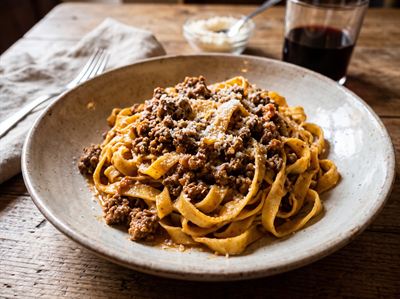
Bologna's egg tagliatelle, 8 mm wide once cooked, the measure the Accademia Italiana della Cucina deposited in 1972, dressed with the ragù it deposited to go with them.
- Course
- Primi & RisottiPasta & Rice
- Serves
- 4
- Hands-on
- 1 h 2 min
- Cooking
- 23 min
- Resting
- 30 min+
In breve
In short
Also called tagliatelle alla bolognese and tagliatelle with Bolognese sauce.
- Egg pasta: 4 eggs to 400 g of 00 flour, kneaded for 20 minutes and rolled just under 1 mm thick.
- Cut 6.5 mm–7 mm wide while raw, to open to the deposited 8 mm once cooked.
- Dressed with ragù alla bolognese, the sauce the Accademia deposited to go with them.
- Never spaghetti: in Bologna, ragù goes on tagliatelle.
La provenienza
Where this recipe comes from
Tagliatelle are Bologna's egg pasta: a thin sheet of flour and eggs, rolled up and cut into ribbons. In 1972 the Bologna delegation of the Accademia Italiana della Cucina deposited their ‘golden measure’ with the city's Chamber of Commerce: 8 mm wide once cooked, one 12,270th of the height of the Asinelli tower. A gold sample of it is kept by the Chamber.
The tagliatella was deposited ‘bare’, in the words of the Accademia's members that the Chamber quotes; in 1982 they deposited the ragù to dress it, and in 2023 the Accademia replaced that text with an updated one. The pasta here follows the recipe Altroconsumo gives for the deposited tagliatella, four eggs to 400 g of flour; the sauce is our ragù alla bolognese, which follows the 2023 deposit.
- Provenance
- An official recipe filed with an Italian Chamber of Commerce or a notary by a recognised culinary body.
- Defined by
- Accademia Italiana della Cucina, Bologna delegation
- Reference
- The ‘golden measure’ of the tagliatella, deposited with the Chamber of Commerce of Bologna, 1972
- Sources
- Camera di Commercio di Bologna: the ragù deposit of 2023 and the Chamber's collection, from the tagliatella's golden measure of 1972 (Italian)
- Camera di Commercio di Bologna, press review: the tagliatella's measure, 8 mm once cooked (from Il Resto del Carlino, PDF, Italian)
- Altroconsumo: tagliatelle, a recipe for the deposited tagliatella and how to keep fresh pasta (Italian)
- Wikipedia: Bolognese sauce, served in Bologna with tagliatelle, not spaghetti
Ingredienti
Ingredients
For the tagliatelle
To cook and dress them
Equipment
- Large wooden pastry board and a long rolling pin
- Fork and a sharp, heavy knife
- Ruler, for the first few cuts
- Clean cotton cloths, lightly floured
- Pot of at least 4 l, a colander, and a wide frying pan for the ragù
Preparazione
Method
Make the ragù the day before. On the day, about 1 hour 30 minutes for the pasta (20 minutes of kneading, 30 of rest, then rolling and cutting) and about 20 minutes to bring the water to the boil, cook the tagliatelle and dress them.
- 1 h 2 minhands-on
- 23 mincooking
- 30 minresting, at least
The day before: the ragù
-
Make the ragù alla bolognese the day before, following its own recipe, and keep it in the fridge until you need it.
The pasta
-
Hands-on 10 min
Heap the flour on the board and make a wide well. Break the eggs into it and add the pinch of salt. Beat the eggs with a fork, drawing in flour from the inner wall little by little, until the mixture is too stiff to stir; then work in the rest with your hands.
Check Soft but workable by hand. Too soft: add a little flour. Too hard: add about half an eggshell of water.
Tip The recipe allows a tablespoon of olive oil with the eggs, if you like.
-
Hands-on 20 min
Knead with the heel of your hand, folding and turning, for 20 minutes, until the dough is smooth and elastic.
Check Press a finger into it: the dent springs back slowly, and the surface is satin-smooth.
-
Rest 30 min
Shape the dough into a ball, cover it with an upturned bowl and leave it at room temperature for 30 minutes.
-
Hands-on 15–20 min
Divide the dough into 3 equal pieces. Roll out one at a time, keeping the others covered, into a thin sheet just under 1 mm thick, turning it a quarter turn every few strokes.
Check Hold the sheet up to the light: you can see the shadow of your hand through it.
Tip Leave each sheet on the board for 5–10 minutes before rolling it up: dry to the touch but still supple, the layers will not stick together.
-
Hands-on 3 min
Dust the sheet lightly with flour and roll it up loosely into a flat roll about 8 cm wide.
-
Hands-on 7 minOfficial text
With a sharp knife, cut the roll across into strips 6.5 mm–7 mm wide; the exact raw width depends on how firm the dough is.
Check Raw, 6.5 mm–7 mm wide: cooked, they open to the deposited 8 mm.
Tip Use a ruler for the first few cuts until your eye is set.
-
Hands-on 5 min
Unroll the strips straight away and wind them loosely around your hand into nests. Set them on a floured cloth, not touching.
Cooking and serving
-
Cooking 10–15 minHeat high
Bring 3 l of water to the boil in the pot and add 2 tablespoons of coarse salt.
-
Cooking 10 minTemp 75 °CHeat medium-low
Meanwhile, put the ragù in a wide frying pan and bring it to a gentle simmer, stirring, then let it bubble for 2–3 minutes until it is steaming hot all through.
Check Steaming hot right through: at least 75 °C at the centre.
-
Cooking 3 min
Drop the tagliatelle into the boiling water. After about 3 minutes they rise to the surface: stop the boil with half a glass of cold water, then drain.
Check Tender, with a slight bite at the centre.
-
Hands-on 2 min
Tip the tagliatelle into the pan with the ragù and toss them over low heat for about a minute, until every strand is coated. Serve at once.
The essentials, for cooks who know the dish. Switch to Detailed for quantities, temperatures, times and checks at every step.
Press “I’m here” on the step you are on, and again when it is done.Tap the pin on the step you are on, and the tick when it is done. Timers keep running while you scroll.
Da sapere
Good to know
- KeepingConservazione
- Fresh, they keep 2–3 days in the fridge, in small floured portions in an airtight container, or a couple of months in the freezer: freeze the nests on a tray for about an hour before bagging them, so they do not stick together, and cook them from frozen. To keep them at room temperature they must be completely dry: warm the oven to 50 °C, turn it off and leave the nests inside, door open, for about an hour; if they are still damp, do it again. Dried this way they keep about four weeks. Source
Errori comuni
Common mistakes
- Cutting them too wide or too narrow: 6.5 mm–7 mm raw, 8 mm cooked, is the deposited measure.
- Rolling the sheet too thick. It should be just under 1 mm.
- Serving the ragù on spaghetti: in Bologna it goes on tagliatelle.