Ravenna, Emilia-Romagna
Passatelli in brodo
Breadcrumb and Parmigiano strands in broth
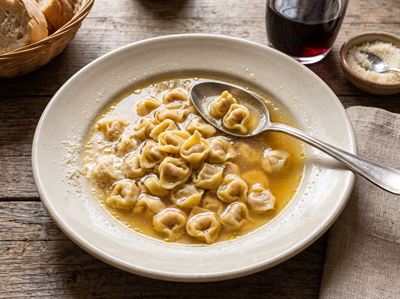
Romagna's festive minestra: breadcrumbs, Parmigiano Reggiano and eggs pressed through an iron into short strands and cooked in meat broth.
- Course
- Primi & RisottiPasta & Rice
- Serves
- 6
- Hands-on
- 25 min
- Cooking
- 17 min
- Resting
- 1 h+
In breve
In short
Also called passatelli and passatelli romagnoli.
- Equal weights of fine breadcrumbs and well-aged Parmigiano Reggiano, about 50 g of each for every egg, with nutmeg.
- Pressed through the passatelli iron into thick strands, 4 cm–8 cm long.
- Cooked in meat broth at a gentle simmer, untouched, and served in it as soon as they rise.
La provenienza
Where this recipe comes from
Passatelli are the minestra of Romagna and the Marche: a dough of breadcrumbs, Parmigiano and eggs, pressed through a perforated iron into short, thick strands and cooked in broth. They were born in peasant kitchens to use up stale bread and hard cheese, and probably descend from the tardura, a Romagnol soup of eggs, cheese and breadcrumbs. Pellegrino Artusi gave two recipes for them in his cookbook, first published in 1891, and explained the name: they ‘pass’ through the holes of an iron made for the purpose, which few families in Romagna were without.
There is no official recipe. The quantities here follow Scatti di Gusto's, whose proportions, about 50 g each of breadcrumbs and Parmigiano for every egg, match Dissapore's. Artusi used far less cheese and added beef marrow; the recipe on the City of Ravenna's tourism pages makes a softer dough. The broth is our meat broth.
- Provenance
- A regional tradition documented in cookbooks and local practice, with no single official text.
- Defined by
- Romagnol tradition
- Reference
- Recorded by Pellegrino Artusi in ‘La scienza in cucina e l'arte di mangiar bene’ (first published 1891)
- Sources
- Pellegrino Artusi: ‘La scienza in cucina e l'arte di mangiar bene’, recipe 20, minestra di passatelli (Project Gutenberg, 25th edition, Italian)
- Scatti di Gusto: passatelli in brodo, and the importance of the cheese (Italian)
- Dissapore: passatelli in brodo, the traditional recipe (Italian)
- City of Ravenna, tourism department: passatelli, with a recipe by chef Erica Liverani
Ingredienti
Ingredients
For the passatelli
To cook them
Equipment
- Passatelli iron (ferro per passatelli), or a potato ricer with large holes
- Large bowl and a fork
- Fine grater, for the cheese and the nutmeg
- Wide pot for the broth, and a ladle
- Tray lined with baking paper
- A clean cotton cloth
Preparazione
Method
Make the broth beforehand. On the day, about 1 hour 40 minutes: 10 minutes for the dough, at least an hour of rest, then 15–20 minutes for the broth to come to the boil while you shape the passatelli, and a few minutes to cook them.
- 25 minhands-on
- 17 mincooking
- 1 hresting, at least
Beforehand: the broth
-
Make the meat broth following its own recipe, and strain it well: passatelli are served in it, so it should be clear.
The dough
-
Hands-on 10 min
In a bowl, mix the breadcrumbs, the Parmigiano and the grated nutmeg. Add the eggs and work everything together, first with a fork, then with your hands, into a ball.
Check Solid, neither too hard nor too soft: it holds together when squeezed and does not stick to your hands.
-
Rest 1 h
Cover the ball with a cloth and leave it at room temperature for at least an hour, so the breadcrumbs absorb the egg.
Tip Dissapore rests it two hours: it firms up and the passatelli hold better.
-
Hands-on 3 min
Bring a ladle of broth to the boil in a small pan and drop in a pinch of dough.
Check It holds together. If it falls apart, work a little more breadcrumbs or cheese into the dough and test again.
Tip A spoonful of flour also binds a soft dough, but it dulls the flavour: use it only if needed.
Shaping and cooking
-
Cooking 15–20 minHeat high
Put the broth in a wide pot over high heat: it takes 15–20 minutes to come to the boil. Shape the passatelli meanwhile.
-
Hands-on 10 min
Press a portion of dough through the iron (or a potato ricer with large holes) and cut the strands as they come out, 4 cm–8 cm long. Lay them on the lined tray, not touching, and press the rest. They wait there until the broth boils.
Tip Put straight into boiling broth as soon as they are pressed, they break: the few minutes on the tray firm them.
-
Cooking 2–4 minHeat a gentle simmer
When the broth boils, lower it to a gentle simmer and slide in the passatelli. Do not stir them or touch them. They are ready as soon as they rise to the surface, in 2–4 minutes.
Check They float and hold their shape.
-
Hands-on 2 min
Ladle the passatelli with their broth into warmed bowls and serve at once.
Tip The passatelli absorb some broth: keep a little extra hot if you like them soupy.
The essentials, for cooks who know the dish. Switch to Detailed for quantities, temperatures, times and checks at every step.
Press “I’m here” on the step you are on, and again when it is done.Tap the pin on the step you are on, and the tick when it is done. Timers keep running while you scroll.
Da sapere
Good to know
- WhenQuando
- A festive dish, eaten in meat broth or in fish broth. Source
- KeepingConservazione
- Best cooked as soon as they are made. If you must wait a few hours, dust them with flour and keep them spread out in the fridge, then shake the flour off well before cooking. They also freeze: the dough in a ball, or the shaped passatelli frozen on a board and then bagged; cook them from frozen. Source
- VariantsVarianti
- Artusi's, with beef marrow: Artusi's first recipe, for four: 100 g of breadcrumbs, 40 g of Parmigiano, 20 g of beef marrow crushed with a knife, and 2 eggs. The marrow makes them more tender. Source
- With lemon zest: Lemon zest instead of the nutmeg, or both together, as Artusi allows. Source
- Softer, as in Ravenna: The recipe on the City of Ravenna's tourism pages uses 150 g each of breadcrumbs and cheese with 4 eggs for six, for a softer dough. Source
- In vegetable broth: Cooked in vegetable broth, for a lighter dish. Source
Errori comuni
Common mistakes
- Dropping them into broth at a fierce boil: they break. Keep it to a gentle simmer.
- Coarse breadcrumbs or a young cheese: the dough does not hold. Use fine, dry breadcrumbs and well-aged Parmigiano.
- Skipping the rest. The breadcrumbs need time to absorb the egg.
- Stirring them in the pot: leave them untouched until you serve, or they break.
Fuori dall'Italia
Cooking it outside Italy
- Make the breadcrumbs yourself from plain, unseasoned stale bread, grated fine: shop crumbs are often seasoned or too coarse.
- No passatelli iron? A potato ricer with large holes does the job.
- Scatti di Gusto allows Grana Padano in place of Parmigiano Reggiano.