Barolo, Piemonte
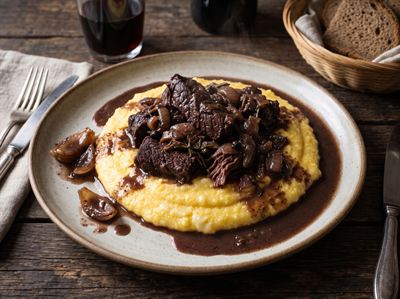
Brasato al Barolo
Beef braised in Barolo wine
Piedmont's great braise: a piece of beef marinated for 12 hours in a bottle of Barolo, then simmered slowly in it, in the Cuneo style.
- Course
- SecondiMain Courses
- Serves
- 6
- Hands-on
- 1 h 13 min
- Cooking
- 2 h 15 min
- Plan
- 2 days
In breve
In short
Also called brasô, brasato di bue al Barolo and beef braised in Barolo.
- Gluten-free
- A single piece of beef, such as cappello del prete from the shoulder, marinated for 12 hours in a whole bottle of Barolo with vegetables, herbs and spices.
- Browned in butter and oil to a crust, then simmered, covered, in its own heated marinade for at least 2 hours, until tender.
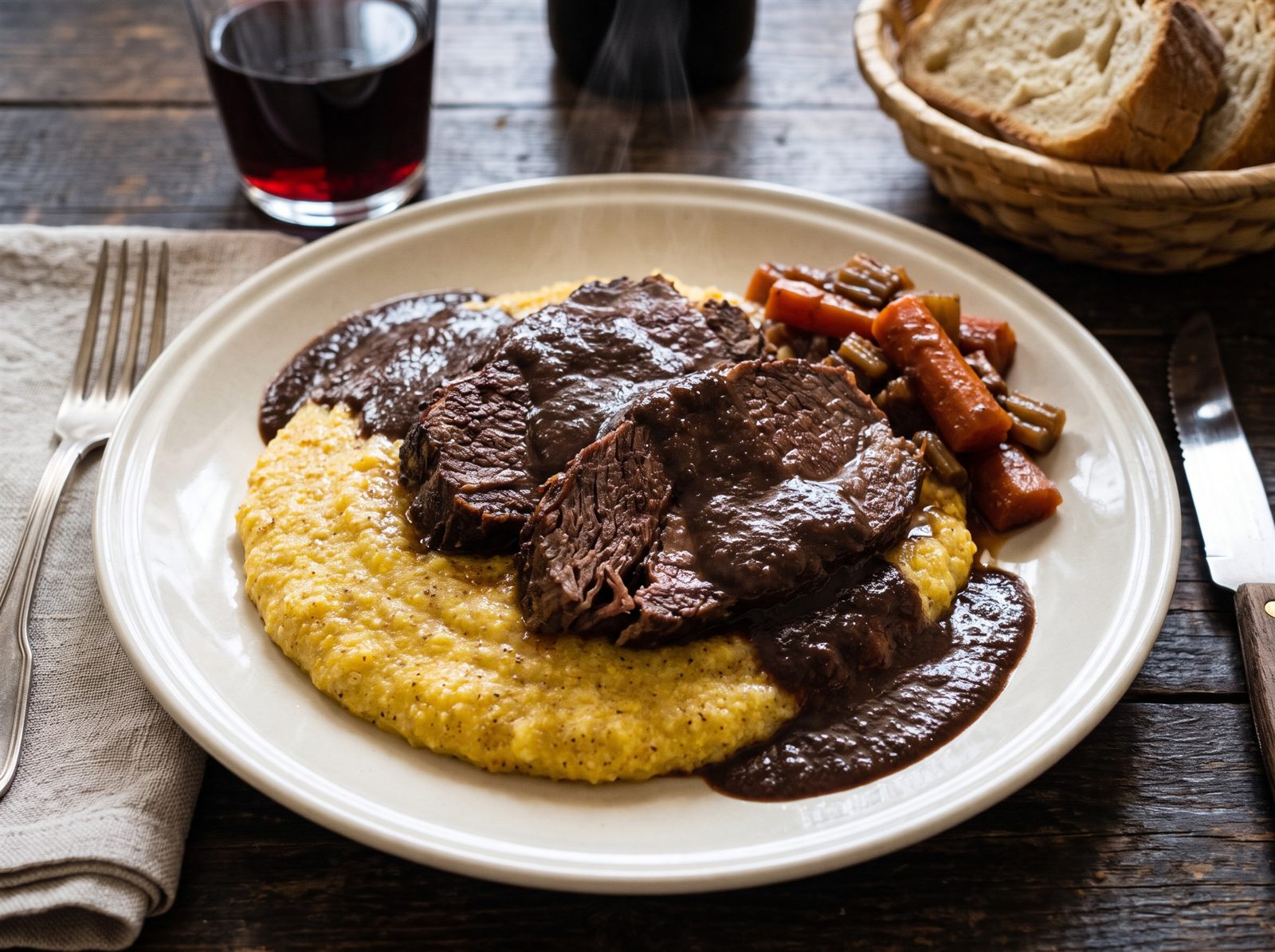
- The sauce is the marinade itself: the vegetables blended into the wine and reduced until thick, poured over the sliced meat.
- Made with Barolo, the Nebbiolo wine of the Langhe: by tradition it is not replaced with a cheaper wine.
La provenienza
Where this recipe comes from
Brasato, brasô in Piedmontese, is meat cooked slowly in a covered pot with little liquid. The word comes from brace, embers: the pot once sat on them in the hearth, with more heaped on its lid. The wine that suits it best is Barolo, the red made only from Nebbiolo grapes in eleven communes of the Langhe, a few kilometres south of Alba. Barolo took shape in the mid-nineteenth century, thanks to Cavour and to Giulia Colbert Falletti, the last Marchioness of Barolo, and earned the saying ‘the king of wines, the wine of kings’. Brasato al Barolo is a dish for the cold months, and one of the best-loved second courses of a Piedmontese Christmas.
There is no official recipe. We compared eleven sources and publish the most widely recognised version. They agree on what makes the dish: a single piece of meat and a bottle of Barolo, with carrot, celery, onion, garlic, herbs and spices, browned and then cooked long and slowly in a covered pot, and served sliced under its sauce. Ours marinates the meat for twelve hours, simmers it for at least two hours in the hot marinade and blends the vegetables into the wine for the sauce. Some recipes call for ox; we use beef, as most do, and we marinate it in the fridge rather than in a cool place, which is safer. The recipe in Nonna Genia, Luciano De Giacomi and Beppe Lodi's book of Langa cooking, skips the marinade and browns the meat with its aromatics before the wine goes in: it is among the variants.
- Provenance
- A regional tradition documented in cookbooks and local practice, with no single official text.
- Defined by
- Piedmontese tradition
- Reference
- Compared across 11 sources, listed below; this page publishes the most widely recognised version.
- Sources
- Accademia Italiana della Cucina: brasato di bue al Barolo all'uso di Cuneo, from its recipe collection (Italian)
- La Cucina Italiana: brasato al Barolo (Italian)
- La Cucina Italiana: brasato, everything to know from the cut to the aromas, by Cristina Gambarini (Italian)
- Langhe.net: brasato al Barolo, Nonna Genia's recipe from Alba (Italian)
- Giallo Zafferano: brasato al Barolo (Italian)
- Dissapore: brasato al Barolo (Italian)
- Il Cucchiaio d'Argento: brasato al Barolo (Italian)
- Consorzio di tutela Barolo Barbaresco Alba Langhe e Dogliani: Barolo DOCG (Italian)
- Italia.it, Italy's tourism portal (Ministry of Tourism and ENIT): the Piedmontese Christmas menu (Italian)
- Treccani, Vocabolario: brasato (Italian)
- University of Modena and Reggio Emilia, Lexi-Term glossary: beef clod (cappello del prete)
Ingredienti
Ingredients
For the marinade
For the braise
Equipment
- Deep bowl of glass, ceramic or stainless steel, just large enough for the meat, and cling film
- A small square of muslin and kitchen string
- Sieve and a second bowl
- Kitchen paper
- Heavy casserole with a lid, about 24 cm across
- Small saucepan, for heating the wine
- Carving fork and a sharp carving knife
- Immersion blender, or a food mill
- Ladle, wooden spoon and aluminium foil
Preparazione
Method
Start the day before: about 20 minutes to set the meat in its marinade, then 12 hours in the fridge. On the day, allow 3¾–5¼ hours: half an hour for the meat to lose its chill, about 45 minutes to dry it, brown it and cook the vegetables with it, 2–3½ hours of simmering, and half an hour for the sauce while the meat rests.
- 1 h 13 minhands-on
- 2 h 15 mincooking
- 2 daysfrom start to table
The day before: the marinade
-
Hands-on 3 min
Pat the beef dry with kitchen paper, taking off any blood, and put it in a deep bowl just large enough to hold it.
Tip A snug bowl lets one bottle of wine cover more of the meat.
-
Hands-on 10 min
Peel the carrots and the onion, trim the celery, and cut them all into cubes of about 2 cm. Peel the garlic and leave it whole. Put them in the bowl around the meat.
-
Hands-on 5 min
Tie the cloves, the cinnamon and the peppercorns in the square of muslin. Tie the rosemary and the bay leaves together with string. Add both to the bowl.
Tip They come out before the sauce is blended: tied up, they are easy to find.
-
Rest 12 h
Pour the whole bottle of Barolo over the meat, cover the bowl with cling film and leave it in the fridge, at about 4 °C, for 12 hours.
Tip If the wine does not cover the meat, turn the meat once or twice while it marinates.
Tip Some recipes marinate it in a cool place; the fridge is safer. Do not go beyond 24 hours: after that, the marinade is best thrown away.
On the day: browning
-
Rest 30 min
Take the bowl out of the fridge half an hour before you start cooking, so the meat loses its chill.
-
Hands-on 5 min
Lift the meat onto a board and dry it gently but thoroughly with kitchen paper. Tip the rest of the marinade into a sieve set over a bowl: keep the wine, and keep the vegetables, the spice bag and the herbs aside.
Check The surface of the meat is dry to the touch.
-
Hands-on 20 minHeat medium-high
In the casserole, melt the butter with the oil. When the butter foams, put in the meat and leave it, without moving it, for about 5 minutes, until the underside has a brown crust. Turn it and brown every side the same way.
Check A deep brown crust on every side, like a roast.
Tip If the butter starts to blacken, lower the heat a little.
-
Cooking 5 minHeat medium
While the meat browns, bring the strained wine to a simmer in the saucepan and skim off the grey foam that rises.
-
Hands-on 15 minHeat medium
Add the drained vegetables, the spice bag and the herbs around the meat and cook them together for about 15 minutes, stirring the vegetables now and then. Season with a level teaspoon of fine salt.
Check The vegetables have softened.
-
Hands-on 5 min
Pour the hot wine over the meat and vegetables, bring it back to a simmer and cover the pot with its lid.
The braise
-
Cooking 2 h to 3 h 30 minHeat low
Turn the heat down until the liquid barely simmers, with a few small bubbles breaking the surface, and cook covered for at least 2 hours. Turn the meat every 30 minutes or so. If the liquid drops below about 2 cm, add a ladle of hot water.
Check A carving fork slides into the thickest part and out again without resistance. If it does not, cover again and test every 20 minutes.
Tip Keep it at a bare simmer: a hard boil tightens the meat.
Tip A piece of cappello del prete can take about 3½ hours; some cooks give theirs about 4 hours over the lowest heat.
The sauce and the table
-
Rest 10 min
Lift the meat onto a warm plate, cover it loosely with foil and let it rest while you make the sauce.
-
Hands-on 5 min
Take the spice bag and the herbs out of the pot. Off the heat, blend the vegetables into the wine with the immersion blender.
Check Smooth, with no pieces of vegetable left.
-
Cooking 10–15 minHeat medium-high
Put the pot back on the heat, uncovered, and boil the sauce until it has reduced by about half and thickened. Taste it and adjust the salt, then let it boil for another minute or two.
Check It coats the back of a spoon, and a line drawn through it with a finger stays clear.
-
Hands-on 5 min
Slice the meat across the grain with a sharp knife, about 1 cm thick, and lay the slices on a warm platter. Pour the hot sauce over them and serve at once.
Tip Polenta or mashed potatoes are the usual companions.
Tip Some cooks slice the meat cold and heat the slices in the reduced sauce for 10 minutes over a brisk flame.
The essentials, for cooks who know the dish. Switch to Detailed for quantities, temperatures, times and checks at every step.
Press “I’m here” on the step you are on, and again when it is done.Tap the pin on the step you are on, and the tick when it is done. Timers keep running while you scroll.
Da sapere
Good to know
- WhenQuando
- One of the best-loved second courses of a Piedmontese Christmas. Source
- KeepingConservazione
- Keeps for 2 days in the fridge in an airtight container, best covered with its sauce. Freezing it is not recommended. Source
- VariantsVarianti
- Without a marinade, from Alba: The recipe in Nonna Genia, a book of Langa cooking, has no marinade, though some cooks marinate the meat overnight all the same. A 1 kg piece of veal sottopaletto goes into a copper pan with 25 g each of butter and lardo (cured pork back fat), pounded on the board, onion, garlic, carrot, celery, rosemary, a bay leaf, ten cloves and a little cinnamon, and colours over a fierce heat until dark brown. Three-quarters of a litre of Barolo goes in and cooks almost away, then a ladle of cold water, three times over as each one dries; then hot broth to cover, and at least an hour, covered, over moderate heat. The aromatics are passed through a sieve and the sauce is reduced with the meat back in it; a small glass of rum goes in a quarter of an hour before serving. Source
- Flamed with brandy: The browned meat is flamed with a small glass of brandy before the vegetables and the wine go in, then braised for about 4 hours over a very low heat. The bunch of herbs adds parsley and sage, and the spices a grating of nutmeg. Source
- With new potatoes: The marinade is optional. The meat, tied like a roast, is browned in butter, the vegetables are softened in the same butter, and the Barolo goes in with bay, cloves and juniper berries. It simmers for 3 hours, topped up now and then with vegetable broth, with halved new potatoes added for the last half hour. Source
- With a rustic sauce: Leave the vegetables in pieces instead of blending them. Source
Errori comuni
Common mistakes
- Browning the meat wet from the marinade: it steams and will not colour. Dry it well first.
- Letting it boil. Keep the braise at a bare simmer, or the meat tightens and dries.
- Blending the sauce with the spices still in it: lift out the spice bag and the herbs first.
- Cutting along the grain: the slices come out stringy. Cut across it.
- Marinating it out of the fridge, or for more than a day.
Fuori dall'Italia
Cooking it outside Italy
- Cappello del prete is the shoulder clod, a cut from the shoulder with a slight vein of connective tissue (macreuse in France). Ask for a single piece of about 1 kg.
- Failing that, choose an inexpensive cut of beef with some fat and connective tissue: the long cooking makes it tender.
- Look for Barolo DOCG on the label. Another red will do for a brasato, as long as it is mature and full-bodied, not young; the dish is then no longer brasato al Barolo.
- Muslin is sold as cheesecloth in the US.
- No immersion blender? Pass the vegetables and wine through a food mill.