Aosta, Valle d'Aosta
Carbonade valdostana
Aosta Valley beef stewed in red wine
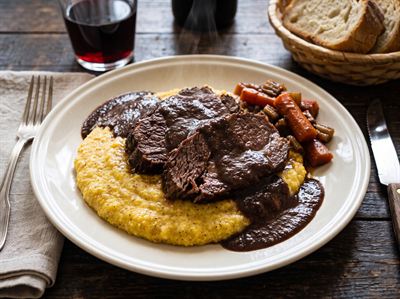
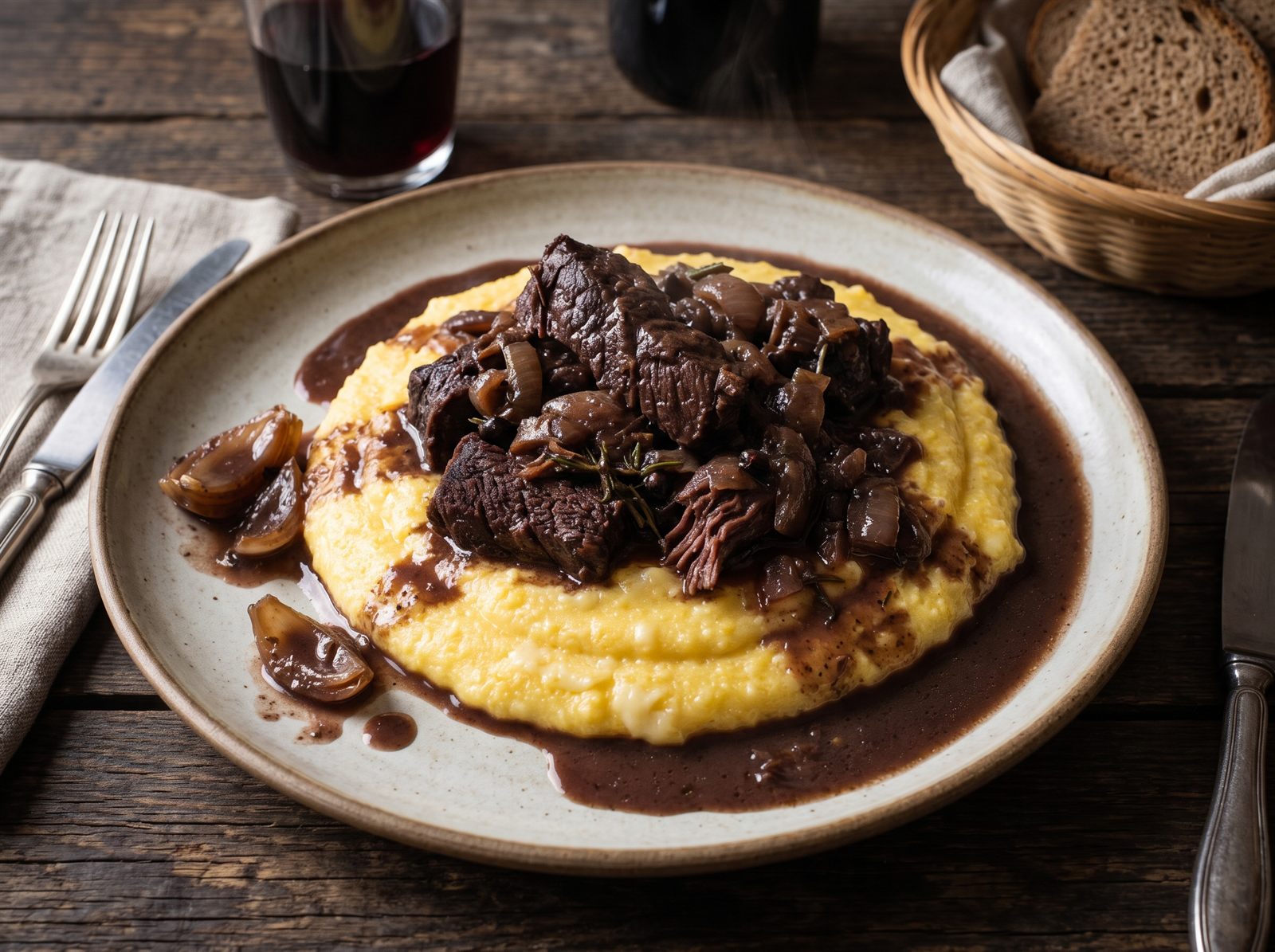
The Aosta Valley's most celebrated dish, once made with salted beef: thin sticks of beef marinated in full-bodied red wine with juniper, cloves and cinnamon, then floured, browned in butter and simmered in their own wine.
- Course
- SecondiMain Courses
- Serves
- 4
- Hands-on
- 45 min
- Cooking
- 40 min
- Resting
- 8 h+
In breve
In short
Also called carbonada, carbonade and carbonade valdôtaine.
- Beef in thin sticks, marinated for hours in a full-bodied red wine with juniper, cloves, peppercorns and a cinnamon stick.
- Floured and browned in butter or smoked lardo, after the onion, garlic and herbs; Aosta Valley cooking uses butter and lard, not oil.
- Cooked in its own marinade with half a glass of vinegar and a little meat broth, at a gentle simmer, until tender.
- Served hot with polenta or boiled potatoes.
La provenienza
Where this recipe comes from
Carbonade, or carbonada, is the most celebrated dish of the Aosta Valley, a beef stew in red wine served in every mountain hut in the region. Its first meat was carne salada. Cattle were kept for work and killed only when they were past it, and the meat had to last: it was salted down in barrels with garlic, sage and rosemary and eaten through the winter. Today the beef is fresh, and marinated instead. The name may come from the sauce, which turns as dark as coal (carbone). Some trace the dish to the Flemish carbonnade, beef cooked in dark beer; in the Aosta Valley the beer became red wine.
There is no official recipe, and the valley knows many: recipes collected across it marinate the meat from a few hours to twelve days and cook it from about 20 minutes to about seven hours, and some skip the marinade or use dry white wine. We compared seven sources and publish the most widely recognised version. Most cook the beef in red wine with butter and onion and serve it with polenta. Some marinate it first in a full-bodied red with spices, as this version does, while others put it straight in the pan; many cut it small, and here it is cut in thin sticks, which cook in about 40 minutes. The town of La Salle has registered its own white-wine version, the Carbon-oda, as a municipal De.C.O. The broth is our meat broth.
- Provenance
- A regional tradition documented in cookbooks and local practice, with no single official text.
- Defined by
- Aosta Valley tradition
- Reference
- Compared across 7 sources, listed below; this page publishes the most widely recognised version.
- Sources
- Chambre valdôtaine (Aosta Valley Chamber of Commerce): ‘Ricette di tradizione della Valle d'Aosta’, recipe 15, carbonada (Italian)
- Regione Autonoma Valle d'Aosta, official tourism site: carbonada (Italian)
- Dissapore: carbonada valdostana, the soft, dark stew (Italian)
- Scatti di Gusto: the typical dishes of Aosta Valley cooking (Italian)
- Zanichelli: the Aosta Valley, a regional profile for cookery students (Italian)
- Federparchi, ‘Parchi’ magazine no. 24 (June 1998): Salvatore Marchese, the cooking of the Gran Paradiso (Italian)
- Wikipedia: Carbonada (Italian)
Ingredienti
Ingredients
For the marinade
To cook it
Equipment
- Sharp knife and a chopping board
- Large glass or ceramic bowl, with a lid or cling film
- Colander set over a bowl, a fine sieve and a jug, and kitchen paper
- Kitchen string, for the herbs
- Wide, heavy casserole or deep sauté pan, about 28 cm across
- Wooden spoon and a slotted spoon
Preparazione
Method
Start at least 8 hours ahead, the evening before or in the morning for dinner: about 20 minutes to cut the meat and set it to marinate in the fridge. Then at least 1 hour 15 minutes: half an hour to drain the meat, soften the onion and brown the meat, then at least 40 minutes of gentle simmering, usually 40–60, longer if the meat is still firm. Make the polenta, or boil the potatoes, while it simmers. Have the meat broth ready.
- 45 minhands-on
- 40 mincooking
- 8 hresting, at least
Beforehand: the marinade
-
Hands-on 10–15 min
Trim off any thick fat and sinew. Slice the beef about 1 cm thick, then cut the slices into sticks about 1 cm wide and 4 cm–5 cm long, or into 1 cm dice.
Check The pieces are all about the same size, so they cook in the same time.
Tip Thin pieces are what let it cook in about 40 minutes; in large chunks the meat needs hours.
-
Hands-on 5 min
Put the meat in the bowl with the juniper berries, the cloves, the peppercorns and the cinnamon stick. Pour in the wine, stir, and cover the bowl.
Check The wine covers the meat. If a few sticks poke out, press them down.
-
Rest 8 h
Leave the bowl in the fridge for at least 8 hours, or overnight. Stir once if you can.
Check The outside of the meat is stained a deep wine red.
Browning
-
Hands-on 5 min
Tip the meat into the colander set over a bowl, then pour the wine through a fine sieve into a jug and keep it for later. Spread the meat on kitchen paper, pick out the juniper berries, cloves, peppercorns and cinnamon stick and throw them away, and pat the meat dry.
Check The meat feels dry to the touch, with no wine running off it, and no whole spices are left among it or in the wine.
Tip Wet meat stews instead of browning, and the flour turns to paste.
Tip The spices have done their work in the marinade: taken out now, nobody bites on a clove or a peppercorn at the table.
-
Hands-on 8–10 minHeat medium-low
Melt the butter in the casserole. Add the sliced onion, the garlic and the bunch of herbs and cook gently, stirring now and then, without letting them brown.
Check The onion is soft and translucent and smells sweet.
-
Hands-on 8–10 minHeat medium-high
Lift the onion, garlic and herbs onto a plate with the slotted spoon, leaving the butter in the pan, and raise the heat. Season half the meat with salt and pepper, dust it with flour, shake off the excess and put it straight in the pan. Brown it for about 4–5 minutes, turning the pieces, and lift it onto the plate. Season, flour and brown the second half the same way, only when the pan is free. Put the first batch, the onion, garlic and herbs back in the pan.
Check The pieces are browned on all sides and the flour coating is golden, not white.
Tip Two batches, not one: a crowded pan steams the meat instead of colouring it.
Tip Taking the onion out while the meat browns keeps it from burning over the higher heat.
Cooking
-
Hands-on 3–5 minHeat high
Pour 3 tablespoons of the marinade wine into a cup and keep it aside. Pour the rest of the wine and the vinegar into the pan. Scrape the bottom with the wooden spoon to lift what has stuck, and bring it to the boil.
Check The liquid is boiling all over.
-
Hands-on 3 min
Whisk the tablespoon of flour into the wine in the cup until smooth, then stir it into the pan. Add the bay leaves, then pour in hot broth only until the meat is just covered.
Check The meat is just under the liquid and there are no lumps of flour.
Tip Flour sprinkled straight into boiling liquid forms lumps: mixed first with a little cold wine, it blends in smoothly.
-
Cooking 40 min to 1 hHeat low, a gentle simmer
Lower the heat and cook, uncovered, at a gentle simmer for about 40 minutes, stirring now and then. Then test a piece. If it is still firm, carry on and test again every 10 minutes, adding a splash of broth if the sauce thickens too much before the meat is ready.
Check A piece gives way easily when pressed against the side of the pan with the wooden spoon, and the sauce is dark and coats the back of the spoon.
Tip If the meat is tender but the sauce is still thin, lift the meat out with the slotted spoon, boil the sauce hard for a few minutes until it coats the spoon, and put the meat back.
Tip A slower version uses 3 cm chunks of a cut that is not too lean, such as shoulder or beef for boiling, cooked for at least three hours, for a darker, softer stew.
-
Hands-on 3 min
Take out the herb bunch and the bay leaves. Taste the sauce and add salt if it needs it. Serve hot with polenta or boiled potatoes.
Tip Slices of hot polenta with stewed onion alongside are another way to serve it.
The essentials, for cooks who know the dish. Switch to Detailed for quantities, temperatures, times and checks at every step.
Press “I’m here” on the step you are on, and again when it is done.Tap the pin on the step you are on, and the tick when it is done. Timers keep running while you scroll.
Da sapere
Good to know
- KeepingConservazione
- It is better made the day before. Cool it and put it in the fridge within 2 hours, in a shallow covered container, and eat it within 3 days of cooking, the day ahead included; bring it back to the boil (75 °C) before serving. Frozen, it keeps up to three months. Source
- VariantsVarianti
- Quick, without a marinade: A quick version, for four: 500 g of beef topside in thin slices or very small pieces, 300 g of onion, 200 g of butter, 100 g of pancetta, 50 g of flour and 500 ml of dry white wine (some prefer red), with nutmeg, cinnamon, salt and pepper. The meat is only turned white over high heat in the butter with the pancetta and onion, and seasoned with the spices and flour; the wine goes in and the dish is served as soon as it boils. Source
- Carbon-oda of La Salle: Registered by the town of La Salle as a De.C.O. and recorded there since the late 19th century, it is made with the local white wine, Blanc de Morgex et de La Salle DOC. Source
- Slow-cooked, in large pieces: A slow version, for four: 1 kg of beef in 3 cm chunks, from a cut that is not too lean (shoulder, beef for boiling or biancostato), marinated in the fridge for at least 8 hours in a bottle of red wine with cloves, juniper, cinnamon and bay, then browned in 40 g of butter with onion and carrots and cooked on the lowest heat in the marinade, a couple of ladles at a time, for at least three hours, until dark and very tender. Source
- With white wine, or both: Some versions use dry white wine instead of red, or the two in equal parts, or red wine with meat broth and a pinch of sugar. Source
Errori comuni
Common mistakes
- Browning wet meat: it stews and the flour turns to paste. Dry it well after the marinade.
- Crowding the pan: brown the meat in two batches so it colours rather than boils.
- A thin, light wine: it should be a fairly full-bodied red.
- Too much broth: add only enough to just cover the meat, or the sauce stays thin.
- A rolling boil: keep it to a gentle simmer, or the thin sticks toughen.
Fuori dall'Italia
Cooking it outside Italy
- Topside is called top round in the US; another lean piece of the round will also do.
- Use a young, fairly full-bodied dry red. Petit Rouge, the valley's best-known red, suits it, as do Barolo or Teroldego.
- Smoked lardo, cured pork back fat, can replace the butter.