Aosta, Valle d'Aosta
Tegole valdostane
Hazelnut and almond tile wafers
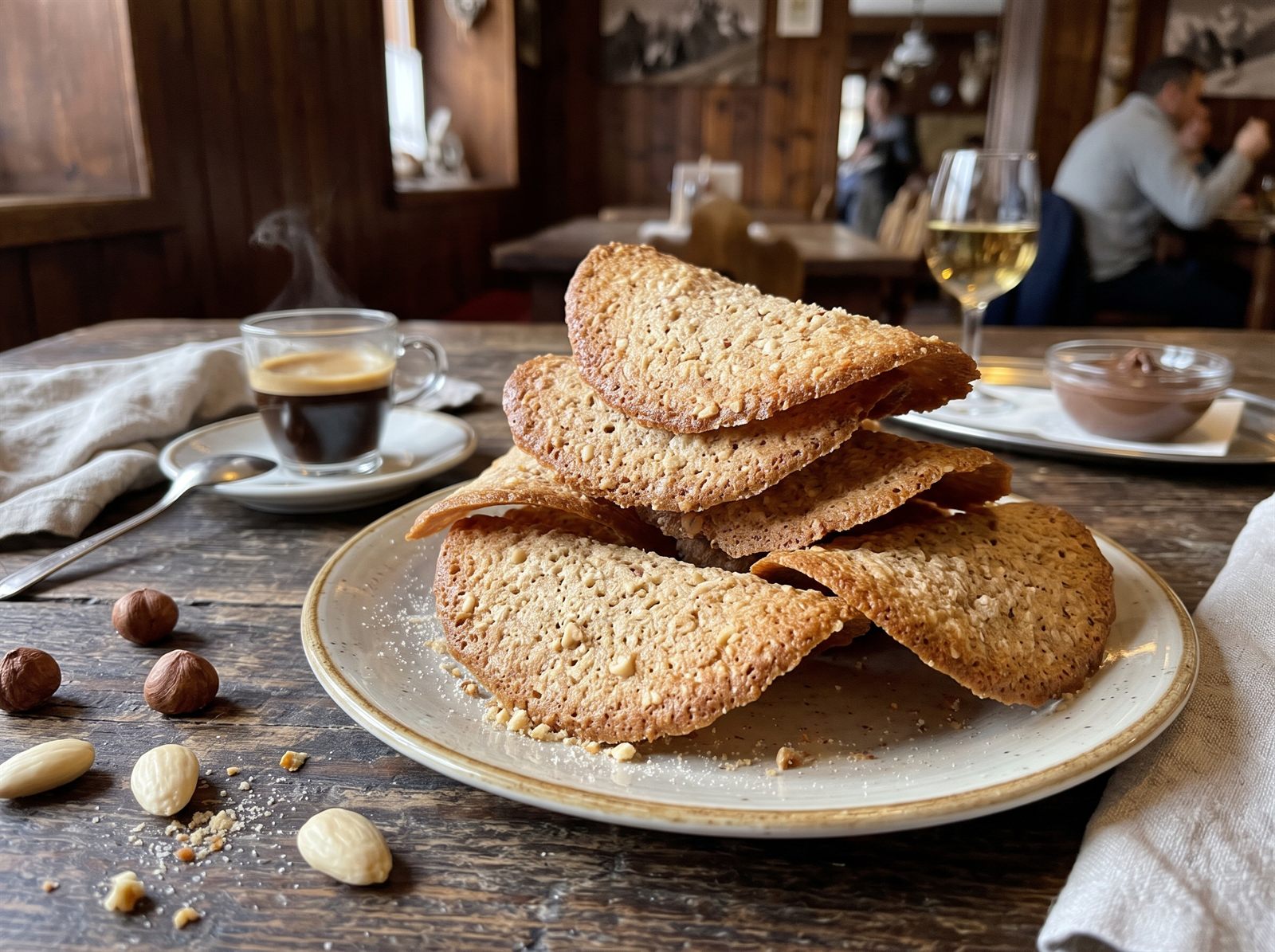
Aosta's thin, crisp wafers of hazelnuts, almonds, sugar, butter and egg white, curved over a rolling pin as they cool.
- Course
- DolciDesserts
- Serves
- 40
- Hands-on
- 1 h 15 min
- Cooking
- 1 h 33 min
- Resting
- 20 min+
In breve
In short
Also called tegole, tegole di Aosta, tegole dolci, tegole della Valle d'Aosta, tegole della Val d'Aosta and tuiles valdôtaines.
- Vegetarian
- Hazelnuts and almonds ground fine with sugar, bound with egg whites, butter and a little 00 flour, flavoured with vanilla.
- Spread thin, about 7 cm across, and baked at 180 °C for about 8 minutes, until lightly browned.
- Laid over a rolling pin straight from the oven, so they set with the curve of a roof tile.
- Kept in a tin in a dry place: damp takes away their crunch.
La provenienza
Where this recipe comes from
Tegole, roof tiles, are thin wafers of hazelnuts, almonds, sugar and egg white, named for the curve they take as they cool, like the curved tiles of Aosta's roofs. They are the valley's most widespread sweet speciality. Their origin is told by tradition, not by any document: two pastry cooks of the Boch family are said to have created them in the 1930s, after a journey to Normandy, and 1930 is the year usually given. Another account places the story in the early 1900s, with a family of Aosta pastry cooks, and notes that the biscuit is not native to the valley.
There is no official recipe: the original is said to be a secret, and tegole are not on Italy's list of the Valle d'Aosta's traditional food products. We compared seven sources and publish the most widely recognised version. They agree on the essentials: hazelnuts and almonds ground fine, sugar, egg whites, butter and a little flour, flavoured with vanilla or lemon zest, spread thin and baked at 180 °C until golden; most curve them over a rolling pin while still warm. The quantities here are the most common ones, and the method is that of the one recipe that gives them in full. Its spacing and its thickness cannot both hold at 10 grams a disc, so here the portions go further apart and are spread two to three millimetres thick. Some cooks stir in the whites unwhipped with soft butter; others add lemon zest and more butter and flour.
- Provenance
- A regional tradition documented in cookbooks and local practice, with no single official text.
- Defined by
- Aosta pastry tradition
- Reference
- Compared across 7 sources, listed below; this page publishes the most widely recognised version.
- Sources
- GialloZafferano: tegole dolci (Italian)
- Regione Autonoma Valle d'Aosta, official tourism site: tegole valdostane, the recipe (Italian)
- Regione Autonoma Valle d'Aosta, official tourism site: tegole of the Valle d'Aosta, product sheet (Italian)
- Il Cucchiaio d'Argento: tegole di Aosta (Italian)
- Montagna.tv with Il Cucchiaio d'Argento: five typical products of the Valle d'Aosta (Italian)
- La Stampa: ‘Ad Aosta le tegole croccanti’, by Rocco Moliterni, 2013, archived copy (Italian)
- Ministry of Agriculture (MASAF): national list of traditional food products, 25th revision, 2025 (Italian)
Ingredienti
Ingredients
Equipment
- Kitchen scale
- Two baking trays, and baking paper cut to their size
- Food processor, for the nuts and sugar
- Small pan, to melt the butter
- Large bowl, a flexible spatula and a fine sieve
- Electric whisk and a second, clean bowl for the whites
- Teaspoons, and a cup of water to wet the back of one
- Thin metal spatula, to lift the hot tegole
- Two rolling pins (one takes five or six tegole), or one and a couple of clean bottles laid on their side
Preparazione
Method
About 2 hours 15 minutes to 2 hours 45 minutes. The first 80 minutes or so go on the nuts and the batter: 15 minutes for the oven to heat, 30 to toast the nuts, 15 to cool them, then 20 minutes to skin and grind them and make the batter while the oven heats up again. Then six or seven sheets of 8–10, each taking some 10–12 minutes to spread, bake and shape (spread the next sheet while one bakes). The quantities are given for 40 tegole; at 10 g each they make nearer 55, and each serving here is one tegola.
- 1 h 15 minhands-on
- 1 h 33 mincooking
- 20 minresting, at least
The nuts
-
Cooking 15 minTemp 150 °C
Heat the oven to 150 °C, static (top and bottom heat), or 130 °C with a fan. It takes about 15 minutes: line a tray with baking paper and weigh the ingredients meanwhile.
-
Cooking 30 minTemp 150 °C
Spread the almonds and hazelnuts on the lined tray and toast them in the hot oven for 30 minutes (25 minutes in a fan oven at 130 °C).
Check Cut one in half: it is lightly golden right through, and the hazelnut skins are dry and cracked.
-
Rest 15 min
Take the tray out and turn the oven up to 180 °C, static, with a shelf in the middle, ready for the tegole. Leave the nuts on the tray until just warm.
Check You can hold a handful comfortably.
-
Hands-on 5 min
Rub the hazelnuts between your hands, a few at a time, so the skins fall away. The blanched almonds need nothing.
Check Most of the skin is gone; a few flecks do no harm.
The batter
-
Hands-on 3 min
Melt the butter in the small pan over low heat, then take it off the heat while you grind the nuts.
Check Fully melted, with no solid pieces left.
-
Hands-on 2 min
Put the skinned hazelnuts and the almonds in the food processor with half the sugar, 100 g, and pulse for a few seconds until they are reduced to crumbs.
Check Fine crumbs with no whole pieces left. Stop before it starts to clump.
Tip Grinding them with sugar keeps the nuts dry; ground alone, or for too long, they soon turn into an oily paste.
-
Hands-on 2 min
Tip the crumbs into the large bowl, pour in the melted butter and mix with the spatula until the mixture comes together.
Check It holds together in a compact mass when pressed.
-
Hands-on 2 min
Split the vanilla pod lengthways, scrape out the seeds with the tip of a knife and add them. Sift the flour straight into the bowl and mix well. Set the bowl aside.
Check No dry flour left.
-
Hands-on 3–4 min
Put the egg whites in the clean bowl and whisk them with the electric whisk. As soon as they start to foam, add the other 100 g of sugar and keep whisking until swollen and frothy.
Check A swollen, white, frothy foam. It need not hold stiff peaks.
-
Hands-on 2 min
Add the whipped whites to the nut mixture and mix them in with the spatula until the batter is even.
Check Smooth and even, with no streaks of white, and fairly soft: soft enough to spread thin with the back of a spoon.
Baking, a sheet at a time
-
Hands-on 3 min
Lay a sheet of baking paper, cut to the size of the tray, on the worktop. Drop portions of about 10 g on it, 10 cm–11 cm apart from centre to centre, so that once spread to 7 cm the discs have a gap of 3 cm–4 cm between them: they spread further in the oven. Weigh the first few to learn the size. Put no more than 8–10 on a sheet, as many as you can shape before they set.
Tip A piping bag with a plain nozzle also works.
-
Hands-on 4 min
Dip the back of a teaspoon in water and spread each portion into an even disc about 7 cm across. Wet the spoon again whenever the batter starts to stick.
Check Thin and even, about 2 mm–3 mm thick, with the edges no thicker than the middle: a thick disc stays soft in the centre.
-
Cooking 8 minTemp 180 °C
Slide the paper onto a tray and bake at once, in the middle of the oven at 180 °C, for about 8 minutes (160 °C for 3–4 minutes in a fan oven). Never spread batter directly on a hot tray: it melts and spreads unevenly.
Check Lightly crisp and browned, darker at the edges. They are still soft enough to bend while hot.
Tip Ovens differ: look from 7 minutes on (from 3 in a fan oven), and go by the colour, not the clock. Pale tegole stay soft; dark ones taste bitter.
-
Hands-on 2 min
As soon as the tray is out, lift each tegola with the thin spatula and lay it over a rolling pin, five or six to a pin, so it dries and cools with the curve of a roof tile. Work quickly: they set within a minute or so.
Check Each one lies snugly over the pin and holds the curve.
Tip If the last ones harden on the tray before you reach them, put the tray back in the oven for about a minute to soften them.
-
Rest 5 min
Leave them on the rolling pins until cold and crisp, then lift them off onto a plate.
Check They are rigid and snap cleanly.
-
Hands-on 45–55 min
Repeat with the rest of the batter, five or six more sheets: spoon and spread the next sheet on the worktop while a tray bakes, slide it onto a tray and straight into the oven as soon as the oven is free, and curve each batch over the pins as it comes out. The baking paper can be used again.
Check All the batter is used and every tegola has cooled on a pin.
-
Cooking 40–50 minTemp 180 °C
Each of those sheets bakes as the first did, at 180 °C for about 8 minutes, until lightly browned: 40–50 minutes of oven time in all, running alongside the spreading and shaping.
Check Every batch is lightly browned before it comes out.
Serving and keeping
-
Hands-on 2 min
Serve them with coffee at breakfast, with tea in the afternoon, or at the end of a meal with a dry white wine, or with the valley's Nus Malvoisie flétri, made from dried grapes and scented of dried fruit and jam, served at 14 °C. They also go with pastry cream, ice cream, hot chocolate, crema di Cogne, or fiocca, whipped cream with sugar and a few drops of grappa. Keep the rest in a tin, in a dry place.
The essentials, for cooks who know the dish. Switch to Detailed for quantities, temperatures, times and checks at every step.
Press “I’m here” on the step you are on, and again when it is done.Tap the pin on the step you are on, and the tick when it is done. Timers keep running while you scroll.
Da sapere
Good to know
- KeepingConservazione
- In a tin for up to a week. Freezing is not recommended. Source
- VariantsVarianti
- All in one bowl: The same quantities, with the egg whites unwhipped: the nuts ground with all the sugar, then the whites, soft butter at room temperature, the flour and a sachet of vanillin stirred in, and the discs baked at 180 °C for 7–10 minutes. Source
- With lemon and creamed butter: For four: 125 g each of flour, sugar and butter, 65 g of hazelnuts, 60 g of almonds, 2 egg whites and the grated zest of half a lemon. The soft butter is creamed with the zest, the lightly beaten whites worked in a little at a time, then the sifted flour, sugar and finely chopped nuts. Discs 5 cm–7 cm across, about 5 cm apart, bake at 180 °C for about 15 minutes, until the edges are lightly golden. Source
- Sweeter, with honey: A little honey in the batter, for sweeter tegole. Source
- Flat: Tegole can also be left flat instead of curved. Source
Errori comuni
Common mistakes
- Leaving them to cool on the tray: they set flat and break when bent. Shape them straight from the oven.
- Spreading them thick: they stay soft in the middle instead of crisp.
- Setting them too close together: spread, they need a gap of 3 cm–4 cm, because they spread further as they bake.
- Taking them out pale: they never crisp. Bake until they are lightly browned.
- Grinding the nuts for too long: they turn oily.
- Storing them anywhere damp, or before they are cold: they lose their crunch.
Fuori dall'Italia
Cooking it outside Italy
- Type 00 is a fine soft-wheat flour: plain flour (all-purpose in the US) is the nearest equivalent.
- Instead of the vanilla pod, a sachet of vanillin (usually 0.5 g), the usual Italian baking flavouring, can be used.
- Use blanched almonds, white and without their brown skins: the skins of unblanched almonds cling after toasting.