Aosta, Valle d'Aosta
Polenta concia
Aosta Valley polenta with Fontina and butter
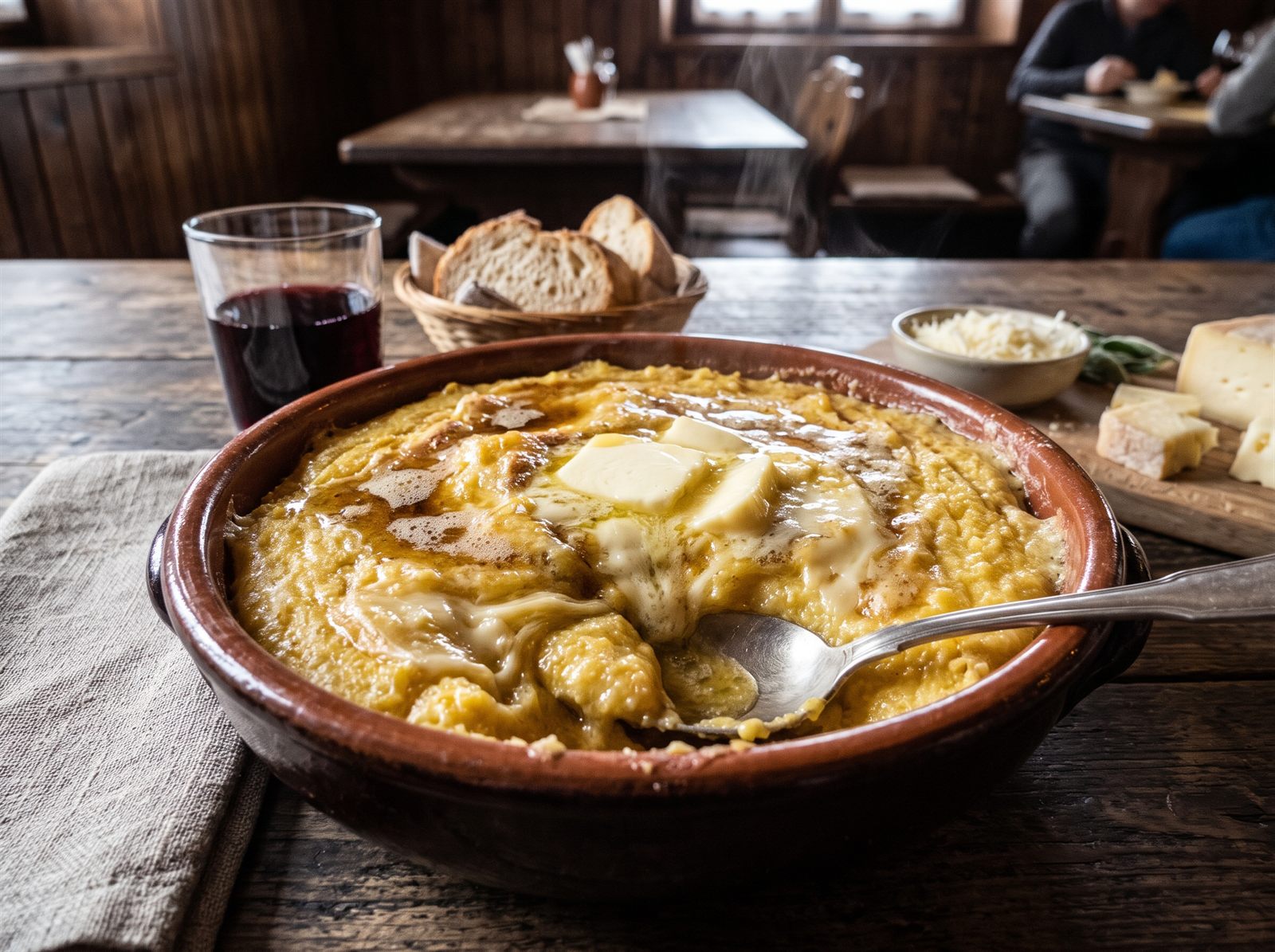
The Aosta Valley's dressed polenta: cornmeal cooked for about 50 minutes, Fontina PDO and butter stirred in off the heat and more butter poured over boiling hot, to the Fontina PDO consortium's recipe.
- Course
- Primi & RisottiPasta & Rice
- Serves
- 4
- Hands-on
- 9 min
- Cooking
- 1 h
In breve
In short
Also called polenta alla valdostana.
- Vegetarian
- Gluten-free
- Only cornmeal, Fontina PDO, butter, coarse salt and pepper.
- 350 g of cornmeal rained into 1.5 l of boiling salted water, then cooked on low heat for about 50 minutes, stirring.
- The Fontina, rind off, diced small or coarsely grated, goes in off the heat with half the butter.
- The rest of the butter is poured over boiling hot, and the polenta is served at once.
La provenienza
Where this recipe comes from
Polenta concia is dressed polenta (conciare means to season or enrich): cornmeal cooked slowly in a pot or a copper paiolo, then made rich with cheese and butter. It comes from the peasant cooking of the mountains, and several Alpine areas have their own version with their local cheeses, from the Biellese and Valtellina to parts of Lombardy. In the Aosta Valley, where polenta rules the table, it is made with Fontina PDO and butter, and the Fontina consortium counts it among the valley's most popular dishes.
This page follows the recipe that the Fontina PDO consortium, the body that protects the cheese, publishes among its traditional Aosta Valley recipes. The consortium protects the cheese rather than the dish, but we found no more authoritative text for the dish itself. Another version, just as well documented in the valley, layers the hot polenta in a dish with more than twice as much sliced Fontina, pours the butter over and bakes it for ten minutes; some cooks add toma and Grana Padano. Both are among the variants. The heat, the times the recipe leaves open and the size of the dice are ours, marked in the method.
- Provenance
- A reference recipe set by a protection consortium or by the town the dish is named after.
- Defined by
- Consorzio Produttori e Tutela della DOP Fontina
- Reference
- ‘Polenta concia con Fontina Dop’, one of the consortium's traditional Aosta Valley recipes (Ricette Tradizionali)
- Sources
- Consorzio Produttori e Tutela della DOP Fontina: ‘Polenta concia con Fontina Dop’, one of its traditional Aosta Valley recipes (Italian)
- Consorzio Produttori e Tutela della DOP Fontina: Fontina in Aosta Valley cooking, from polenta concia to fonduta (Italian)
- Regione Autonoma Valle d'Aosta, tourism department (Lovevda, the official tourism site): polenta concia (Italian)
- Italia.it, the Ministry of Tourism's portal: polenta concia, a Viaggio Italiano video recipe (Italian)
- Gambero Rosso: where to eat polenta in the Aosta Valley (Italian)
- Dissapore: polenta concia, the typical Aosta Valley recipe (Italian)
- Scatti di Gusto: the typical dishes of Aosta Valley cooking (Italian)
Ingredienti
Ingredients
For the polenta
To dress it
Equipment
- Heavy-bottomed pot of about 4 l, or a copper paiolo
- Whisk
- Long-handled wooden spoon
- Knife, or a grater with large holes, for the Fontina
- Small pan, for the butter
- Serving plate or wooden board
Preparazione
Method
About 1 hour 10 minutes, almost all of it the polenta's slow cooking (the consortium allows an hour). Prepare the Fontina while it cooks, and have the plate or board ready: polenta concia is served the moment it is made.
- 9 minhands-on
- 1 hcooking
The polenta
This follows the Fontina consortium's recipe. Steps marked as the official text say only what it says; the times, heat and sizes it does not give are in the step's details and in tips marked ‘Our guide’.
-
Cooking 10 minHeat highOfficial text
Pour 1.5 l of water into a heavy-bottomed pot or a copper paiolo, add a level tablespoon of coarse salt and bring it to the boil.
Check A full, rolling boil.
Tip Our guide: about 10 minutes on high heat.
-
Hands-on 3 minOfficial text
Rain in the cornmeal, stirring with a whisk so that no lumps form.
Check Smooth and thickening evenly, with no lumps.
Tip Our guide: pour it slowly, a little at a time, and keep whisking until it is smooth.
-
Cooking 50 minHeat lowOfficial text
Lower the heat and go on cooking for about 50 minutes, stirring with a wooden spoon.
Check Thick, smooth and glossy; it comes away from the sides of the pot as you stir, and a taste has no raw, gritty bite.
Tip Our guide: low enough that the polenta only bubbles slowly. Stir at least every few minutes, from the sides to the centre and back, scraping the bottom so it does not catch.
Tip Our guide: polenta spits as it bubbles, so use a long-handled spoon and keep your hand clear.
-
Official text
Meanwhile, remove the rind from the Fontina and cut it into small cubes, or grate it on a grater with large holes.
Check No rind left; small, even cubes or coarse shreds.
Tip Our guide: cubes of about 1 cm. Cut 100 g of the butter into pieces and put the other 100 g in the small pan.
The dressing
-
Hands-on 2–3 minOfficial text
When the polenta is cooked, take it off the heat, add the Fontina and half the butter, and stir well until it melts.
Check No cubes of cheese are left: the polenta is smooth and glossy and pulls into strings from the spoon.
-
Hands-on 1 minOfficial text
Turn the polenta out onto a plate or a board.
Check It lies in one soft mound; scrape out what clings to the pot with the spoon.
Tip The consortium's other telling of the recipe allows a baking tray as well.
-
Hands-on 2–3 minHeat mediumOfficial text
Melt the remaining butter and pour it, boiling hot, over the polenta.
Check Melted, foaming and sizzling, still pale gold, when it goes on.
Tip Our guide: melt it over medium heat for 2–3 minutes, take it off the heat as soon as it foams, and pour it at once, before it browns.
-
Hands-on 1 minOfficial text
Dust it with a grinding of pepper and serve straight away.
Tip Our guide: it firms as it cools. Put any left over in a shallow covered container in the fridge within 2 hours of cooking, use it within 3 days, and reheat it until hot all through, at least 75 °C at the centre.
Tip The consortium pairs it with a Torrette, a velvety red.
The essentials, for cooks who know the dish. Switch to Detailed for quantities, temperatures, times and checks at every step.
Press “I’m here” on the step you are on, and again when it is done.Tap the pin on the step you are on, and the tick when it is done. Timers keep running while you scroll.
Da sapere
Good to know
- KeepingConservazione
- A dish for straight away: it sets firm as it stands. Leftovers can be sliced and grilled until browned and hot all through, to serve as a starter or beside a board of cured meats and cheese. Source
- VariantsVarianti
- Baked in layers: For four: 375 g of cornmeal cooked in 1.5 l of salted water for 50 minutes, stirring; layered while hot in a dish with 850 g of thinly sliced Fontina, starting with polenta and ending with cheese; 200 g of butter, melted, poured over, and 10 minutes in the oven at 180 °C. Source
- With brown butter: The butter cooked slowly until golden and nutty, a burro nocciola or beurre noisette, before it goes over the polenta. Source
- With toma and Grana: For four: 250 g of bramata cornmeal in 1 l of water, cooked 45 minutes, with 200 g of Fontina and 100 g of toma stirred in 5 minutes before the end; served in bowls with 100 g of brown butter, 40 g of grated Grana Padano and pepper. Source
Errori comuni
Common mistakes
- Tipping the cornmeal in all at once: it forms lumps. Rain it in, whisking.
- Cutting the cooking short: the polenta needs about 50 minutes on low heat, or it stays raw and gritty.
- Leaving the Fontina in big pieces, or with its rind: dice it small or grate it, so it melts into the polenta off the heat.
- Letting it wait. Polenta concia firms up as it cools; serve it as soon as it is ready.
Fuori dall'Italia
Cooking it outside Italy
- Buy cheese marked Fontina PDO (Fontina DOP on Italian labels): cheeses sold simply as fontina may be imitations.
- For the cornmeal, ask for medium-grind polenta meal (bramata), not instant polenta, which cooks in minutes and would not stand 50 minutes on the heat.