Teglio, Lombardia
Pizzoccheri della Valtellina
Buckwheat pasta from Valtellina with potatoes, savoy cabbage and cheese
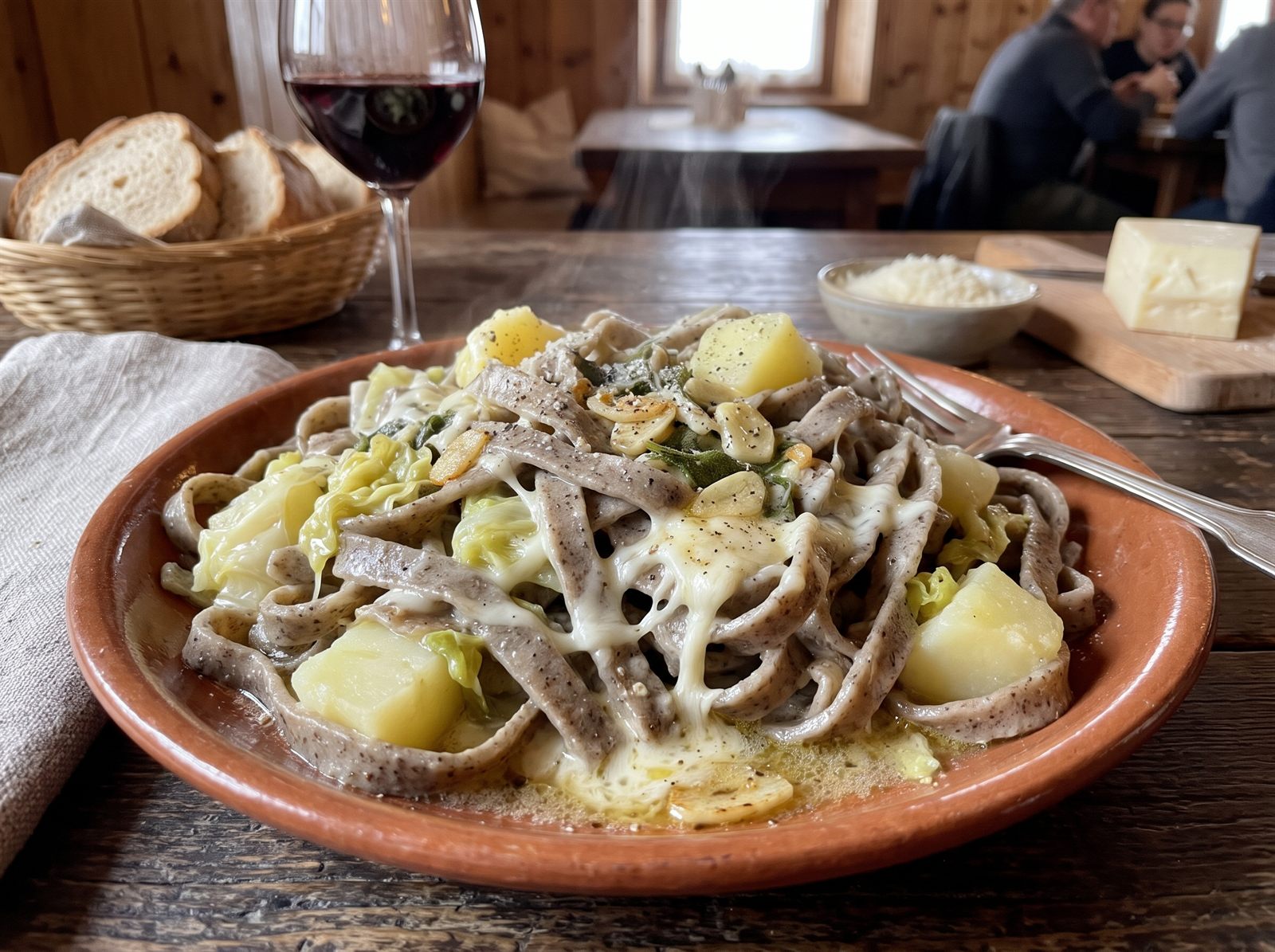
Short buckwheat noodles boiled with potatoes and savoy cabbage, then layered with Valtellina Casera and grana and doused with garlic butter: the dish of Teglio, whose pasta has been an EU PGI since 2016.
- Course
- Primi & RisottiPasta & Rice
- Serves
- 4
- Hands-on
- 1 h 1 min
- Cooking
- 15 min
In breve
In short
Also called pizzoccheri, pizzoccheri valtellinesi, pizzoccheri di Teglio and pizzocchero di Teglio.
- Vegetarian
- A pasta of 400 g of buckwheat flour and 100 g of white flour with water, no eggs, rolled 2 mm–3 mm thick and cut 5 mm wide.
- Short noodles, about 7 cm–8 cm long: not tagliatelle.
- Boiled in one pot with potatoes and savoy cabbage, which go in 5 minutes before the pasta.
- Layered in a hot dish with grated grana and flakes of Valtellina Casera PDO, then doused with butter browned with garlic.
- Lifted out with a skimmer, never drained in a colander, and never stirred once layered: served boiling hot with pepper.
La provenienza
Where this recipe comes from
Pizzoccheri are short, rough noodles of buckwheat, a grain grown on the sunny slopes around Teglio, in the heart of Valtellina, since at least 1616. Wills from 1750 and 1775 already list the tools for making them, and in 1834 a botanist noted that both the gnocchi and the noodles made of buckwheat went by the name. From the early 1800s the better-off farmers ate them much as they are eaten today: boiled with potatoes and cabbage, then layered with cheese. Where the name comes from is uncertain: an old guess links it to the pinzochere, lay sisters, while later studies point to a German word for a flour dumpling.
There is no official recipe for the dish: the EU protection, since 2016, covers only the pasta (dried or fresh, made in the province of Sondrio with at least 20% buckwheat flour). We compared nine sources and publish the most widely recognised version, the recipe kept in Teglio by a local academy founded in 2002 to protect the dish, which three of the other sources reprint. The recipes among them agree on four parts buckwheat flour to one of white flour, mixed with water and no eggs; potatoes and savoy cabbage boiled in the same pot as the pasta; layers of Valtellina Casera and grana; butter browned with garlic poured over; and no stirring. A 2005 bill in the Italian Parliament printed the same recipe with a smaller weight of potatoes. The recipe gives no figures for the water in the dough, the salt or the heat of the dish, so those are our own guide.
- Provenance
- A regional tradition documented in cookbooks and local practice, with no single official text.
- Defined by
- Valtellina tradition
- Reference
- Compared across 9 sources, listed below; this page publishes the most widely recognised version.
- Sources
- Accademia del Pizzocchero di Teglio: the original recipe (Italian)
- Accademia del Pizzocchero di Teglio: the history of the Accademia, founded in 2002 (Italian)
- Accademia del Pizzocchero di Teglio: the history and tradition of pizzoccheri (Italian)
- Camera dei Deputati: bill no. 6221 of 2005 on the pizzoccheri di Teglio, with a recipe for four (Italian)
- Valtellina.it (Provincia di Sondrio tourism service): the pizzoccheri recipe (Italian)
- Official Journal of the EU, C/2024/5271: the PGI Pizzoccheri della Valtellina and its single document (Italian)
- legislation.gov.uk: Commission Implementing Regulation (EU) 2016/1730, registering the PGI
- Scatti di Gusto: the original pizzoccheri, the Accademia di Teglio's recipe (Italian)
- Dissapore: pizzoccheri, five mistakes to avoid (Italian)
Ingredienti
Ingredients
For the pasta
For cooking
To dress
Equipment
- Large wooden board and a rolling pin
- Large sharp knife
- Large pot holding at least 8 l, for four servings
- A skimmer (a large slotted spoon)
- Deep ovenproof serving dish or tureen
- Small frying pan, for the butter
- Cheese grater and a pepper mill
- A clean cloth and oven gloves
Preparazione
Method
Allow about 1 hour 30 minutes. The pasta takes about 35 minutes to mix, roll and cut; put the water on and the dish in the oven as you finish cutting, prepare the vegetables and the cheeses while the water comes to the boil, then cook for about 20 minutes, counting the time the water takes to come back to the boil, layer, and brown the butter at the last moment.
- 1 h 1 minhands-on
- 15 mincooking
The pasta
-
Hands-on 10 min
Sift the buckwheat flour and the white flour together and mix them well. Work in 250 ml of lukewarm water a little at a time, then add more by the spoonful only if the dough stays crumbly. Knead for about 5 minutes.
Check A firm, even, greyish-brown dough that holds together and does not stick to your hands. It will never be as elastic as an egg pasta dough.
Tip Keep the dough covered with an upturned bowl or a cloth whenever you are not working it: with so little wheat flour it dries and cracks quickly.
-
Hands-on 10–15 min
Dust the board lightly with white flour. Roll the dough with the rolling pin, half at a time if your board is small, into a sheet 2 mm–3 mm thick.
Check An even thickness all over: thicker than a sheet for tagliatelle, so it feels sturdy when you lift an edge.
-
Hands-on 10 min
Cut the sheet into bands 7 cm–8 cm wide. Dust them lightly with flour, stack them, and cut across the stack into noodles about 5 mm wide. Spread them out on a lightly floured cloth so they do not stick together.
Check Short, flat noodles about 7 cm–8 cm long, 5 mm wide and 2 mm–3 mm thick.
Getting ready to cook
-
Hands-on 5 minHeat high
Bring 6 l of water to the boil in the large pot, covered, and add 60 g of coarse salt; it takes about 20–30 minutes. Heat the oven to 100 °C and put the serving dish in it, so it is hot when you need it.
Check The water is at a full rolling boil before the vegetables go in.
-
Hands-on 15 min
While the water heats, peel the potatoes and cut them into chunks of about 2 cm. Cut away the tough central ribs of the cabbage and cut the leaves into pieces of about 2 cm. Grate the grana, cut the Casera into thin flakes about 2 mm thick, and peel the garlic clove and crush it lightly, keeping it whole.
Check Potato chunks all about the same size, so they cook evenly in the time the pasta takes.
Cooking
-
Cooking 5 minHeat high
Put the potatoes and the cabbage into the boiling salted water. Cover until the water is back at a full boil, then uncover and cook for 5 minutes, counted from that moment.
Check The water is back at a full boil and the cabbage has wilted; the potatoes are still firm.
-
Cooking 10 minHeat high
Add the pizzoccheri to the vegetables in the same pot and stir once gently so the pieces separate. When the water is back at a steady boil, cook for about 10 minutes, counted from that moment.
Check Taste a piece: the pasta is tender but holds its shape, and a potato chunk is soft when pierced with a knife.
Tip Pasta and vegetables cook together on purpose: the pasta takes up the flavour the vegetables give to the water.
Layering and serving
-
Hands-on 5 min
Take the hot dish from the oven with gloves. With the skimmer, lift out about a third of the pizzoccheri with their vegetables, let the water drip off for a moment, and spread them in the dish. Scatter over a third of the grated grana and a third of the Casera flakes. Repeat twice more, ending with cheese.
Check Three layers, each covered with both cheeses, and the Casera starting to melt in the heat of the pasta.
Tip Never tip the pot into a colander: the pasta and vegetables turn into a soft, shapeless mass.
-
Hands-on 4–6 minHeat medium
Turn off the heat under the pot. Set the dish on the pot of hot cooking water and cover it with a clean cloth to keep it hot, keeping the edges of the cloth clear of the burners. In the small pan, melt the 200 g of butter with the garlic over medium heat and let it foam and colour well.
Check The foam dies down, the butter turns deep golden to hazelnut brown and smells of toasted nuts, and the garlic is golden. Take it off the heat before the butter or the garlic darkens further, or they turn bitter.
-
Hands-on 2 min
Pour the sizzling butter evenly over the pizzoccheri, garlic and all. Do not stir: the layers stay as they are. Serve at once, boiling hot, with a grind of black pepper.
Check The butter sizzles as it hits the dish and the Casera melts into strings between the layers.
Tip In some homes in Valtellina the dish goes into a hot oven for a few minutes before serving, to make the Casera melt into longer strings.
The essentials, for cooks who know the dish. Switch to Detailed for quantities, temperatures, times and checks at every step.
Press “I’m here” on the step you are on, and again when it is done.Tap the pin on the step you are on, and the tick when it is done. Timers keep running while you scroll.
Da sapere
Good to know
- WhenQuando
- An everyday dish, still eaten at home at least once a week, and the one served to family and friends at a feast. In 1883 Bartolommeo Besta, a doctor from Teglio, called buckwheat dishes such as pizzoccheri the lean food of the well-off devout and the farmer's dish for a lunch with guests. Source
- VariantsVarianti
- Pizzoccheri with chard or green beans: Out of season, chard or green beans take the place of the savoy cabbage; the potatoes always stay. Source
- Gluten-free pizzoccheri: Replace the white flour with a gluten-free flour, or use buckwheat flour alone, and dust the board and the bands with the same flour. Without gluten the dough needs firmer kneading to come together evenly. For a coeliac, use buckwheat flour labelled gluten-free, since it can carry wheat from the mill. Source
- With onion and sage: In some parts of the valley onion and sage take the place of the garlic, as they long have. Source
Errori comuni
Common mistakes
- Cutting them long and thin like tagliatelle: pizzoccheri are short, about 7 cm, 5 mm wide and 2 mm–3 mm thick.
- Cooking the pasta and the vegetables in separate pots: they cook together, so the pasta takes up their flavour.
- Draining them in a colander: lift them out with a skimmer, or they turn into a soft mass.
- A cold dish: heat it first, so the cheese melts between the layers.
- Stirring before serving: once layered, they stay in layers.
- Leaving out the potatoes: they are always there; only the cabbage changes with the season.
Fuori dall'Italia
Cooking it outside Italy
- Valtellina Casera PDO is a cheese of partly skimmed cows' milk that melts easily; the recipe names it, so ask for it by name at an Italian deli.
- The white flour is soft wheat flour: Italian tipo 00, or plain (all-purpose) flour.
- Verza is savoy cabbage. When it is out of season, chard or green beans can take its place.
- Packets sold as Pizzoccheri della Valtellina PGI, dried or fresh, are the protected pasta: made in the province of Sondrio with at least 20% buckwheat flour. This recipe makes its own, with four parts buckwheat to one of wheat.