Trento, Trentino-Alto Adige
Strangolapreti
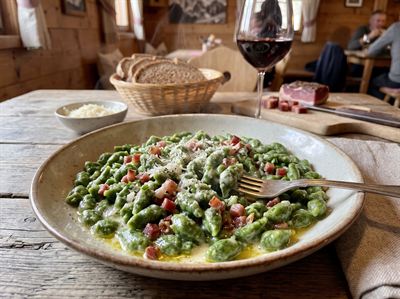
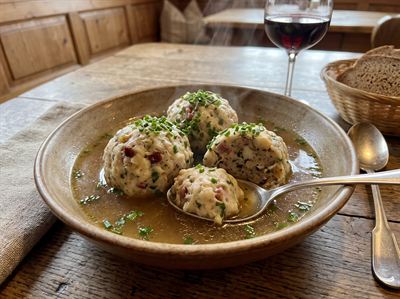
Bread and spinach dumplings with sage butter
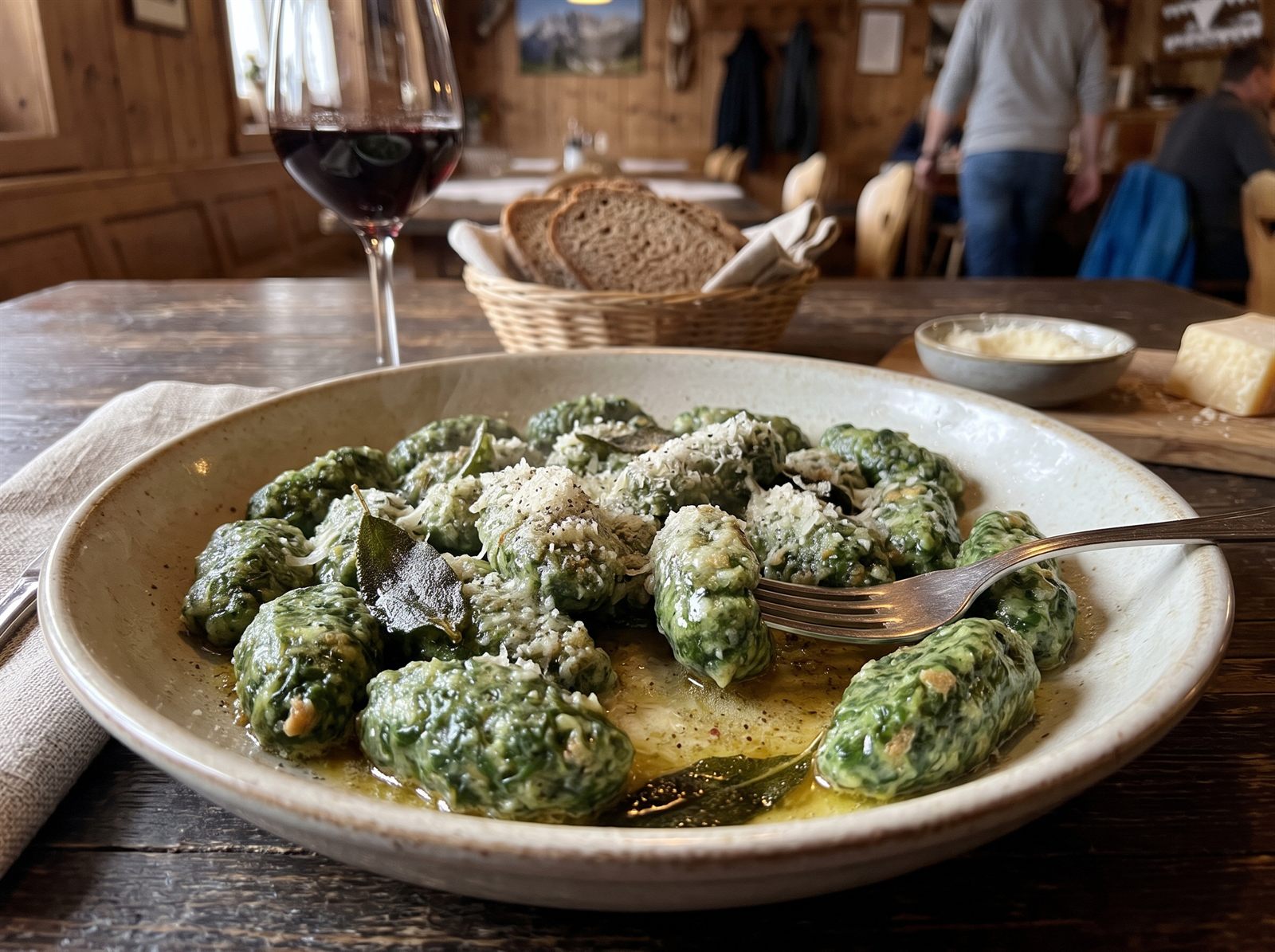
Trentino's dumplings of stale bread soaked in milk, spinach, eggs and grana, poached at a gentle boil and served with butter and sage.
- Course
- Primi & RisottiPasta & Rice
- Serves
- 4
- Hands-on
- 49 min
- Cooking
- 1 h
- Resting
- 40 min+
In breve
In short
Also called strangolapreti alla trentina, strangolapreti trentini, gnocchi di pane e spinaci and bread and spinach dumplings.
- Vegetarian
- Stale bread soaked in hot milk and squeezed, spinach squeezed hard and dried in butter with onion, bound with eggs, grana and a spoonful of flour.
- No meat in the dumplings: unlike canederli, they are vegetarian.
- The mixture must be dry: squeeze the bread and spinach well, and firm it with breadcrumbs rather than more flour, which takes over the taste.
- Shaped between two spoons into quenelles and cooked a few at a time at a very gentle boil.
- Served with butter melted with sage leaves and grated Grana Trentino.
La provenienza
Where this recipe comes from
Strangolapreti are Trentino's gnocchi of bread and greens: stale bread soaked in milk, eggs and boiled spinach, a dish of the poor kitchen that used up the previous day's bread and leaf greens, from chard to nettles and bladder campion. One account places their home in the basin of Pieve di Bono, in the Giudicarie valleys. The name, ‘priest-stranglers’, comes with legends rather than records: that they were served to the prelates at the Council of Trent in 1545, or that priests invited to Sunday lunch ate them so fast they nearly choked; another explanation is simply that they stick to the palate. They are not the strozzapreti of central Italy, a pasta of flour and water.
There is no official recipe. We compared seven sources and publish the most widely recognised version. They agree on the essentials: stale bread soaked in milk, boiled greens squeezed dry, eggs, flour or breadcrumbs to firm the mixture, cooking in salted water, and butter and grated cheese to serve, most often with sage. They differ on the rest: some cooks soften an onion with the spinach and put cheese in the mixture, as here; others use only a splash of milk and keep all the cheese for the top, or use far less bread and much more flour. They also differ on size and cooking time, from ovals 2–3 cm across lifted out as soon as they float to larger dumplings cooked for about 8 minutes. The recipe followed here gives neither, so the size and time are ours: about 20 g each, cooked for 7–8 minutes, long enough for the egg at the centre to set.
- Provenance
- A regional tradition documented in cookbooks and local practice, with no single official text.
- Defined by
- Trentino tradition
- Reference
- Compared across 7 sources, listed below; this page publishes the most widely recognised version.
- Sources
- Accademia Italiana della Cucina: strangolapreti, a Trentino-Alto Adige recipe from its recipe collection (Italian)
- Accademia Italiana della Cucina: strangolapreti, a Lombard recipe from its recipe collection (Italian)
- Val di Sole tourist board (APT Valli di Sole, Peio e Rabbi): strangolapreti alla trentina, recipe and recipe card (Italian)
- Dissapore: strangolapreti alla trentina, 2023 (Italian)
- GialloZafferano: strangolapreti alla trentina, chef Alessandro Gilmozzi's recipe (Italian)
- Scatti di Gusto: seven Trentino dishes not to miss, Giulia Ubaldi, 2016 (Italian)
- Scatti di Gusto: ten typical dishes of Trentino-Alto Adige, Nico Cristiani, 2020 (Italian)
Ingredienti
Ingredients
For the dumplings
To cook and serve
Equipment
- Small saucepan for the milk
- Large pan with a lid, for the spinach, and a colander
- Chopping board and a large knife
- Non-stick frying pan
- Two large bowls
- Two tablespoons, and a glass of water to wet them
- Clean tea towel, dusted with flour, on a tray
- Large pot for about 5 litres of water, and a slotted spoon
- Small pan for the sage butter
- Ovenproof serving dish
- Probe thermometer (optional)
Preparazione
Method
About 2 hours, start to finish. The bread soaks for 30 minutes while you boil, squeeze and chop the spinach and dry it with the onion; the spinach then cools for 10 minutes while the water comes to the boil. Mix, cook one test dumpling, shape the rest (about 45), make the sage butter, then cook them in four batches, 35–40 minutes in all (half that with two pots).
- 49 minhands-on
- 1 hcooking
- 40 minresting, at least
The mixture
-
Rest 30 min
Cut the stale bread into chunks of about 2 cm and put them in a bowl. Bring the milk to the boil and pour it over the bread. Leave it for at least 30 minutes so it softens right through.
Check The bread is soft right through, with no hard core left in the chunks.
-
Cooking 2–3 minHeat high
Meanwhile, wash the spinach and pull off the tougher stalks. Bring about 2 cm of water to the boil in the large pan, add the spinach, cover and cook, turning it once, for 2–3 minutes.
Check The leaves have collapsed and the stalks are tender.
-
Hands-on 10 min
Drain the spinach in the colander and, when you can handle it, squeeze it very well with your hands, a handful at a time. Chop it finely with the knife.
Check A squeezed handful gives no more than a drop or two of water when you press it again.
-
Hands-on 8–10 minHeat low
Chop the onion finely. Melt the 40 g of butter in the non-stick frying pan and cook the onion over low heat, stirring now and then, until soft and translucent, about 10 minutes.
Check The onion is soft and translucent, not browned.
-
Hands-on 5 minHeat medium-low
Add the chopped spinach to the onion and cook it, stirring, until it is quite dry, about 5 minutes. Season it with the pinch of salt and the nutmeg, and spread it on a plate.
Check No more steam rises, and when you push the spinach aside the pan stays dry.
Tip This is what keeps the dumplings whole in the water: every drop of water left in the spinach ends up in the mixture.
-
Rest 10 min
Leave the spinach to cool. Meanwhile, put the water on to boil for the dumplings (next phase).
Check Barely warm to the touch, so it does not start to cook the eggs.
-
Hands-on 5 min
Squeeze the bread hard with your hands, letting the milk drain away, and crumble it into the second bowl. Add the spinach, the 40 g of grated cheese, the tablespoon of flour and the eggs, and mix well with your hands.
Check Soft, evenly green, with no large lumps of bread, and not wet: a spoonful holds its shape.
Tip Too wet? Work in a little breadcrumbs, or a little more flour. Flour firms the dumplings but makes them dense and takes over the taste, so use breadcrumbs first.
Testing, shaping and cooking
-
Cooking 15–20 minHeat high
Bring about 5 l of water to the boil in the large pot and salt it with about 10 g of coarse salt a litre. Turn the oven to 80 °C and put the serving dish in it.
-
Cooking 8 minHeat medium-low, a very gentle boil
Wet two tablespoons in the glass of water, take a rounded spoonful of mixture (about 20 g) and pass it from one spoon to the other to make a smooth oval about 3 cm across and 4 cm long. Lower the heat until the water boils very gently, slide the dumpling in and cook it for 7–8 minutes. Lift it out and cut it in half. Taste it for salt.
Check It holds its shape in the water and is set right through, at least 75 °C at the centre if you probe it. If it falls apart, work a spoonful of breadcrumbs into the mixture and test again. If it is bland, add a little salt to the mixture.
Tip Taste the cooked dumpling, never the raw mixture: it contains raw egg.
-
Hands-on 15–20 min
Shape the rest of the mixture the same way, a rounded tablespoon at a time, and set the dumplings on the floured tea towel, not touching. They rest there until they go into the water.
Check Smooth ovals that hold their shape on the cloth: about 45 in all, 11 or 12 a serving.
Tip Wet the spoons again whenever the mixture starts to stick.
-
Hands-on 3–4 minHeat low
Melt the 80 g of butter with the sage leaves in the small pan over low heat and let it foam until the leaves crisp, about 3–4 minutes, so the butter takes their flavour. Take it off the heat.
Check The butter foams and smells of sage, and the leaves are crisp. It should be golden, not brown.
Tip Some cooks let the butter brown with the sage, for a nuttier taste.
-
Cooking 35–40 minHeat medium-low, a very gentle boil
Keep the water at a very gentle boil and slide in about 12 dumplings, no more. Cook them for 7–8 minutes from when the water is back to a gentle boil: they rise to the surface before they are done, so go by the time. Lift them out gently with the slotted spoon, let them drain for a moment and lay them in the warm dish with a spoonful of the sage butter so they do not stick. Put the dish back in the oven and cook the next batch: four batches in all.
Check Cut one from each batch: set and hot right through, at least 75 °C at the centre if you probe it. If not, give the batch a minute more.
Tip A hard boil, or too many at once, breaks them.
Tip With two pots of water on the hob, the cooking takes half the time.
-
Hands-on 3 min
Warm the rest of the sage butter for a minute, until it foams again. Spoon the dumplings onto warm plates, pour the butter and the sage leaves over them, and finish with the 50 g of grated cheese. Serve at once.
Tip Leftovers: cool them in a shallow container and put them in the fridge within 2 hours; eat them within 3 days, reheated until hot right through, at least 75 °C at the centre.
Tip Dumplings cooked from frozen need the same check as fresh ones: cut one open, set and hot right through, at least 75 °C at the centre.
The essentials, for cooks who know the dish. Switch to Detailed for quantities, temperatures, times and checks at every step.
Press “I’m here” on the step you are on, and again when it is done.Tap the pin on the step you are on, and the tick when it is done. Timers keep running while you scroll.
Da sapere
Good to know
- WhenQuando
- A very common dish at family lunches on feast days. In the warm months it is sometimes dressed with a light tomato sauce instead. Source
- KeepingConservazione
- Cooked, they keep for two or three days in a closed container in the fridge, and can be reheated in melted butter. Uncooked, they can be frozen for about a month; boil them straight from frozen. Source
- VariantsVarianti
- With little milk and the cheese on top: For six: 300 g of stale bread moistened with only 100 ml of lukewarm milk, 700 g of spinach or chard boiled in salted water, squeezed and chopped, 2 eggs and 60 g of flour, with no onion and no cheese in the mixture. Shaped with a spoon into ovals 2 cm–3 cm across, drained as soon as they float, and served with melted butter and 50 g of grated Parmigiano. Source
- With browned butter and goat's cheese: The mixture rolled into logs, cut into equal pieces and shaped by hand into elongated balls; the dumplings tossed in butter browned with sage and finished with flakes of aged goat's cheese. Source
- With wild greens: Made with other leaves instead of spinach, from nettles and bladder campion (silene) to cavolo nero. Source
- With tarragon or caraway: Each family has its own touch: fresh herbs in the mixture, most often tarragon and caraway. Source
- With speck or pancetta: Speck or pancetta added to the butter and sage. Source
- Lombard strangolapreti: In Lombardy, for six: 1 kg of stale bread soaked in 1 l of milk for at least an hour, 500 g of erbette (leafy greens), 2 egg yolks and 70 g of flour, with nutmeg, salt and pepper, the bread, greens and yolks passed through a mincer; served with 150 g of butter flavoured with 3 sage leaves and 50 g of grated grana. Source
Errori comuni
Common mistakes
- Bread or spinach not squeezed well: the mixture is wet and the dumplings fall apart in the water.
- Fixing a wet mixture with lots of flour: the dumplings turn dense and taste of flour. Use a spoonful of breadcrumbs instead.
- Cooking too many at once, or at a rolling boil: they break.
- Lifting them out as soon as they float: the centre may not be set yet. Give them the full 7–8 minutes.
- Skipping the test dumpling: bread and spinach vary, and one dumpling shows whether the mixture holds before you shape it all.
Fuori dall'Italia
Cooking it outside Italy
- Grana Trentino is hard to find abroad. Parmigiano Reggiano or Grana Padano work, or another well-flavoured aged hard cheese, even a sheep's cheese.
- For the bread, use plain white wheat bread or white rolls made without oil.
- Frozen spinach works: about 400 g of frozen for every 350 g of fresh, so about 690 g here.