Langhe hills south of Alba, Piemonte
Agnolotti del plin
Pinched pasta parcels filled with veal, pork and rabbit
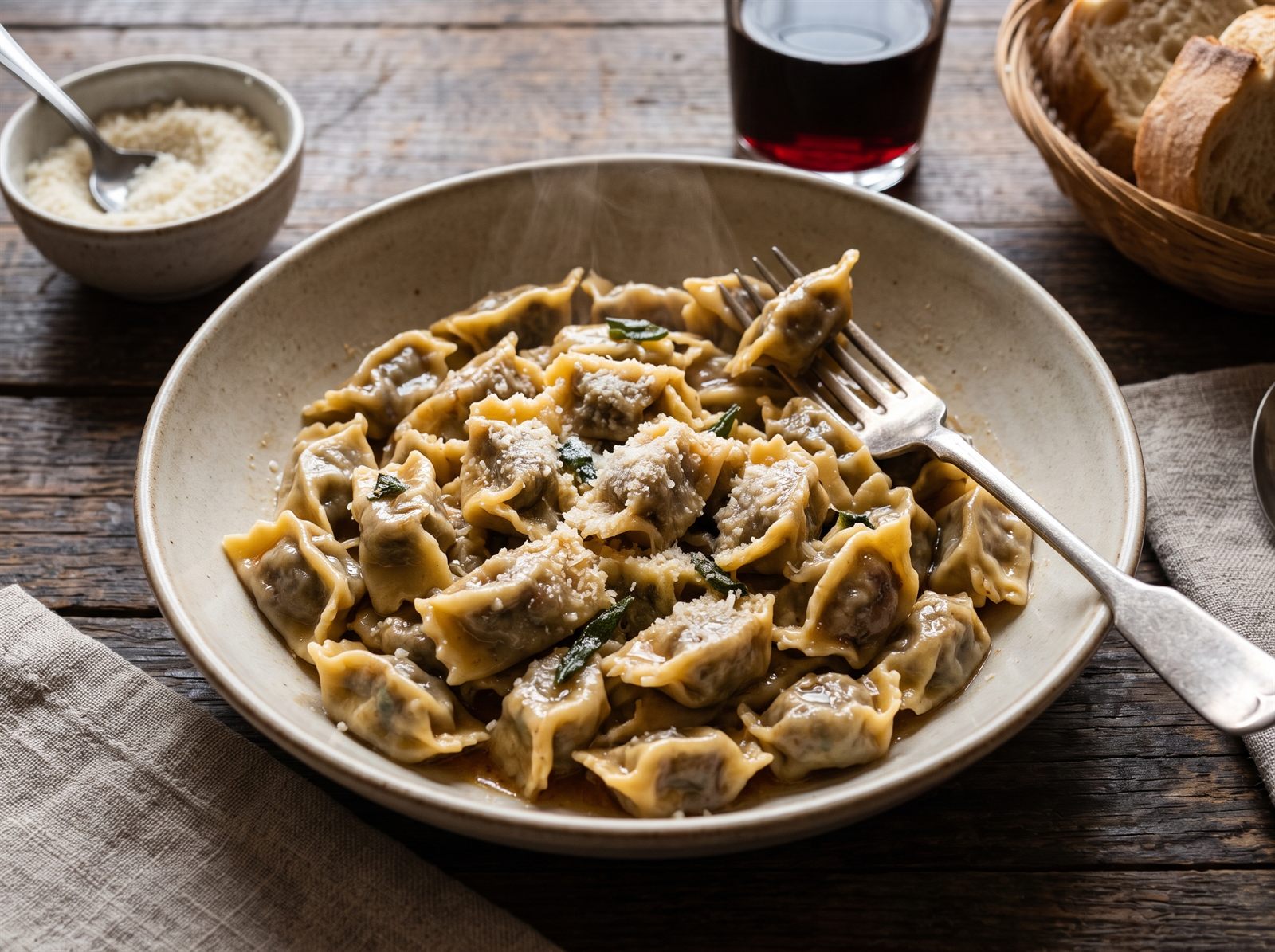
The small pinched agnolotti of the Langhe: veal, pork and rabbit cooked with vegetables and minced with greens, egg and Parmigiano, sealed in thin egg pasta and dressed with the meat's own juices.
- Course
- Primi & RisottiPasta & Rice
- Serves
- 8
- Hands-on
- 2 h 22 min
- Cooking
- 1 h 23 min
- Resting
- 1 h 30 min+
In breve
In short
Also called ravioli del plin, raviole del plin and plin.
- A filling of veal, pork and rabbit, browned, then cooked covered with carrot, celery and onion, and minced with wilted greens, egg and Parmigiano.
- Egg pasta, 100 g of flour to each egg, rolled thin and filled at once, before it hardens.
- The plin is the pinch: small balls of filling, the sheet folded over them and pinched at their sides, then cut into pouches about 2 cm long.
- Cooked in salted water until they float, and dressed with the vegetables and juices the meat cooked in, blended smooth.
La provenienza
Where this recipe comes from
Agnolotti are Piedmont's filled pasta, and the plin is their small Langhe form: plin is Piedmontese for a pinch, the pinch that seals each dot of filling in very thin egg pasta. Square agnolotti are typical of the Monferrato. Nonna Genia, the classic Langhe cookbook first published in 1982, finds them square in Alba and pinched, ‘del plin’, in the hills from Alba up to the Alta Langa. Today the plin is the form that prevails in the Langa, where they were probably for a long time the one course of the Sunday meal: the roast went into the filling, and its juices became the sauce. Where the name comes from is uncertain, and the tale of a French cook who invented agnolotti in Turin during a siege is a legend that Nonna Genia's own authors doubt.
There is no official recipe: Piedmont lists agnolotti and plin among its traditional food products, but we found no recipe for them deposited or registered. We compared nine sources and publish the most widely recognised version. Most share the essentials: veal and pork, often with rabbit, cooked slowly and minced with cooked greens, grated cheese and usually an egg; thin egg pasta; and the meat's own juices as the sauce. They differ on the dough, from whole eggs to yolks alone; on the greens, spinach, escarole or savoy cabbage; and on the shape, pinched in the hills, cut square around Alba. Ours are the sheet's thickness, the salt in the water and the figures for the small hazelnut-sized balls of filling the recipe describes: about 1.5 cm across and 2.5 g, so that the batch makes about 200.
- Provenance
- A regional tradition documented in cookbooks and local practice, with no single official text.
- Defined by
- Langhe tradition
- Reference
- Compared across 9 sources, listed below; this page publishes the most widely recognised version.
- Sources
- Giallo Zafferano: ravioli del plin (Italian)
- Giallo Zafferano: fresh egg pasta, the basic dough (Italian)
- Langhe.net: agnolotti del plin al sugo di arrosto, Nonna Genia's recipe (Italian)
- Beppe Lodi and Luciano De Giacomi: ‘Nonna Genia’, the Langhe cookbook first published in 1982, agnolotti al sugo di arrosto (English edition, Araba Fenice, 2007)
- Scatti di Gusto: agnolotti del plin al canovaccio, the recipe of the Trattoria Panoramica Sarroc, Vignale Monferrato (Italian)
- Dissapore: ravioli del plin, the Piedmontese filled pasta (Italian)
- RSI, Swiss television: Lidia's agnolotti, with roast juices or ‘al tovagliolo’, by Ugo Alciati (Italian)
- Gambero Rosso: the best agnolotti del plin in Piedmont, and the history of the name (Italian)
- Wikipedia: Piedmont's traditional food products (PAT) (Italian)
Ingredienti
Ingredients
For the pasta
For the filling
To cook them
Equipment
- Large heavy casserole with a lid, and a frying pan
- Food processor
- Blender or stick blender, for the sauce
- Large wooden board, and a pasta machine or a long rolling pin
- Pastry wheel
- Trays lined with clean cotton cloths, dusted with flour
- Shallow container, for the sauce base in the fridge
- Pot of at least 8 l, and a skimmer
- Wide frying pan, for the sauce
Preparazione
Method
One long day, about 4 hours from start to table. The meat cooks for an hour while you make and rest the dough; then about 45 minutes for the filling, about an hour and a half to shape some 200 plin (longer the first time; the filling sets the count, and some dough will be left over), and about half an hour to make the sauce, cook the plin and serve. Put the water on while you shape the last strip.
- 2 h 22 minhands-on
- 1 h 23 mincooking
- 1 h 30 minresting, at least
The meat
-
Hands-on 10 min
Trim the fat from the pork loin and the veal, leaving each in one piece. Chop the carrots, celery and onion roughly.
-
Hands-on 10–15 minHeat medium-high
In the casserole, heat 3 tablespoons of oil and brown the pork and the veal on every side. At the same time, in the frying pan, brown the rabbit legs in 2 tablespoons of oil.
Check All the meat is a deep golden brown on every side.
-
Cooking 1 hHeat low
Put the rabbit into the casserole with the pork and veal, add the carrots, celery and onion, and season with salt and pepper. Pour in a ladleful of broth or water (about 100 ml), cover, and cook gently for about an hour, adding a little more broth or water whenever the pan looks dry.
Check A knife slides easily into the pork and veal, and the rabbit comes away from the bone.
Tip Some cooks roast the meat with a sprig of rosemary and two cloves of garlic; others splash it with white wine as it cooks and add herbs to taste.
The dough, while the meat cooks
-
Hands-on 5 min
Heap the flour on the board and make a well. Break the eggs into it one at a time and beat them with a spoon, starting from the centre, then work in the rest of the flour with a fork or your hands.
Check It gathers into a firm ball and takes up all the flour. If it will not, or feels hard, add 1 or 2 tablespoons of lukewarm water.
-
Hands-on 10–15 min
Knead firmly with the heel of your hand for at least 10 minutes, folding and turning, until the dough is smooth and compact.
Check Smooth and compact, with no cracks; a dent pressed into it springs back slowly.
-
Rest 1 h
Wrap the dough tightly in cling film and leave it for an hour in a cool, dry place.
The filling
-
Rest 30 min
Lift the meat out onto a plate and leave it until it is lukewarm, about 30 minutes. Keep the vegetables and cooking juices: they become the sauce. Pour them into a shallow container and put it in the fridge as soon as it stops steaming, within 2 hours.
-
Hands-on 5 minHeat medium
Meanwhile, in the frying pan, cook the escarole in 1 tablespoon of oil for a couple of minutes, then add the spinach and cook until both have wilted, about 5 minutes in all.
Check Soft and wilted.
-
Hands-on 10 min
Bone the rabbit and cut the pork and veal into pieces. Chop all the meat in the food processor, then add the egg, the greens and the Parmigiano, season with salt and pepper, and blend into a smooth filling.
Check Very dense and compact: it holds in a ball. If it is too dry to come together, blend in a spoonful of broth.
Tip Keep the filling covered in the fridge while you shape, and take out a portion at a time.
Tip Some cooks add a pinch of nutmeg.
Shaping the plin
Work one piece of dough at a time, keeping the rest wrapped: the sheet must not harden before it is filled, or it will not seal.
-
Hands-on 5 min
Cut off a small piece of dough, about an eighth, only as much as you can shape in about 15 minutes, and keep the rest wrapped. Pass it 3 or 4 times through the widest setting of the pasta machine, folding it in half each time, then close the rollers one notch at a time down to the thinnest; by hand, roll it to about 0.6 mm.
Check Hold it up to the light: you can see the shadow of your hand through it.
Tip Work quickly from here on: a sheet that hardens will not close.
-
Hands-on 5 min
Along the lower half of the sheet, set a row of balls of filling the size of a small hazelnut, about 1.5 cm across, 1 cm–2 cm apart.
Check Each ball weighs about 2.5 g: the filling should make about 200.
-
Hands-on 5 min
Fold the upper half of the sheet over the filling along its length. Pinch the pasta together with your fingers at the sides of each ball, pressing it close around the filling so no air is left inside.
Check Every ball is sealed in snugly, with no air around it, and a pinched pleat stands between each one.
-
Hands-on 5 min
With the pastry wheel, cut along the length of the folded sheet a few millimetres from the filling. Then cut between the balls to separate the plin, giving each a rectangular shape, and lay them on a tray lined with a floured cloth.
Check Little rectangular pouches about 2 cm long, sealed all round.
Tip Some cooks turn the strip so the folded edge faces them before cutting between the balls with the wheel: each plin then folds over into its classic shape.
-
Hands-on 1 h to 1 h 15 min
Repeat with the rest of the dough and filling. Plin that will wait more than 2 hours from when they were shaped go into the fridge on their floured tray until the water boils.
Check About 200 plin. The filling sets the count: when it runs out, some dough will be left over.
Cooking and serving
-
Cooking 20–25 minHeat high
While you shape the last strip, bring 5 l of water to the boil in the large pot with the coarse salt.
-
Hands-on 10 minHeat medium
Blend the vegetables with their cooking juices until smooth, then bring the sauce to the boil in the wide frying pan. If it is too thin, let it bubble for a few minutes to dry out a little. Keep it hot over the lowest heat.
Check Smooth, and boiling all through: at least 75 °C.
-
Cooking 3–4 min
Drop half the plin into the boiling water. As soon as they rise to the surface, after 3–4 minutes, lift them out with the skimmer, let them drain well, and put them into the sauce. Cook the second batch the same way.
Check They float, and the pasta at the pinch is tender.
Tip Some cooks keep the water at a gentle boil, so the plin do not break.
-
Hands-on 2 min
Turn the plin gently in the sauce until they are coated, and serve at once.
Tip Some cooks stir a knob of butter into the sauce at this point, and pass grated Parmigiano at the table.
The essentials, for cooks who know the dish. Switch to Detailed for quantities, temperatures, times and checks at every step.
Press “I’m here” on the step you are on, and again when it is done.Tap the pin on the step you are on, and the tick when it is done. Timers keep running while you scroll.
Da sapere
Good to know
- WhenQuando
- Probably for a long time the one course of the Sunday meal in the Langhe; at Carnival, a classic that is never missing. Source
- KeepingConservazione
- Cooked and dressed, they keep in an airtight container in the fridge for 2 days at most. Raw plin can be frozen: spread them out on a tray, not touching, and once frozen move them to a freezer bag; cook them from frozen in plenty of salted water until they float. The filling can be frozen too, if the meat was fresh. Source
- VariantsVarianti
- Al tovagliolo: Boiled in meat broth, drained and served in a napkin on a plate, with no sauce at all, to be eaten with the fingers. Source
- With butter and sage: Dressed with the traditional butter and sage instead of the roast's juices. Source
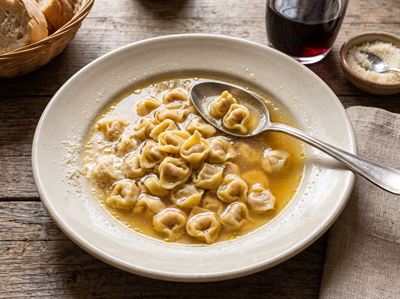
- In broth: Served in a light meat broth, preferably capon broth. Source
- All rabbit, as in the high Langa: Up where the Langa is highest and the farms were poorest, veal and pork often cost too much: a farmyard rabbit, roasted and boned, made both the filling and the sauce. Source
- In Dolcetto: One Langhe family's way of tasting them: hot from the pot and with no sauce, a dozen plin are drowned in Dolcetto in a bowl and eaten with a fork, one at a time. The wine sharpens every flavour, and shows up any fault in the filling or in the choice of wine. Source
- With white truffle: With melted butter and a grating of Alba's white truffle. Source
- With a yolk-rich dough: A dough of 500 g of flour, 18 yolks, 1 whole egg and 80 g–100 g of cold water, rested about 30 minutes under a damp cloth. Source
- With a semolina dough: 250 g of flour and 50 g of fine durum wheat semolina to 3 eggs: the sheet stays thin but is sturdier, and holds better in the water. Source
Errori comuni
Common mistakes
- A soft filling. It should be very dense and compact before you start shaping.
- Letting the sheet harden before you fill it: it will not seal. Roll one piece at a time, work quickly and keep the rest wrapped.
- Air trapped around the filling: the plin can burst as they cook. Press the pasta close around each ball as you pinch.
- Balls of filling that are too big: the sheet will not close around them. About 200 from this batch is right.
Fuori dall'Italia
Cooking it outside Italy
- Escarole is also called broad-leaved or Batavian endive.
- Savoy cabbage can take the place of the spinach or the escarole.
- No rabbit? The filling can be made with veal and pork alone.
- Grana Padano can replace the Parmigiano Reggiano.
- Polpa di vitello is simply lean, boneless veal: ask for a lean piece for roasting.