Bolzano, Trentino-Alto Adige
Spätzle
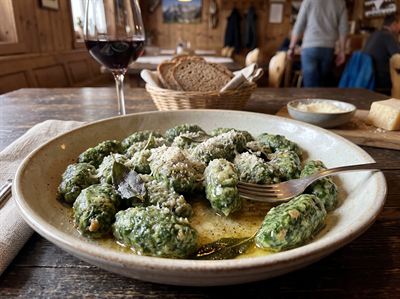
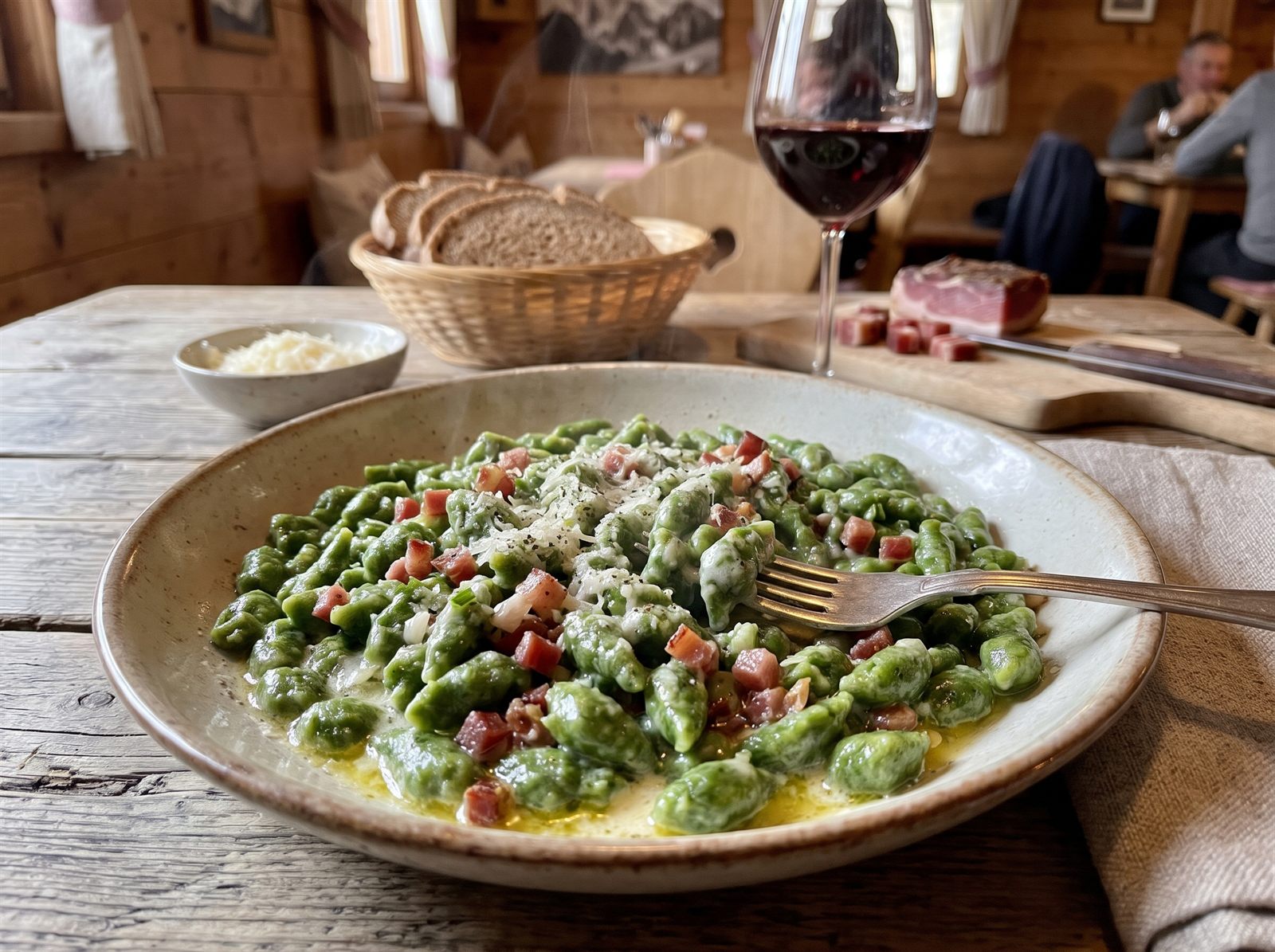
Spinach spätzle with ham and cream
South Tyrol's green spätzle: spinach, eggs and flour pushed through a grater into boiling water, then folded into a sauce of butter, cream and cooked ham.
- Course
- Primi & RisottiPasta & Rice
- Serves
- 4
- Hands-on
- 22 min
- Cooking
- 31 min
In breve
In short
Also called Spinatspätzle, Spinatspatzlen, Spatzln, spätzle agli spinaci, gnocchetti tirolesi and spinach spaetzle.
- Fresh spinach, blanched and squeezed, blended with eggs and water, then flour: 300 g of spinach to 260 g of flour for four.
- A soft but compact dough, pushed through a spätzle grater straight into boiling salted water.
- Lifted out as soon as they float, then folded into butter, cream, strips of cooked ham and a pinch of nutmeg.
- Served at once, with freshly grated Parmesan.
La provenienza
Where this recipe comes from
Spätzle, ‘little sparrows’ in the Swabian dialect, are small, irregular dumplings of soft-wheat flour, eggs and water. They come from southern Germany, from Swabia and Bavaria above all, and are just as much at home in Tyrol, Switzerland, Alsace and Trentino-Alto Adige; in Italy they are eaten as a primo. South Tyrol calls them Spatzln, Trentino gnocchetti tirolesi, and in Ladin they are fierfuli. They can be cut by hand from a wet board or pressed through a tool like a potato ricer; in South Tyrol the dough is dropped into boiling water through a grater with a sliding hopper. There they are also made green, with spinach in the dough, and with a sauce of cream and cooked ham they are a warm first course typical of the province, and a favourite with children.
There is no official recipe. We compared seven sources, South Tyrolean ones first, and publish the most widely recognised version: spinach spätzle with ham and cream. The spinach recipes agree on the essentials: spinach blended with eggs, a liquid and flour into a soft dough, dropped through a grater into boiling salted water, lifted out as soon as they float, and dressed with butter and cheese or with a cream sauce. Some cooks use speck instead of the ham, and plain egg spätzle, with no spinach, are the simplest form. On this page the sauce is made while the water comes to the boil, so the spätzle go straight from the pot into it.
- Provenance
- A regional tradition documented in cookbooks and local practice, with no single official text.
- Defined by
- South Tyrolean tradition
- Reference
- Compared across 7 sources, listed below; this page publishes the most widely recognised version.
- Sources
- IDM Südtirol: Spinatspätzle mit Schinken und Sahne, on the official South Tyrol travel site (German)
- IDM Südtirol: the same recipe on the site's Italian edition, made with speck (Italian)
- Gallo Rosso: spätzle agli spinaci, a recipe from the Lüch de Survisc farm inn in La Val, on the South Tyrolean farm-holiday quality seal's site (Italian)
- Gallo Rosso: ‘Spätzle’ all'uovo, plain egg spätzle, on the same site (Italian)
- Südtiroler Bäuerinnenorganisation: Eierspatzln, plain egg spätzle, from the South Tyrolean farm women's recipe pages (German)
- GialloZafferano: spätzle di spinaci con speck e panna (Italian)
- Wikipedia: Spätzle, for the history and the local names (Italian)
Ingredienti
Ingredients
For the spätzle
For the sauce
To serve
For blanching and cooking
Equipment
- Spätzle grater (Spätzlehobel), or a grater with large holes
- Blender or food processor
- Saucepan for blanching the spinach, and a colander
- Large pot, about 6 l, for the cooking water
- Large non-stick frying pan, for the sauce
- Slotted spoon
Preparazione
Method
About 55 minutes: 20 minutes for the spinach and the dough, 15–20 minutes for the big pot of water to come to the boil (cut the ham meanwhile, and make the sauce as the water nears the boil), then about 12 minutes to cook the spätzle in three batches and fold them into the sauce. Putting the big pot on at the start saves about a quarter of an hour; the sauce is then made once the dough is ready.
- 22 minhands-on
- 31 mincooking
The spinach dough
-
Cooking 10 minHeat high
Wash the spinach in plenty of cold water, lifting it out so any grit stays behind, and drain it. Meanwhile bring 2 l of water to the boil in the saucepan.
Check The water is at a full boil.
-
Cooking 2–3 minHeat high
Put the spinach into the boiling water and blanch it for 2–3 minutes, pushing it under with a spoon, until it has all wilted. Drain it in the colander.
Check Every leaf is limp and bright green.
-
Hands-on 5 min
Run cold water over the spinach until you can handle it, then squeeze it hard in your hands, a fistful at a time, to get rid of the excess water.
Check Tight green balls: no more water runs out when you squeeze.
Tip Water left in the spinach thins the dough, so squeeze as hard as you can.
-
Hands-on 2 min
Put the spinach in the blender or food processor with the 100 ml of water, the eggs and a pinch of salt, and blend to a purée.
Check Smooth and bright green, with no pieces of leaf left.
-
Hands-on 2 min
Add the 260 g of flour and blend again until you have a soft but compact dough. If it is too runny, add a tablespoon of flour and blend briefly; if it is too thick, add a little water, a tablespoon at a time.
Check Smooth, thick and sticky: it falls slowly from a spoon in heavy dollops, neither pouring like a batter nor holding its shape like bread dough.
The sauce and the cooking
-
Cooking 15–20 minHeat high
Bring 4 l of water to the boil in the large pot over high heat, then add the 40 g of salt. Cut the ham meanwhile, and start the sauce when the water is close to the boil.
Check A full, rolling boil.
-
Hands-on 3 min
Cut the 150 g of cooked ham into strips about 5 mm wide.
Check Even strips, about 5 mm wide.
-
Cooking 3–5 minHeat low
In the frying pan, melt the 50 g of butter over low heat. Add the 250 ml of cream, the ham and a pinch of nutmeg, season with pepper and a little salt, and let it simmer gently for 3–5 minutes. Then take the pan off the heat: the spätzle go into it as they are cooked, and it goes back on the heat only at the end.
Check It bubbles gently at the edges and has thickened a little, enough to coat a spoon.
Tip Taste before you salt: the ham is salty, and so is the Parmesan that goes on at the end.
Tip Left on the heat while the spätzle cook, the cream reduces too far and turns tight or greasy.
-
Hands-on 2 minHeat high
Set the spätzle grater over the pot of boiling water, fill its hopper with about a third of the dough and slide it back and forth, so the dough drops through the holes into the water.
Check Short, irregular green drops fall into the water.
Tip Cook the dough in three batches: too much at once stops the boil, and the spätzle stick together.
Tip Give the water a short stir once the dough is in, so the spätzle do not stick together.
-
Cooking 1–2 minHeat high
They are done as soon as they rise to the surface, in 1–2 minutes. Lift them out with the slotted spoon, let them drain well and put them straight into the pan with the sauce, off the heat.
Check They float, and hold their shape when lifted.
-
Hands-on 6–8 minHeat high
Let the water come back to the boil and cook the rest of the dough in two more batches in the same way, adding each to the sauce as it is done.
Check All the dough is used and every batch is in the pan.
-
Hands-on 2–3 minHeat low
Put the pan back over low heat and fold the spätzle gently into the sauce until they are all coated and hot, and the sauce bubbles again at the edges. Serve at once, with the freshly grated Parmesan on top.
Check Every spätzle is coated, and the sauce is creamy rather than runny.
Tip Leftovers go into the fridge in a shallow, covered container within 2 hours; reheat them until steaming hot right through, 75 °C.
The essentials, for cooks who know the dish. Switch to Detailed for quantities, temperatures, times and checks at every step.
Press “I’m here” on the step you are on, and again when it is done.Tap the pin on the step you are on, and the tick when it is done. Timers keep running while you scroll.
Da sapere
Good to know
- WhenQuando
- A dish for winter dinners, though it is made in every season. Source
- KeepingConservazione
- Leftovers keep in the fridge for a couple of days; they are not suited to freezing. Dressed leftovers make a gratin, baked with Parmesan and other melting cheeses on top. Source
- VariantsVarianti
- With speck: Speck in place of the ham: 150 g cut into thin strips and fried crisp in a knob of the butter before the rest of the butter, the cream and the nutmeg go in. A few crisp strips are kept back to scatter over the plates. Source
- With raw spinach, butter and Parmesan: For six: 120 g of raw spinach blended with a clove of garlic, then 3 eggs, 300 ml to 400 ml of milk and a little nutmeg, with 200 g of flour stirred in slowly and salt, worked smooth with a wooden spoon. Boiled until they float and served with butter and Parmesan. Source
- Plain, with butter and chives: Egg spätzle with no spinach, for six: 400 g of wheat flour and 100 g of spelt flour mixed with a pinch of salt, 2 tablespoons of cream and 250 ml of milk, then 4 eggs, into a smooth, thick batter. Brought to the boil once, lifted out, cooled in cold water and drained in a sieve, then warmed in 2 tablespoons of butter, salted and served with a bunch of chives. Source
- Plain, with Graukäse: For four: 400 g of flour and 8 eggs with just enough water or milk to stir, beaten hard and rested for 15 minutes, then boiled for a minute. A large batch is drained, cooled in cold water and oiled so the spätzle do not stick. Served sprinkled with hot butter and Graukäse. Source
Errori comuni
Common mistakes
- Spinach not squeezed hard enough: the water left in it thins the dough.
- A dough that is too runny or too stiff: correct it with a tablespoon of flour, or a little water, before you start.
- Too much dough in the pot at once: the water stops boiling and the spätzle stick together. Work in batches.
- Leaving them in the water after they float: lift them out at once.
- Boiling the sauce hard: keep it to a gentle simmer on low heat.
Fuori dall'Italia
Cooking it outside Italy
- No spätzle grater? A grater with large holes works, or a potato ricer with a slightly stiffer dough, made with a little less water.
- Cooked ham is Italian prosciutto cotto, German gekochter Schinken: not cured, raw prosciutto.
- For the cream, use whipping cream, about 35% fat, the nearest to Italian panna fresca; single cream can split as it simmers.