Campofilone, Marche
Maccheroncini di Campofilone
Campofilone's very fine dried egg pasta, with a meat ragù
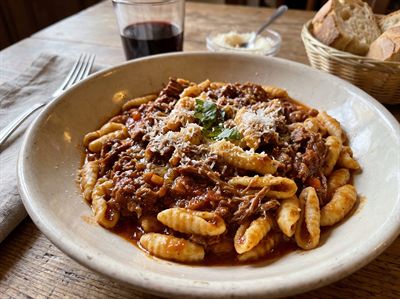
Campofilone's pasta of durum wheat semolina and eggs, with no water, rolled almost transparent, cut into threads about a millimetre wide and dried, served here with a slow red ragù of beef and sausage; only the pasta is protected, an EU PGI since 2013.
- Course
- Primi & RisottiPasta & Rice
- Serves
- 4
- Hands-on
- 2 h 44 min
- Cooking
- 1 h 31 min
- Plan
- 2 days
In breve
In short
Also called Maccheroncini di Campofilone IGP, Maccheroncini di Campofilone PGI, maccheroncini di Campofilone al ragù and Campofilone egg pasta.
- Only fresh eggs and durum wheat semolina (or tipo 00 flour), 7 to 10 eggs to the kilo: the specification allows no water at all.
- Rolled 0.3 mm–0.7 mm thin and cut into threads 0.8 mm–1.2 mm wide and 35 cm–60 cm long.
- Laid on sheets of white paper, 155 g–175 g to a sheet, folded in on four sides and, in Campofilone, dried for 24–36 hours.
- Cooked for only 1–2 minutes, then dressed with a long-simmered red ragù of mixed meats and grated pecorino.
- Only the pasta is protected: the PGI fixes how it is made, not the sauce it is served with.
La provenienza
Where this recipe comes from
Campofilone is a small medieval village on a hill above the lower Aso valley, in the province of Fermo. Eggs were not to be had all year round, so its women made pasta when the hens laid and learned to dry it, so that it kept in the kitchen chest and could be eaten all year. Coarsely cut pasta curled in the air as it dried and broke, so they cut the sheet into threads so fine that they stayed whole. It became the dish of feast days, the mark of a good cook and a prized gift for distinguished friends. By local tradition a letter of the town's abbey praised it in the 1400s and documents of the Council of Trent mention it; the Touring Club's first gastronomic guide to Italy named it in 1931. The name comes from maccheroni, the old word for any pasta, and the long, fine threads. A pasta workshop opened in the town in 1960, and the festival held every August since 1964 serves some 20,000 portions.
‘Maccheroncini di Campofilone’ has been a PGI since 2013, under Commission Implementing Regulation (EU) No 1130/2013, and only pasta made in the comune of Campofilone under its specification may carry the name; since 2023 a consortium of the town's pasta makers, recognised by the Italian ministry, looks after it. The specification protects only the pasta, not what it is served with. It asks for fresh eggs, 7 to 10 to a kilo of durum wheat semolina or tipo 00 flour, and no water at all; a sheet 0.3–0.7 mm thick, cut into threads 0.8–1.2 mm wide and 35–60 cm long; and the threads laid on sheets of white paper, 155–175 g to a sheet, folded in on four sides and dried at 28–40 °C for 24 to 36 hours. Cooked, they need one or two minutes. This page makes the pasta at home within those limits but one, from a published household recipe, and serves it with the long-simmered red ragù of beef, minced beef and sausage that comes with that recipe; other cooks use duck or giblets, or dress the pasta on a wooden board. It is pasta in the Campofilone manner, not the protected product. One step changes at home: the specification's slow drying is a controlled process in drying rooms, and US food-safety guidance for home-made egg pasta allows no more than 2 hours at room temperature, so this page rests the dough and the pieces waiting to be rolled in the fridge, dries the cut pasta in a food dehydrator at 57 °C for 2–4 hours, until it snaps, and keeps it in the freezer; without a dehydrator, it is kept in the fridge and cooked fresh within 3 days.
- Provenance
- The dish itself is protected by an EU specification (TSG, PDO or PGI) that fixes how it is made.
- Defined by
- European Union
- Reference
- PGI ‘Maccheroncini di Campofilone’, Commission Implementing Regulation (EU) No 1130/2013; the quantities and the sugo as in Scatti di Gusto's recipe
- Sources
- Ministry of Agriculture (MASAF): production specification of the PGI ‘Maccheroncini di Campofilone’ (Italian)
- EU Official Journal C 78 of 16 March 2013: the application to register the PGI, with the single document (EUR-Lex, Italian)
- Commission Implementing Regulation (EU) No 1130/2013, registering the name (EUR-Lex, Italian)
- Gazzetta Ufficiale della Repubblica Italiana no. 256 of 2 November 2023: the decree recognising the protection consortium (Italian)
- Scatti di Gusto: maccheroncini di Campofilone with the traditional sugo, the pasta and the sauce (Italian)
- Corriere News, a news site of the province of Fermo: the maccheroncini di Campofilone, with a ragù recipe (Italian)
- Regione Marche: menu and product sheets for the region's dishes in the Italy Pavilion at Osaka, with a producer's description of the maccheroncini (Italian)
- Iowa State University Extension and Outreach, AnswerLine: homemade egg noodles made safe
- University of Illinois Extension: homemade egg noodles, with drying and storing (PDF)
- USDA Food Safety and Inspection Service: Leftovers and Food Safety (archived copy of 29 May 2025)
Ingredienti
Ingredients
For the maccheroncini
For the sugo
For cooking
Equipment
- Large wooden board
- Pasta machine, or a long, thin rolling pin
- Kitchen scale and a ruler; a caliper, if you have one, to measure 0.5 mm
- Large, very sharp knife
- Clean cotton cloths
- White baking paper or greaseproof paper, and scissors
- Food dehydrator that holds 57 °C (without one, the pasta is cooked fresh)
- Airtight box or freezer bags
- Wide, heavy pan with a lid, about 28 cm across, and a wooden spoon
- Large pot holding at least 6 l, and a colander
- Cheese grater
Preparazione
Method
Two days. Day 1: about 2 1/4–2 3/4 hours for the pasta (about 20 minutes to weigh and knead, 30 of rest in the fridge, then 1 1/2–2 hours to roll, cut and lay it on paper, one piece at a time, the rest of the dough waiting in the fridge), with each sheet going into the dehydrator as it is full, for 2–4 hours; once dry, it goes into the freezer. Day 2, or any day within the next few months: about 2 1/2–3 hours for the sugo, most of it simmering; put the pasta water on 20 minutes before the end, and the pasta cooks in 1–2 minutes. Without a dehydrator, each sheet goes into the fridge as it is full, and the pasta is cooked fresh within 3 days. The sugo can also be made the day before: into the fridge within 2 hours of cooking, and back to the boil before you dress the pasta.
- 2 h 44 minhands-on
- 1 h 31 mincooking
- 2 daysfrom start to table
Day 1: the dough
Make the pasta a day or more ahead: it is dried in a dehydrator and kept in the freezer. Without a dehydrator, the cut pasta goes into the fridge and is cooked within 3 days.
-
Hands-on 2 min
Break the 3 eggs into a bowl and weigh them: you want about 165 g, and no less than 150 g.
Check The scale reads 150 g or more.
Tip Our guide: 3 eggs to 300 g of semolina is 10 to the kilo, the most the specification allows. Below about 150 g the dough is too dry to come together without water: use larger eggs.
-
Hands-on 15 minOfficial text
Make the dough with the fresh eggs and the durum wheat semolina. No water may be added.
Check Hard and elastic: it resists when you press it and springs back slowly.
Tip Heap the semolina into a well on the board, break the eggs into the middle and beat them with a fork, drawing in the semolina little by little; then work the dough with your hands.
Tip Work with clean hands, on a clean board never used for raw meat or poultry, and do not taste the raw dough: raw eggs and flour can carry salmonella.
Tip Our guide: knead for about 10 minutes, pushing the dough away with the heel of your hand and folding it back. It starts crumbly and stiff: keep going, and never add water, however dry it seems.
-
Rest 30 min
Wrap the dough in a damp cloth, then in a bag or cling film, and leave it to rest in the fridge for 30 minutes.
Check Cool and firm, with a smooth surface that has not dried out or formed a skin.
Tip Our guide: rest it in the fridge, not on the worktop. Raw egg dough should spend no more than 2 hours in all at room temperature, counted from when the eggs are broken, and the rolling and cutting take time: the fridge keeps every piece well inside that.
Day 1: rolling, cutting and drying
Work one piece at a time, taking each from the fridge only when you are ready to roll it: roll a sheet, let it firm up while you roll the next, then cut the first, so that no sheet waits more than about 10 minutes. Worked this way, no part of the dough spends more than about 1 1/2 hours at room temperature before it goes into the dehydrator.
-
Hands-on 30–45 minOfficial text
Roll the dough out by hand, or between rollers, into a sheet between 0.3 mm and 0.7 mm thick.
Check Held up to the light, the sheet shows the shadow of your hand through it, and it is even all over, with no thicker edges.
Tip Our guide: cut the dough into 6 pieces of about 75 g–80 g, put five back in the fridge, wrapped, and take them out one at a time. Aim for about 0.5 mm, the middle of the range; a caliper, if you have one, measures it.
Tip Our guide: the dough is stiff from the fridge. If it cracks at the edges, fold it in three and roll it again; it softens as you work it.
Tip Our guide: with a pasta machine, start at the widest setting, fold the piece in three and pass it 3 or 4 times, then once through each setting down to the one that gives about 0.5 mm. Each piece makes a strip about 90 cm long: cut it into two lengths of about 45 cm.
Tip Our guide: with a rolling pin, roll each piece on a board dusted with semolina into a sheet about 35 cm × 40 cm, turning it often.
Tip Our guide: trim as little as you can. Put the trimmings straight back in the fridge, wrapped, as you cut them, and knead them all into the last piece when you take it out. Discard what you trim from that last piece. The first two sheets then come out a little light and the last one heavier (see the paper step).
-
Rest 5–10 min
Lay each sheet on a cloth dusted with semolina and leave it for a few minutes, turning it once, while you roll the next.
Check No longer tacky to the touch, but still supple: it bends without cracking.
Tip Our guide: a sheet this thin, rolled up while still sticky, glues its coils together; left too long, it cracks when you roll it. Cut each one within about 10 minutes.
-
Hands-on 45 min to 1 hOfficial text
Then cut the sheet to the specified size: threads 0.8 mm–1.2 mm wide and 35 cm–60 cm long.
Check Threads about 1 mm wide, all alike, as long as the sheet, and none stuck together.
Tip Dust the sheet lightly with semolina, roll it up loosely and cut across the roll with a very sharp knife.
Tip Our guide: roll each sheet up from a short edge, so the threads come out as long as the sheet, about 40 cm–45 cm. Cut at about 1 mm, the middle of the range, and shake the threads loose as soon as each roll is cut.
Tip Campofilone's cooks cut them this fine because coarser pasta curled and broke as it dried; fine threads stay whole.
-
Hands-on 10 minOfficial text
Lay the cut maccheroncini on sheets of white food paper 22 cm–26 cm wide and 32 cm–35 cm long, 155 g–175 g of fresh pasta to each sheet.
Check Three sheets, the first two of about 140 g–150 g and the last of about 170 g–185 g, the threads lying in loose folds.
Tip Fold the threads in two as you lay them on the paper.
Tip Our guide: cut three sheets of white baking paper or greaseproof paper to 24 cm × 33 cm, put the threads of two pieces on each and weigh them as you go. This batch averages about 155 g a sheet, the bottom of the specification's range, but the sheets are not even: the trimmings of the first five pieces all go into the sixth, so the first two sheets come out light, about 140 g–150 g, and the last one heavy, about 170 g–185 g. A home batch keeps the specification's 155 g–175 g a sheet only roughly.
-
Rest 2–4 h
As each sheet is full, slide its threads, in their loose folds, onto a tray of a food dehydrator heated to 57 °C, and dry them for 2–4 hours, until they snap. No part of the dough may spend more than 2 hours in all at room temperature, counted from when the eggs were broken, before it goes in.
Check The threads snap cleanly when bent, even in the thickest part of a nest, with none still soft; each sheet's pasta weighs about a quarter less than it did fresh.
Tip In Campofilone the packets go into drying rooms at 28 °C–40 °C for 24 to 36 hours, a controlled process in the pasta works. At home, food-safety guidance for egg pasta allows no more than 2 hours at room temperature, since raw eggs and flour can carry salmonella and drying does not kill it; so this page dries the pasta fast and hot instead.
Tip Our guide: keep each sheet's threads together on their tray, or on their paper if it fits the tray. Start checking after 2 hours, and turn a nest over if its underside is still soft.
Tip No dehydrator? Do not dry them at room temperature. As each sheet is full, lay its threads, dusted with semolina, in an airtight box and put it in the fridge; cook them within 3 days, straight from the fridge. Fresh, they cook faster than dried.
-
Hands-on 5 min
Lay each sheet's dried threads back on their paper and fold the paper in on its four sides, as Campofilone's makers do, so that no pasta falls out. Pack the packets in an airtight box or freezer bag and keep them in the freezer; use them within 3–6 months.
Check Three closed packets, sealed airtight, in the freezer.
Tip Dried home-made egg pasta is no longer kept in the cupboard: it goes into the freezer.
Tip Our guide: cook the packets straight from the freezer, and handle them gently: the dried threads are fragile and break if knocked.
Day 2: the sugo
Start about 3 hours before you eat, or the day before.
-
Hands-on 15 min
Peel the onion and the carrot, trim the celery and chop all three finely. Cut the beef into chunks of about 3 cm if it is not already cut, skin the sausages and crumble the meat, and grate the pecorino.
Check The vegetables are in small, even pieces, so they melt into the sugo.
-
Hands-on 10 minHeat low
Warm the olive oil in the wide pan and let the onion, carrot and celery soften in it, stirring now and then.
Check Soft, translucent and shrunk, not browned.
Tip Our guide: about 10 minutes over a low heat.
-
Hands-on 10 minHeat low to medium-low
Add the stewing beef, the 2 cloves, a light grating of nutmeg and a pinch each of salt and pepper, and let the beef brown slowly, turning the pieces.
Check The beef is browned on all sides.
Tip Our guide: about 10 minutes. If the beef gives off liquid and stews instead of browning, raise the heat a little until it has gone.
-
Hands-on 15 minHeat medium
Add the minced beef and the crumbled sausage and brown them well, breaking them up with the wooden spoon. Pour in the white wine and let it bubble away.
Check The mince is brown all through, with no pink left, and the wine has almost gone and no longer smells sharp.
Tip Our guide: about 10 minutes for the meat, then 2–3 minutes for the wine, scraping the bottom of the pan.
-
Cooking 1 h 30 min to 2 hHeat low: the gentlest bubble
Pour in the passata and the 300 ml of water, stir everything together, put the lid on and cook over a low heat for 1 1/2–2 hours, stirring every 20 minutes or so.
Check A piece of beef breaks when pressed with a spoon, and the sugo is thick and dark red.
Tip Our guide: if the sugo is still thin at the end, cook it uncovered for the last 15–20 minutes; if the beef is still firm, give it up to 30 minutes more.
-
Hands-on 2 min
Stir in half of the grated pecorino, then taste and add salt if it needs it. Fish out the 2 cloves.
Check The cheese has melted into the sugo and it tastes properly seasoned.
Tip Our guide: made ahead, the sugo goes into the fridge in shallow containers within 2 hours of cooking and keeps for 3 days; bring it back to the boil before you dress the pasta.
Day 2: cooking and serving
-
Hands-on 2 minHeat high
Bring 4 l of water to the boil in the large pot, covered, and add the 40 g of coarse salt; it takes about 15–20 minutes. Keep the sugo warm over a very low heat.
Check The water is at a full rolling boil before the pasta goes in.
-
Cooking 1–2 minHeat highOfficial text
Cook them in boiling water for one to two minutes.
Check Tender, with a slight bite, and still in long threads.
Tip Unfold the packets, slide the nests into the water one at a time and do not stir them: the threads break.
Tip Our guide: about 2 minutes; taste a thread after the first minute. Before you drain them, set aside a cup of the cooking water.
Tip Fresh, undried threads cook faster than dried ones. Our guide: taste one after 30 seconds.
-
Hands-on 2 min
Drain the maccheroncini and dress them with the sugo, adding a few spoonfuls of the cooking water if it needs loosening.
Check Every thread is coated, with no pool of sauce or water left.
Tip In Campofilone the pasta is traditionally dressed on a wooden board, which takes up the extra cooking water.
-
Hands-on 1 min
Scatter the rest of the pecorino over the top and serve at once.
Tip Our guide: leftovers go into the fridge within 2 hours, in shallow containers, and keep for 3 days; reheat them until steaming hot, 75 °C at the centre.
The essentials, for cooks who know the dish. Switch to Detailed for quantities, temperatures, times and checks at every step.
Press “I’m here” on the step you are on, and again when it is done.Tap the pin on the step you are on, and the tick when it is done. Timers keep running while you scroll.
Da sapere
Good to know
- WhenQuando
- A feast-day dish: once eaten only at the main holidays and given as a prized gift to distinguished friends. Campofilone's festival has served it every year since 1964, in the first ten days of August. Source
- KeepingConservazione
- Home-made egg pasta is used fresh at once, or kept in the fridge for up to three days. Dried until it snaps, it is packed airtight and kept in the freezer for 3–6 months, not in the cupboard. Source
- VariantsVarianti
- With soft wheat flour: Tipo 00 soft wheat flour in place of the durum wheat semolina, in the same weight, which the specification also allows. Source
- Cooked in the sauce: The threads are so thin that they may be cooked directly in the sauce, without boiling them first. Source
- With duck in the ragù: A red ragù of mixed meats, beef, pork and Muscovy duck, with the pasta dressed on a wooden board that takes up the extra cooking water. Source
- With a ragù of beef and pork on the bone: Beef chuck and shin, oxtail and pork in small pieces, browned in oil with pork and beef bones, marjoram, bay and sage; then minced beef, white wine, peeled tomatoes, a spoonful of concentrate and two ladles of broth, boiled for about two hours. The bones and meat are lifted out, and the pasta, cooked for two minutes without stirring, is dressed on a wooden board with plenty of ragù and Parmigiano. Source
- The old country way, with giblets: A sauce rich in giblets that browns the pasta, with pecorino and a veil of black pepper or red chilli. Source
Errori comuni
Common mistakes
- Adding water to the dough: the specification forbids it. Only eggs and semolina, however stiff the dough feels.
- A sheet too thick: it must be 0.3 mm–0.7 mm, thin enough to see your hand through.
- Cutting them too wide: over 1.2 mm they are no longer maccheroncini, and coarser pasta curls and breaks as it dries.
- Drying them for a day at room temperature, as some home recipes do: raw egg pasta should stand out no more than 2 hours. Dry it in a dehydrator, or cook it fresh.
- Cooking them like ordinary pasta: one or two minutes is all they need.
- Stirring them in the pot: the fine threads break.
Fuori dall'Italia
Cooking it outside Italy
- Egg sizes differ: a US large egg is about 50 g out of the shell, so three come only to about 150 g, the least this batch takes. In the US use extra-large eggs, and weigh them.
- Semola rimacinata is durum wheat semolina milled fine, sold abroad as semolina flour or durum wheat flour; choose the finely milled kind, not the coarse semolina for puddings.
- The specification also allows tipo 00 soft wheat flour with at least 10% protein on the dry matter, about 9.5 g per 100 g on the label; plain (all-purpose) flour is the nearest abroad.
- Spezzatino is beef cut for stewing, such as chuck or shin, in chunks; Italian fresh pork sausage (salsiccia) is sold at Italian delis.
- Passata is sieved tomato purée, sold in bottles. Pecorino is a sheep's milk cheese: use a mature one for grating.
- The protected pasta, Maccheroncini di Campofilone PGI, is sold dried in boxes of 250 g (two paper sheets), 500 g or 1 kg; it cooks the same way, in 1–2 minutes.