Macerata, Marche
Vincisgrassi alla maceratese
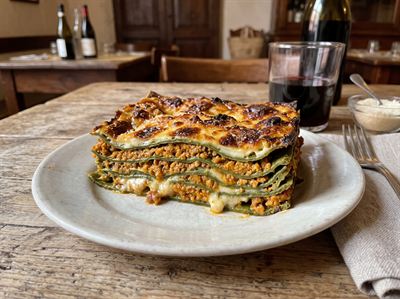
Macerata's baked pasta with meat and giblets
Macerata's baked pasta: seven or eight layers of egg pasta made with vino cotto, a red sugo of poultry, veal and pork with chicken giblets, a little béchamel and grated cheese, protected by the EU as a TSG since 2022.
- Course
- Primi & RisottiPasta & Rice
- Serves
- 6
- Hands-on
- 2 h 21 min
- Cooking
- 2 h 15 min
- Resting
- 1 h 10 min+
In breve
In short
Also called vincisgrassi, vincesgrassi, Vincisgrassi alla maceratese TSG and Marche baked pasta.
- Egg pasta kneaded with vino cotto or Marsala, rolled 2 mm–5 mm thick, blanched, and layered 7 or 8 times.
- A red sugo of poultry, veal or beef and pork, simmered until reduced by half, with chicken gizzards and livers browned apart.
- More pasta than sauce: the specification sets 50–63% pasta, 30–40% sugo and 6–10% béchamel.
- Only a little béchamel in each layer; plenty of sugo and Parmigiano Reggiano or Grana Padano on top, for a crisp crust.
- Baked at 180 °C for about 30–40 minutes, until the crust is dark red to dark brown.
La provenienza
Where this recipe comes from
Vincisgrassi are the baked pasta of the Marche, above all of the province of Macerata. Once a rich, costly dish for special occasions and noble households, it spread after the Second World War, as the middle class grew better off, and is still made for every feast. Its mark is the giblets of farmyard animals, long thrown away. Antonio Nebbia's Il cuoco maceratese of 1779 already has a ‘lasagna in princisgrass’, with ham and truffles. By legend the name honours the Austrian general Windisch-Graetz, for whom a cook in Ancona made the dish after the siege of 1799, though he was too young to have been there; a later account moves the story to 1849. The first recipe under the name is in Cesare Tirabasso's La guida in cucina, published in Macerata in 1927.
‘Vincisgrassi alla maceratese’ has been a Traditional Speciality Guaranteed (TSG) since 2022, on the application of Macerata's provincial association of cooks. Unlike a PDO or a PGI, a TSG protects a recipe, not a place: the dish may be made anywhere if it is made as the specification sets, though only a dish checked by an appointed control body may carry the name. The specification fixes egg pasta made with vino cotto or Marsala, a red sugo of meats with their bones and the giblets of farmyard animals, and a béchamel, layered seven or eight times with grated cheese and baked at 180 °C. It sets proportions rather than quantities, 50–63% pasta, 30–40% sugo and 6–10% béchamel, so the pasta leads. Our quantities are a home batch within them, every part weighed raw; at that size the veal and pork are cut by knife, as the specification allows, and the centre is checked with a probe at 75 °C.
- Provenance
- The dish itself is protected by an EU specification (TSG, PDO or PGI) that fixes how it is made.
- Defined by
- European Union
- Reference
- TSG ‘Vincisgrassi alla maceratese’, Commission Implementing Regulation (EU) 2022/509
- Sources
- EU Official Journal C 504 of 14 December 2021: application for registration, with the full TSG specification (EUR-Lex, Italian)
- Commission Implementing Regulation (EU) 2022/509, registering the TSG (EUR-Lex, Italian)
- Regione Marche: the TSG ‘Vincisgrassi alla maceratese’ registered by the EU, news of 4 April 2022 (Italian)
- Wikipedia: Vincisgrassi, for the history (Italian)
Ingredienti
Ingredients
For the pasta
For the sugo
For the béchamel
To assemble
Equipment
- Heavy pot of about 3 l, about 20 cm across, and a wooden spoon
- Small frying pan with a lid, for the giblets
- Two small saucepans and a whisk, for the béchamel
- Large wooden board and a rolling pin, or a pasta machine, and a ruler
- Wide pot for 4 l of water, a slotted spoon and a large bowl of cold water
- Two clean cotton cloths, and kitchen string for the herbs
- Rectangular oven dish about 25 cm × 20 cm, at least 6 cm deep
- Kitchen scale and a probe thermometer
Preparazione
Method
About three and three-quarter to four and a half hours. Start the sugo; while it simmers (an hour and a half to two hours), make the dough, rest it for an hour, roll and cut it, and cook the giblets. Then bone the sugo, blanch and dry the sheets (about 25 minutes), make the béchamel, assemble (about 20 minutes), bake for 30–40 minutes and rest for 10. The sugo can be made the day before: in the fridge within 2 hours of cooking, and back to the boil before you assemble.
- 2 h 21 minhands-on
- 2 h 15 mincooking
- 1 h 10 minresting, at least
The sugo
Start here. The pasta, the giblets and the béchamel are made while the sugo simmers.
-
Hands-on 15 min
Chop the guanciale finely. Cut the chicken wings at the joints, or the necks into two or three pieces, and cut the veal and pork by knife into pieces of about 1 cm. Finely chop the celery and carrot. Push the 2 cloves into the piece of onion, leaving it whole, and tie the parsley stalks and bay leaf together with string.
Tip The specification's traditional cuts are veal or beef and pork on the bone, with marrow and muscle, boned after cooking. A batch this size holds only about 100 g of them, so they are cut by knife, which the specification also allows; the chicken keeps its bones.
-
Hands-on 10–15 minHeat medium, then highOfficial text
Put the chopped guanciale in the pot with the olive oil and let it fry. Add the bones and meats, the celery, the carrot and the onion studded with cloves, and brown everything very well over a high heat. Season with salt and pepper.
Check Every piece is deep brown on all sides and the vegetables are golden; the bottom of the pot is brown, not black.
Tip Our guide: 40 ml of the oil goes in the pot; keep 10 ml for the giblets. Fry the guanciale over a medium heat for 2–3 minutes, until its fat runs, then turn the heat up before the meat goes in.
Tip Our guide: brown in one layer and turn each piece only when it comes away from the pot by itself. Salt lightly for now; taste again at the end.
-
Hands-on 2 minOfficial text
Deglaze with the white wine.
Check The wine has almost gone and no longer smells of alcohol.
Tip Our guide: 20 ml of the wine; let it bubble for 1–2 minutes, scraping the bottom of the pot.
-
Hands-on 3 minHeat mediumOfficial text
Add the concentrate and the passata and stir them into the meat for a few minutes.
Check The concentrate has darkened a shade and coats the meat.
Tip Our guide: 2–3 minutes, stirring all the time so the concentrate does not catch.
-
Cooking 1 h 30 min to 2 hHeat low: a slow, steady bubbleOfficial text
Pour in plenty of hot water, enough to cover the meat, and let it boil slowly until the sauce has reduced by half and the meat is well cooked.
Check The level has dropped by half, the sauce is thick and dark red, and the chicken comes away from the bone.
Tip Our guide: about 700 ml of water from the kettle, enough to cover the meat by about 1 cm. Add the tied herbs now. Simmer uncovered and stir every 20 minutes or so, scraping the bottom.
Tip Our guide: before it starts to simmer, stand the handle of a wooden spoon in the pot and mark the level: halfway down is the target.
Tip The specification also allows whole milk in the sugo as it simmers, but it is optional. Our guide: no more than 50 ml for this batch, which keeps the sugo within its 40% of the dish.
-
Hands-on 10 minOfficial text
Take the meat and the bones out of the sauce. Strip the meat from the bones, cut it into small pieces and put it back in the sauce.
Check No bones, cloves or herbs left in the sauce.
Tip Our guide: lift out the chicken pieces, the onion with its 2 cloves and the herbs; the small pieces of veal and pork stay in the sauce. Discard the bones, skin and cartilage, the onion, the cloves and the herbs, and cut the chicken meat into pieces of about 5 mm.
The giblets
Cook them while the sugo simmers, and stir them in once it is boned.
-
Hands-on 5 min
Trim the gizzards of any tough, silvery skin or yellow lining, and the livers of sinews and of any green spots, which taste bitter. Cut them coarsely, into pieces of about 1 cm.
-
Hands-on 4 minHeat medium-highOfficial text
Brown the giblets in the olive oil in a frying pan and deglaze with the dry white wine.
Check Browned on the outside before the wine goes in; then the wine has almost gone.
Tip Our guide: 10 ml of oil and 10 ml of wine. Brown for 3–4 minutes, stirring, before the wine goes in.
-
Cooking 15 minHeat low, coveredOfficial text
Finish cooking them for about 15 minutes.
Check The livers are brown right through, with no pink, and the gizzards are firm but tender enough to bite.
Tip Our guide: over a low heat with the lid on, adding a spoonful of water if the pan dries.
-
Hands-on 2 min
When the sugo is boned, stir in the giblets with their juices. Taste, and add salt and pepper if it needs them.
The pasta
Make the dough as soon as the sugo is simmering, so it rests while the sugo cooks.
-
Hands-on 15 minOfficial text
Knead the flour with the eggs, the vino cotto, the olive oil and the fine salt into a smooth, compact dough.
Check Smooth and compact, no longer sticky: a finger pressed in leaves a dent that fills slowly.
Tip Our guide: heap the flour on the board and make a wide well. Beat the eggs, vino cotto, oil and salt in it with a fork, draw in the flour little by little, then knead for about 10 minutes.
-
Rest 1 hOfficial text
Leave it to rest in a cool place for about an hour.
Tip Our guide: wrap it in film so it does not dry out, and leave it at cool room temperature.
-
Hands-on 25–30 minOfficial text
Roll the pasta into a thin sheet, between 2 mm and 5 mm thick, and cut it into rectangles.
Check 2 mm at the edge, measured with a ruler; 16 rectangles (at least 14), two for each layer.
Tip Our guide: divide the dough into 8 pieces of about 120 g and keep them covered. Roll each to 2 mm, the thinnest the specification allows: it then covers about 25 cm × 20 cm, the size of the dish. Cut each sheet in half across, into two rectangles of about 12.5 cm × 20 cm, which fit the pot.
Tip Our guide: a pasta machine gives even sheets; stop at the setting that gives 2 mm, and check it with the ruler.
-
Hands-on 15–20 minHeat high, a full boilOfficial text
Blanch the rectangles in boiling salted water for a few minutes, then cool them in cold water and drain them.
Check Soft and pliable, a little swollen, and still whole.
Tip Our guide: 4 l of water with 40 g of coarse salt. Two or three rectangles at a time, for about 2 minutes from when the water comes back to the boil; lift them with the slotted spoon into the bowl of cold water.
-
Hands-on 5 minOfficial text
Lay the pasta on a cloth to dry.
Check No water pooling on the sheets.
Tip Our guide: flat, in one layer, not touching; pat the tops with the second cloth.
The béchamel
Make it while the sheets dry, so it is still warm and soft when you assemble.
-
Hands-on 10 minHeat medium-lowOfficial text
Bring the milk to the boil with salt, pepper and nutmeg. Melt the butter in a small pan, add the flour and stir to a smooth paste, then add the hot milk slowly, until you have a smooth, white cream.
Check Smooth and white, with no lumps, and thick enough to coat the back of a spoon.
Tip Our guide: cook the butter and flour for a minute without letting them colour, whisk in the milk a little at a time, then simmer for 2–3 minutes, whisking.
Assembling and baking
-
Hands-on 2 min
Heat the oven to 180 °C, conventional heat, with a shelf in the middle.
-
Hands-on 15–20 minOfficial text
Butter the rectangular dish and lay in it, in layers, the pasta, the meat and giblet sauce, a little béchamel and the grated cheese. Repeat 7 or 8 times.
Check 7 or 8 even layers, each covered edge to edge with a thin film of sugo.
Tip Our guide: weigh the sugo, set about a quarter aside for the top and divide the rest by eye between the other layers. Put about a tablespoon of béchamel on each layer, in dots, and a light dusting of cheese: 10 g in all for the layers, keeping 23 g for the top.
Tip Our guide: the specification lists the grated cheese with the sugo, at 2–5% of it, and uses it only in the layers and on top; this page takes that as all the cheese in the dish, 33 g.
Tip Our guide: each layer is two rectangles side by side; trim them to the dish and patch any gaps with the trimmings. A thin layer of sauce is right, since the specification wants more pasta than sauce.
-
Hands-on 3 minOfficial text
On the last layer put plenty of sauce, a little béchamel and plenty of grated cheese, so that it forms a crisp layer once baked.
Check Sugo, dots of béchamel and cheese cover the top edge to edge.
-
Cooking 30–40 minTemp 180 °COfficial text
Bake at 180 °C for about 30–40 minutes.
Check The top is crisp and dark red to dark brown, the edges bubble, and a probe in the centre reads at least 75 °C.
Tip Our guide: if the centre is below 75 °C after 40 minutes, give it 5 minutes more, loosely covered with foil if the top is already dark.
-
Rest 10 min
Let it settle for 10 minutes, so the layers hold when you cut it, then cut it into portions and serve hot.
Tip Our guide: leftovers go into the fridge, covered, within 2 hours of baking; eat them within 3 days, reheated in the oven, covered, until the centre reads 75 °C.
Tip Our guide: to make it ahead, as the specification allows, bake the assembled dish for 20 minutes at 180 °C, then cool it and put it in the fridge, covered, within 2 hours. Use it within 3 days, or freeze it for up to 3 months; to use it, thaw it in the fridge overnight and finish it within 3 days. Finish it at 180 °C, covered, straight from the fridge, until the centre reads 75 °C, roughly 40–60 minutes; uncover it for the last minutes so the top crisps.
Tip Our guide: bake it straight from frozen only in a metal dish or one sold as freezer-to-oven: a frozen glass or ceramic dish can crack in a hot oven.
The essentials, for cooks who know the dish. Switch to Detailed for quantities, temperatures, times and checks at every step.
Press “I’m here” on the step you are on, and again when it is done.Tap the pin on the step you are on, and the tick when it is done. Timers keep running while you scroll.
Da sapere
Good to know
- WhenQuando
- A dish for feast days: once made for special occasions and in noble households, it is still prepared for every celebration. Source
- KeepingConservazione
- It can be eaten at once or later. To keep it, the specification bakes the assembled dish for 20 minutes at 180 °C, then chills it to 3 °C or freezes it at -18 °C; it may also be frozen straight away, unbaked. It keeps in its dish or in closed single portions. Source
- VariantsVarianti
- With Marsala: Marsala DOP in the pasta in place of vino cotto, which the specification allows, in the same amount. Source
- With durum wheat flour: Durum wheat flour in the pasta in place of soft wheat flour, which the specification also allows. Source
- Lasagna in princisgrass (1779): An older dish with a similar name, printed by Antonio Nebbia in Il cuoco maceratese from 1779: egg pasta cooked in half broth and half water, layered with a sauce of milk and flour cooked with diced ham and finely sliced truffles, then finished with cream, with butter and Parmigiano, and no giblets. Source
Errori comuni
Common mistakes
- Grinding the meat fine. The specification allows the veal or beef and pork only coarsely minced or cut by knife, and the meat traditionally goes in on the bone.
- Leaving out the giblets: gizzards and livers are the dish's defining ingredient.
- Too much béchamel. The specification asks for only a little on each layer, 6–10% of the dish.
- Stopping at five or six layers: the specification asks for 7 or 8.
- Dried herbs or flavourings. The specification wants fresh herbs, never dried ones or flavourings in their place.
Fuori dall'Italia
Cooking it outside Italy
- Vino cotto, the Marche's sweet wine of boiled-down must, is hard to find elsewhere: the specification allows Marsala DOP in its place, in the same amount.
- The giblets may also be the gizzards and livers of duck or goose, or a rabbit's stomach and liver, in the same weight.
- Lardo is cured pork back fat, not rendered lard. If you can find neither lardo nor guanciale, leave it out: the specification allows the sugo without either.
- The cheese must be Parmigiano Reggiano PDO or Grana Padano PDO, the two the specification names, not a generic grated ‘parmesan’.
- Tomato concentrate is tomato paste; passata is sieved tomato purée.