Torino, Piemonte
Vitello tonnato
Cold veal in tuna sauce
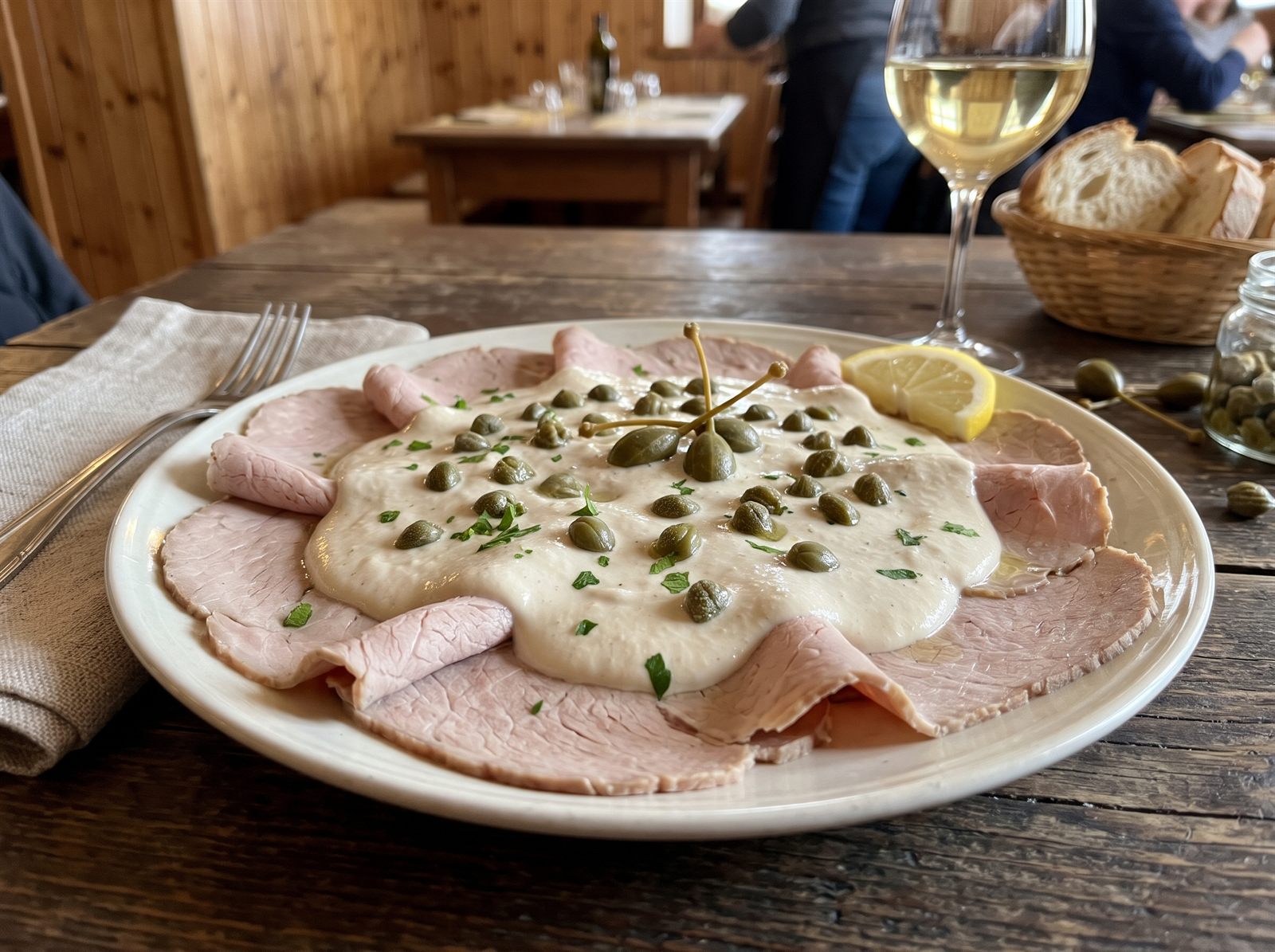
Piedmont's cold veal: girello marinated in white wine, gently simmered, sliced thin once cold and covered with a sauce of tuna, anchovies, capers and hard-boiled eggs.
- Course
- AntipastiStarters
- Serves
- 6
- Hands-on
- 35 min
- Cooking
- 1 h 7 min
- Plan
- 2 days
In breve
In short
Also called vitel tonné, vitel tonnè and veal with tuna sauce.
- Gluten-free
- Veal girello, marinated 12 hours in dry white wine, then simmered gently and lifted out at 63 °C at the centre, never past 65 °C: slightly pink.
- Sliced as thin as possible, and only once the meat is completely cold and firm.
- The sauce: hard-boiled eggs, tuna in oil, anchovies and capers, blended with the cooking broth until a little looser than mayonnaise.
- No mayonnaise in this version: the eggs and the broth bind the sauce. Mayonnaise came into fashion only in the 1980s.
La provenienza
Where this recipe comes from
Vitello tonnato, once called vitel tonné, is Piedmont's cold veal: thin slices of girello under a sauce of tuna, eggs, anchovies and capers. The name probably comes from the French tanné, ‘tanned’, and not from tonno, tuna. The dish is said to date from the eighteenth century, when it was a thrifty way with leftover meat, dressed with anchovies and oil. Tuna came later: it is in the recipe of Pellegrino Artusi, whose cookbook, first published in 1891, spread the dish across northern Italy. Mayonnaise only became the fashion in the 1980s.
There is no official recipe. We compared seven sources and publish the most widely recognised version. Most of them agree on the essentials: a piece of girello cooked in water with aromatics, sliced thin once cold and covered with a sauce of tuna, anchovies and capers, usually with hard-boiled eggs. Some cooks first marinate the meat in white wine, as this page does, and the recipes that use a thermometer cook it only until the centre is just pink, never past 65 °C; others boil it for an hour and a half. We lift it out at 63 °C, so that it stays under 65 °C as it rests. Artusi's own version, with no eggs, plenty of olive oil and lemon, and the slices left in the sauce for a day or two, is among the variants.
- Provenance
- A regional tradition documented in cookbooks and local practice, with no single official text.
- Defined by
- Piedmontese tradition
- Reference
- Compared across 7 sources, listed below; this page publishes the most widely recognised version.
- Sources
- Pellegrino Artusi: ‘La scienza in cucina e l'arte di mangiar bene’, recipe 363, vitello tonnato (Project Gutenberg, 25th edition, Italian)
- Turismo Torino e Provincia, Turin's tourism board: vitello tonnato (Italian)
- City of Asti, VisitAsti tourism site: vitello tonnato and its origins (Italian)
- Dissapore: vitello tonnato, the typical Piedmontese recipe (Italian)
- Giallo Zafferano: vitello tonnato (Italian)
- Giallo Zafferano: vitello tonnato alla maniera antica, the roasted Turin version (Italian)
- La Cucina Italiana: vitello tonnato (Italian)
Ingredienti
Ingredients
For the veal and its marinade
For the tuna sauce
To finish
Equipment
- A bowl or container that holds the meat snugly, or a food bag
- A wide pot or oval casserole of about 5 l–6 l with a lid, in which the meat lies flat, and a skimmer
- Probe thermometer
- Fine sieve
- Small pan for the eggs
- Immersion blender and a tall jug, or a food processor
- Meat slicer, or a long, sharp knife with a smooth blade
- Serving platter and cling film
Preparazione
Method
Start the evening before: 10 minutes to put the veal in its marinade, then 12 hours in the fridge. On the day allow about 5 hours, mostly waiting: about an hour to cook the meat, at least 3½ hours for it to cool and firm up (make the sauce meanwhile), and 15 minutes to slice and dress it. It serves 6 as a starter, or 4 as a main course.
- 35 minhands-on
- 1 h 7 mincooking
- 2 daysfrom start to table
The day before: the marinade
-
Hands-on 10 min
Peel the carrot, the onion and the garlic, pull the strings from the celery, and cut the vegetables into chunks. Trim the fat and gristle from the surface of the meat, keeping it in one piece.
-
Rest 12 h
Put the meat in a bowl or container that holds it snugly, with the vegetables, the bay leaf, the salt, the cloves and the peppercorns. Pour in the wine to cover, cover the container and leave it in the fridge for 12 hours.
Tip If the wine does not cover the meat, turn it once halfway through. A food bag with the air pressed out keeps it covered with less wine.
On the day: cooking the veal
-
Cooking 15–20 minHeat medium-high
Lift out the meat and strain the marinade, keeping the vegetables and spices. Put the meat, the vegetables and spices, the strained wine and 2 l of cold water in the pot. If the liquid does not cover the meat, add cold water until it does. Bring it to the boil, and as it heats, skim off the foam that rises.
Check The liquid covers the meat, it boils, and no more foam rises.
-
Cooking 40–45 minTemp 63 °CHeat low, a bare simmer
Lower the heat so the liquid barely simmers, put the lid on and cook for about 45 minutes. From 35 minutes on, check the centre of the thickest part with a probe thermometer, and lift it out of the pot onto a plate as soon as it reads 63 °C. Left in the hot broth it keeps cooking, and even on the plate the centre still rises a little.
Check 63 °C at the centre when you lift it out; as it rests it should not pass 65 °C, and the meat stays slightly pink inside.
Tip A bigger piece takes longer, about 30 minutes for every 500 g: go by the thermometer, not the clock.
-
Hands-on 5 min
Strain the broth through a fine sieve and keep about 150 ml of it for the sauce.
Tip Keep the rest of the broth for a risotto, as Artusi advises.
-
Rest 3 h 30 min
Leave the meat on the plate for about 30 minutes, until it stops steaming, then wrap it in cling film and put it in the fridge for at least 3 hours, or overnight. It must be completely cold before you slice it, so that it is firm. Make the sauce meanwhile.
Check Cold right through and firm to the touch.
The tuna sauce
-
Cooking 12–15 min
Put the eggs in a small pan with plenty of cold water and bring it to the boil. From the moment it boils, cook them for 9 minutes, then drain them and cool them under cold running water. Peel them and cut them into quarters.
Check The yolk is firm right through.
-
Hands-on 5 min
Put the eggs, the drained tuna, the anchovy fillets and the drained capers in a tall jug. Blend with an immersion blender (or in a food processor), adding the broth a little at a time, and more if needed, until the sauce is smooth and just a little more fluid than mayonnaise. Cover it and keep it in the fridge until you serve.
Check Smooth, with no flakes of tuna left, and it flows slowly off a spoon.
Tip For a sharper sauce, add a tablespoon of wine vinegar or lemon juice. Usually the capers and the wine in the broth make it sharp enough.
Slicing and serving
-
Hands-on 10 min
Unwrap the cold meat and slice it across the grain as thin as you can, ideally with a meat slicer, otherwise with a long, sharp knife with a smooth blade.
Check Thin, even slices that hold together.
-
Hands-on 5 min
Lay the slices on a serving platter, cover them with the sauce and decorate with a few capers or caper berries, some whole and some halved. Serve cool.
The essentials, for cooks who know the dish. Switch to Detailed for quantities, temperatures, times and checks at every step.
Press “I’m here” on the step you are on, and again when it is done.Tap the pin on the step you are on, and the tick when it is done. Timers keep running while you scroll.
Da sapere
Good to know
- WhenQuando
- A summer dish, served cool, as an antipasto or as a second course. Source
- KeepingConservazione
- Covered with cling film, it keeps 1–2 days at most in the fridge; better to keep the sauce apart. Do not freeze it. The leftover broth is good for a risotto. Source
- VariantsVarianti
- With oil and lemon, no eggs: Pellegrino Artusi's recipe 363: 1 kg of milk-fed veal from the leg or rump, larded with two anchovies, tied and put into generously salted boiling water with a quarter onion stuck with two cloves, a bay leaf, celery, carrot and parsley, and boiled for an hour and a half. Once cold it is sliced thin and left for a day or two in a sauce of 100 g of tuna in oil and two anchovies, sieved with plenty of olive oil and the juice of a lemon or more, finished with a handful of capers. Served with lemon wedges. Source
- With sage and gherkins: A version for eight: 1 kg of girello marinated for about 24 hours in white wine with bay, cloves, sage and celery, then boiled in the strained wine and water for an hour and a half, with six salted anchovies added for the last 30 minutes. The sauce blends 300 g of tuna with the yolks of three hard-boiled eggs, capers, lemon juice, the cooked anchovies, half a glass of olive oil and a spoonful of vinegar, loosened with two small ladles of broth; garnished with capers and gherkins. Source
- Alla maniera antica, roasted: An old-fashioned Turin version: the girello is browned, then cooked with the tuna, anchovies and capers, splashed with white wine and milk, and roasted at 180 °C for 7–8 minutes a side. The pan juices are blended with hard-boiled eggs, olive oil, vegetable broth and Marsala, and a teaspoon of this cream goes on each slice, folded into a half-moon, so that every mouthful gets its share of sauce. Source
- With mayonnaise: Some versions bind the sauce with mayonnaise instead of the hard-boiled eggs. Source
Errori comuni
Common mistakes
- Letting the centre of the meat go past 65 °C: it turns grey and dry, where it should be tender and slightly pink.
- Slicing it before it is completely cold: the meat is not yet firm and will not cut thin.
- A sauce as thick as mayonnaise: loosen it with broth until it is just a little more fluid.
Fuori dall'Italia
Cooking it outside Italy
- Girello, also called magatello, is a long, lean muscle of the leg: eye of round in the US; in Britain it is part of the silverside.
- Salted capers can stand in for capers in vinegar: rinse them under running water first.
- No meat slicer? Chill the meat well and use your longest, sharpest knife with a smooth blade.