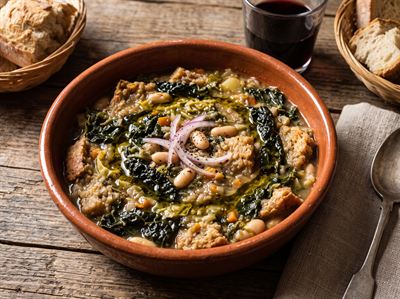
Valpelline, Valle d'Aosta
Zuppa alla valpellinentze
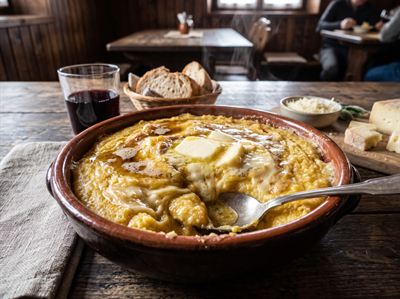
Valpelline baked soup of bread, Fontina and broth
Valpelline's baked soup of stale white bread and Fontina in three layers, soaked in a meat broth made with Savoy cabbage and herbs and finished with cinnamon butter, as the town's De.C.O. recipe sets it out.
- Course
- ZuppeSoups
- Serves
- 4
- Hands-on
- 1 h 14 min
- Cooking
- 2 h 10 min
- Resting
- 5 min+
In breve
In short
Also called Seupa à la Vapelenentse, Seupa à la Vapelenentze, Seupa Vapelenentse, zuppa valpellinese, zuppa alla valpellinese, Valpelline soup and Vapelenentse soup.
- Stale white bread in 1 cm slices and Fontina in 2 mm–3 mm slices, laid in three layers, each fully covered by the cheese.
- The Savoy cabbage goes only into the meat broth, never between the layers.
- Soaked with boiling broth, then covered with butter melted with a pinch of cinnamon.
- Baked for 40 minutes at 200 °C–220 °C, until the top is golden but not burnt.
La provenienza
Where this recipe comes from
The seupa comes from Valpelline, a village of some six hundred people in the Buthier valley, a few kilometres north of Aosta. It was born of thrift: white bread was once bought almost only for the sick and the elderly, and it cost too much to throw away, even when stale. The village began offering it to visitors as its typical dish in the 1960s, and it has long been the heart of the summer Sagra, held on the last weekend of July for the patron saint's feast. As early as 1971 a local paper ran the headline that the true Vapelenentse is made without cabbage; today the town allows it only in the broth.
In July 2007 Valpelline became the first town in the Aosta Valley to set up a De.C.O., a municipal designation of origin, and by the mayor's decree no. 7 of 17 July 2007 granted it to the recipe of the village Pro Loco, number 1 in the town's register. This page follows that recipe, as the town published it. The town's recipe names the broth's herbs and cabbage but not its meat: the beef and the cooking time here come from the region's file on the dish, which lists it among Italy's traditional food products (PAT), and the amounts are our own. The town's old website is no longer online, so its pages are linked through the Internet Archive.
- Provenance
- A reference recipe set by a protection consortium or by the town the dish is named after.
- Defined by
- Comune di Valpelline, for the recipe of the Pro Loco di Valpelline
- Reference
- De.C.O. (Denominazione Comunale di Origine) recipe, Mayor's decree no. 7 of 17 July 2007, register no. 1
- Sources
- Comune di Valpelline: the De.C.O. recipe for the Seupa à la Vapelenentse (Internet Archive, 2022 copy; Italian)
- Comune di Valpelline: Mayor's decree no. 7 of 17 July 2007, granting the De.C.O. (Internet Archive; Italian)
- Comune di Valpelline: how the town set up its De.C.O. in 2007 (Internet Archive; Italian)
- Regione Autonoma Valle d'Aosta: the file on the Seupa à la Vapelenentse as a traditional food product (PAT) (Italian)
- LoveVDA, the Aosta Valley's official tourism site: Seupa à la Vapelenentse, recipe for four (Italian)
- Gambero Rosso: how a stale-bread soup became the pride of the Aosta Valley (Italian)
Ingredienti
Ingredients
For the broth (makes about 2 litres, for 4)
For the seupa
Equipment
- Stockpot of at least 5 l, with a lid
- Skimmer and a fine sieve
- Bread knife, and a sharp knife or a slicer for the Fontina
- Baking dish about 20 cm × 25 cm and at least 7 cm deep
- Ladle and a fork
- Small saucepan for the butter
- Pastry brush
Preparazione
Method
Make the broth first, or the day before: about 2½ hours, most of it unattended. Then about 1 hour 20 minutes: 35 minutes to slice and layer while the oven heats, 40 minutes in the oven and a few minutes of rest. Buy the bread the day before.
- 1 h 14 minhands-on
- 2 h 10 mincooking
- 5 minresting, at least
The broth (it can be made the day before)
-
Hands-on 10 min
Put the beef, the bone, the quarter of cabbage, the carrot, the onion, the sage, the rosemary, the bay leaves and 10 g of coarse salt in the stockpot, and pour in 2.5 l of cold water. Meat and bones start in cold water, so the broth takes all their flavour.
Tip This is the only place the cabbage goes. In Valpelline it never goes between the layers: with cabbage in them it is another dish.
-
Hands-on 20–30 minHeat medium
Heat over medium heat so the water comes to the boil slowly, in 20–30 minutes. As it nears the boil, grey foam rises: lift it off with the skimmer, again and again.
Check The surface stays clean.
-
Cooking 1 h 30 min to 2 hHeat low, a gentle simmer
Lower the heat until the surface barely trembles, set the lid ajar and leave the broth to cook for 1½–2 hours, skimming off any new foam now and then.
Check The broth is golden and full of flavour.
-
Hands-on 10 min
Lift out the meat, the bone and the vegetables with the skimmer, then pour the broth through the fine sieve into a clean pan. You need about 1.5 l for the seupa; keep any extra. Keep the broth hot over low heat while you make the layers.
Check Clear, with no bits of vegetable or herb left in it.
Tip Made the day before: stand the pot in a sink of iced water, or pour the broth into shallow containers, so it drops below 20 °C within 2 hours; then keep it in the fridge at 4 °C and use it within 3 days. Bring it back to a full boil before you start the layers.
The layers
-
Temp 200 °C–220 °C
Turn the oven on to 200 °C–220 °C now, conventional setting (top and bottom heat): it heats while you slice and layer, and is hot when the seupa goes in.
Tip With a fan oven, set it lower, to 180 °C–200 °C: a fan browns the top faster, and it must not burn.
-
Hands-on 5 minOfficial text
Cut the bread, bought the day before, into slices about 1 cm thick.
Check Even slices, all about 1 cm.
Tip The region's file on the dish lets the bread go stale for 3 or 4 days: older bread works too, as long as it is not fresh.
-
Hands-on 10 minOfficial text
Slice the Fontina, without its rind, about 2 mm–3 mm thick.
Check Thin, even slices that lie flat.
-
Hands-on 1 minOfficial text
Take about 10 g of the butter and grease the baking dish, bottom and sides. Keep back another small piece, about 10 g, for later.
-
Hands-on 10 minOfficial text
Lay a layer of bread in the dish, the slices close together so there are no gaps; cut pieces to fill the corners. Cover it with a layer of Fontina in the same way, so that no bread shows. Repeat twice more, for three layers of each, finishing with Fontina.
Check Three layers of bread, each completely covered by Fontina, with Fontina on top.
-
Hands-on 5 minOfficial text
Bring the broth to a full boil. Pour about 1.5 l over the seupa, no more, slowly, a ladle at a time, and prick through the layers with a fork here and there so it soaks in evenly. Do not overdo the pricking: a few holes, not all over, so the layers of cheese stay whole.
Check All of the 1.5 l has gone in, and a fork pushed in at a corner and at the centre comes out wet from the bottom layer.
Tip The broth must be boiling, not just hot.
-
Hands-on 3 minHeat lowOfficial text
Melt the remaining butter, about 130 g, with the pinch of cinnamon in the small saucepan. Pour it evenly over the whole surface.
Check The butter is fully melted and very hot, just starting to foam, but not browned.
In the oven
-
Cooking 40 minTemp 200 °C–220 °COfficial text
Bake the seupa in the hot oven at 200 °C–220 °C (conventional setting) for 40 minutes, until the top is golden, without letting it burn. If the top looks dry towards the end, brush it with the piece of butter you kept back.
Check The Fontina on top is golden all over and starting to form a crust, with no dark or burnt patches.
Tip Look at it from 30 minutes on: ovens differ, and the top must colour, not burn.
-
Rest 5 minOfficial text
Take the dish out of the oven a few minutes before it goes to the table and let it rest. Serve it hot, spooning each portion down to the bottom layer, into warmed soup plates.
Tip The region's tourism site suggests an Arnad Montjovet wine with it, served at 18 °C.
The essentials, for cooks who know the dish. Switch to Detailed for quantities, temperatures, times and checks at every step.
Press “I’m here” on the step you are on, and again when it is done.Tap the pin on the step you are on, and the tick when it is done. Timers keep running while you scroll.
Da sapere
Good to know
- WhenQuando
- A Sunday dish in the valley's trattorie and a holiday one at home, Christmas included; Valpelline's own Sagra della Seupa falls on the last weekend of July. Source
- VariantsVarianti
- At Christmas, with a white ragù: In some homes the Christmas seupa also gets a white ragù of minced beef, lardo (cured pork back fat), pancetta, onions and herbs; the bread, Fontina and broth are unchanged. Source
- Baked in two stages: The region's file bakes it for 20–25 minutes at about 200 °C–220 °C, rests it for about 10 minutes, then finishes it at 190 °C–200 °C for 20 minutes until golden, and brushes the top with a piece of butter. Source
- Seupa i plat: With cabbage between the layers. In Valpelline this counts as a different dish. Source
Errori comuni
Common mistakes
- Putting cabbage between the layers. In Valpelline it goes only into the broth; with cabbage in the layers it is another dish.
- Fresh bread. The bread should be at least a day old.
- Gaps between the slices, or bread showing through the cheese: each layer of bread must be close-packed and completely covered by Fontina.
- Broth that is only warm. It must be boiling when it goes on.
- A burnt top. Take it to golden and no further, and brush it with butter if it looks dry.
Fuori dall'Italia
Cooking it outside Italy
- The bread is a plain white country loaf (‘pane casereccio’, as the region's tourism site calls it), not rye, wholemeal or dark bread.
- The cheese is Fontina PDO, as the region's file names it.
- The broth: the region's file asks for beef and bones of the Valdostana breed, but the town's recipe asks only for a meat broth, so any beef for boiling will do.
- The butter: the region's file names the Aosta Valley's cream butter (beuro) or whey butter; the town's recipe asks only for butter.