Guarcino, Lazio
Amaretto di Guarcino
Guarcino's soft almond biscuits
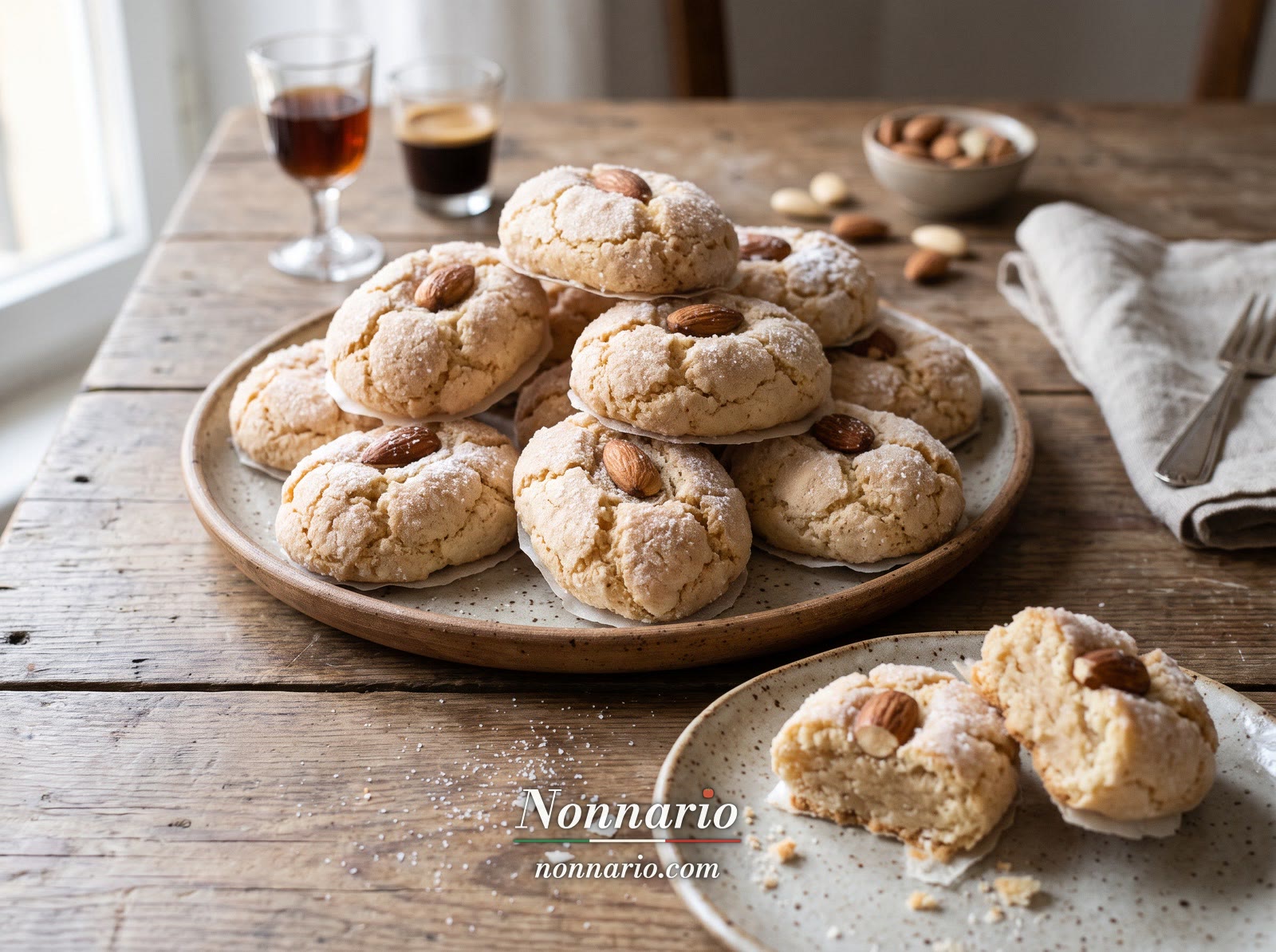
Guarcino's soft almond biscuits, a PGI applied for in 2025: peeled sweet almonds and bitter almonds ground fine, kneaded with sugar and egg white, shaped by hand into rounded lozenges on starch wafers and baked until hazelnut brown and cracked.
Applied for as a PGI in 2025 (EU file PGI-IT-03436) and not yet decided: the proposed specification may still change, or the name may not be registered.
- Course
- DolciDesserts
- Serves
- 11
- Hands-on
- 50 min
- Cooking
- 55 min
- Resting
- 45 min+
The video and the photos of every step are also gathered on a separate page.
In breve
In short
Also called Amaretto di Guarcino IGP, amaretti di Guarcino, Guarcino amaretti and Guarcino almond biscuits.
- Vegetarian
- Peeled sweet almonds, bitter almonds, egg whites and granulated sugar, each amaretto on its own starch wafer: no flour, butter or raising agent.
- Shares of the paste: sweet almonds 35–40%, bitter almonds 4–7%, egg whites 15–20%, sugar 35–40%, each within 2% either way.
- The almonds are ground fine and kneaded with the sugar and whites, then shaped between the fingers into rounded lozenges on the wafers.
- Baked at 150 °C–200 °C for 25–35 minutes: hazelnut brown, with marked cracks along the length, and soft, unlike dry amaretti.
- Each weighs 35 g–45 g and measures 6 cm–10 cm long, 4 cm–6 cm wide and 1 cm–2 cm thick.
La provenienza
Where this recipe comes from
Guarcino is a small medieval town in the province of Frosinone, among the Ernici Mountains of Lazio, and its amaretto is a soft biscuit of sweet and bitter almonds. A legend says the recipe was given to a family of the town by a passing friar, in thanks for their hospitality. The record begins in the early twentieth century: from 1909 diplomas from national and international fairs tie the name of Guarcino to ‘amaretti alla mandorla’. Made by the town's bakers or at home, they were sold in the café on the main square or ordered from the women skilled at making them, for family feasts and ceremonies, which always ended with them; above all they were the sweet given to brides, and they are still suggested as a gift for wedding guests. From the 1930s guidebooks and encyclopaedias name the amaretti among the town's specialities. By local memory, and as G. Floridi's book on the amaretto of 1992 records, their fame came mostly from the spa visitors of nearby Fiuggi, and the coach tours that stopped in Guarcino to buy them; skiers at Campo Catino helped too. The craft spread to the neighbouring towns, and emigrants carried it further, since the amaretti are still sent to family and friends as a gift. They are a Christmas sweet in Ciociaria as well. Since 2011 Guarcino has held a Festa dell'Amaretto every year, in the third week of September, and the biscuit is on Lazio's list of traditional food products.
‘Amaretto di Guarcino’ has been applied for as a PGI. The Associazione produttori Amaretto di Guarcino wrote the specification; after a public hearing in Guarcino in February 2025 the Ministry of Agriculture published it in the Gazzetta Ufficiale of 3 April 2025, and the application reached the European Commission in 2025, where it is still pending. The proposed area is the towns of Alatri, Guarcino, Fiuggi, Torre Cajetani, Trivigliano and Vico nel Lazio. The specification sets the shares of the paste: peeled sweet almonds 35–40%, bitter almonds 4–7%, egg whites 15–20% and granulated sugar 35–40%, each with a tolerance of 2% either way, and starch wafers as the base of each piece; only natural preservatives may be added. The almonds are ground fine and kneaded with the sugar and the whites, the paste is portioned by hand or by machine straight onto the wafers in the shape of a rounded lozenge, pressed between the index fingers, and baked in a preheated oven at 150–200 °C for 25–35 minutes. As sold, each piece is hazelnut brown, with marked cracks mostly along its length, 6–10 cm long, 4–6 cm wide, 1–2 cm thick and 35–45 g in weight; it is soft, unlike dry amaretti, and neither sweet nor bitter, from the balance of the two almonds.
The specification sets shares, not a household batch. The quantities here are ours, worked out from it for 500 g of paste: sweet almonds 38%, bitter almonds 4%, egg whites 19% and sugar 39%. The bitter almonds are kept at the bottom of their range, by our choice, because they release cyanide; they are weighed, never added by eye. The steps marked as official give the specification's words; the oven at 180 °C for 25–30 minutes, within its range, the drying of the almonds and the size of each piece are ours, each said where it applies. One home recipe uses icing sugar and whips the whites to stiff peaks; it is among the variants. Made outside the six towns, these are amaretti in the Guarcino manner, not Amaretto di Guarcino.
- Provenance
- An application to protect the dish in the EU (TSG, PDO or PGI) is under way; this page follows its specification as it stands, which may change before it is granted.
- Defined by
- Associazione produttori Amaretto di Guarcino (PGI applicant)
- Reference
- PGI ‘Amaretto di Guarcino’, applied for (EU file PGI-IT-03436); proposed production specification published by the Ministry of Agriculture in the Gazzetta Ufficiale n. 78 of 3 April 2025
- Sources
- Gazzetta Ufficiale n. 78 of 3 April 2025: the Ministry of Agriculture's notice of the application for the PGI, with the proposed production specification (Italian)
- European Commission, eAmbrosia: the EU register entry for the PGI application PGI-IT-03436, status applied
- ARSIAL, the Lazio Region's agency for agricultural development: Lazio's entries in the national list of traditional food products, 2026 (Italian, PDF)
- VisitLazio, the official tourism site of the Lazio Region: Amaretti di Guarcino, with a home recipe (Italian)
- VisitLazio, the official tourism site of the Lazio Region: the sweetest side of Ciociaria at Christmas time
- Ciociaria Oggi, Frosinone daily newspaper: the Amaretto di Guarcino and its PGI hearing, by Arianna Castaldi, 17 February 2025 (Italian)
- European Food Safety Authority (EFSA), Panel on Contaminants: health risks of cyanogenic glycosides in foods other than raw apricot kernels, EFSA Journal, 2019
Ingredienti
Ingredients
The original recipe serves 11
The paste
For shaping
Equipment
- Kitchen scale, ideally one that weighs single grams (for the bitter almonds)
- Small saucepan, a sieve and a clean cloth, to blanch and peel the almonds
- Food processor (or a large mortar)
- A large baking tray, about 30 cm by 40 cm, and baking paper
- Large bowl and a fork
- Small scissors, a wire rack and a tin with a tight lid
Preparazione
Method
Scaled to 11 servings: the amounts in the steps follow. Pot and pan sizes and cooking times are still for the original 11.
About 2 hours 35 minutes, much of it waiting: 15 minutes to blanch and peel the almonds, 15 to dry them and 15 to cool them, 15 for the oven to heat, 10 to grind and knead the paste, 5 to cut the wafers, 15 to shape, 25–30 in the oven, 30 to cool and 5 to trim. By our estimate the quantities make about 11 amaretti, on one large tray; each serving here is one amaretto.
- 50 minhands-on
- 55 mincooking
- 45 minresting, at least
The almonds
-
Hands-on 15 min
Bring a small pan of water to the boil. Put the sweet almonds in one bowl and the bitter almonds in a small bowl of their own, cover both with the boiling water and leave them for 1 minute. Drain each bowl in turn in the sieve and pinch each almond between your fingers, so that it slips out of its skin. Pat them dry with the cloth, still in their two lots, and weigh out 190 g of the sweet almonds and 20 g of the bitter ones, to the gram.
Check Every almond is white all over, with no brown skin left, and the two lots weigh 190 g and 20 g.
Tip Our guide: the specification asks for peeled sweet almonds and does not say whether the bitter ones are peeled; this page peels both, as the home recipe among the variants does.
Tip Our guide: with almonds bought already peeled, peel only the bitter ones.
Tip Our guide: the bitter almonds are blanched and weighed on their own because, once peeled, they look like the sweet ones. Put any left over back in their packet, out of the reach of children.
-
Cooking 15 minTemp 100 °C
Heat the oven to 100 °C. Spread the peeled almonds on a tray and dry them in the oven.
Check Dry to the touch all over, with no damp patches, and still pale: they should not colour.
Tip Our guide: almonds bought already peeled need only about 10 minutes.
-
Rest 15 min
Take the almonds out and leave them on the tray until cold.
Check Cold to the touch.
Tip Warm almonds release their oil in the food processor and the paste turns greasy.
The paste
-
Cooking 15 minTemp 180 °C
Heat the oven to 180 °C, static (top and bottom heat), with a shelf in the middle. Line the tray with baking paper.
Check The oven has reached 180 °C: its light has gone off, or an oven thermometer reads it.
-
Hands-on 5 minOfficial text
Grind the sweet and the bitter almonds finely.
Check A fine, even powder, with no pieces of almond left and no sign of oil.
Tip Our guide: in the food processor, all the almonds with 2 tablespoons of the 195 g of sugar, in short pulses of a few seconds. Stop as soon as it is fine: ground too long, it clumps and turns oily.
Tip Safety, from the European Food Safety Authority: raw bitter almonds release cyanide quickly when chewed; at the highest level it has recorded, 0.1 g–1.4 g of them eaten at once, depending on body weight, reaches the acute reference dose, the safe amount for a single eating occasion: less than half a small almond for a toddler, one large almond for an adult. Each amaretto here is made with about 1.8 g of them. The authority gives no figure for bitter almonds once baked; it notes that heating lowers both the cyanide and the activity of the enzyme that releases it.
Tip Our guide: keep the bitter almonds away from children, and never taste the raw paste, which also holds raw egg white.
-
Hands-on 5 minOfficial text
Knead the ground almonds together with the sugar and the egg white.
Check A soft, even, slightly sticky paste that holds its shape when pressed, with no dry powder left.
Tip Our guide: tip the ground almonds and the rest of the sugar into the large bowl and mix them. Break up the 95 g of egg white with a fork, without whipping it, pour it in and stir, then knead the paste with one hand in the bowl for 2–3 minutes.
Shaping
-
Hands-on 5 min
Cut the wafer sheets into ovals about 9 cm long and 6 cm wide and lay them on the lined tray in three rows of four, one place left empty, their long sides across the width of the tray, about 1 cm apart.
Check 11 wafers on the tray, none touching.
Tip Our guide: the ovals are cut a little larger than the amaretti; what sticks out is trimmed after baking.
-
Hands-on 15 minOfficial text
Portion the paste by hand straight onto the wafers, giving each piece the characteristic shape of a rounded lozenge, pressed between the index fingers with quick, simple movements. The wafers stay on the amaretti.
Check Weigh the first piece: about 45 g. Each is a rounded lozenge about 7 cm long, 4.5 cm wide and 2 cm high, centred on its wafer.
Tip Our guide: wet your fingers lightly in cold water so that the paste does not stick. Roll each piece into a ball, set it on a wafer, then press it from both sides between your index fingers to draw out the two points, and smooth the top.
Tip Our guide: baked, the specification wants 35 g–45 g, 6 cm–10 cm long, 4 cm–6 cm wide and 1 cm–2 cm thick; a piece of 45 g loses a little water in the oven and lands within it.
Baking
-
Cooking 25–30 minTemp 180 °COfficial text
Bake them in a preheated oven at 150 °C–200 °C, for 25–35 minutes.
Check Hazelnut brown all over, with marked cracks mostly along their length; firm on the outside but still soft when pressed gently.
Tip Our guide: at 180 °C, static, on the middle shelf, for 25–30 minutes. Look from 25 minutes and take them out while they still give a little: they firm up as they cool.
Tip Our guide: if they are still pale at 30 minutes, give them up to 5 minutes more, within the specification's 35.
-
Rest 30 minOfficial text
Leave the amaretti to cool once baked.
Check Cold right through. Weigh one: 35 g–45 g, and about 1 cm–2 cm thick. Our guide: if it is heavier, shape the next batch a little smaller; if lighter, a little larger.
Tip Our guide: leave them on the tray for 10 minutes, since they break if lifted warm, then move them to the wire rack.
-
Hands-on 5 min
Cut away the wafer that sticks out beyond each amaretto with the small scissors. Keep them in a tin with a tight lid.
Check Each amaretto sits on its own wafer, with none showing round the edge.
Tip Our guide: an airtight tin keeps them soft; the specification's packs are sealed airtight too.
The essentials, for cooks who know the dish. Switch to Detailed for quantities, temperatures, times and checks at every step.
Press “I’m here” on the step you are on, and again when it is done.Tap the pin on the step you are on, and the tick when it is done. Timers keep running while you scroll.
Da sapere
Good to know
- WhenQuando
- For family feasts and ceremonies, and above all weddings: it was the sweet given to brides, and it is still suggested as a gift for wedding guests. Source
- VariantsVarianti
- With whipped whites and icing sugar: For four: 200 g of sweet almonds and 20 g of bitter almonds, peeled, dried in the oven and pounded in a mortar, mixed with 300 g of icing sugar and a pinch of salt; the whites of 4 eggs whipped stiff and folded in a little at a time. The paste is set in small ovals on wafer discs on a floured tray and baked at 180 °C for 30 minutes. Source
Errori comuni
Common mistakes
- Adding bitter almonds by eye, or more than the 20 g: they release cyanide. Weigh them to the gram.
- Using icing sugar: the specification names granulated sugar.
- Adding flour, butter, yolks, a raising agent or flavourings: none is in the specification.
- Grinding the almonds warm, or for too long: they turn oily and the paste goes greasy.
- Shaping them too big: baked, each must weigh 35 g–45 g.
- Taking them out pale, or baking them until hard: they should be hazelnut brown and still soft inside.
- Lifting them warm: the soft paste breaks.
Fuori dall'Italia
Cooking it outside Italy
- Bitter almonds are sold in Italy as mandorle amare. The specification names bitter almonds; apricot kernels (armelline) are not among its ingredients.
- Peeled almonds are sold as blanched almonds; with them, skip the blanching and peel only the bitter almonds.
- Ostie are wafer paper, the thin edible starch sheets sold for baking and cake decorating.
- Granulated sugar is ordinary white sugar.
From nonnario.com/recipes/amaretto-di-guarcino/, where you will find its sources, its story and the step photos. Sources checked in November 2026.