Roma, Lazio
Carciofi alla romana
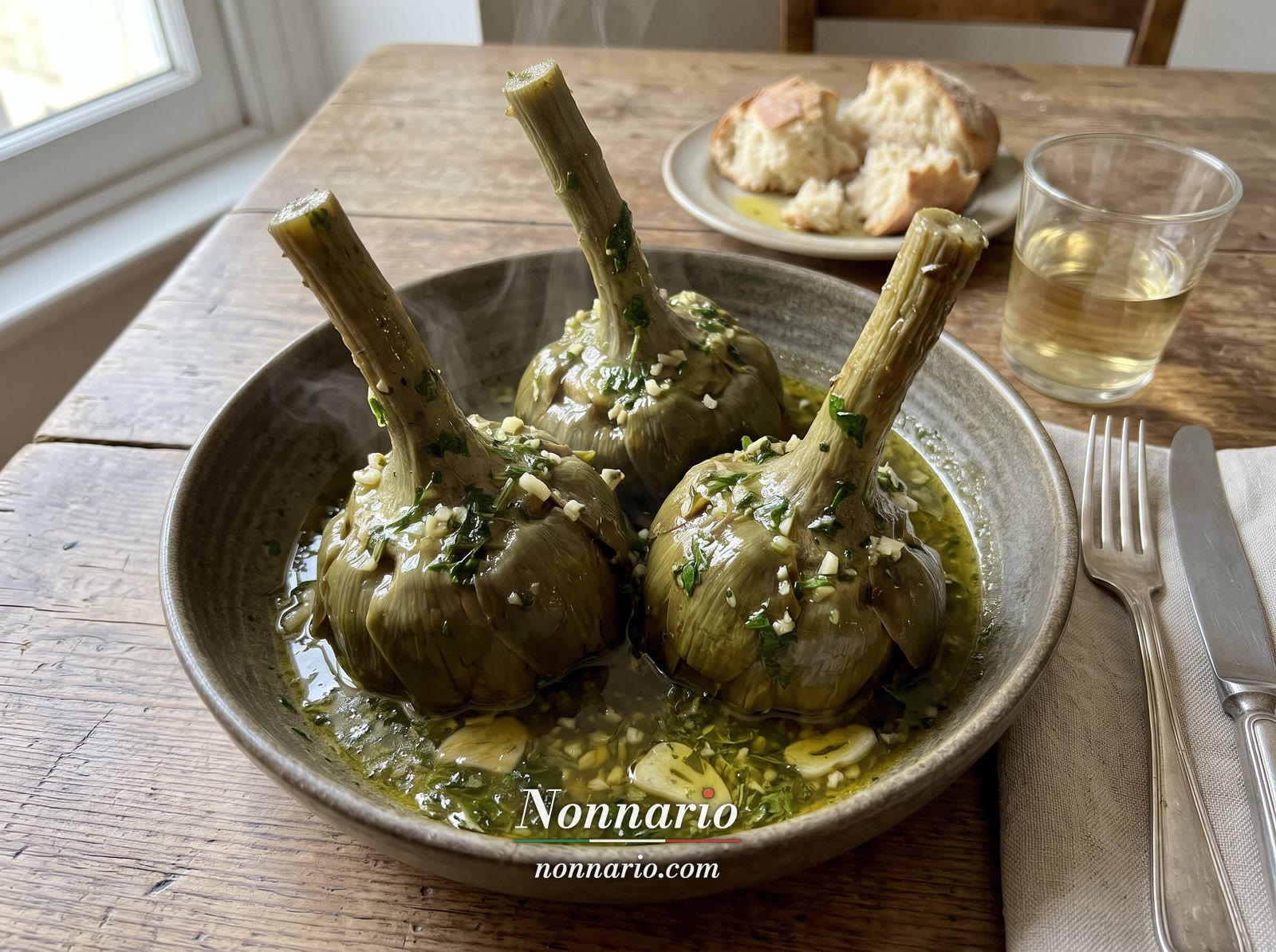
Roman artichokes filled with mentuccia, parsley and garlic, braised upside down in oil and water
Whole romanesco artichokes trimmed to their tender heart, filled with chopped mentuccia, parsley and garlic, and braised upside down in olive oil and water until soft but whole: the Roman side dish of the artichoke protected in Lazio as a PGI since 2002.
- Course
- ContorniSide Dishes
- Serves
- 4
- Hands-on
- 1 h
- Cooking
- 34 min
- Resting
- 5 min+
The video and the photos of every step are also gathered on a separate page.
In breve
In short
Also called carciofo alla romana, Roman-style artichokes and artichokes Roman style.
- Vegetarian
- Vegan
- Gluten-free
- Whole romanesco artichokes (mammole), round and without thorns, trimmed to the tender leaves and kept in lemon water so they do not darken.
- Filled with a fine chop of mentuccia, parsley and garlic, loosened with a little olive oil and salt; this version has no breadcrumbs, anchovy or cheese.
- Packed upside down, stems up, tight against each other in a high-sided pot, so they cannot open out.
- Braised in olive oil and water a third of the way up, under parchment, about 30 minutes, until a toothpick slides into the base.
La provenienza
Where this recipe comes from
Carciofi alla romana are a side dish of Rome and Lazio: whole artichokes, opened out, filled with a chop of mentuccia, parsley and garlic and braised standing on their heads in olive oil and water. They are not carciofi alla giudia, the other Roman artichoke, which are opened and deep-fried. The artichoke for both is the romanesco, also called mammola or cimarolo: round, compact, green shading to violet, with a small hole at the top and no thorns. Grown along the coast and plains of the provinces of Viterbo, Rome and Latina from the cultivars Castellammare and Campagnano, and picked from January to May, it has been protected by the EU as the PGI Carciofo Romanesco del Lazio since a regulation of 21 November 2002. The application for the PGI traces its cultivation in Lazio, by some authors' account, back to the Etruscans, citing artichoke leaves depicted on the walls of tombs at Tarquinia; it grew after the Second World War, and in 1950 Ladispoli held its first artichoke festival, on 2 April. A story often told has Caravaggio, in 1604, attacking a waiter in a Roman tavern for serving him artichokes cooked in butter.
There is no official recipe: the PGI specification covers the artichoke, not the dish. We compared ten sources and publish the most widely recognised version: eight artichokes for four, trimmed and kept in lemon water, filled with parsley, mentuccia and garlic with a little oil and salt, and braised upside down on the hob in olive oil and water under a sheet of paper for about 30 minutes. Most of them agree on the trimming, the herbs, the artichokes packed tightly with their stems up, and a slow braise in oil and water. They differ on the rest: some bake them in the oven, some add white wine, some put anchovy, breadcrumbs or grated cheese in the filling while others never would, and some add pepper. Ours are the pot size, the amounts of oil and water, the heat, the short rest and the fridge rules, which follow food-safety guidance: out of the fridge 2 hours at most, eaten within 2 days.
- Provenance
- A regional tradition documented in cookbooks and local practice, with no single official text.
- Defined by
- Roman tradition
- Reference
- Compared across 10 sources, listed below; this page publishes the most widely recognised version.
- Sources
- EU Official Journal C 51 of 26 February 2002: the application to register Carciofo romanesco del Lazio as a PGI, with the summary of its specification (EUR-Lex, Italian)
- Commission Regulation (EC) No 2066/2002 of 21 November 2002, registering Carciofo romanesco del Lazio as a PGI (EUR-Lex, Italian)
- ARSIAL, the Lazio Region's agency for agriculture: Carciofo Romanesco del Lazio IGP, a product sheet from its book on Lazio's food heritage, with a recipe for 4 (PDF, Italian)
- Scatti di Gusto (online food magazine): carciofi alla romana, a recipe for 4, 2021 (Italian)
- Dissapore (food magazine): six Roman side dishes, with carciofi alla romana, 2022 (Italian)
- GialloZafferano: carciofi alla romana, editorial recipe for 4 made with a Roman osteria (Italian)
- La Cucina Italiana: carciofi alla romana, a recipe for 4, 2026 (Italian)
- Accademia Italiana della Cucina: carciofi con la mentuccia, a Lazio recipe from its recipe collection, for 4 (Italian)
- Turismo Roma, Rome's official tourism portal: the artichoke, with a recipe for carciofi alla romana (Italian)
- USDA Food Safety and Inspection Service: Leftovers and Food Safety (archived copy of 29 May 2025)
Ingredienti
Ingredients
The original recipe serves 4
For the artichokes
For the filling
For the pot
Equipment
- Disposable or rubber kitchen gloves
- A large bowl for the lemon water
- A small sharp knife (a paring knife) and a board; a vegetable peeler for the stems, if you like
- A chef's knife or mezzaluna for the herbs, and a small bowl
- A teaspoon or melon baller for the choke
- A high-sided pot about 24 cm–26 cm across and at least 12 cm deep, just wide enough to hold the 8 artichokes standing tightly
- A sheet of baking parchment large enough to cover the pot
- A toothpick or a thin skewer, and a slotted spoon
Preparazione
Method
Scaled to 4 servings: the amounts in the steps follow. Pot and pan sizes and cooking times are still for the original 4.
About 1 hour 40 minutes from start to table, of which about 1 hour of work: the filling and the lemon water first, then the trimming, which is the long part (about 3 minutes an artichoke once you have the knack), then the filling and about 35 minutes on the hob, and a 5-minute rest. Serve them warm or at room temperature; from the end of cooking they may be out of the fridge for 2 hours at most (1 hour on a day above 32 °C). To make them ahead, put them in the fridge within 2 hours of cooking and eat them within 2 days.
- 1 hhands-on
- 34 mincooking
- 5 minresting, at least
The filling and the lemon water
The quantities and the method follow one recipe whole; the pot size, the amounts of oil and water, the heat levels, the rest, the checks and the tips marked ‘Our guide’ are ours.
-
Hands-on 8 min
Wash and dry the bunch of parsley and the bunch of mentuccia and pick off the leaves. Peel the clove of garlic. Chop the leaves finely together with the garlic, put them in the small bowl and stir in 2 tablespoons of olive oil and a pinch of fine salt.
Check A fine, moist green chop with no whole leaves or pieces of garlic left, glossy with the oil.
Tip Our guide: dry the herbs well before chopping, in a cloth or a salad spinner; wet herbs turn to a watery mush under the knife.
Tip Our guide: if the garlic clove has a green shoot in the middle, take it out; it is the bitter part.
-
Hands-on 3 min
Fill the large bowl with about 2 l of cold water, squeeze in the juice of 2 of the lemons and drop in the squeezed halves. Cut the third lemon in half and keep it by the board. Put on the gloves.
Check The bowl of lemon water and the halved lemon are next to the board, and your hands are gloved.
Tip Wear gloves for all the trimming: artichokes stain bare hands black.
Tip Our guide: the amount of water is ours; there must be enough for the 8 artichokes and the stem pieces to float freely.
Trimming the artichokes
This is the heart of the dish. Trim one artichoke from start to finish, drop it in the lemon water, then do the next. A cut artichoke darkens within minutes in the air, so it meets the lemon at every stage.
-
Hands-on 2 min
Hold the artichoke by its stem. Bend each dark outer leaf back and down until it snaps off near the base, and work round and round, layer after layer, until the leaves you reach are pale green and tender. Do not be afraid of throwing away a lot: a tough artichoke is unpleasant to eat.
Check Only pale, yellowish-green leaves are left, and they bend rather than snap when pressed.
Tip Our guide: with the small knife, pare away the dark green stubs left round the base where the leaves came off, turning the artichoke against the blade.
-
Hands-on 1 min
Hold the knife at a slant and cut away the hard, dark tops of the leaves, turning the artichoke as you go, so that only the tender part is left and the top takes the typical shape of a rose.
Check The top is a neat, pointed rose of pale leaves, with no dark green tips left.
Tip Our guide: turn the artichoke against the knife rather than sawing; one steady slanting cut all round gives the cleanest rose.
-
Hands-on 1 min
Rub all the cut surfaces of the artichoke with the halved lemon, so it does not darken.
Check Every cut surface glistens with lemon juice.
Tip Our guide: squeeze the lemon a little as you rub, so the juice reaches between the leaves.
-
Hands-on 2 min
Cut the stem, leaving about 5 cm on the artichoke. Peel the fibrous outside off the stem left on the artichoke. Peel the cut-off piece of stem too and keep its tender part. Drop the artichoke and the stem piece into the lemon water.
Check The stem left on is pale and smooth, with no green strings, and the artichoke and the stem piece are under the lemon water.
Tip Our guide: peel with the small knife or a vegetable peeler until you reach the pale, tender core; the outer layer stays stringy however long it cooks.
Tip Our guide: throw away the woody end of the cut-off stem; keep only the part that peels to a pale core.
-
Hands-on 20–25 min
Trim the remaining artichokes one by one in the same order: outer leaves, rose, lemon, stem, lemon water.
Check All 8 artichokes and their stem pieces are in the lemon water, pale and unblemished.
Tip Our guide: squeeze the rubbing halves into the bowl if the water is no longer sharp, and push the artichokes under now and then; they float.
Opening and filling
-
Hands-on 3 min
Lift the artichokes out of the water and shake them. Set each one face down on the board and press on it so the head opens out.
Check The leaves have spread apart and you can see down into the heart of each artichoke.
Tip Our guide: press with the flat of your hand, firmly but slowly; a sharp blow can split the heart.
-
Hands-on 4 min
Open the leaves at the centre with your fingers and scrape out the fuzz in the heart with the teaspoon or melon baller.
Check The heart is smooth, with no hairy fuzz left.
Tip In spring romanesco artichokes have little or no choke, and what there is is so soft it may be left; outside the season, take it out.
Tip Our guide: scrape gently; the heart is the best part, so take only the fuzz.
-
Hands-on 5 min
Divide the herb filling among the 8 artichokes and push it into the centre of each.
Check Each artichoke has its share of green filling in the heart, and the heads are closed enough that it does not fall out when tipped over.
Tip Our guide: squeeze each head gently once it is filled, to close it a little round the filling.
Tip Our guide: share the filling out first, a small heap for each artichoke on the board, so the last one is not left short.
Braising
-
Hands-on 3 min
Stand the artichokes on their heads, stems up, in the high-sided pot, tight against one another so they cannot open out. Cut the stem pieces into short lengths and tuck them in between. Sprinkle over another pinch of salt.
Check The artichokes stand upright on their heads without toppling, touching on all sides.
Tip Our guide: if there is a gap, wedge it with the stem pieces; loose artichokes open up and lose their filling.
Tip Our guide: for more servings, use a wider pot that still holds them tightly.
-
Hands-on 2 min
Pour about 150 ml of olive oil over and around the artichokes, then enough water to come about a third of the way up them (about 500 ml–600 ml in a 24 cm–26 cm pot).
Check The liquid comes about a third of the way up the artichokes, with a film of oil on top.
Tip Our guide: the amounts of oil and water are ours; the depth is what matters. Pour the water down the side of the pot, not over the filling.
-
Cooking 4–6 minHeat medium
Wet the sheet of baking parchment, wring it out, and lay it over the artichokes, pressing it down round them and tucking it in at the sides of the pot. Set the pot over a medium heat until the liquid simmers.
Check Small bubbles rise steadily round the edges and steam escapes from under the paper.
Tip The paper, used instead of a lid, keeps in the right amount of moisture while letting some of the water evaporate. Traditionally it was a sheet of straw paper (carta paglia).
Tip Our guide: wetting and wringing the parchment makes it soft enough to lie down over the stems.
-
Cooking 30 minHeat low
Turn the heat to low and let the artichokes braise gently for about 30 minutes. Then lift a corner of the paper and push a toothpick or the tip of a knife into the base of an artichoke, where the stem joins it.
Check The toothpick slides into the base with no resistance; the artichokes are tender but still whole and hold their shape.
Tip Our guide: if the toothpick still meets resistance, cover again and give them 5 minutes more, then test again.
Tip Our guide: keep a gentle simmer, not a boil, so the heads do not break up. If the liquid has nearly cooked away before they are tender, add a few spoonfuls of hot water.
-
Rest 5 min
Take the pot off the heat and leave the artichokes to rest, still covered with the paper.
Check The bubbling has stopped and the juices in the pot have settled, oil on top.
Tip Our guide: the rest firms them up a little, so they hold together when you lift them out.
Serving and keeping
-
Hands-on 3 min
Lift the artichokes out with the slotted spoon, turn them stem up on a serving dish, and spoon the juices from the pot over them. Serve them warm or at room temperature.
Check The artichokes stand on the dish, stems up, glossy with oil, the green filling showing between the leaves.
Tip Our guide: from the end of cooking they may be out of the fridge for 2 hours at most (1 hour on a day above 32 °C), so a dish served at room temperature is eaten within that time.
-
Hands-on 3 min
Put any leftovers, with their juices, in a shallow covered container in the fridge as soon as the meal is over, within 2 hours of the end of cooking (1 hour on a day above 32 °C).
Check The artichokes are covered, in the fridge at 4 °C or below, within 2 hours of the end of cooking (1 hour above 32 °C).
Tip Eat them within 2 days of cooking; they are not for the freezer.
Tip Our guide: to serve them hot again, warm them covered in a small pan with a spoonful of water over a low heat until they reach 75 °C at the heart. To serve them at room temperature, take them out about 1 hour before; they may be out for 2 hours at most (1 hour above 32 °C), then what is left goes straight back in the fridge, or is thrown away, and is not set out again.
The essentials, for cooks who know the dish. Switch to Detailed for quantities, temperatures, times and checks at every step.
Press “I’m here” on the step you are on, and again when it is done.Tap the pin on the step you are on, and the tick when it is done. Timers keep running while you scroll.
Da sapere
Good to know
- WhenQuando
- The romanesco artichoke is in season from January to May, and at its best from early March to the end of April. Source
- KeepingConservazione
- Covered in the fridge, in a glass container, they keep for 1–2 days; freezing is not advised. Source
- VariantsVarianti
- Baked in the oven: Eight artichokes for four, trimmed with about 6 cm of stem and kept in lemon water; filled with parsley, mentuccia and garlic chopped with salt, pepper and half a glass of olive oil, and salted outside; packed upside down in a high-sided dish, covered with two parts water to one of oil, lidded and baked at 200 °C for 1 hour. Source
- Finished in the oven: Filled with slices of garlic, mentuccia, salt and pepper; set upside down in an ovenproof pot with a glass of water and a few spoonfuls of oil, covered and brought to the boil, then baked at 180 °C for 45–50 minutes until tender. Served warm or cold. Source
- With anchovy, breadcrumbs and cheese: The filling is parsley, mentuccia, garlic and 3 anchovy fillets in oil chopped together, mixed with 2 tablespoons of breadcrumbs, 1 of grated grana and a pinch of salt; 4 artichokes with 4 cm–5 cm of stem, stems up in a pan with 5–6 tablespoons of oil, a ladle of water and 2–3 tablespoons of white wine, covered and cooked for 20 minutes from the boil, and served with their thick juices. Source
- Carciofi con la mentuccia: For 4 artichokes, 4 cloves of garlic, about 50 g of fresh mentuccia, a salted anchovy and parsley, all finely chopped; part of it fills the artichokes, which are salted and peppered and set stems up in a pan with the rest of the chop on top, olive oil and a little water, and cooked with the lid on. Source
- Browned, with white wine: The filled artichokes are first browned upside down and then on every side in plenty of olive oil, the stems wedged between them; white wine goes in, then hot water halfway up, and they cook covered for about 30 minutes, under a sheet of wet, wrung-out paper and the lid, and are served with the cooking juices. Source
Errori comuni
Common mistakes
- Leaving the tough outer leaves on: pull them off until only pale, tender leaves are left, even if it seems a lot to throw away.
- Letting the trimmed artichokes stand in the air: rub them with lemon and put them straight into lemon water, or they turn black.
- Leaving the stem unpeeled: its fibrous outside never softens.
- Using a pot that is too wide: the artichokes must stand tightly, upside down, or they open out and lose their filling.
- Boiling them hard or for too long: braise gently, test at 30 minutes, and stop when they are tender but whole.
Fuori dall'Italia
Cooking it outside Italy
- Romanesco artichokes (mammole, cimaroli) are large, round and have no thorns. Where they cannot be found, use the largest globe artichokes you can, or violet ones; small ones leave little after trimming.
- Mentuccia is lesser calamint (nepitella in Italian), a wild herb less minty than garden mint. Garden mint is the substitute.
- Use flat-leaf (Italian) parsley, not curly.
- Straw paper (carta paglia) is hard to find outside Italy: baking parchment does the same job.
From nonnario.com/recipes/carciofi-alla-romana/, where you will find its sources, its story and the step photos. Sources checked in November 2026.