Roma, Lazio
Spaghetti cacio e pepe
Roman pasta with pecorino and black pepper
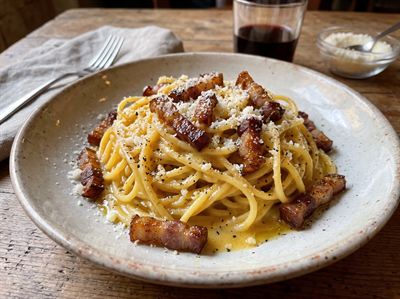
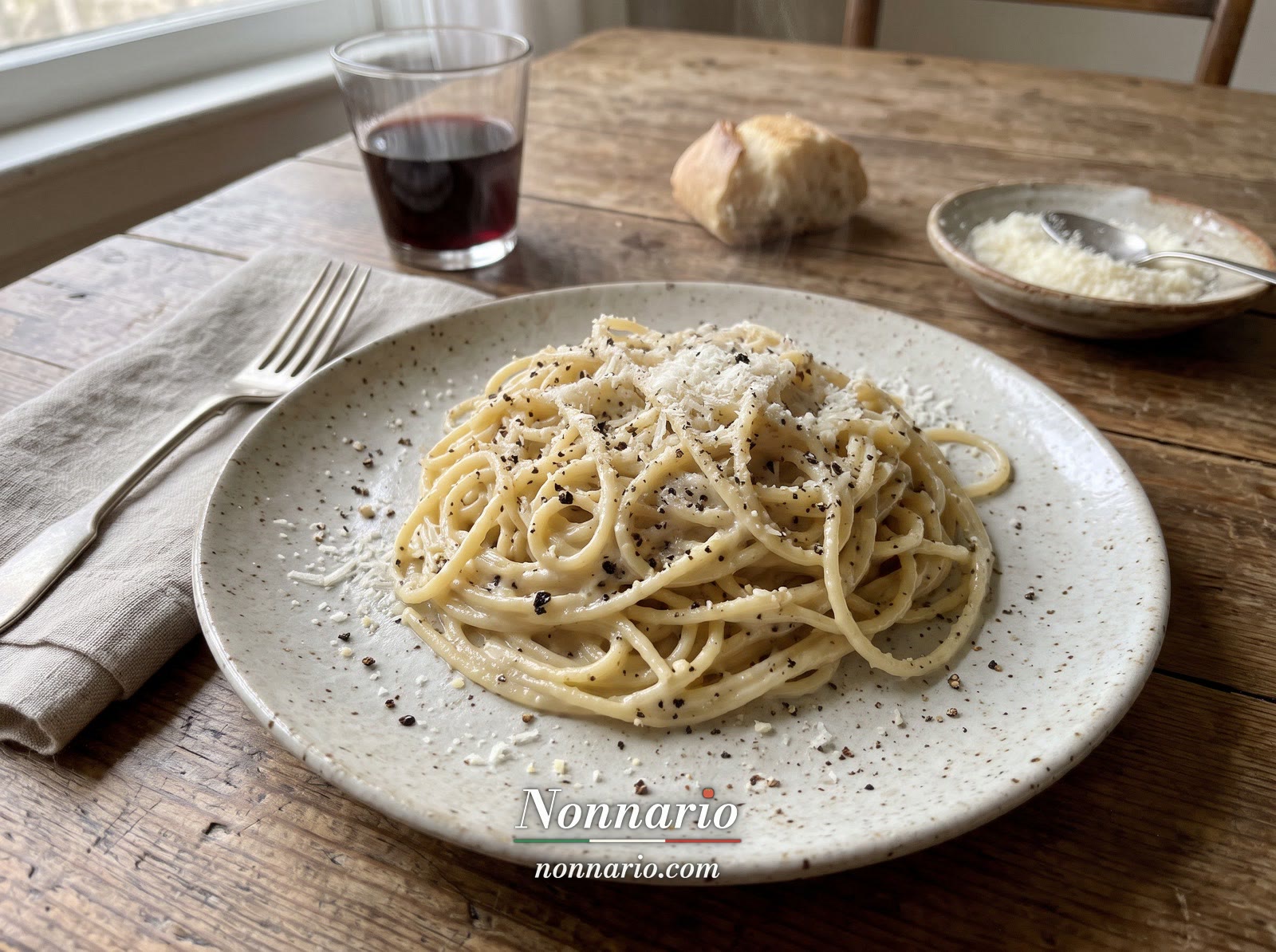
Thick spaghetti tossed in a warm tureen with grated Pecorino Romano, freshly ground black pepper and a few spoonfuls of their own cooking water, stirred until the cheese turns into a cream: one of the dishes Rome is known by.
- Course
- Primi & RisottiPasta & Rice
- Serves
- 4
- Hands-on
- 15 min
- Cooking
- 23 min
The video and the photos of every step are also gathered on a separate page.
In breve
In short
Also called cacio e pepe, tonnarelli cacio e pepe, pasta cacio e pepe and spaghetti a cacio e pepe.
- Only pasta, Pecorino Romano, black pepper and the pasta's own starchy cooking water: no oil, no butter, no cream.
- Long pasta: thick spaghetti here, or tonnarelli, drained while still wet and tipped into a warm tureen.
- Water, pecorino and pepper go onto the hot pasta off the heat and are stirred at length until the cheese melts into a cream.
- Too much heat or too much water makes the pecorino clump; a little more cheese or water sets the cream right.
- The pasta water is only lightly salted, because the pecorino is salty.
La provenienza
Where this recipe comes from
Cacio e pepe is one of the dishes Rome is known by, beside carbonara and amatriciana (‘matriciana’ in the city). It has always been there, but long stood in their shadow, a plain dish for connoisseurs, and has only lately become fashionable. Its fame rests on the sheep's milk cheeses made all over Lazio, Pecorino Romano among them. The food historian Massimo Montanari sees in it a popular dish first reworked by the rich that later turned into its opposite: from the seventeenth and eighteenth centuries spices grew cheaper, fine cooking gave them up, and they passed into the cooking of ordinary people. Two ingredients, and still hard to get right: Jannattoni called it a lost cause for anyone without practice, and Ada Boni dismissed adding oil as far-fetched.
Cacio e pepe has no official recipe. We compared ten sources and publish the most widely recognised version: 350 g of thick spaghetti and 100 g of pecorino for four, tossed off the heat in a warm tureen with a few spoonfuls of the cooking water and freshly ground pepper. The sources agree that pasta, pecorino (Pecorino Romano for nearly all of them), black pepper and the pasta's starchy water are the whole dish, and that oil, butter and cream do not belong in it. They differ on the pasta (spaghetti, thick spaghetti or tonnarelli) and on where the cream is made: in the serving bowl, as here, or in a pan, sometimes as a cream of cheese and water made first. What is ours is marked ‘Our guide’: the amounts of water and salt for the pot, the times, how much water to start with, the cheese held back for the end, and the fixes for a sauce that clumps or runs.
- Provenance
- A regional tradition documented in cookbooks and local practice, with no single official text.
- Defined by
- Roman tradition
- Reference
- Compared across 10 sources, listed below; this page publishes the most widely recognised version.
- Sources
- Accademia Italiana della Cucina: spaghetti cacio e pepe ‘all'uso di Roma’, a Lazio recipe from its collection (Italian)
- Accademia Italiana della Cucina: spaghetti cacio e pepe in Rome's restaurants, an article of its survey of typical dishes, with its Rome delegations (Italian)
- City of Rome (Roma Capitale), its official tourism site Turismo Roma: spaghetti cacio e pepe (Italian)
- Regione Lazio, VisitLazio, the Region's official tourism site: spaghetti cacio e pepe, 2022 (Italian)
- La Cucina Italiana: tonnarelli cacio e pepe, the magazine's traditional recipe, 2018 (Italian)
- La Cucina Italiana: spaghetti cacio e pepe, the magazine's recipe, with a note on its history by the food historian Massimo Montanari, 2025 (Italian)
- Giallo Zafferano: spaghetti cacio e pepe, its house recipe, on a page sponsored by a pasta maker (Italian)
- Consorzio per la Tutela del Formaggio Pecorino Romano: spaghetti cacio e pepe with a cream of new broad beans, from the recipes on its site (Italian)
- Consorzio per la Tutela del Formaggio Pecorino Romano: the characteristics of Pecorino Romano PDO (Italian)
- USDA Food Safety and Inspection Service: Leftovers and Food Safety (archived copy of 29 May 2025)
Ingredienti
Ingredients
The original recipe serves 4
Equipment
- Large pot holding at least 5 l, with a lid
- Tongs, or a large slotted spoon, to lift out the spaghetti
- A tureen or large serving bowl, and a ladle
- A jug or mug for the cooking water, and a tablespoon
- Grater with fine holes, and a pepper mill
- Kitchen scale
- Four plates, warmed (a low oven, or very hot water)
Preparazione
Method
Scaled to 4 servings: the amounts in the steps follow. Pot and pan sizes and cooking times are still for the original 4.
About 30 minutes, half of it waiting for the water to boil: grate the pecorino and grind the pepper meanwhile. Everything happens in the last two minutes, so have the tureen warm, the cheese and pepper beside it and a jug of cooking water set aside before you drain the pasta. Serve at once: the cream sets as it cools.
- 15 minhands-on
- 23 mincooking
While the water heats
-
Cooking 12–15 minHeat high
Bring 3.5 l of water to the boil in the large pot, covered, over a high heat.
Check A full, rolling boil.
Tip Our guide: about a litre of water for every 100 g of pasta, the usual measure for plenty of water.
-
Hands-on 5 min
Grate the 100 g of Pecorino Romano on the fine holes of the grater into a bowl. Set aside about 2 tablespoons of it in a cup: they go into the tureen at the end, to thicken the sauce if it runs, or simply tossed in last if it does not.
Check Fine, fluffy shreds, with no coarse pieces or crumbs of rind.
Tip Our guide: holding a little back is ours, so you can correct the sauce; all 100 g still go into the dish.
Tip Our guide: finely grated cheese melts evenly into the water; coarse shreds are slower to melt and more likely to stay as strings.
-
Hands-on 1 min
Grind black pepper into a small dish: about 1 teaspoon, or as much as you like, since the dish should taste clearly of it.
Check Freshly ground and fragrant.
Tip Ground just before use, it has far more scent; the pepper can also be pounded in a mortar.
Cooking the pasta
-
Cooking 11–13 minHeat high
When the water boils, salt it lightly, about 5 g per litre, then add the 350 g of thick spaghetti and stir so they do not stick. Cook them, uncovered and at a lively boil, until al dente.
Check Bite a strand: tender, with a thin, firm thread at the centre.
Tip Our guide: about half the usual salt, because the pecorino is very salty. Use the packet time as your guide and start tasting a minute or two before it.
-
Hands-on 2 min
While the spaghetti cook, ladle about 150 ml of the boiling water into the tureen, swirl it round and leave it for a minute, then pour it away and dry the tureen.
Check The tureen is warm to the touch, not too hot to hold.
Tip Our guide: the tureen should keep the pasta warm, no more. A scalding bowl makes the cheese clump.
-
Hands-on 2–10 min
Warm the four plates while the spaghetti cook: put them in the oven at its lowest setting, about 60 °C, for about 10 minutes, or rinse them under very hot water and dry them just before draining, which takes about 2 minutes.
Check The plates are warm to the touch, not hot.
Tip Our guide: how to warm them is ours. A warm plate keeps the cream soft for longer; on a cold one it sets sooner.
-
Hands-on 1 min
A minute before the spaghetti are done, scoop about 250 ml of their cooking water into the jug and keep it beside the tureen.
Check A jug of cloudy, starchy water within reach.
Tip Our guide: the starch in the water is what turns the cheese into a cream. By the time you use it, it has dropped a little below the boil.
Making the cream
This is the moment that makes the dish: the heat of the pasta and of the water melts the pecorino, and the starch in the water binds it into a cream. It takes a minute or two, off the heat, and all your attention.
-
Hands-on 1 min
Lift the spaghetti out of the pot with the tongs, letting them drip only for a moment, and put them straight into the warm tureen, still wet with their water.
Check The spaghetti glisten with water; there is no pool of it at the bottom of the tureen.
-
Hands-on 1 min
At once, pour about 60 ml (about 4 tablespoons) of the cooking water from the jug, by now a little below the boil, over the spaghetti, then scatter over the pecorino and the pepper.
Check The cheese is spread over the pasta, not heaped in one place.
Tip Our guide: about 4 tablespoons is our reading of ‘a few spoonfuls’; add more, a spoonful at a time, as the cream needs.
Tip Our guide: scatter the pecorino in two or three goes, tossing a little between them, so it never lands in one lump on the hottest pasta.
-
Hands-on 1–2 min
Toss and stir the spaghetti with the tongs or two forks, lifting them and turning them over, without stopping, until the cheese has melted and coats every strand in a smooth cream. If it looks dry or pasty, add more cooking water, a tablespoon at a time, tossing between each.
Check A glossy, smooth cream clings to every strand and loosens slightly when you lift them, with no strings or lumps of cheese and no water left at the bottom of the tureen.
Tip Too thick or dry: a tablespoon of cooking water at a time, tossing well between each.
Tip Too runny: scatter in the pecorino you set aside, a spoonful at a time, and keep tossing.
Tip Our guide: if the sauce is right without it, toss in the pecorino you set aside at the end all the same, so all the 100 g go into the dish.
Tip The cream forms below about 65 °C; hotter, the pecorino clumps.
Tip Our guide, if it clumps: stop adding cheese, add a tablespoon of the water from the jug, which is now cooler, and toss hard: small clumps loosen. Cheese that has set into rubbery lumps will not melt back; lift them out, and next time scatter the cheese in smaller goes, tossing between them.
Tip Do not add oil, butter or cream to rescue it: they are the most serious mistakes made with this dish.
-
Hands-on 1 min
Share the spaghetti between the warm plates, spooning the last of the cream over them, and serve straight away.
Check Hot, glossy and creamy on the plate.
Tip The cream sets as it cools, so do not let the plates wait.
Tip Our guide: if any is left, put it in the fridge within 2 hours, in a shallow container, and eat it within 3 days, reheated until steaming hot, 75 °C at the centre. The sauce will not be creamy again.
The essentials, for cooks who know the dish. Switch to Detailed for quantities, temperatures, times and checks at every step.
Press “I’m here” on the step you are on, and again when it is done.Tap the pin on the step you are on, and the tick when it is done. Timers keep running while you scroll.
Da sapere
Good to know
- KeepingConservazione
- Best eaten as soon as it is made; it is not meant to be kept. Source
- VariantsVarianti
- With tonnarelli: Tonnarelli, square-cut and thicker than spaghetti, in the same amount; tossed off the heat in the serving bowl with two small ladles of their water, the pecorino added little by little until it has melted, with more grated on top. Source
- With the pecorino cream made first: The pecorino stirred with about the same weight of cooking water into a smooth cream, kept below 65 °C; the spaghetti, drained a couple of minutes early, finish cooking in a pan with the cream and a little more water, with fresh pepper on the plates. Source
- With toasted pepper, finished in the pan: Crushed peppercorns toasted in a wide pan and splashed with cooking water; the spaghetti, drained 2–3 minutes early, finish cooking there like a risotto, and a paste of pecorino whisked with hot cooking water is stirred in off the heat. Source
- With a cream of new broad beans: Young broad beans, peeled and cooked with spring onion, oil and mint, blended into a green cream that goes under spaghettoni tossed with pecorino, cooking water and pepper. Source
- With other pastas: Rigatoni, tonnarelli, or egg pastas such as tagliolini or spaghetti alla chitarra, which some find make the dish creamier. Source
Errori comuni
Common mistakes
- Adding oil, butter or cream: the dish is only pasta, pecorino, pepper and the cooking water.
- Heaping all the cheese onto the pasta at once, or using a tureen too hot to touch: the pecorino clumps instead of melting into a cream.
- Pouring in too much water at once: like too much heat, it makes the pecorino clump. Add it a spoonful at a time.
- Draining the pasta dry: it needs the water clinging to it.
- Salting the pasta water fully: the pecorino is salty, so use about half the usual.
- Letting it wait before serving: the cream sets as it cools.
Fuori dall'Italia
Cooking it outside Italy
- Pecorino Romano PDO is a hard sheep's milk cheese, sold abroad under that name; the rind carries a mark of a sheep's head in a lozenge with the words Pecorino Romano. It is sold aged at least 5 months as a table cheese and at least 8 months for grating; cooks differ on which to use, some asking for a young cheese, others for one of medium age.
- Spaghetti grossi are thick spaghetti, sometimes sold as spaghettoni.
- Tonnarelli are a Roman pasta, square in section and a little thicker than spaghetti; use the same 350 g in place of the spaghetti.
From nonnario.com/recipes/cacio-e-pepe/, where you will find its sources, its story and the step photos. Sources checked in November 2026.