Orvieto, Umbria
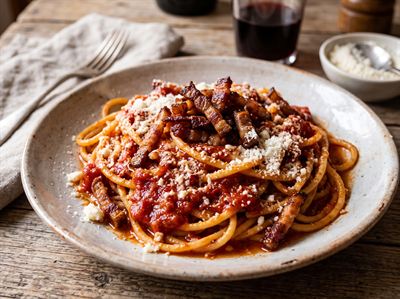
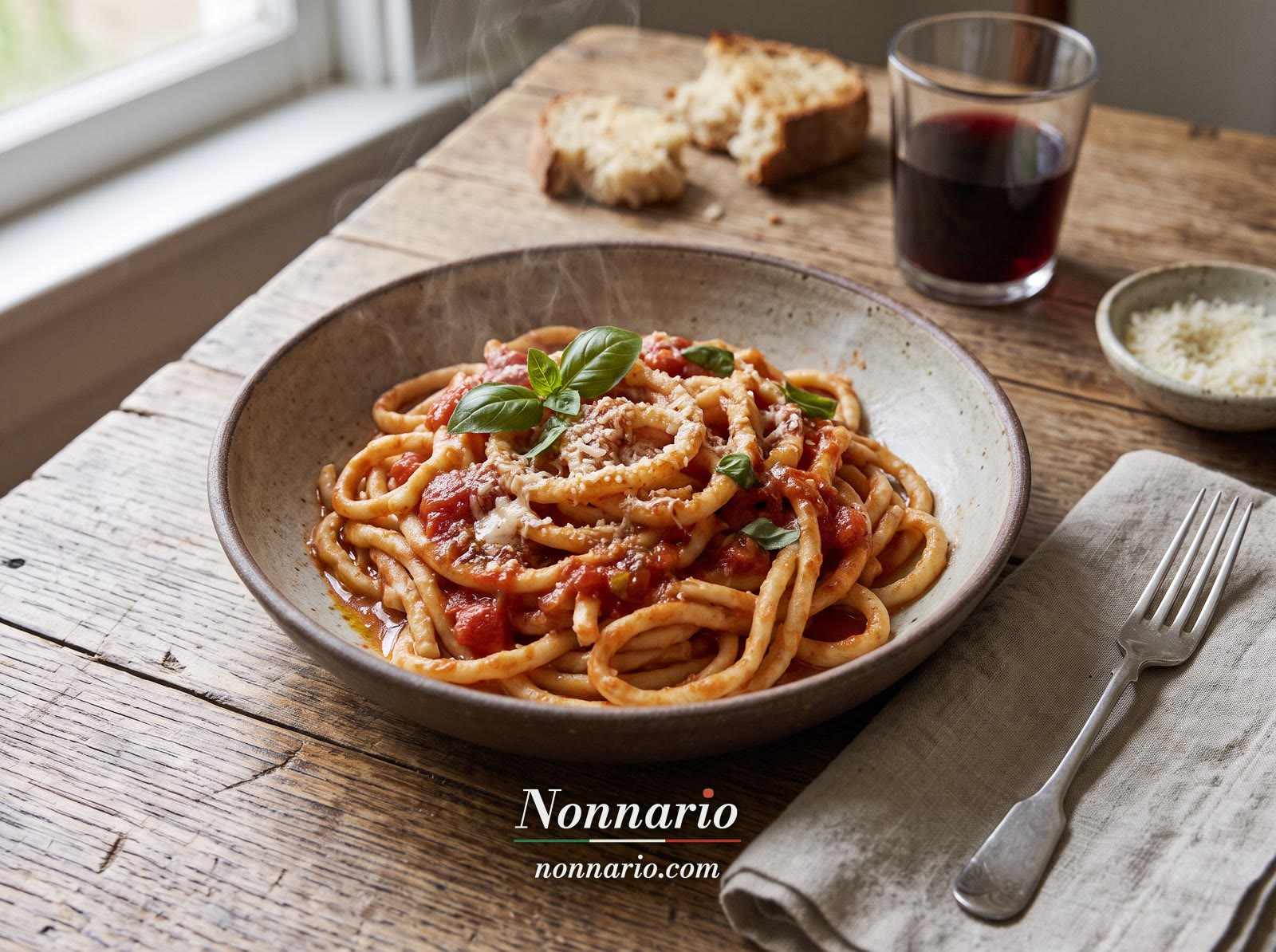
Umbricelli al pomodoro
Umbria's thick hand-rolled pasta of flour and water, with a fresh tomato sauce
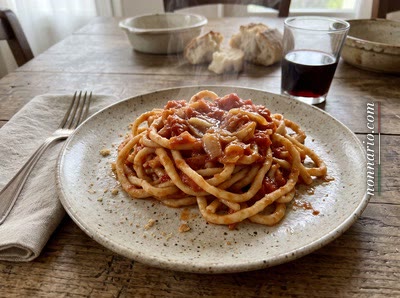
Umbria's thick strands of flour and water, rolled by hand with no egg, tossed in a tomato sauce made on garlic and parsley in olive oil and finished with pecorino; a traditional food product of the region.
- Course
- Primi & RisottiPasta & Rice
- Serves
- 4
- Hands-on
- 1 h 7 min
- Cooking
- 45 min
- Resting
- 1 h 30 min+
In breve
In short
Also called umbrichelli, umbrichi and umbricelli with tomato sauce.
- Vegetarian
- Soft wheat flour, water and a pinch of salt, no egg: an even dough, rolled by hand into thick strands, with no rolling pin.
- The dough rests for half an hour before shaping, and the shaped umbricelli, well floured, rest for another hour before they are cooked.
- The sauce: garlic and parsley in olive oil, then peeled fresh tomatoes (or passata), simmered for 15 minutes over a low heat.
- Tossed in the sauce for a minute, then finished with grated pecorino, with more at the table.
La provenienza
Where this recipe comes from
Umbricelli are thick spaghetti rolled by hand from soft wheat flour and water, with no egg. The Umbria Region lists them among its traditional food products, made across the province of Perugia and in Orvieto, with the dialect names umbrichi, umbrichelli and umbrichelle; the name comes from the Perugian word umbrico, an earthworm, for their long, rounded shape. Made by hand they are about 25 to 30 cm long; pasta workshops also extrude them by machine. They take many dressings: a tomato sauce, grated black truffle, a meat ragù.
There is no official recipe for the dish. We compared the serious sources and publish the most widely recognised version: most dress umbricelli with a tomato sauce made on garlic and parsley in olive oil, and several finish it with grated pecorino; one uses basil instead of parsley, and some add chilli. The dough here follows one documented recipe for four, and the sauce and the finish another. What is ours is the size of the strands, about 4 mm thick, with the length of 25 to 30 cm that the Region gives, and the kneading time.
- Provenance
- A regional tradition documented in cookbooks and local practice, with no single official text.
- Defined by
- Umbrian tradition
- Reference
- Compared across 8 sources, listed below; this page publishes the most widely recognised version.
- Sources
- Dissapore, food magazine: umbricelli al pomodoro, byline iFood (Italian)
- Regione Umbria: traditional food product sheet for umbricelli, archived copy of 2006 (Italian)
- Ministry of Agriculture (MASAF): national list of traditional food products, 25th revision, 2025, Umbria no. 62 (Italian)
- Agrodolce, food magazine: umbricelli al pomodoro, by Ileana Pavone, 2019 (Italian)
- Il Cucchiaio d'Argento, Editoriale Domus: umbricelli alla nursina (Italian)
- Umbriatourism, the Umbria Region's tourism portal: ciriole alla ternana (Italian)
- MICHELIN Guide Italy: an article on umbricelli and their classic dressings, 2019 (archived copy, Italian)
- USDA Food Safety and Inspection Service: Leftovers and Food Safety (archived copy of 29 May 2025)
Ingredienti
Ingredients
The original recipe serves 4
For the umbricelli
For the sauce
To serve
Equipment
- Mixing bowl and a large wooden pastry board
- Two clean tea towels, and a board or tray for the floured umbricelli
- Kitchen scale and a measuring jug
- Medium pot, for blanching the tomatoes in plenty of water, and a slotted spoon
- Wide frying pan, about 28 cm across, for the sauce and the pasta together
- Large pot holding at least 5 l, and a colander
- Cheese grater
Preparazione
Method
Scaled to 4 servings: the amounts in the steps follow. Pot and pan sizes and cooking times are still for the original 4.
About 2½–3 hours, most of it resting. Make the dough (about 15 minutes) and rest it for half an hour; shape the umbricelli (40–60 minutes) and rest them for an hour. Make the sauce during that hour (about 40 minutes, counting the water for the tomatoes), and put the pasta water on about 15 minutes before the hour is up. The umbricelli then cook in 5–8 minutes and go straight into the sauce. Leftover sauce goes into the fridge, in a shallow container, within 2 hours of cooking; use it within 3 days and bring it back to the boil (75 °C) before you use it.
- 1 h 7 minhands-on
- 45 mincooking
- 1 h 30 minresting, at least
The dough
The dough and its shaping follow one documented recipe for four, and the sauce and the finish follow another; the size of the strands and the kneading time are our guide.
-
Hands-on 5 min
Put the 400 g of flour in the bowl with a pinch of salt. Add the water a little at a time, mixing with your fingers, until the flour comes together into an even dough: you need about 200 ml–230 ml.
Check An even, firm dough with no dry flour left in the bowl, and it does not stick to your fingers.
Tip Add the last of the water only if the dough needs it: too much gives a soft dough, and soft strands sag and stick together.
-
Hands-on 10 min
Turn the dough out onto the board and work it until you have a smooth, even ball, pushing it away with the heel of your hand, folding it back and turning it.
Check Smooth, with no dry spots, and it springs back slowly when you press it with a finger.
Tip Our guide: about 10 minutes.
-
Rest 30 min
Cover it with a tea towel and leave it at room temperature for 30 minutes.
Tip Do not skip the rest: the dough relaxes and becomes much easier to roll into strands.
Shaping the umbricelli
-
Hands-on 40 min to 1 h
Keep the dough covered and work with a little at a time. Pinch off a small ball of dough, about the size of a hazelnut, and roll it on the unfloured board under your palms, working from the middle outwards, until it is a thick strand, as fat as a big spaghetto. Flour each strand well and lay it on the board or tray, apart from the others, and carry on until the dough is used up.
Check Strands about 4 mm across and 25 cm–30 cm long, round and a little irregular, none touching.
Tip Our guide: pieces of about 5 g give strands of about that size; this dough makes roughly 120.
Tip Do not flour your hands: the dough slides instead of rolling. If the board is too slippery, wipe it with a barely damp cloth.
Tip For even pieces, roll a piece of dough out 5 mm–8 mm thick, cut it into strips 1 cm wide, cut those into short lengths and roll each one out: this is how the Region's description has them made by hand.
-
Rest 1 h
Leave the floured umbricelli to rest on the board or tray for an hour before you cook them. Make the sauce in the meantime.
Check The surface of the strands has dried slightly and no longer feels tacky.
The sauce (while the umbricelli rest)
-
Cooking 8–10 min
Bring a medium pot of plenty of water to the boil.
-
Cooking 5 min
Cut a shallow cross in the skin at the base of each of the 4 tomatoes and lower them into the boiling water for 5 minutes. Lift them out with the slotted spoon.
Check The skin has split and curls back from the cross.
-
Hands-on 5 min
Peel off the skins, cut the tomatoes in half, scoop out the seeds and dice the flesh.
Check Small cubes of tomato flesh, with no skin or seeds.
Tip Out of season, use about 400 g of tomato passata instead, and go straight to the next step.
-
Hands-on 3 min
Peel the garlic and chop it finely; strip the parsley leaves from the stalks and chop them finely too.
-
Hands-on 2 minHeat medium-low
Put the olive oil, garlic and parsley in the wide frying pan over a medium-low heat and let them sizzle gently for a couple of minutes.
Check The garlic smells sweet and is soft but has not coloured.
Tip Do not let the garlic brown: it turns bitter. If it starts to colour, take the pan off the heat for a moment.
-
Cooking 15 minHeat low
Add the diced tomatoes (or the passata) and cook over a low heat for 15 minutes, stirring now and then. Season with salt and, if you like, black pepper. Take the pan off the heat until the pasta is ready.
Check The tomato has broken down into a loose sauce and the oil shows at the edges.
Tip If it gets too thick before the pasta is ready, loosen it with a spoonful of the pasta water.
Cooking and serving
-
Cooking 12–15 min
About 15 minutes before the umbricelli have finished resting, bring about 4 l of water to the boil in the large pot and add about 40 g of coarse salt.
-
Cooking 5–8 min
Shake off the excess flour and drop the umbricelli into the fast-boiling water. Stir once so they do not stick, and cook them until they have risen to the surface and are cooked through.
Check Bite one: cooked right to the centre, with no pale, floury core, but still with some bite.
Tip Our guide: 5–8 minutes. Rested strands take a little longer than freshly rolled ones, so taste rather than trust the clock.
-
Hands-on 2 minHeat low
Put the sauce back over a low heat. Drain the umbricelli in the colander, keeping back a cup of the cooking water, and tip them straight into the pan. Toss them in the sauce for a minute. Take the pan off the heat, add the 50 g of grated pecorino and mix well. Serve at once, with more pecorino at the table.
Check Every strand is coated in sauce and the pecorino has melted into it.
The essentials, for cooks who know the dish. Switch to Detailed for quantities, temperatures, times and checks at every step.
Press “I’m here” on the step you are on, and again when it is done.Tap the pin on the step you are on, and the tick when it is done. Timers keep running while you scroll.
Da sapere
Good to know
- KeepingConservazione
- The fresh umbricelli can be made ahead: keep them spread out on food trays in the fridge, at about 4 °C, for 1–2 days at most. Source
- VariantsVarianti
- With passata and basil: A sauce of tomato passata cooked on whole garlic cloves in olive oil for 20–25 minutes, until well reduced; the garlic comes out at the end, a few basil leaves go in, and grated pecorino on top. Source
- With sausage: Two crumbled sausages, browned in a pan, stirred into the tomato sauce. Source
- Umbricelli alla nursina: A quicker sauce: garlic and parsley chopped together and cooked in olive oil for 5 minutes, then tomato paste diluted with a ladle of hot water and simmered for a few minutes; grated pecorino on top. Source
- Ciriole alla ternana: In Terni, hand-rolled ciriole of flour and water are tossed in tomato passata cooked for about 15 minutes on garlic, parsley and chilli, with no cheese. Source
- With black truffle or meat ragù: Among the classic dressings for umbricelli: grated black truffle, a meat ragù, or a tomato sauce alla spoletina. Source
- With durum semolina: The dough can also be made with durum wheat semolina alone, or with two-thirds tipo 0 flour and one-third durum wheat semolina. Source
Errori comuni
Common mistakes
- Adding too much water to the dough: it must be firm, or the strands sag and stick together.
- Flouring your hands to roll the strands: the dough slides on the board instead of rolling.
- Skipping either rest: the dough is hard to roll, and the fresh strands stick in the pot.
- Browning the garlic: it is only softened in the oil with the parsley.
Fuori dall'Italia
Cooking it outside Italy
- Tipo 0 and tipo 00 are Italian grades of soft wheat flour; plain (all-purpose) flour is also soft wheat flour.
- Vine tomatoes: any ripe, fleshy tomatoes will do; out of season, use tomato passata, as the method allows.
- Pecorino is an Italian sheep's milk cheese: buy a piece and grate it yourself.
From nonnario.com/recipes/umbricelli/, where you will find its sources, its story and the step photos. Sources checked in November 2026.