Marche (the whole region), Marche
Coniglio in porchetta
Whole rabbit roasted like a porchetta, with wild fennel and its own liver
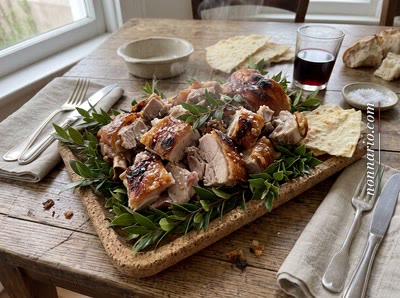
A whole rabbit seasoned the way central Italy seasons its roast pig, rubbed inside and out with wild fennel, garlic and lardo, stuffed with its own liver and pancetta and roasted slowly with white wine: the Marche's coniglio in porchetta, celebrated at Frontone with a sagra without a break since 1957.
- Course
- SecondiMain Courses
- Serves
- 4
- Hands-on
- 1 h 17 min
- Cooking
- 2 h
- Resting
- 5 h 40 min+
The video and the photos of every step are also gathered on a separate page.
In breve
In short
Also called coniglio porchettato, coniglio in porchetta alla marchigiana, rabbit in porchetta, porchetta-style rabbit and stuffed rabbit with wild fennel.
- Gluten-free
- A whole rabbit of about 1 kg, rubbed inside and out with a bright green paste of wild fennel fronds, lardo, garlic and olive oil.
- The stuffing is the rabbit's own liver, blanched with the fennel stems and sautéed with chopped pancetta.
- Stuffed, sewn up and rested at least 5 hours in the fridge so the meat takes the scent of fennel and garlic, then roasted at 180 °C for about 1½ hours.
- White wine poured over after 40 minutes, then basted with the fennel water until well browned.
- Cut into pieces, the stuffing served apart; it is good hot or cold.
La provenienza
Where this recipe comes from
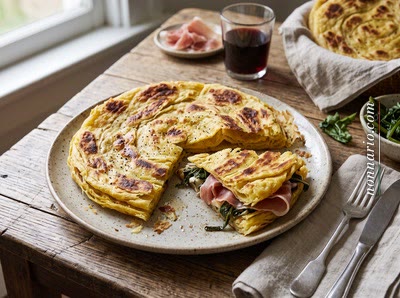
In porchetta means seasoned like the roast pig of central Italy, with wild fennel, garlic and pork fat, and a rabbit cooked that way is a Sunday and feast-day dish of the Marche and of Romagna across the border, made above all inland, from the hills behind Rimini and Cesena to those of Pesaro and Urbino. It is told that farm families who could not afford a suckling pig, a dish for the well-off, used a rabbit instead, seasoned with its own giblets, pork rind and wild fennel; rabbits were raised at home and were long the meat of the poor, reaching the tables of the rich only from the eighteenth century. In Frontone, in the province of Pesaro and Urbino, a sagra has been held for it without a break since 1957, in the days after the feast of 15 August, recognised by the Regione Marche as a Sagra di Qualità; more than 2,000 rabbits have been cooked at a single edition. In 2023 the town gave the dish a De.Co. There the stuffing was once the rabbit's feet, head and liver, browned with garlic, wild fennel and pancetta; today it is mostly the liver. Hot, it was a dish for ceremonies; cold, one to take on an outing.
We could not find the text of Frontone's De.Co., and the accounts of the town's recipe differ, so there is no official recipe to follow. We compared the serious sources and publish the most widely recognised version. They agree on wild fennel and garlic, salt and pepper, pork fat as lardo or pancetta, and a roast in the oven, nearly always with white wine; most put the rabbit's own liver or offal in the stuffing, and some use sausage instead. They differ on the boning: some open the whole rabbit, stuff it and sew it up; others bone it and roll it round the stuffing. Here it stays whole, and the rolled roast is a variant. The method is given as it is written down: the rabbit is stuffed with the cooled stuffing and rests at least five hours in the fridge before it is roasted. US food-safety guidance, which we follow, recommends instead that stuffing never wait inside raw meat, but go in hot just before the rabbit goes into the oven; the page says so beside those steps. Ours is the probe check: 71 °C in the thickest part of the leg and 74 °C in the centre of the stuffing, the figures that guidance gives for rabbit and for stuffing.
- Provenance
- A regional tradition documented in cookbooks and local practice, with no single official text.
- Defined by
- Marche tradition
- Reference
- Compared across 13 sources, listed below; this page publishes the most widely recognised version.
- Sources
- Accademia Italiana della Cucina: coniglio in porchetta, a recipe of the Marche from its recipe collection (Italian)
- Accademia Italiana della Cucina: coniglio in porchetta all'uso di Orvieto, a recipe of Umbria from its recipe collection (Italian)
- Comune di Frontone: the Sagra del Coniglio in Porchetta and the dish's De.Co., on the town's website (Italian)
- Non solo Flaminia, a local news site of the Pesaro and Urbino uplands: the history of Frontone's sagra and its traditional recipe, 2026 (Italian)
- Quotidiano Nazionale: Frontone, its crescia and its coniglio in porchetta, both De.Co., 2024 (Italian)
- Scatti di Gusto, a food magazine: coniglio in porchetta of the Marche or Romagna, boned and rolled, 2021 (Italian)
- Dissapore: coniglio in porchetta, the stuffed rabbit shared by Romagna and the Marche, 2023 (Italian)
- Agrodolce: coniglio in porchetta alla marchigiana, 2019, updated 2021 (Italian)
- Cookist: coniglio in porchetta, a recipe of the Marche, 2024 (Italian)
- TgTourism, a registered travel news site: coniglio in porchetta, the traditional recipe of the Marche, 2024 (Italian)
- USDA Food Safety and Inspection Service: Leftovers and Food Safety, on cooling, keeping and reheating leftovers (archived copy of 29 May 2025)
- USDA Food Safety and Inspection Service: Rabbit From Farm to Table, on the safe cooking temperature and roasting time of rabbit (archived copy of 27 February 2024)
- USDA Food Safety and Inspection Service: Stuffing and Food Safety, on stuffing meat just before roasting and its safe temperature (archived copy of 23 September 2026)
Ingredienti
Ingredients
The original recipe serves 4
The rabbit and its paste
For the stuffing and the roasting
Equipment
- A large plate or dish that holds the whole rabbit, and cling film or a lid to cover it
- Chopping board and a heavy knife or mezzaluna (a mortar also works) for the paste
- Saucepan of about 2 l, a slotted spoon, and a jug or bowl to keep the cooking water
- Frying pan about 24 cm across
- Trussing needle and undyed cotton thread, or wooden skewers
- Roasting dish about 30 cm × 22 cm, a small ladle and a spoon for basting
- Probe thermometer, and kitchen foil
Preparazione
Method
Scaled to 4 servings: the amounts in the steps follow. Pot and pan sizes and cooking times are still for the original 4.
About 9 hours from start to table, but only about 1¼ hours of it hands-on: about 1½ hours to season the rabbit, make the stuffing, let it cool and stuff the rabbit, then at least 5 hours' rest in the fridge, so start in the morning for dinner. Heat the oven for the last 20 minutes of the rest; then about 1½ hours in the oven, a 20-minute rest and the carving. For 4 people one rabbit of about 1 kg; for 8, two rabbits side by side in a larger dish, or in two dishes.
- 1 h 17 minhands-on
- 2 hcooking
- 5 h 40 minresting, at least
Seasoning and stuffing the rabbit, at least 5 hours ahead
There is no official recipe to follow. This page publishes the most widely recognised version: a whole rabbit, rubbed with wild fennel, lardo and garlic, stuffed with its own liver and roasted with white wine. Amounts and times the sources leave out are ours, marked ‘Our guide’.
-
Hands-on 10 min
Take the liver out of the rabbit and set it aside in a small covered bowl in the fridge. Wash the rabbit well, inside and out, and dry it thoroughly with kitchen paper.
Check The rabbit is dry to the touch inside and out, and the liver is in the fridge.
Tip Our guide: if the green gall-bladder sac is still on the liver, cut it away with any flesh it has stained green: it is very bitter.
Tip Our guide: rinse it gently under cold running water, without splashing, and wash the sink, the board and your hands afterwards.
-
Hands-on 3 min
Lay the rabbit on a large plate that holds it and season it generously with fine salt and pepper, inside and out.
Check An even sprinkling of salt and pepper over all the meat, in the belly too.
Tip Our guide: about 10 g of fine salt for a rabbit of 1 kg, and several turns of the pepper mill.
-
Hands-on 10 min
Wash the 250 g of wild fennel and separate the fine fronds from the thicker, tougher stems. Keep the stems for the stuffing.
Check Two piles: soft, feathery fronds, and the stems.
-
Hands-on 10 min
Chop the fennel fronds finely, then chop them together with the 150 g of lardo and the 6 garlic cloves, working in the 3 tablespoons of oil, which make the paste soft and spreadable.
Check A soft, bright green, very fragrant paste with no large pieces of lardo or garlic left.
Tip Our guide: cut the lardo into small dice first, then chop everything together with a heavy knife or a mezzaluna; a mortar works as well.
-
Hands-on 5 min
Spread the paste over the rabbit, inside the belly and all over the outside, so that no part is left uncovered.
Check The whole rabbit, inside and out, is coated in green paste.
-
Cover the rabbit and leave it to rest in a cool place while you make the stuffing.
Check The rabbit is covered, and the paste stays on it.
Tip Our guide: the fridge is the cool place, for the 45 minutes or so the stuffing takes.
-
Cooking 10 minHeat high
Put the fennel stems in the saucepan with the 1 l of cold, lightly salted water and bring it to the boil.
Check The water is at a full boil and smells of fennel.
Tip Our guide: about 5 g of salt in the water.
-
Hands-on 4 minHeat medium-high, at a steady boil
Add the rabbit's liver to the boiling water and blanch it for about 4 minutes. Lift out the liver and the stems with the slotted spoon and keep the cooking water.
Check The liver has turned firm and greyish brown on the outside.
Tip Our guide: keep at least 400 ml of the water: it is used to baste the rabbit in the oven.
-
Hands-on 5 min
Cut the liver and the fennel stems into small pieces, and chop the 4 slices of pancetta.
Check Liver and stems in pieces of about 1 cm, the pancetta finely chopped.
Tip Our guide: the stems are tough: cut them across into thin slices.
-
Hands-on 5 minHeat medium
Put the pancetta in the frying pan over medium heat for 2–3 minutes, until its fat runs, then add the liver and the stems and let them take the flavour for about 3 minutes, stirring.
Check The pancetta is translucent, the liver is cooked through with no pink left when a piece is cut, and the stuffing is hot and moist.
-
Rest 20 min
Let the stuffing cool. (The food-safety reference we follow recommends instead that stuffing is not cooled before it goes into the meat: it is made just before roasting and spooned in hot.)
Check The stuffing is cool to the touch.
Tip Our guide: spread it on a plate so it cools quickly, about 20 minutes, then stuff the rabbit at once.
-
Hands-on 10 min
Spoon the cooled stuffing loosely into the belly and sew up the opening with undyed cotton thread, or close it with wooden skewers. (The food-safety reference we follow recommends that a stuffed raw meat goes into the oven immediately after it is stuffed, at 163 °C or more, and is never kept stuffed in the fridge.)
Check The opening is closed all along and no stuffing shows.
Tip Our guide: stitches about 2 cm apart; leave a long end of thread to pull out at the table.
-
Rest 5 hTemp 4 °C
Leave the stuffed rabbit, covered, in the fridge for at least 5 hours before cooking it, so that the meat takes the scent of the fennel and garlic. (The food-safety reference we follow recommends instead that stuffing never waits inside raw meat: rest the rabbit with its paste, make the stuffing at the end of the rest and spoon it in hot just before roasting; the rabbit is safe at 71 °C in the thickest part of the leg, the stuffing at 74 °C in the centre.)
Check After 5 hours the rabbit smells strongly of fennel and garlic.
Tip Our guide: cook the rabbit within 2 days of buying it.
Roasting and serving
-
Cooking 20 minTemp 180 °C
For the last 20 minutes of the rest, heat the oven to 180 °C, conventional heat.
Check The oven has reached 180 °C.
-
Cooking 40 minTemp 180 °C
Roast the rabbit in the oven at 180 °C for 40 minutes.
Check The paste has melted and the rabbit has begun to colour.
-
Cooking 50 minTemp 180 °C
Pour the 250 ml of white wine over the rabbit and keep roasting, basting it now and then with the fennel cooking water, until it is well browned: about 50 minutes more, about 1½ hours in all.
Check The rabbit is a deep, even golden brown, and the juices in the dish are bubbling.
Tip Our guide: baste every 15 minutes or so with a small ladle (about 100 ml) of the fennel water and the juices in the dish, so the dish never dries out.
Tip If the top browns before the rabbit is done, lay a loose sheet of foil over it.
-
Hands-on 5 minTemp 74 °C
Push the probe into the thickest part of a hind leg, not touching the bone, then through the belly into the centre of the stuffing.
Check The leg reads at least 71 °C and the centre of the stuffing at least 74 °C.
Tip If either is short, put the rabbit back for 10 minutes, baste it and check again. The stuffing is often the last to get there: even when the meat is done, roast on until it does.
-
Rest 20 min
Take the rabbit out of the oven and leave it to stand for 20 minutes, loosely covered with foil, before you open it.
Check The juices have settled and the rabbit is still hot.
Tip Our guide: 20 minutes, the standing time US food-safety guidance gives for a whole stuffed bird before the stuffing is taken out.
-
Hands-on 10 min
Pull out the thread or skewers, spoon the stuffing into a warm bowl and cut the rabbit into pieces. Serve the pieces with the juices from the dish, and the stuffing apart. It is very good hot, and also cold.
Check Each piece has a browned outside and moist, white meat, and the stuffing is served separately.
Tip Our guide: cut off the hind legs and the front legs, then cut the saddle across into 3–4 pieces.
Tip Out of the oven, it may stay out of the fridge 2 hours at most (1 hour on a day above 32 °C). To serve it cold, let it cool, then chill it, and take out only what will be eaten.
The essentials, for cooks who know the dish. Switch to Detailed for quantities, temperatures, times and checks at every step.
Press “I’m here” on the step you are on, and again when it is done.Tap the pin on the step you are on, and the tick when it is done. Timers keep running while you scroll.
Da sapere
Good to know
- WhenQuando
- Served hot, it was a dish for ceremonies; cold, a dish to take on an outing. Source
- KeepingConservazione
- Leftovers, the stuffing taken out and the rabbit cut into pieces, go into the fridge in shallow, covered containers within 2 hours of cooking, and keep 3 days. Served cold from the fridge, they are out at most 2 hours, then back in the fridge or thrown away, never out again. To eat them hot, reheat them covered until they reach 75 °C at the centre. Source
- VariantsVarianti
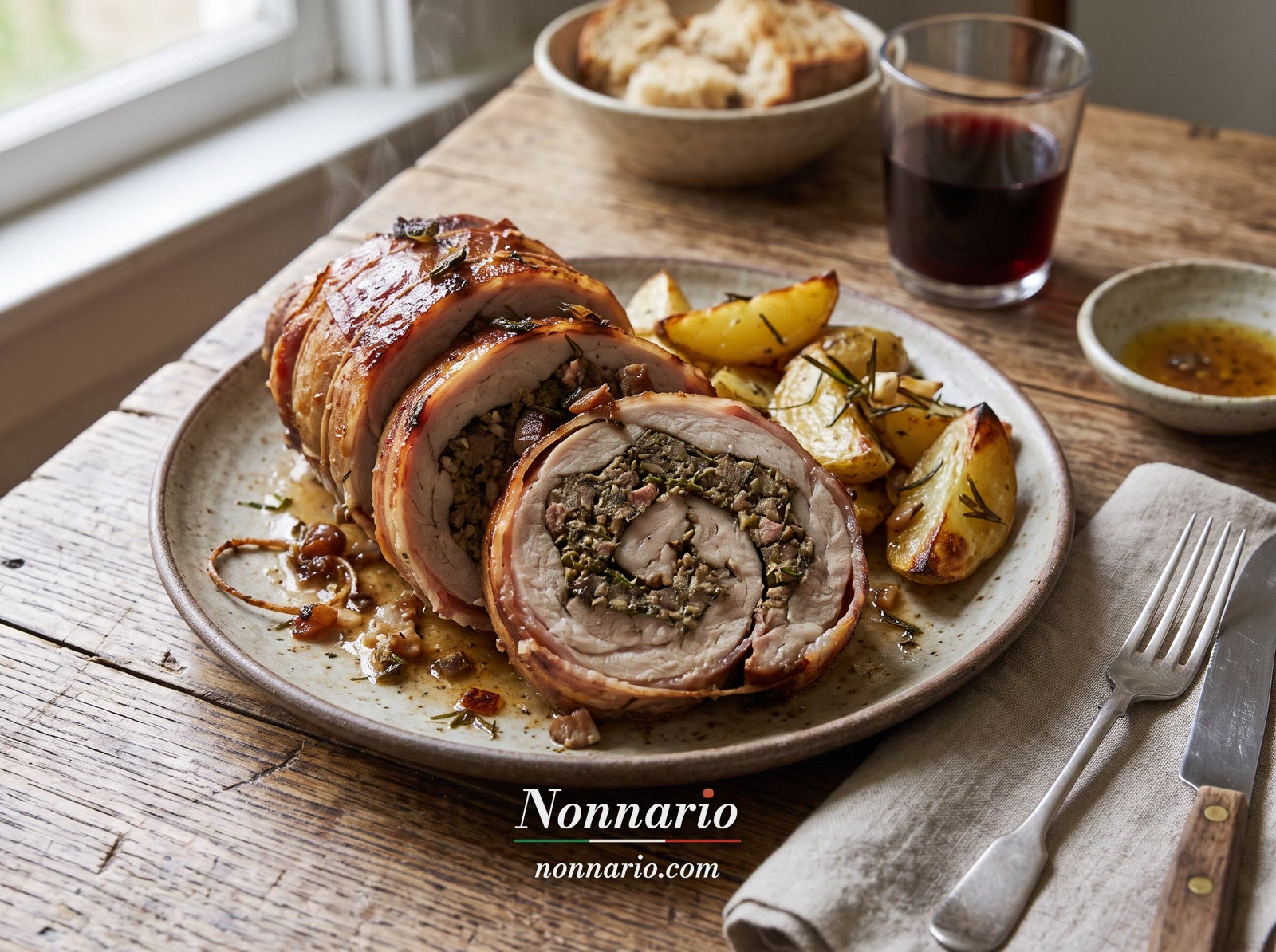
- Boned and rolled: For 6: have the butcher bone a whole rabbit, keeping its offal. Wash it in water and vinegar and pat it dry. Soften a chopped onion, carrot and celery stalk in olive oil (2 tablespoons in all go into the recipe), add the chopped offal and 3 sausages, crumbled, and cook them through. Let the mixture cool, then mix in a bunch of chopped herbs (thyme, rosemary, sage, parsley) and, by our reading, the wild fennel fronds, an egg and a handful of grated pecorino (about 50 g), and pitted green olives if you like. Lay the rabbit flat under baking paper and press it thin with a meat mallet. Lay 15 slices of pancetta side by side on cling film, put the rabbit on them, season with salt, pepper and a little oil, spread the stuffing over, roll it up and close it with cocktail sticks, or sew it with a strong needle and thread. Roast it in a dish with 2 garlic cloves, oil and a generous glass of white wine (Verdicchio dei Castelli di Jesi is suggested) at 180 °C for about 50 minutes, turning it now and then and basting it with its juices, adding a little water or vegetable broth if it dries. When it is warm, take out the sticks, blend the juices for a sauce, slice it and serve it with roast potatoes. (The food-safety reference we follow recommends instead not cooling the stuffing: stuff and roll the rabbit just before it goes in the oven, and roast it until the centre of the roll reaches 74 °C.) Source
- Orvieto style, with potatoes: In Umbria, around Orvieto, the rabbit's cleaned offal is cut small and cooked with 4 potatoes in small cubes, olive oil, salt, pepper, rosemary and sage until half done, then splashed with dry white wine and left to evaporate. The mixture is wrapped in a large slice of prosciutto and put inside the rabbit with a sprig of rosemary, a few sage leaves and a good bunch of fresh fennel, and the opening is sewn up. The rabbit is roasted in an oiled dish, in a wood oven if possible, and oiled more than once as it cooks. (The food-safety reference we follow recommends roasting it until the centre of the stuffing reaches 74 °C.) Source
- With a stuffing of meat and pork rind: The rabbit is opened along its length and salted and peppered inside and out. The wild fennel leaves are boiled for a few minutes, starting in cold water, squeezed and chopped very fine. Minced meat, pancetta and salame are browned with a whole head of garlic; the fennel goes in with boiled pork rind, trimmed of fat and cut small, then the rabbit's offal, and everything is seasoned and cooked through. The garlic is taken out and the stuffing left to cool; it goes into the rabbit, which is sewn up, oiled and roasted in a hot oven, turned often so both sides cook, for about 50 minutes. It is served in pieces, with the stuffing sliced. (The food-safety reference we follow recommends instead spooning the stuffing in hot and roasting at once, until the centre of the stuffing reaches 74 °C.) Source
Errori comuni
Common mistakes
- Judging it by its colour alone: the leg must reach 71 °C and the centre of the stuffing 74 °C.
- Letting it dry out: from the moment the wine goes in, baste it with the fennel water.
- Leaving out the wild fennel: its scent is what makes the dish.
Fuori dall'Italia
Cooking it outside Italy
- Rabbit is often sold frozen: thaw a whole one in the fridge, which can take a day or longer. In the US, a ‘fryer’ or young rabbit, under 12 weeks and 1½–3½ lb, is the one to roast; an older ‘roaster’ is better braised.
- Outside its season some cooks use dried or frozen wild fennel. Where there is none, it can be left out, with a little rosemary and sage instead, but the dish then loses its defining scent.
- Lardo is Italian cured pork back fat, sold by Italian delicatessens; ask for it in one piece.
From nonnario.com/recipes/coniglio-in-porchetta/, where you will find its sources, its story and the step photos. Sources checked in November 2026.