Friuli (Udine), Friuli-Venezia Giulia
Brovada e muset
Friulian sour turnips fermented in grape marc, with a slow-simmered pork cooking sausage
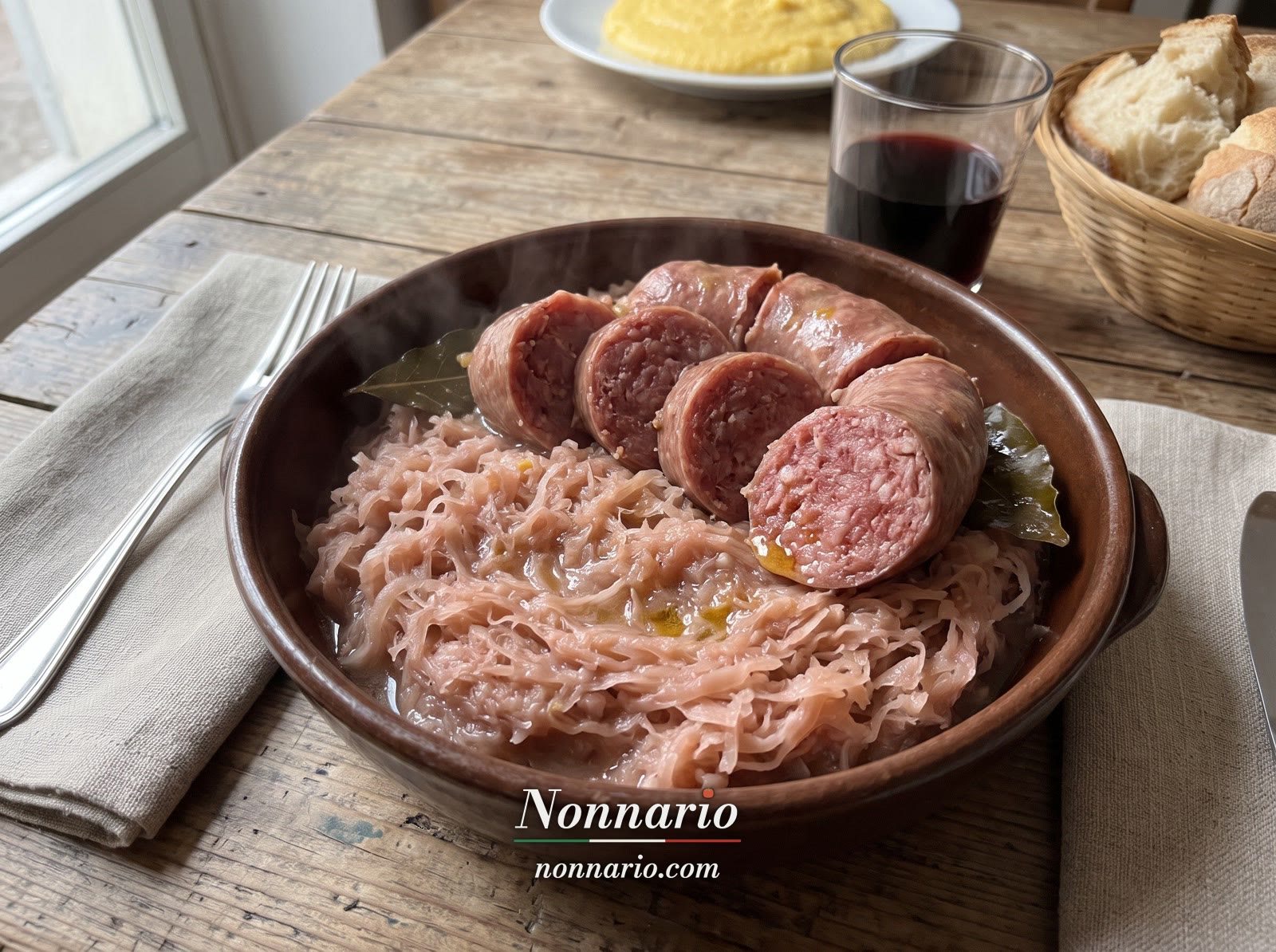
Friuli's winter pairing of brovada, white turnips fermented in red grape marc and grated, braised slowly with onion and pounded lardo, under thick slices of muset, a cooking sausage of pork, rind and snout simmered whole; the brovada has been an EU PDO since 2011.
- Course
- SecondiMain Courses
- Serves
- 4
- Hands-on
- 28 min
- Cooking
- 4 h 15 min
The video and the photos of every step are also gathered on a separate page.
In breve
In short
Also called muset e brovada, brovade e muset, musèt e brovade, musetto e brovada, cotechino con rape acide and Friulian sausage with fermented turnips.
- Brovada: white turnips with purple shoulders fermented in red grape marc and grated into strips. Muset: a Friulian cotechino of pork, rind and snout.
- The muset simmers whole, not pricked, in its own pot of water over low heat for 2 hours.
- The brovada cooks slowly, covered, for about 2 hours on a soffritto of onion, olive oil and pounded lardo, with bay leaves.
- Loosen it with ladles of the muset's water as needed: at the end it is neither brothy nor creamy.
- Served as a bed of brovada with two thick slices of muset on each plate.
La provenienza
Where this recipe comes from
Brovada is made from a local white turnip with a purple shoulder, layered in vats with the marc left from pressing red grapes, so that the marc sours by one fermentation and the turnips by another; it is then grated into strips and sold in sealed packs through autumn and winter. Soured turnips already appear in the Roman cookbook of Apicius, but the marc is what makes brovada Friulian; an agricultural annal of 1810 describes the method, and Ippolito Nievo has a character eat a bowl of it by the fire. Since 2011 the name has been an EU Protected Designation of Origin, for turnips grown and fermented in the provinces of Gorizia, Pordenone and Udine. Muset, or musetto, is the best-known Friulian sausage, a cooking sausage like a cotechino of lean pork, rind, tender inner muscles and snout, on the national list of traditional foods of Friuli Venezia Giulia; a formula printed in 1842 seasons it with cinnamon, cloves, pepper, nutmeg and two bottles of Picolit wine. Together they make the most characteristic dish of the whole region, a winter dish for the Christmas holidays and the turn of the year.
There is no official recipe: the PDO fixes how brovada is made, not how it is cooked, and the dish varies from house to house. We compared eleven sources and publish the most widely recognised version: the muset simmered whole for two hours in its own pot, and the brovada cooked slowly and covered for about two hours on a soffritto of onion, olive oil and pounded lardo with bay leaves, loosened with the muset's water, then served with thick slices on top. The sources agree on cooking the two apart, on a soffritto of pork fat and onion, on bay leaves and on thick slices. They differ on garlic, on pricking the sausage, on broth instead of the muset's water, and on time, from 40 minutes to two hours for the brovada and one to two for the muset; some cooks bind the brovada with a little browned flour. Ours are the cold start for the muset, so the unpricked casing does not burst, and, for safety, a probe at its centre, which must read at least 71 °C; also ours are the weight of the muset, the heat and time of the soffritto, salting at the end and the thickness of the slices.
- Provenance
- A regional tradition documented in cookbooks and local practice, with no single official text.
- Defined by
- Friulian tradition
- Reference
- Compared across 11 sources, listed below; this page publishes the most widely recognised version.
- Sources
- Accademia Italiana della Cucina: cotechino con rape acide (musét e brovada), a recipe of Friuli Venezia Giulia from its collection (Italian)
- Il Cucchiaio d'Argento: musèt e brovade, its recipe for 6 (Italian)
- Pordenone with love, the tourism and events site of the Pordenone area, run by the Pordenone-Udine Chamber of Commerce: muset e brovada, a recipe
- AIS Lombardia, the Lombardy branch of the Italian Sommelier Association: Viniplus no. 21, November 2021, an article on Brovada DOP, with a recipe for brovada e muset taken from Il Cucchiaio d'Argento (Italian)
- Dissapore: cotechino, zampone and their side dishes for New Year's Eve, 29 December 2014 (Italian)
- ERSA, the Region's rural development agency: Cibario del Friuli Venezia Giulia, the atlas of its traditional food products, 2017 edition (Italian)
- PromoTurismoFVG, the regional tourism agency: la brovada, among the PDO products (Italian)
- Italia.it, Italy's official tourism portal: an overview of the typical products and dishes of Friuli Venezia Giulia (Italian)
- Ministry of Agriculture (MASAF): national list of traditional agri-food products, 25th revision, 2025, Friuli Venezia Giulia no. 24, Musetto (Italian)
- Official Journal of the European Union C 35, 4 February 2011: single document of the Brovada PDO, the turnips, not the dish (Italian)
- USDA Food Safety and Inspection Service: Leftovers and Food Safety (archived copy of 29 May 2025)
Ingredienti
Ingredients
The original recipe serves 4
For the muset
For the brovada
Equipment
- Pot of about 4 l with a lid, for the muset (for 4 servings)
- Heavy pan or casserole of about 4 l with a lid, for the brovada
- Heavy knife and a board, for pounding the lardo
- Ladle, wooden spoon and slotted spoon
- Probe thermometer
- Shallow containers, for any leftovers
Preparazione
Method
Scaled to 4 servings: the amounts in the steps follow. Pot and pan sizes and cooking times are still for the original 4.
About 2½ hours, most of it unattended. Put the muset on first; while it comes up to a simmer, make the soffritto and start the brovada, so the two pots cook side by side for about 2 hours. Slice the muset at the last moment and serve at once. Leftovers go into the fridge within 2 hours of coming off the heat and are eaten within 3 days of the day they were cooked.
- 28 minhands-on
- 4 h 15 mincooking
The muset
-
Cooking 15–20 minHeat low
Rinse the muset under cold water but do not prick it. Lay it in the pot, pour in the 2 l of cold water, enough to cover it, and set it over low heat so it comes up to a bare simmer slowly.
Check The muset is fully under water and the first small bubbles are rising slowly at the edges.
Tip Our guide: the recipe does not say whether the water starts cold; a slow start from cold keeps an unpricked casing from bursting.
Tip Some cooks prick the muset with a fork before it goes in, and some throw away the first water after about 10 minutes of boiling, to get rid of excess fat.
-
Cooking 2 hHeat low, a bare simmer
Keep it at a bare simmer over low heat, lid ajar, for 2 hours, counted from when it starts to simmer. Never let it boil hard. Top up with hot water if it no longer covers the muset.
Check A probe pushed into the centre of the muset, from one end, reads at least 71 °C, and the casing is still whole. If it reads less, simmer 15 minutes more and probe again.
Tip Muset is a raw pork sausage: it is safe only once the centre has reached 71 °C.
Tip Keep its cooking water: it goes into the brovada.
-
Rest 0–15 minHeat lowest
If the brovada needs longer, cover the pot and leave the muset in its water over the lowest heat until you slice it.
Check The water is steaming but not bubbling.
Tip Our guide: kept hot in its water it stays moist and above 60 °C; out of the water it dries and cools.
The brovada
Start this while the muset comes up to a simmer: the two pots then cook side by side for about 2 hours.
-
Hands-on 8 min
Chop the 60 g of lardo on the board, then pound and scrape it with the flat of the heavy knife until it is a soft paste. Peel the onion and chop it finely.
Check A smooth, spreadable paste of lardo with no hard pieces, and the onion in small, even dice.
-
Hands-on 8–10 minHeat medium-low
Put the 3 tablespoons of olive oil, the pounded lardo and the onion in the heavy pan over medium-low heat and cook, stirring, for 8–10 minutes.
Check The lardo has melted and the onion is soft, translucent and pale gold, not browned.
Tip Our guide: the heat and time are ours; the recipe says only to fry the onion with the oil and the lardo.
-
Hands-on 5 minHeat medium-low
Tip in the 1 kg of brovada with the liquid in its pack and the 2 bay leaves, and stir until the strips are coated in the fat. Bring it to a gentle simmer.
Check Coated all over, with small bubbles in the liquid at the bottom of the pan.
Tip Our guide: the recipe does not say whether to drain the brovada; its liquid is part of the product, and it gives the pan moisture to start with.
-
Cooking 2 hHeat low, lid on
Cover the pan, turn the heat to low and let it cook slowly for about 2 hours. Stir every 15–20 minutes, and whenever the bottom looks dry add a ladle of the muset's cooking water, about 100 ml at a time.
Check The strips are tender and have lost their crunch, and no liquid runs when you tilt the pan, yet it is not creamy: neither brothy nor creamy.
Tip Our guide: if it is still wet when it is tender, take the lid off for the last few minutes.
Tip Some cooks add no other flavourings at all, so as not to change the taste of the brovada.
-
Hands-on 2 min
Taste, then season with salt and black pepper. Take out the bay leaves.
Tip Our guide: taste before salting; the muset's water that went in is already salty.
Serving
-
Hands-on 3 min
Lift the muset out with the slotted spoon onto the board and cut it into 8 thick slices, about 2 cm each.
Check Thick, even slices, moist and pink-grey right through.
Tip Our guide: if the casing is tough, peel it off each slice.
-
Hands-on 2 min
Spread the brovada on warm plates and lay two slices of muset on each. Serve hot, at once.
Tip Leftovers: in the fridge in shallow containers within 2 hours of coming off the heat, eaten within 3 days of the day they were cooked, and reheated with the slices in the brovada, covered, until it bubbles and the slices read at least 75 °C at the centre.
The essentials, for cooks who know the dish. Switch to Detailed for quantities, temperatures, times and checks at every step.
Press “I’m here” on the step you are on, and again when it is done.Tap the pin on the step you are on, and the tick when it is done. Timers keep running while you scroll.
Da sapere
Good to know
- WhenQuando
- A classic winter dish, inseparable from the Christmas holidays and from gathering with family and friends. Source
- VariantsVarianti
- With a browned flour roux: The brovada boiled for two hours, covered with water, and the bay leaves; onion and a clove of garlic browned, flour stirred in and well toasted, then poured into the cooked brovada, stirring, and seasoned with salt and pepper. Source
- Cooked together: After about an hour of cooking, the cotechino goes into the brovada, and the two finish cooking together. Source
- With garlic and sage, in broth: A soffritto of onion, garlic and lard; the brovada with sage, bay, salt and pepper, cooked for 2 hours with broth added now and then; the sausages pricked and cooked for 60 minutes in salted water, then sliced thickly. Source
- Quicker, with garlic: Lardo pounded fine with sliced onion and a crushed clove of garlic, the garlic taken out after a few minutes; the brovada cooked with bay, salt and pepper for about 40 minutes or more; the sausages pricked with a needle, boiled about an hour, then left a few minutes in the brovada. Source
Errori comuni
Common mistakes
- Boiling the muset hard: the casing splits and the sausage dries out. Keep it at a bare simmer.
- Slicing the muset before the centre reaches 71 °C: it is a raw pork sausage.
- Browning the soffritto: the onion and lardo should only soften.
- Leaving the brovada brothy, or cooking it down to a cream: it should end tender and just moist.
Fuori dall'Italia
Cooking it outside Italy
- Muset (musetto) is a Friulian cooking sausage like a cotechino: a raw cotechino from an Italian butcher is the substitute.
- Our guide: a precooked cotechino in a foil pack needs only heating, as its packet says; loosen the brovada with hot water instead of the muset's.
- Brovada is sold grated in sealed packs in Friuli in autumn and winter; elsewhere, look for it in a well-stocked delicatessen. At home, turnips are washed and left to macerate in water with grape marc in vinegar and a little salt for a month to forty days, then peeled and coarsely grated.
- Without brovada, plain turnips cooked sweet and sour, or savoy cabbage in strips softened in oil with shallot, are a substitute that still goes well with the muset.
- Lardo is cured pork back fat, sold in Italian delis; it is not lard (strutto).
From nonnario.com/recipes/brovada-e-muset/, where you will find its sources, its story and the step photos. Sources checked in November 2026.