Sandrigo, Veneto
Baccalà alla vicentina
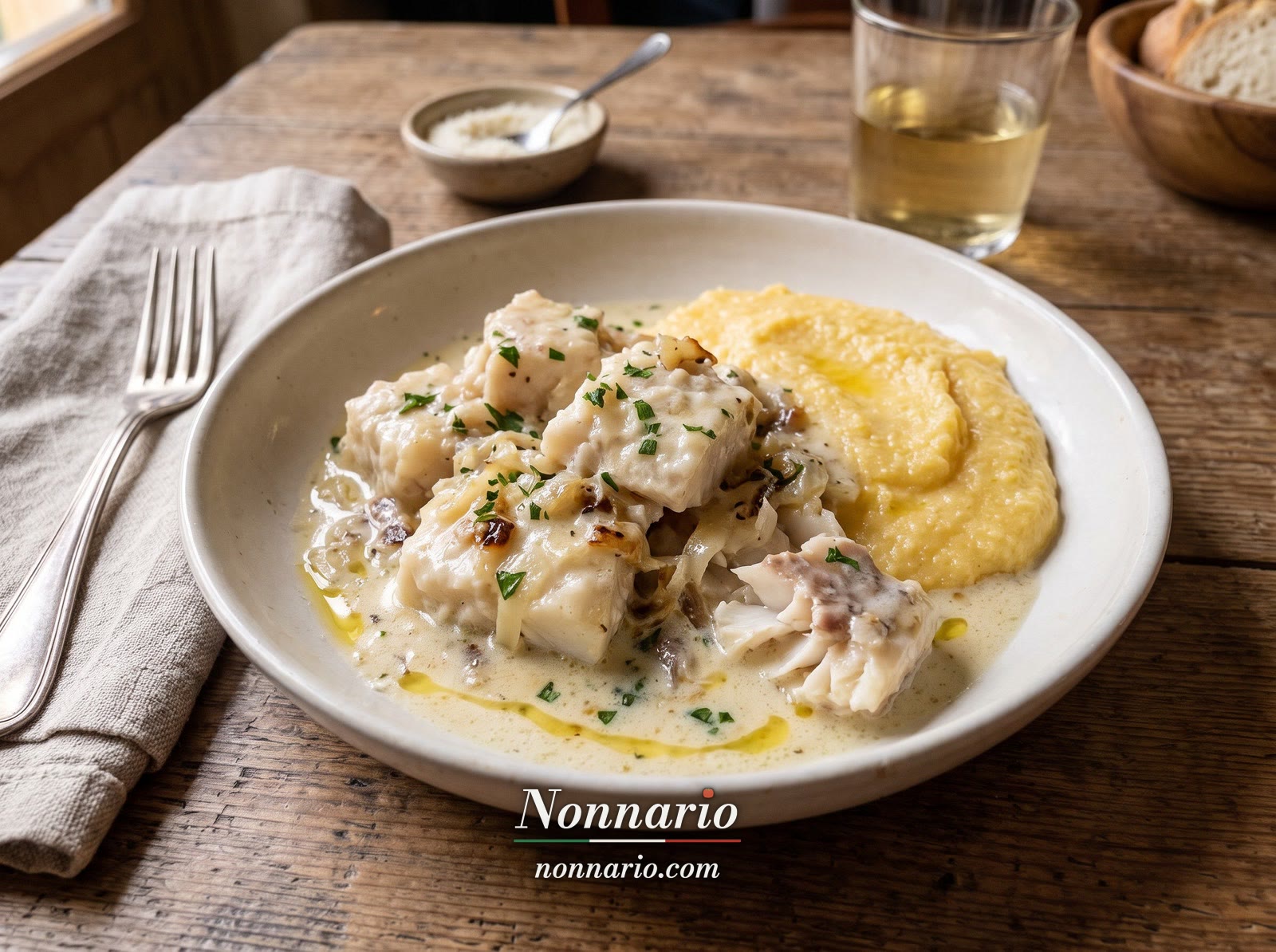
Stockfish slow-cooked in milk and olive oil, Vicenza style
Stockfish soaked for days, floured and cooked very slowly for about four and a half hours under onion, salted sardines, milk, grana and olive oil, never stirred: a De.Co. of Sandrigo since 2012.
- Course
- SecondiMain Courses
- Serves
- 12
- Hands-on
- 1 h 17 min
- Cooking
- 4 h 30 min
- Plan
- 3 days
The video and the photos of every step are also gathered on a separate page.
In breve
In short
Also called bacalà alla vicentina, baccala alla vicentina, bacalà, Vicenza-style stockfish and stockfish Vicenza style.
- Made with stockfish, cod dried in the cold northern air with no salt, which Vicenza calls bacalà; salt cod is not used.
- Soaked in cold water for 2–3 days, the water changed every 4 hours, then opened, boned and cut into pieces.
- Floured and laid side by side, under a soffritto of onion, salted sardines and parsley, with milk, grana and olive oil to cover.
- Cooked over a very gentle heat for about four and a half hours, the pan swirled now and then and never stirred.
- Served with polenta; it is excellent after a rest of 12–24 hours.
La provenienza
Where this recipe comes from
In the Veneto, bacalà means stockfish: cod dried for months in the cold air of the north, not the salted cod the rest of Italy calls baccalà. The story goes back to Pietro Querini, a Venetian merchant who sailed from Crete in 1431 with a cargo of malvasia wine and was shipwrecked in 1432 on Røst, in Norway's Lofoten islands, where the fishermen dried their cod hard as a stick; he brought it home to Venice. The Council of Trent's fasting rules made a cheap fish that kept for months welcome on the tables of the poor, and in Vicenza it became the Friday dish, as it has been for centuries. In 2010 the Region of Veneto announced that EuroFIR, a food information network funded by the European Commission, had chosen it as one of five traditional foods representing Italy, beside Sicilian cannoli, Tuscan castagnaccio, pizza Margherita and brasato al Barolo.
The Venerabile Confraternita del Bacalà alla Vicentina was founded in Sandrigo, north of Vicenza, in 1987 by the lawyer Michele Benetazzo, and one of its first aims was to write the recipe down. Its recipe, for twelve, came from studying and comparing those served in the best-known restaurants and trattorie of the Vicenza area between the 1930s and the 1950s, without condemning the variants. In July 2012 Sandrigo's town council approved a regulation for De.Co., municipal designations, for its traditional products, and the De.Co. of bacalà alla vicentina was presented on 15 December 2012; the Province of Vicenza's De.Co. website publishes the Confraternita's recipe on the dish's De.Co. page. We have not been able to read the council's resolution itself; the recipe on this page follows the Confraternita's text, which reads the same in both places, and the steps marked official carry only its words. The soaking in the fridge, the size of the pieces and of the pan, the heat diffuser and the checks are ours, so that someone cooking it for the first time knows when each stage is done; the cooling and reheating follow food-safety guidance.
- Provenance
- A reference recipe set by a protection consortium or by the town the dish is named after.
- Defined by
- Comune di Sandrigo (De.Co.), recipe of the Venerabile Confraternita del Bacalà alla Vicentina
- Reference
- De.Co. (Denominazione Comunale) for bacalà alla vicentina, under the De.Co. regulation approved by Sandrigo's town council in July 2012, presented on 15 December 2012; the recipe is the Confraternita's, shown on the dish's De.Co. page of the Province of Vicenza's De.Co. website and on the Confraternita's site (the council's resolution and regulation could not be read)
- Sources
- Venerabile Confraternita del Bacalà alla Vicentina: the recipe, for 12 (Italian)
- Comuni De.Co. (Province of Vicenza and Consorzio Vicenza è): Sandrigo's De.Co. bacalà alla vicentina, with its recipe (Italian)
- Comuni De.Co.: Sandrigo celebrates the De.Co. of bacalà alla vicentina, 16 December 2012 (Italian)
- Comuni De.Co.: Sandrigo's council approves its De.Co. regulation, 17 July 2012 (Italian)
- Venerabile Confraternita del Bacalà alla Vicentina: its history, founded in 1987 (Italian)
- Venerabile Confraternita del Bacalà alla Vicentina: why Vicenza calls stockfish bacalà (Italian)
- Venerabile Confraternita del Bacalà alla Vicentina: history and legend, Pietro Querini (Italian)
- Venerabile Confraternita del Bacalà alla Vicentina: baccalà and stockfish (Italian)
- Regione del Veneto: bacalà alla vicentina among the five traditional foods most representative of Italy, 21 September 2010 (Italian)
- Accademia Italiana della Cucina: baccalà alla vicentina, from its recipe collection (Italian)
Ingredienti
Ingredients
The original recipe serves 12
For the bacalà
To serve
Equipment
- A large tub or bowl that holds the stockfish under water, and room for it in the fridge
- A wooden mallet, if the stockfish is not already beaten
- A sharp knife, kitchen scissors and fish tweezers or small pliers, for the bones
- A small pan for the soffritto
- A wide pan of earthenware or aluminium, or an ovenproof dish, to hold the pieces side by side: for 12 servings about 34 cm across, or two smaller ones
- A heat diffuser, for an earthenware pan or for keeping the heat very low
- A wide spoon or spatula, for serving without breaking the pieces
Preparazione
Method
Scaled to 12 servings: the amounts in the steps follow. Pot and pan sizes and cooking times are still for the original 12.
Start two or three days ahead: the stockfish soaks in cold water, changed every 4 hours, for 2–3 days. On the day, about an hour and a quarter of work, then about four and a half hours of very slow cooking, so start in the morning for dinner, and make the polenta in the last hour. It is excellent after a rest of 12–24 hours, so you can also cook it the day before and reheat it gently.
- 1 h 17 minhands-on
- 4 h 30 mincooking
- 3 daysfrom start to table
Two to three days ahead: soaking the stockfish
This follows the Confraternita's recipe, the one shown on the dish's De.Co. page. Steps marked official carry only its words; the times, heat levels, sizes and checks it does not give are ours, some in tips marked ‘Our guide’.
-
Rest 2 days to 3 daysOfficial text
Soak the 1 kg of stockfish, already well beaten, in cold water for 2–3 days, changing the water every 4 hours.
Check The fish has swollen and turned pale; it bends without cracking and the thickest part gives under a firm press of the finger, with no hard core.
Tip Our guide: buy it already beaten if you can. If it is not, beat it all over with a wooden mallet on a board before soaking, to break the dry fibres so the water gets in.
Tip Our guide: break or cut it into lengths that fit the tub, keep it fully under the water, and keep the tub in the fridge at 4 °C or below: once it takes up water the fish is as perishable as fresh fish.
Tip Our guide: set a reminder for every change; at each one, tip the water away and refill with fresh cold water.
On the day: preparing the fish
-
Hands-on 20–30 minOfficial text
Open the fish lengthwise, take out the backbone and all the bones. Cut it into pieces.
Check Run a finger over and through every piece: you feel no bone, not even the small ones.
Tip Our guide: drain it and pat it dry first. Cut the backbone out with scissors, then pull the small bones with fish tweezers or pliers.
Tip Our guide: pieces about 5 cm wide, with the skin left on: it holds them together through the long cooking.
-
Hands-on 10 min
Rinse the 3 salted sardines under cold running water to take off the salt. Pull off the heads and the skin, open them and lift out the backbone, then pat them dry.
Check Clean fillets, with no salt crystals, scales or bones left.
Tip Our guide: they are salty even after rinsing, so the dish needs only a little salt later.
-
Hands-on 3 min
Chop the parsley finely.
Check A fine, even green mince, with no whole leaves.
The soffritto
The recipe gives no heat or times for the soffritto: those on these steps are ours.
-
Hands-on 5–8 minOfficial text
Slice the onions finely.
Check Thin, even slices, about 2 mm.
-
Hands-on 10–12 minHeat medium-lowOfficial text
Cook the onions golden in a small pan with a glass of the oil.
Check The onions are soft and pale gold, with no dark edges.
Tip Our guide: a glass is about 100 ml, taken from the 500 ml of oil; keep the rest for covering the fish. Stir now and then.
-
Hands-on 2 minHeat lowOfficial text
Add the salted sardines, cut into small pieces.
Check The sardines have broken down into the onions.
Tip Our guide: turn the heat down first, then stir for 1–2 minutes, pressing the pieces with the spoon so they melt; they must not fry.
-
Hands-on 1 minOfficial text
Last, with the heat off, stir in the chopped parsley.
Check The parsley is bright green and just wilted.
Into the pan
-
Hands-on 1 minOfficial text
Pour a few spoonfuls of the soffritto over the bottom of the pan: earthenware or aluminium, or an ovenproof dish.
Check The bottom is thinly and evenly covered.
Tip Our guide: for 12 servings, a pan about 34 cm across, or two smaller ones, so the pieces fit side by side.
-
Hands-on 10 minOfficial text
Moisten the pieces of stockfish with some of the soffritto, then flour them.
Check Every piece has a thin, even coat of flour, with no dry lumps.
Tip Our guide: spoon a little soffritto over each piece, roll it in a plate of flour, then shake off the excess.
-
Hands-on 5 minOfficial text
Lay the pieces side by side in the pan.
Check One close layer, the pieces touching, with no gaps to fill.
-
Hands-on 3 minOfficial text
Cover the fish with the rest of the soffritto, adding the 500 ml of milk, the 50 g of grated grana, salt and pepper.
Check The soffritto is spread over every piece and the milk lies round them.
Tip Our guide: only a light pinch of salt: the sardines and the cheese are salty.
-
Hands-on 2 minOfficial text
Pour in the oil until all the pieces are covered, levelling them.
Check No piece shows above the surface.
Tip Our guide: this is the rest of the 500 ml of oil. If a few pieces still show once it is all in, add a little more: the oil must cover them.
The slow cooking
In Vicenza this stage is called pipare: the surface barely trembles for hours. The recipe gives the time and the very gentle heat; the uncovered pan, the diffuser, the swirling every half hour and the check are ours.
-
Cooking 4 h 30 minHeat very lowOfficial text
Cook over a very gentle heat for about four and a half hours, moving the pan now and then with a circular motion, never stirring.
Check A fork slides into the thickest piece with no resistance and the flesh parts into flakes; the milk and oil have become a thick, creamy golden sauce.
Tip Our guide: set the pan on a heat diffuser over the smallest ring and bring it up slowly; earthenware cracks on a sudden high heat. Once it is hot, only a lazy bubble should break the surface now and then.
Tip Our guide: cook it uncovered, so you can watch the surface tremble; if the oil sinks below the top pieces and they start to dry, set the lid on ajar.
Tip Our guide: about every 30 minutes, take the pan by its handles and swirl it gently in a circle so nothing sticks. Never put a spoon in it: stirring breaks the fish.
Tip Only experience tells the exact moment, as one stockfish differs from another in texture. Our guide: if the thickest piece is still firm, give it 30 minutes more.
-
Rest 10 min
Take the pan off the heat and leave it to settle for 10 minutes.
Check The bubbling has stopped and the sauce has thickened a little.
Tip Our guide: the pieces firm up slightly as they rest, so they lift out whole.
-
Hands-on 5 minOfficial text
Serve with polenta.
Check Each plate has whole pieces of fish, with their sauce spooned over.
Tip Our guide: lift the pieces with a wide spoon or spatula, never a fork, and spoon the sauce over them.
Tip It is excellent after a rest of 12–24 hours. Our guide: cool it and put it in the fridge, covered, within 2 hours of the end of cooking, and reheat it covered over a very low heat, swirling the pan without stirring, until the centre of the thickest piece reaches 75 °C.
The essentials, for cooks who know the dish. Switch to Detailed for quantities, temperatures, times and checks at every step.
Press “I’m here” on the step you are on, and again when it is done.Tap the pin on the step you are on, and the tick when it is done. Timers keep running while you scroll.
Da sapere
Good to know
- WhenQuando
- The Friday dish in Vicenza, every week, for centuries. Source
- KeepingConservazione
- It is excellent after a rest of 12–24 hours. Cool it and put it in the fridge, covered, within 2 hours of the end of cooking, in its wide pan or in shallow containers; eat it within 3 days of cooking, the day ahead included, reheated covered over a very low heat, swirling the pan without stirring, until the centre reaches 75 °C. Source
- VariantsVarianti
- With anchovies and garlic, filled and sliced: The stockfish halves spread with a soffritto of onion, garlic, salted anchovies and parsley, sprinkled with flour, Parmigiano, salt and pepper and closed again, then cut into slices five centimetres wide, floured again with flour and cheese, packed into an earthenware pan and covered with milk; about four hours over a slow, steady heat. Source
- Rolled: The pieces tied into rolls before cooking. Source
- Milder: Less anchovy (or sardine) and onion, for a more delicate but less savoury dish; or more milk, which makes it paler. Source
- With garlic: Garlic, either chopped or added whole and taken out halfway through the cooking. Source
- Longer, shorter, or without flour: Some cooks hold that four or even five hours of slow cooking are essential, others only three; some flour the pieces and some do not. Source
Errori comuni
Common mistakes
- Using salt cod: in Vicenza bacalà is stockfish, cod dried with no salt.
- Stirring it: the pan is only swirled in a circle, or the fish breaks into shreds.
- Cooking it fast: it needs a very gentle heat for about four and a half hours.
- Skimping on the oil: it must be of the best quality, and enough to cover the fish.
- Leaving bones in: the backbone and every small bone come out before cooking.
Fuori dall'Italia
Cooking it outside Italy
- Look for stockfish, Norwegian tørrfisk: whole cod air-dried with no salt, from northern Norway. Salt cod (bacalao, bacalhau, morue) is a different product and is not used here.
- If you cannot find salted sardines, salted anchovies are the fish the variants of the dish use; rinse and bone them the same way.
- Formaggio grana means Grana Padano or Parmigiano Reggiano; either will do.
From nonnario.com/recipes/baccala-alla-vicentina/, where you will find its sources, its story and the step photos. Sources checked in November 2026.