Venezia, Veneto
Bigoli in salsa
Thick whole-wheat Venetian pasta with a sauce of slow-cooked onions and salted sardines
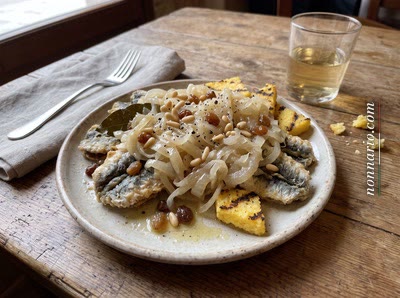
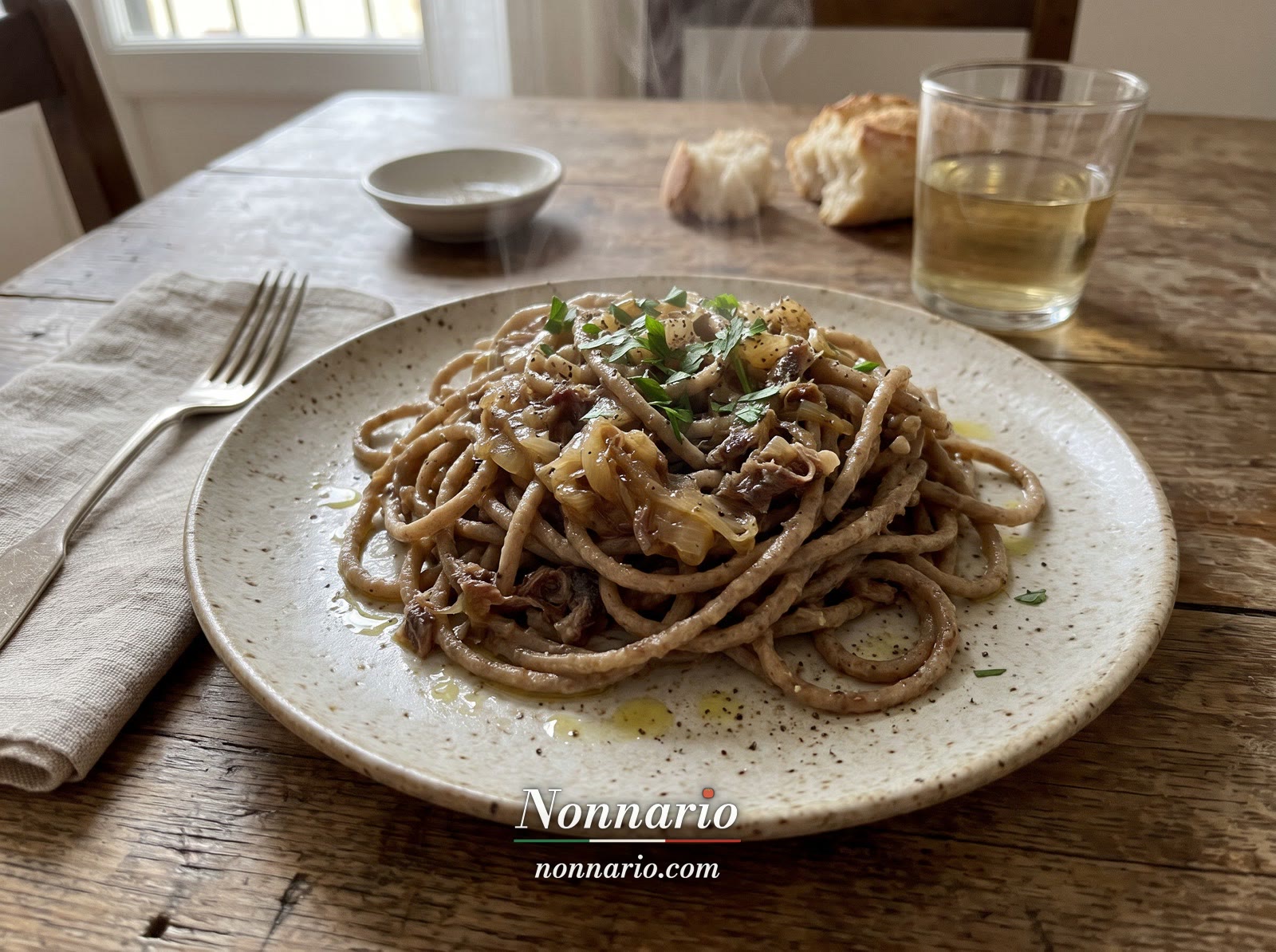
Thick whole-wheat bigoli dressed with a sauce of onions stewed slowly in olive oil until soft and pale, with salted sardines melted into them: a Venetian dish of meatless days, on the Veneto's list of traditional products.
- Course
- Primi & RisottiPasta & Rice
- Serves
- 4
- Hands-on
- 35 min
- Cooking
- 32 min
The video and the photos of every step are also gathered on a separate page.
In breve
In short
Also called bigoi in salsa, bigoli scuri in salsa, bigoli in salsa alla veneziana, Venetian bigoli with onions and sardines and bigoli with anchovy sauce.
- Bigoli: thick, rough Venetian spaghetti, about 3 mm–4 mm across; here the dark whole-wheat kind, bought fresh or dried.
- Salted sardines, boned and left about 20 minutes under cold running water to lose their salt; salted anchovies may replace them.
- Onions, with garlic in this version, chopped fine and stewed in olive oil for half an hour over a moderate heat, with spoonfuls of water so they never colour.
- The sardines melted into the onions over the lowest heat, in this version a splash of white wine, then the sauce poured very hot over the just-drained bigoli.
- A dish of meatless days, such as Christmas Eve, Good Friday and Ash Wednesday.
La provenienza
Where this recipe comes from
Bigoli are the long pasta of the Veneto, also made in eastern Lombardy: much thicker than spaghetti, about 3–4 mm across, rough enough to hold a rich sauce, of soft wheat and water, with darker versions of whole-wheat or buckwheat flour and others made with egg. Traditionally they were pressed through the bigolaro, a hand press with a bronze die, and today they are still made in hand or machine presses; the bigolaro’s invention is credited to Bartolomio Veronese, a Paduan pasta maker known as ‘Abbondanza’, who was granted a patent for it by the town council in 1604. The name is usually traced to the dialect word bigàt, a caterpillar, for the shape; others derive it from the Latin bombyx, the silkworm. In salsa, with onions and salted fish, is how they are eaten on meatless days, Christmas Eve, Good Friday and Ash Wednesday among them: a very cheap, easy dish, called a ‘salsa’ because the sauce is smooth and velvety, not grainy like a ragù. The Region of Veneto lists bigoli in salsa among the traditional agri-food products of the Veneto.
There is no official recipe. We compared six sources and publish the most widely recognised version: bigoli dressed with onions stewed slowly in olive oil and salted fish melted into them. This version uses whole-wheat bigoli and salted sardines, boned and desalted under running water, stews the white onions for half an hour without letting them colour, adds two cloves of garlic and finishes the sauce with a splash of white wine; other versions leave out the garlic and the wine. The sources agree on what matters: onions cooked slowly in oil, salted fish melted into them, and the bigoli boiled and dressed with the sauce. They differ on garlic and wine (some versions add nothing at all but onion and fish), on sardines or anchovies, on whether the onions may turn golden, and on finishing the pasta in the pan. Ours are the cleaning of the sardines, the pasta water and the checks at each stage.
- Provenance
- A regional tradition documented in cookbooks and local practice, with no single official text.
- Defined by
- Venetian tradition
- Reference
- Compared across 6 sources, listed below; this page publishes the most widely recognised version.
- Sources
- Gambero Rosso: bigoli scuri in salsa, a recipe card for 4, 2008 (Italian; archived copy of 2020)
- Gambero Rosso: home-made pasta with the experts' advice, the bigoli, their history and a recipe for bigoli in salsa, 19 July 2020 (Italian; archived copy)
- Accademia Italiana della Cucina: bigoli in salsa, a Venetian recipe for 4 from its recipe collection (Italian)
- Dissapore: bigoli in salsa alla veneziana, with salted anchovies, for 4, 8 September 2024 (Italian)
- Dissapore: bigoli, home-made egg pasta pressed through the bigolaro, 4 April 2020 (Italian)
- Regione del Veneto: list of the traditional agri-food products of the Veneto, updated 24 July 2026 (Italian)
Ingredienti
Ingredients
The original recipe serves 4
For the sauce
For the bigoli
Equipment
- A sharp knife and a chopping board, or a mezzaluna
- A sieve or small colander for the sardines, and kitchen paper
- A wide frying pan or sauté pan about 26 cm–28 cm across, with a lid, and a wooden spoon
- A large pot of about 6 l with a lid, a colander and a mug for pasta water
- A serving bowl, warmed
Preparazione
Method
Scaled to 4 servings: the amounts in the steps follow. Pot and pan sizes and cooking times are still for the original 4.
Start about 1 hour 10 minutes before you eat. Chop the onions and clean the sardines first, about 20 minutes; then the onions stew for half an hour while the sardines lose their salt under running water and the pasta water comes to the boil. The bigoli go in when the onions are ready, and the sardines melt into the sauce while they cook. The dish is eaten as soon as it is made.
- 35 minhands-on
- 32 mincooking
Getting ready: the onions and the sardines
The quantities and the method follow one recipe whole; the sizes, heat levels, the times it does not give, the checks and the tips marked ‘Our guide’ are ours.
-
Hands-on 8–10 min
Peel the 200 g–300 g of white onions and the 2 garlic cloves and chop them finely together.
Check Small, even pieces, about 3 mm, with no long strips left.
Tip Our guide: slice the onions thinly first, then chop across the slices; a mezzaluna makes quick work of it.
-
Hands-on 3 min
Take the 100 g of sardines out of their salt and rinse them one at a time under cold water, rubbing off the salt with your fingers.
Check No salt crystals are left on the skin or inside the fish.
Tip Our guide: if you use salted anchovies instead, clean them the same way, here and in the next step.
-
Hands-on 8–10 min
Bone the sardines. Pull off the head if it is still on, bringing the guts with it; open each fish along the belly with your thumb, lift out the backbone from the head end with the small bones attached, and pull off the fins and tail. Scrape away any dark matter left inside.
Check Clean fillets, two from each fish, with no backbone, fins or dark matter; a few hair-fine bones may remain.
Tip Our guide: the hair-fine bones that remain soften and melt into the sauce.
Tip Our guide: wash your hands, the board and the sink with soap and hot water when you have finished.
The onions, while the sardines lose their salt
-
Hands-on 2 minHeat medium-low
Put the 4 tablespoons of olive oil and the chopped onions and garlic into the wide pan over a moderate heat, on the low side, and let them stew. They cook for half an hour in all and must not take any colour.
Check The onions are sizzling very gently and have started to soften, with no browning at the edges.
Tip Our guide: set the lid on the pan slightly ajar, so the onions stew in their own moisture rather than fry.
-
Hands-on 1 min
Lay the sardine fillets in the sieve or colander under a thin stream of cold running water and leave them there for about 20 minutes, so they lose their salt.
Check The water runs gently over all the fillets without pushing them about.
Tip Our guide: a thin stream is enough, and the fillets stay whole.
Tip Our guide: salted anchovies, boned in the same way, are not left under the water: scrape them and rinse them quickly, pat them dry and break them up, then skip the drying step that follows.
-
Hands-on 2 min
Bring 4 l of water to the boil in the large pot, covered.
Check The pot is on the heat, covered; it will take 15–20 minutes to boil, about when the onions are ready.
Tip Our guide: if it boils before the onions are done, turn it down and let it wait.
-
Cooking 20 minHeat medium-low
Let the onions stew for 20 minutes, stirring every few minutes and adding a tablespoon or two of water or broth whenever the pan looks dry, so they never colour.
Check The onions are soft and translucent, still pale, and nothing is catching on the bottom of the pan.
Tip Our guide: at the first golden edge, add a spoonful of water at once and turn the heat down a little.
-
Hands-on 3 min
Turn off the water, pat the sardine fillets dry with kitchen paper and break them into small pieces.
Check Taste a small piece: pleasantly salty, no longer harsh. If it still stings with salt, rinse the fillets a few minutes more.
Tip Our guide: the sardines bring all the salt the sauce needs.
-
Cooking 2–4 minHeat medium-low
Carry on stewing the onions until they have had half an hour in all, adding a spoonful of water if needed.
Check A piece of onion crushes to a paste between two fingers; the onions are very soft, almost creamy, and still pale, with no golden edges. The pasta water is boiling.
Tip Our guide: the onions are ready when the bigoli go in, not before: they can wait over the lowest heat for a few minutes, with a spoonful of water.
The bigoli and the sauce
-
Cooking 10–14 min
Add the 20 g of coarse salt to the boiling water, put in the 400 g of bigoli and stir. Cook them until al dente: the time on the packet, usually 10–14 minutes for dried whole-wheat bigoli, less for fresh. Before draining, keep back a mug of the pasta water.
Check Bite a strand: tender, with a slight firmness at the centre.
Tip Our guide: stir them in the first minute so they do not stick together, then now and then.
Tip Our guide: salt the water only lightly, 5 g per litre, since the sauce is salty.
-
Hands-on 4–5 minHeat very low
As soon as the bigoli are in, turn the onions down to the lowest heat, add the sardine pieces and stir, pressing them with the wooden spoon, until they melt into the sauce.
Check The sardines have dissolved into the onions and no pieces of fish can be seen; the sauce is smooth and hot.
Tip Our guide: the sauce should barely bubble: if the sardines sizzle, the heat is too high and they will fry and harden instead of melting.
Tip Our guide: taste the sauce: it rarely needs salt.
-
Hands-on 1 minHeat low
When the bigoli are nearly ready, splash about 2 tablespoons of white wine over the sauce, grind in some black pepper and stir.
Check The wine has bubbled briefly and its raw smell has gone; the sauce is very hot.
Tip Our guide: leave it on the heat for about 1 minute after the wine goes in, then keep it hot until the bigoli are drained.
-
Hands-on 3 min
Drain the bigoli as soon as they are done, tip them into the warmed bowl and pour the very hot sauce over them. Toss and serve at once.
Check Every strand is coated with the sauce, with flecks of sardine and onion clinging to it, and the dish is steaming hot.
Tip Our guide: if it looks dry, toss in a spoonful or two of the pasta water you kept.
Tip Our guide: warm the bowl with a little of the boiling pasta water and pour it away just before the bigoli go in.
The essentials, for cooks who know the dish. Switch to Detailed for quantities, temperatures, times and checks at every step.
Press “I’m here” on the step you are on, and again when it is done.Tap the pin on the step you are on, and the tick when it is done. Timers keep running while you scroll.
Da sapere
Good to know
- WhenQuando
- A dish of meatless days, such as Christmas Eve, Good Friday and Ash Wednesday. Around Vicenza, bigoli are dressed with duck ragù, or with the anchovy sauce in the lean periods of the year. Source
- KeepingConservazione
- Eat it at once, while the sauce is very hot. Leftover bigoli go into the fridge in a shallow covered container within 2 hours of cooking and keep until the next meal; they lose the creaminess of the sauce, so warm them through in a frying pan with a little oil until a light crust forms and they are piping hot (75 °C). The sauce made ahead and kept on its own goes into a covered glass jar and into the fridge within 2 hours of cooking; it keeps there for a couple of days. Bring it back to the boil before using it. Source
- VariantsVarianti
- With salted anchovies: Salted anchovies, the same weight as the sardines, give much the same result; they are not left under running water, only scraped and rinsed quickly. Source
- Onion and sardines only: No other flavouring at all: for four, 800 g of bigoli pressed through the torchio, 80 g of salted sardines, two onions, a glass of oil, salt and pepper. The cleaned sardines are cut small and cooked slowly with the sliced onions in the oil, with two spoonfuls of water, until the onions are soft and golden, then stirred a few minutes more so onion and sardine melt together. The bigoli are boiled in plenty of salted water, drained al dente and dressed with the sauce and a drizzle of raw oil. Source
- With garlic instead of onion: Two or three cloves of garlic, well crushed, can take the place of the onion: the dish is more savoury, if heavier. Source
- With anchovies, finished in the pan: The onion chopped fine and softened in olive oil, covered, over a very low heat until almost a cream; desalted, boned salted anchovies stirred in over a low heat until they melt; the bigoli drained a minute short of the packet time and tossed in the pan with half a ladle of their water. Anchovy fillets in oil are a handy alternative; some cooks add a whole clove (the spice) to the onion, or use red onion for a sweeter, darker sauce. Source
- Home-made egg bigoli: For four, 400 g of type 0 flour, 4 eggs and a pinch of salt, kneaded for at least 10 minutes until smooth, wrapped and rested for at least 30 minutes, then shaped into short logs and pressed through the bigolaro; the strands are cut to length and laid on a floured board. A meat mincer with its blades taken out can stand in for the bigolaro. Source
Errori comuni
Common mistakes
- Letting the onions colour: they stew over a moderate heat for half an hour, with spoonfuls of water, and stay pale.
- Not desalting the sardines: about 20 minutes under cold running water, or the sauce is too salty.
- Leaving the backbone in: it comes out when the sardines are boned.
- Frying the sardines: they melt into the onions over the lowest heat and never sizzle.
- Letting the sauce cool: it goes on very hot, over bigoli just drained.
Fuori dall'Italia
Cooking it outside Italy
- Bigoli are thick spaghetti, here whole-wheat; outside the Veneto they are sold, fresh or dried, in Italian delicatessens.
- Salted sardines are sold packed in salt, in tins or jars; salted anchovies of the same weight may replace them, scraped and rinsed quickly rather than left under the water.
- White onions are the mild, white-skinned kind.
From nonnario.com/recipes/bigoli-in-salsa/, where you will find its sources, its story and the step photos. Sources checked in November 2026.