Venezia, Veneto
Risi e bisi
Venetian rice and fresh peas
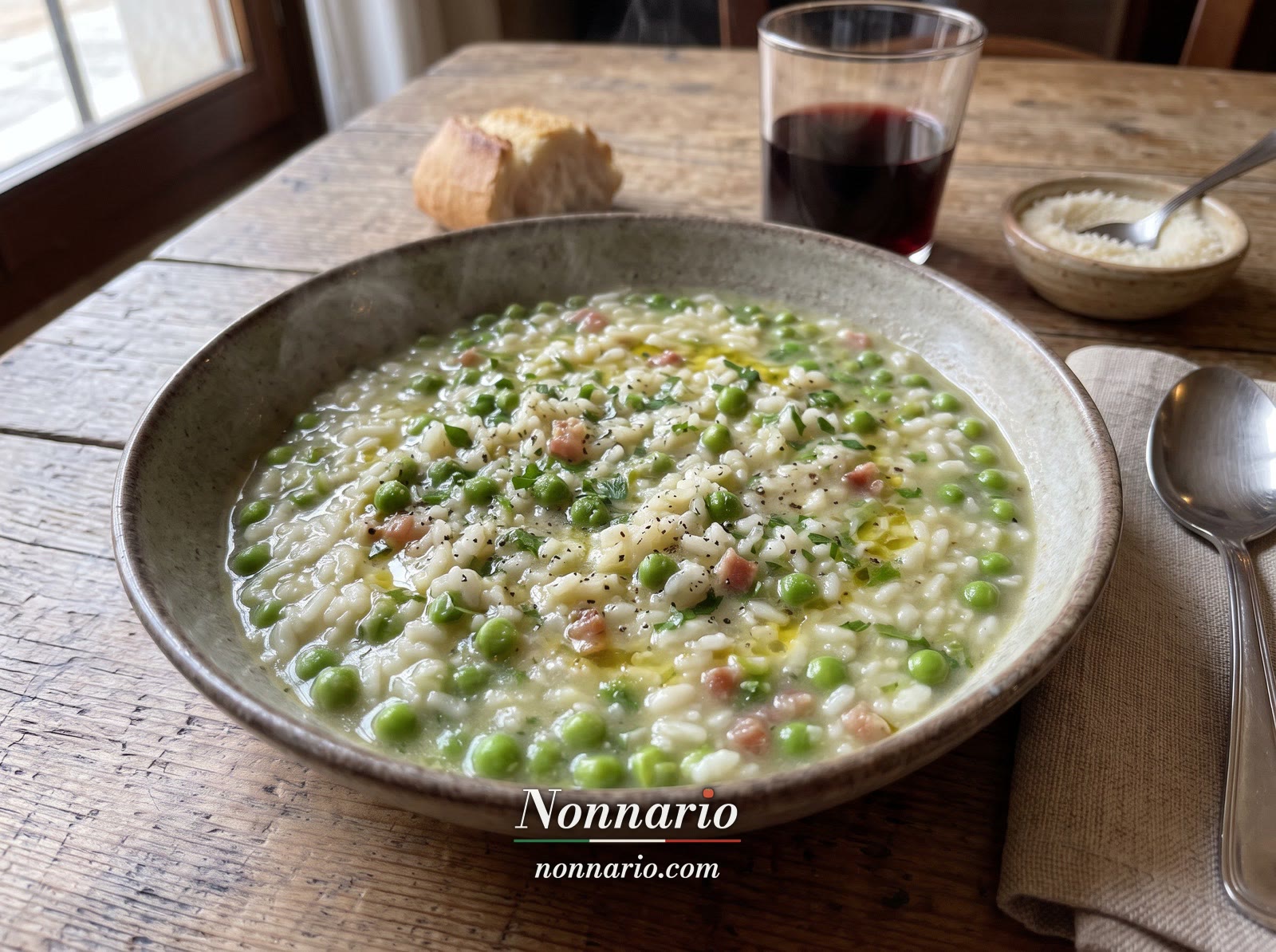
Venice's rice and fresh peas, cooked with fresh white onions in a chicken broth and finished loose, ‘all’onda’, with butter and parmigiano, as the town of Scorzè, with the Accademia Italiana della Cucina's local delegation, deposited it with the Venice Chamber of Commerce in 2013.
- Course
- Primi & RisottiPasta & Rice
- Serves
- 6
- Hands-on
- 1 h 25 min
- Cooking
- 2 h 40 min
- Plan
- 2 days
The video and the photos of every step are also gathered on a separate page.
In breve
In short
Also called riso e piselli and rice and peas.
- Gluten-free
- Fresh shelled peas and Vialone Nano rice in equal weight, 500 g of each for six, with fresh white onions, parsley, olive oil, butter and parmigiano.
- A chicken broth with celery, carrot, onion and a clove of garlic, made preferably the day before and strained.
- The peas cook first, with the onions, parsley, oil and half a glass of water, for 10–15 minutes until the water is absorbed.
- The rice goes in with the peas and cooks as the hot broth is added a little at a time, until still a little al dente.
- Off the heat: butter, parmigiano, pepper and enough broth to make it ‘all’onda’, just brothy, moving softly when the plate is moved.
La provenienza
Where this recipe comes from
Risi e bisi, rice and peas in Venetian, is a dish of Venetian cooking made with the first peas of the season, the bisi, and it sits halfway between a risotto and a thick soup. By tradition it was on the Doge's table every 25 April, the feast of Saint Mark, the city's patron. The Doges' favourite rice came from Grumolo delle Abbadesse or from around Verona, and their peas usually from Lumignano, near Vicenza, sweet and delicate and the first to ripen in the mild hills. By one account Carlo Goldoni praised the dish. The Region of Veneto lists risi e bisi among the traditional agri-food products of the Veneto, together with several local peas, among them those of Lumignano, Peseggia, Baone, Borso del Grappa and Colognola ai Colli. Two ways of making it are rooted in neighbouring parts of the Veneto: one with a chicken broth, now the more common, the other with a broth made from the pea pods, which needs peas of good quality grown without chemical treatments.
In July 2013 the recipe was signed before a notary in the council chamber of Scorzè, near Venice, in the presence of the mayor and of the delegate of the Accademia Italiana della Cucina for Venezia-Mestre, and deposited with the Venice Chamber of Commerce, to be kept by its office for local customs. The Pro Loco of Scorzè and the Accademia's local delegation had reconstructed it from historical documents of the Venetian mainland, the local customs of Peseggia and the Venetian area, and the memories of the oldest people there; the Province of Venice and the Comune of Scorzè backed it, and it was also meant to promote the peas grown in Scorzè. The notarial deed itself is not published, but its text, for six, can be read in the recipe sheet issued with the announcement and in the accounts printed in full at the time, all word for word the same; the steps marked as the official text carry only its words. A close version the Accademia publishes, for four, uses less rice to the same peas; it is among the variants. The peas cook first with fresh onions, parsley, oil and a little water; the rice follows, with a chicken broth added a little at a time; butter, parmigiano and a last ladle of broth leave it loose. Ours are the amounts and times for the broth, the heat, the cooking time of the rice, how much broth it takes and the size of a ladle, and the food-safety rules: the broth goes into the fridge within 2 hours of cooking, and the dish and its leftovers keep only until 3 days after the broth was made.
- Provenance
- An official recipe filed with an Italian Chamber of Commerce or a notary by a recognised culinary body.
- Defined by
- Pro Loco di Scorzè and the Accademia Italiana della Cucina, Venezia-Mestre delegation, with the Comune di Scorzè and the Provincia di Venezia
- Reference
- Recipe signed before a notary at Scorzè and deposited with the Venice Chamber of Commerce (Ufficio Usi) in July 2013, after research by the Pro Loco of Scorzè with the Accademia's local delegation; the deed itself is not published, so its text is read in the recipe sheet issued with the announcement (il Bàcaro, 1 August 2013) and as printed in full by La Nuova Venezia and VeneziaToday on 31 July 2013, all word for word the same
- Sources
- il Bàcaro: the recipe sheet for risi e bisi issued with the announcement of its deposit with the Venice Chamber of Commerce, for 6, 1 August 2013 (Italian)
- il Bàcaro: the recipe for risi e bisi deposited with the Venice Chamber of Commerce, with its partners, 1 August 2013 (Italian)
- La Nuova Venezia: Scorzè and the Province deposit the recipe for risi e bisi, with the deposited recipe for 6, 31 July 2013 (Italian)
- VeneziaToday: the true recipe for risi e bisi, deposited with the Chamber of Commerce from Scorzè, with the recipe, 31 July 2013 (Italian)
- Cucina Regionale Italiana: risi e bisi, its transcription of the recipe deposited with the Venice Chamber of Commerce in 2013 (Italian)
- Accademia Italiana della Cucina: riso e piselli 1 (risi e bisi), with a broth of the pea pods, from its recipe collection, for 4 (Italian)
- Accademia Italiana della Cucina: riso e piselli 2 (risi e bisi), with chicken broth, from its recipe collection, for 4, with a note on the two versions (Italian)
- VeneziaUnica, the official tourism site of the City of Venice: risi e bisi, its history and a recipe (Italian; archived copy)
- Regione del Veneto: list of the traditional agri-food products of the Veneto, updated 24 July 2026 (Italian)
- La Cucina Italiana: risi e bisi, a typical dish of the Veneto, with pancetta, for 4 (Italian)
- Dissapore: risi e bisi, the deposited recipe retold, with notes on pancetta and the pea pods (Italian)
Ingredienti
Ingredients
The original recipe serves 6
For the chicken broth, the day before
For the risi e bisi
Equipment
- Stockpot holding at least 6 l, with a lid
- Skimmer, and a fine sieve
- Shallow containers with lids, for chilling the broth
- Saucepan for keeping the broth hot beside the stove
- Wide, heavy casserole about 28 cm across, with sides about 10 cm high
- Ladle and a wooden spoon
- Grater for the cheese
- Probe thermometer, useful for the simmer and for reheating leftovers
- Warmed soup plates
Preparazione
Method
Scaled to 6 servings: the amounts in the steps follow. Pot and pan sizes and cooking times are still for the original 6.
Two days. The day before: about 3 hours for the chicken broth, almost all of it unattended, then into the fridge within 2 hours of turning off the heat. On the day: about 30 minutes to shell the peas and slice the onions while the broth comes back to the boil, then about 30 minutes at the stove: 10–15 minutes for the peas, 14–16 for the rice and a few to finish. Serve it at once: it thickens as it stands. The broth, the dish and any leftovers keep only until 3 days after the day the broth was made.
- 1 h 25 minhands-on
- 2 h 40 mincooking
- 2 daysfrom start to table
The day before: the chicken broth
The deposited text asks only for a chicken broth with celery, carrot, onion, a clove of garlic and a little salt, made preferably the day before and strained. The amounts, the heat and the times here are ours.
-
Hands-on 5 min
Rinse the chicken pieces under cold water. Peel the carrot, wash the celery stalk, peel the onion and cut it in half, and peel the garlic clove.
Check Everything is ready for the pot; the carrot and celery are whole or in two or three pieces.
-
Hands-on 3 min
Put the chicken, celery, carrot, onion and garlic in the stockpot with the salt, and pour in 3.5 l of cold water.
Check The water covers the chicken by a few centimetres.
Tip Our guide: starting in cold water draws the flavour out slowly and brings up the foam you will skim, for a clearer broth.
-
Cooking 30–40 minHeat medium
Bring the pot slowly to the boil, lifting off the grey foam with the skimmer as it rises.
Check The water has come to the boil and the surface stays clean, with only small drops of fat.
Tip Our guide: on medium heat it takes 30–40 minutes. Skim again and again as it nears the boil, until no more foam rises.
-
Cooking 2 hTemp 90 °C–95 °CHeat lowest, a bare simmer
Lower the heat until the broth barely simmers, set the lid ajar, and leave it for 2 hours, skimming now and then.
Check The broth is pale gold and smells of chicken, and the meat comes away from the bone.
Tip Our guide: only a few small bubbles should break the surface, at about 90 °C–95 °C. A rolling boil makes the broth cloudy.
-
Hands-on 10 min
Lift out the chicken and vegetables with the skimmer, then pour the broth through the fine sieve into a clean bowl or pot.
Check No pieces of meat or vegetable are left in the broth, and you have about 2.5 l–3 l.
Tip Our guide: taste it. It should be only lightly salted: the peas are salted later.
Tip Our guide: the cooked chicken can go into another dish; put it in the fridge, covered, within 2 hours of turning off the heat under the pot.
-
Hands-on 10–20 min
Divide the broth among shallow containers and put them in the fridge within 2 hours of turning off the heat under the pot; standing them in a sink of cold or iced water first cools them faster.
Check The broth is in the fridge, covered, no more than 2 hours after the heat went off.
Tip Our guide: the 3 days that the broth, the dish and its leftovers keep count from today, the day the broth is made, not from the day you cook the rice.
-
Rest 12 hTemp 4 °C
Leave the broth overnight in the fridge at 4 °C or below. The next day you can lift off the fat that has set on top.
Check By morning the broth is cold, with a layer of set fat on top.
Tip Our guide: count about 12 hours; the text asks for the broth preferably the day before.
On the day: before you start
-
Hands-on 15–20 min
If you bought the peas in the pod, shell them until you have 500 g.
Check You have 500 g of peas, with no bits of pod or string among them.
Tip Our guide: about 1.3 kg–1.5 kg of pods give 500 g of shelled peas. The dish is made with the first peas of the season: choose firm, bright green pods.
-
Cooking 10–15 minHeat medium-high, then low
Pour the broth into the saucepan, bring it to a full boil, then lower the heat and keep it at a gentle simmer beside the casserole.
Check It has boiled all over, not just at the edges, and now simmers gently.
Tip Our guide: you need about 2 l for the rice and the finish. Keep it hot all through: cold broth stops the rice cooking.
Tip Our guide: a broth from the fridge always comes back to a full boil before use.
Tip Our guide: once the risi e bisi is served, put any broth left over in shallow containers in the fridge within 2 hours of turning off the heat, use it within the same 3 days from the day it was made, and boil it again before use.
-
Hands-on 10 min
Slice the 2 fresh white onions into thin pieces, the white and the tender green. Chop the parsley until you have 1 tablespoon, and grate the parmigiano.
Check The onions are in thin, even slices, about 2 mm; the parsley is finely chopped.
Tip Our guide: do this while the broth comes back to the boil.
The peas
-
Hands-on 2 minOfficial text
In a casserole put the 5 tablespoons of olive oil, the 500 g of shelled peas, the 2 fresh white onions cut into thin pieces, the chopped parsley and half a glass of water.
Check Peas and onions lie in a shallow bath of oil and water.
Tip Our guide: everything goes in together, with no frying of the onions first. Half a glass is about 100 ml.
-
Hands-on 10–15 minHeat medium-lowOfficial text
Cook the peas for 10–15 minutes, until the water has been absorbed.
Check No water is left at the bottom of the pan; the peas are bright green and tender, and the onions soft and translucent, not coloured.
Tip Our guide: uncovered, at a gentle simmer, stirring now and then. If the water goes before the peas are tender, add a spoonful more.
-
Hands-on 1 minOfficial text
Season with salt.
Check A pea tastes seasoned but not salty: the broth adds more.
Tip Our guide: about a level teaspoon, less if your broth is well salted.
The rice
-
Hands-on 1 minHeat mediumOfficial text
Add the 500 g of Vialone Nano rice.
Check Every grain is coated with the oil from the peas.
Tip Our guide: stir it into the peas for about a minute; there is no need to toast it.
-
Hands-on 14–16 minHeat medium, a lively simmerOfficial text
Go on cooking, pouring in a little at a time the broth it needs, strained beforehand, until the rice is cooked but still a little al dente.
Check Bite a grain: it is tender, with a small firm point at the centre. The rice is still loose, in a little broth.
Tip Our guide: the broth goes in hot, a ladle of about 150 ml at a time, the next as soon as the rice is no longer quite covered; stir often so it does not stick. Vialone Nano takes about 14–16 minutes from when it goes in.
Tip Our guide: you will use about 1.5 l of broth here; keep the rest hot for the finish.
-
Hands-on 1 minOfficial text
When it is cooked, with the rice a little al dente, turn off the heat and stir in the 50 g of butter, the 5 tablespoons of grated parmigiano and a little freshly ground pepper.
Check The butter has melted and the cheese has disappeared into the rice, with no streaks.
Tip Our guide: stir briskly, so the butter and cheese bind with the starch of the rice into a creamy whole.
-
Hands-on 1 minOfficial text
Stir in as much broth as it needs to be soft and ‘all’onda’, that is, just brothy, so that it moves softly when the plate is moved.
Check Shake the pan: the rice moves in a slow wave, neither soupy nor stiff.
Tip Our guide: hot broth, a ladle or two, a little at a time. It thickens as it stands, so keep it on the loose side.
-
Hands-on 2 min
Serve it straight away in warmed soup plates.
Check Each plate settles into a soft, even layer, with the peas spread through the rice.
Tip Our guide: if it has to wait a minute or two, loosen it again with a little hot broth.
Tip Our guide: put any leftovers, in shallow covered containers, in the fridge within 2 hours of turning off the heat; eat them within 3 days of the day the broth was made, reheated with a little broth or water, stirring, until they boil (75 °C).
The essentials, for cooks who know the dish. Switch to Detailed for quantities, temperatures, times and checks at every step.
Press “I’m here” on the step you are on, and again when it is done.Tap the pin on the step you are on, and the tick when it is done. Timers keep running while you scroll.
Da sapere
Good to know
- WhenQuando
- Made with the first peas of the season. In Venice it was always on the Doge's table on 25 April, the feast of Saint Mark, the city's patron. Source
- KeepingConservazione
- The chicken broth is best made the day before. Source
- VariantsVarianti
- With a broth of the pea pods: For four: 300 g of Vialone Nano and 1 kg of fresh peas in the pod. Garlic and onion chopped and browned in oil and butter, the peas added with a little water and parsley and cooked over moderate heat. The pods, cleaned and washed, boiled covered with water with onion, carrot, celery and salt for an hour, keeping the water level up, then strained. When the peas are almost cooked the rice goes in, is toasted for a few minutes, and the hot pod broth is added a little at a time; finished with grated Parmigiano Reggiano and a knob of butter, and served ‘all’onda’. Source
- For four, with less rice: 300 g of Vialone Nano to the same 500 g of shelled peas, with two fresh white onions, five tablespoons of olive oil, 50 g of butter and five tablespoons of parmigiano, made the same way with a chicken broth. Source
- With pancetta: For four: 50 g of an 80 g piece of pancetta chopped and fried with a sliced spring onion, a knob of butter, two tablespoons of olive oil and chopped parsley; 350 g of shelled peas softened in a ladle of broth, then 1.2 l of broth and, at the boil, 200 g of Vialone Nano, stirred so it does not stick. Finished very thick with three tablespoons of grana, a knob of butter, salt and pepper, and the rest of the pancetta, in slices, crisped in the oven at 210 °C and laid on each plate. Source
- With a purée of the pods: The pods washed, cut into pieces and boiled in salted water for about 50 minutes until soft, blended with a ladle of their water and passed through a fine sieve to remove the strings; part of the purée goes into the rice as it cooks, with the hot broth. A little pancetta may also be browned in the oil for a couple of minutes before the peas go in. Source
Errori comuni
Common mistakes
- Frying the onions before the peas: oil, peas, onions, parsley and water go into the pan together, and the peas cook until the water has gone.
- Pouring in all the broth at once: it goes in strained, a little at a time.
- Cooking the rice soft: it comes off the heat still a little al dente.
- Serving it stiff like a dry risotto: it is loosened with broth until it moves softly when the plate is moved.
- Using broth from the fridge without boiling it again; leaving the broth or leftovers out of the fridge more than 2 hours after cooking, or keeping them beyond 3 days from the day the broth was made.
Fuori dall'Italia
Cooking it outside Italy
- Vialone Nano is a historic Italian rice variety for risotto, sold by name in Italian delicatessens; it gives off more starch as it cooks, which makes the dish soft and creamy.
- Fresh white onions are young onions sold in spring with their green tops; spring onions (scallions) are the nearest, and some cooks use a single spring onion.
- Parmigiano is Parmigiano Reggiano: look for the name on the rind, since cheese sold as Parmesan outside the EU is often a different one; some cooks use grana instead.
- The recipe asks for fresh peas, shelled: buy them in the pod, in spring.
From nonnario.com/recipes/risi-e-bisi/, where you will find its sources, its story and the step photos. Sources checked in November 2026.