Venezia, Veneto
Sarde in saor
Fried sardines marinated in sweet-and-sour onions, Venetian style
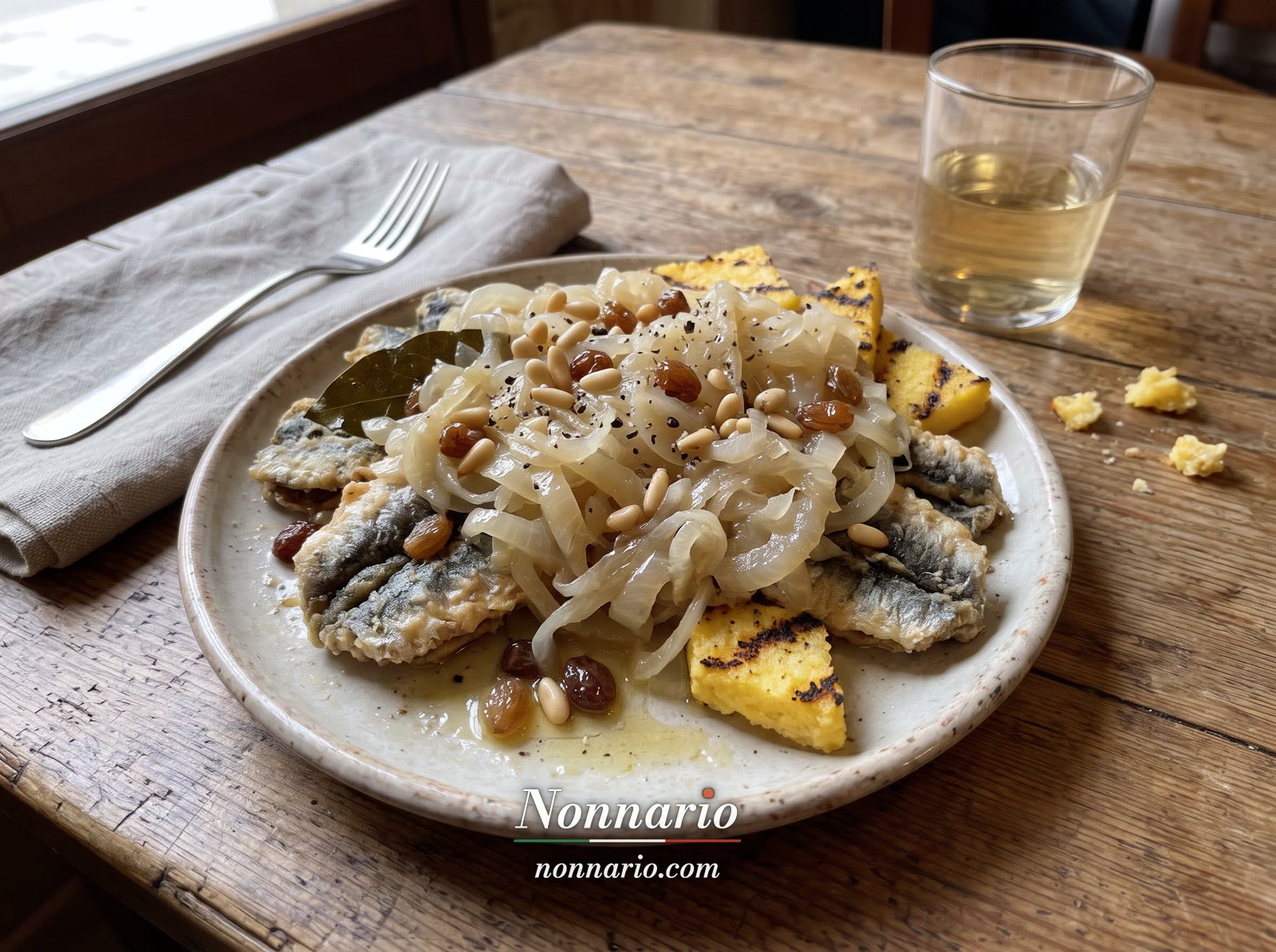
Fresh sardines opened like a book, floured and fried, then left overnight in the fridge under onions cooked very slowly in olive oil and finished with vinegar, pine nuts and raisins: a Venetian dish on the Veneto's list of traditional products.
- Course
- AntipastiStarters
- Serves
- 6
- Hands-on
- 1 h 22 min
- Cooking
- 20 min
- Plan
- 2 days
The video and the photos of every step are also gathered on a separate page.
In breve
In short
Also called sardee in saor, sarde in saòr, sardines in saor, Venetian sweet-and-sour sardines and sweet and sour sardines.
- Fresh sardines, scaled and opened like a book, with the head, guts and backbone removed and the two fillets left joined at the back.
- Floured and fried for 1 minute in plenty of peanut oil at 175 °C–180 °C, then drained and lightly salted.
- Onions sliced thin and cooked very gently in olive oil for about 20 minutes, until very soft but never coloured.
- The onions finished with white wine vinegar, pine nuts and soaked raisins, then spread hot over the fried sardines.
- Rested, covered, in the fridge for at least a night; taken out 30 minutes before serving, and out of the fridge 2 hours at most.
La provenienza
Where this recipe comes from
Sarde in saor is a dish of Venice: fried sardines kept under a marinade, the saor, of onions cooked in oil and vinegar. It is remembered as food of the Venetian fleet, whose galleys had no means of keeping fish cold, and the marinade let it last; by one account the first written traces go back to the fourteenth century. Accounts differ on the raisins and pine nuts: one says they came later, when the dish found favour at court; another that the oldest version already had them. The same treatment is given to other fried fish, such as small sole. Today it is a starter and one of the cicchetti, the small bites served with a glass of wine in Venice's bacari, and it is the dish of the Festa del Redentore in July, which recalls the end of the plague of 1575–1577. The Region of Veneto lists sarde in saor among the traditional agri-food products of the Veneto.
There is no official recipe. We compared six serious sources and publish the most widely recognised version: large sardines floured and fried briefly in hot peanut oil, and an equal weight of onions softened for about twenty minutes in olive oil, finished with white wine vinegar, a little sugar, bay leaves, pine nuts and raisins, then a night in the fridge. Most of them agree on what matters: the sardines cleaned, floured and fried; onions softened slowly in oil and then sharpened with vinegar; fish and onions left together for a night or more before eating. Most add raisins and pine nuts, and one version without them says the oldest recipe had them. They differ on how much onion and vinegar, whether the onions colour, and on spices. Ours are the fridge rules and the checks: the dish is a cold marinade of cooked fish, so it rests and keeps in the fridge, and is eaten within three days, following food-safety guidance.
- Provenance
- A regional tradition documented in cookbooks and local practice, with no single official text.
- Defined by
- Venetian tradition
- Reference
- Compared across 6 sources, listed below; this page publishes the most widely recognised version.
- Sources
- La Cucina Italiana: sarde in saor, a Venetian antipasto, for 6–8 (Italian)
- Accademia Italiana della Cucina: sarde in saor, a Venetian antipasto from its recipe collection, with a note on the older version (Italian)
- Accademia Italiana della Cucina: sarde in saòr, with sultanas and pine nuts, from its recipe collection (Italian)
- Gambero Rosso: the Festa del Redentore and the history of sarde in saor, with a recipe, 14 July 2022 (Italian; archived copy)
- Regione del Veneto: Economia & Gastronomia, a booklet on fishing and aquaculture in the Veneto, with a recipe for sardee in saor (Italian)
- Regione del Veneto: list of the traditional agri-food products of the Veneto, updated 24 July 2026 (Italian)
Ingredienti
Ingredients
The original recipe serves 6
For the sardines
For the saor
To serve
Equipment
- A small sharp knife and kitchen scissors, for scaling and opening the sardines
- Kitchen paper
- A deep, heavy pan about 24 cm–26 cm across and at least 8 cm deep, or a deep fryer, with a lid that fits kept within reach, and a kitchen thermometer that reads up to 200 °C
- A slotted spoon or a spider, for lifting the sardines out of the oil
- A wide casserole, about 28 cm across, for the onions
- A deep serving dish of glass or ceramic, about 30 cm across, and cling film or a lid
Preparazione
Method
Scaled to 6 servings: the amounts in the steps follow. Pot and pan sizes and cooking times are still for the original 6.
Make it the day before: about 1¾ hours of work, then at least a night in the fridge. It serves 6–8 as a starter. Slice the onions before you start frying, so the saor is ready soon after the sardines and the dish goes into the fridge within 2 hours of frying. On the day, take it out of the fridge 30 minutes before serving; it may be out of the fridge for 2 hours at most. It keeps in the fridge for up to 3 days from the day it is made.
- 1 h 22 minhands-on
- 20 mincooking
- 2 daysfrom start to table
The day before: cleaning the sardines and slicing the onions
The quantities and the method follow one recipe whole; the sizes, heat levels, checks and tips marked ‘Our guide’ are ours.
-
Hands-on 8–10 min
Scale the 1 kg of sardines.
Check Run a finger from tail to head along each fish: no loose scales come away.
Tip Our guide: work under a thin stream of cold water and scrape from the tail towards the head with the back of a small knife, so the scales do not fly about the kitchen.
-
Hands-on 20–25 min
Open each sardine like a book: take out the head, the guts and the backbone, leaving the two fillets joined along the back.
Check Each sardine lies flat in one piece, the two fillets joined at the back, with no backbone and nothing dark left inside.
Tip Our guide: pull the head forward between two fingers and the guts come away with it. Slit the belly open to the tail with your thumb or the scissors and press the fish flat, skin side up, along the backbone; turn it over, lift the backbone from the head end towards the tail and snip it off just before the tail.
Tip Our guide: keep the cleaned sardines in the fridge, covered, while you finish the rest.
-
Hands-on 5 min
Rinse the sardines quickly and pat them dry with kitchen paper.
Check The sardines are dry to the touch on both sides.
Tip Our guide: dry them well: wet fish spits in the hot oil and the flour turns to paste.
-
Hands-on 10–12 min
Peel the 1 kg of onions and slice them thinly.
Check Thin, even slices, about 3 mm.
Tip Our guide: slice them now, before you heat the oil, so the saor is ready soon after the sardines are fried and the dish reaches the fridge within 2 hours of frying.
Frying the sardines
-
Hands-on 8–10 minTemp 175 °CHeat medium-high
Heat plenty of peanut oil to 175 °C–180 °C.
Check The thermometer reads 175 °C–180 °C; a pinch of flour dropped in sizzles at once.
Tip Our guide: use a deep, heavy pan, the oil at least 3 cm deep and the pan no more than half full; a kitchen thermometer in the oil keeps the temperature honest.
Tip Our guide: never leave hot oil unattended, and keep the lid within reach. If the oil starts to smoke, take the pan off the heat. Never put water on hot or burning oil: if it catches fire, turn off the heat and slide the lid over the pan. Let the oil cool completely before you move the pan.
-
Hands-on 10–15 minTemp 175 °CHeat medium-high
Flour the sardines and fry them for 1 minute.
Check The coating is crisp and pale gold and the flesh is white and opaque right through.
Tip Our guide: flour them just before they go in, shaking off the excess, and fry 5 or 6 at a time so the oil stays at 175 °C–180 °C; let it come back to temperature before the next batch.
Tip Our guide: lower them in gently, away from you, with a slotted spoon, and lift them out the same way.
-
Hands-on 5 min
Drain the sardines on kitchen paper, salt them lightly and lay them in a deep serving dish.
Check The sardines are no longer shiny with oil and lie open in the dish.
Tip Our guide: a dish of glass or ceramic, about 30 cm across: the vinegar can react with bare metal. If they do not fit in one layer, lay half now and keep the rest for the second layer.
The saor
-
Hands-on 5–10 minHeat low
Heat 4–5 tablespoons of olive oil in a wide casserole, add the onions and let them soften over a low heat, seasoning with salt and pepper.
Check The onions have wilted and begun to turn translucent, with no colour.
Tip Our guide: a casserole about 28 cm across; stir often at this stage, while the onions are still releasing their water.
-
Cooking 10 minHeat very low
Turn the heat down to the lowest and carry on cooking the onions, uncovered, for 10 minutes: over about 20 minutes in all they must become very soft without taking any colour.
Check The onions are soft and still pale, and nothing is sticking to the bottom.
Tip Our guide: stir every few minutes. If they start to catch on the bottom, add a spoonful of water.
-
Cooking 10 minHeat very low
Put the 40 g of raisins to soak in warm water for 10 minutes, while the onions cook for about 10 minutes more over the lowest heat.
Check A slice of onion crushes to a paste between two fingers and is still pale, with no golden edges; the raisins are plump and soft.
Tip Our guide: keep stirring the onions every few minutes. Drain the raisins and squeeze them gently just before they go in.
-
Hands-on 3 minHeat medium
Pour in the 120 g of vinegar and let it bubble briefly, then add the 4 bay leaves, the 20 g of sugar, the 40 g of pine nuts and the drained raisins. Stir until the sugar dissolves, then turn off the heat.
Check The sugar has dissolved, the sharpest smell of vinegar has eased and the onions are glossy and loose.
Tip Our guide: turn the heat up to medium for the vinegar and let it bubble for about 1 minute, stirring, before the rest goes in.
Into the fridge
-
Hands-on 3 min
Spread the hot saor over the sardines, with all its liquid.
Check Every sardine is covered with onions and the liquid lies around them; less than 2 hours have passed since the first sardines came out of the oil.
Tip Our guide: if you kept half the sardines back, spread half the saor, lay the rest of the sardines on top and finish with the other half of the saor.
-
Rest 12 h
Cover the dish and put it in the fridge straight away, while it is still hot, and leave it there for a night. It must be in the fridge within 2 hours of frying.
Check The dish is in the fridge, at 4 °C or below, within 2 hours of frying; after the night the onions are cold and set around the sardines.
Tip Our guide: count at least 12 hours. Hot food can go straight into the fridge, and a wide, shallow dish cools quickly.
Tip Our guide: never leave it to marinate at room temperature: it is cooked fish in a cold marinade and rests only in the fridge.
-
Rest 30 min
Take the sardines out of the fridge 30 minutes before serving.
Check The dish is cool rather than cold, and the olive oil in the saor has turned liquid again.
Tip Our guide: take out only what you will serve. From the moment it leaves the fridge it may stay out for 2 hours at most, these 30 minutes included (1 hour on a day above 32 °C): then put what is left straight back in the fridge, or throw it away, and do not set it out again.
Tip Our guide: eat it within 3 days of making it.
-
Hands-on 5 min
Serve the sardines with their onions, with slices of toasted bread or white polenta if you like.
Check Each portion has whole sardines with onions, pine nuts and raisins spooned over.
Tip Our guide: lift the sardines with a wide spoon or a fish slice so they stay whole, and leave the bay leaves in the dish.
The essentials, for cooks who know the dish. Switch to Detailed for quantities, temperatures, times and checks at every step.
Press “I’m here” on the step you are on, and again when it is done.Tap the pin on the step you are on, and the tick when it is done. Timers keep running while you scroll.
Da sapere
Good to know
- WhenQuando
- In Venice it is the dish of the Festa del Redentore, held over the weekend leading up to the third Sunday of July; an old saying runs ‘Al Redentor prepara il saor’, for the Redentore, make the saor. Source
- KeepingConservazione
- It rests at least a night in the fridge before serving. Keep it covered in the fridge at 4 °C or below and eat it within 3 days of making it. On the day, take out only what you will serve, 30 minutes ahead: once out of the fridge it may stay out for 2 hours at most, then what is left goes straight back in the fridge, or is thrown away, and is not set out again. Source
- VariantsVarianti
- Without raisins or pine nuts: The sardines fried in plenty of very hot oil a few at a time, the onions softened for ten minutes in part of the frying oil, then vinegar and salt brought back to the boil; sardines and onions in alternate layers, covered with the vinegar, and rested at least a couple of days. The oldest version adds soaked raisins and pine nuts; pepper, cloves, bay and grated lemon zest are optional. Source
- With spices: The onions softened until translucent, then boiled for two or three minutes with the vinegar, peppercorns, coriander seeds and cloves; the raisins soaked in white wine; sardines, onions, pine nuts and raisins in layers in a small terrine, ending with onions, and rested at least 24 hours. Source
- With less onion: Onion half the weight of the fish, sliced very fine and softened in olive oil until pale gold, moistened now and then with fish broth or water; layered with the fish in an earthenware terrine, with pine nuts and raisins soaked in wine, and eaten at least two days later. Source
- Sole or eel in saor: The same saor suits small sole and eels. Source
Errori comuni
Common mistakes
- Letting the onions colour: they cook very gently for about 20 minutes and must stay pale and very soft.
- Frying in oil that is not hot enough, or too many at once: keep it at 175 °C–180 °C, or the sardines soak up oil.
- Leaving the backbone in: it comes out when the sardines are opened like a book.
- Leaving it out of the fridge: it goes in within 2 hours of frying, rests and keeps there, and on the day is out for 2 hours at most.
- Serving it at once: it needs at least a night in the fridge first.
Fuori dall'Italia
Cooking it outside Italy
- Sardines are the European pilchard, Sardina pilchardus; buy them fresh and whole, or ask the fishmonger to open them.
- 00 flour is a fine soft-wheat flour; plain flour will do.
- Peanut oil is groundnut oil; some cooks fry the sardines in olive oil instead.
- Golden onions are ordinary yellow onions; white onions are also used for this dish.
From nonnario.com/recipes/sarde-in-saor/, where you will find its sources, its story and the step photos. Sources checked in November 2026.