Crucoli, Calabria
Sardella
Calabrian preserve of newborn fish fry with hot chilli and wild fennel
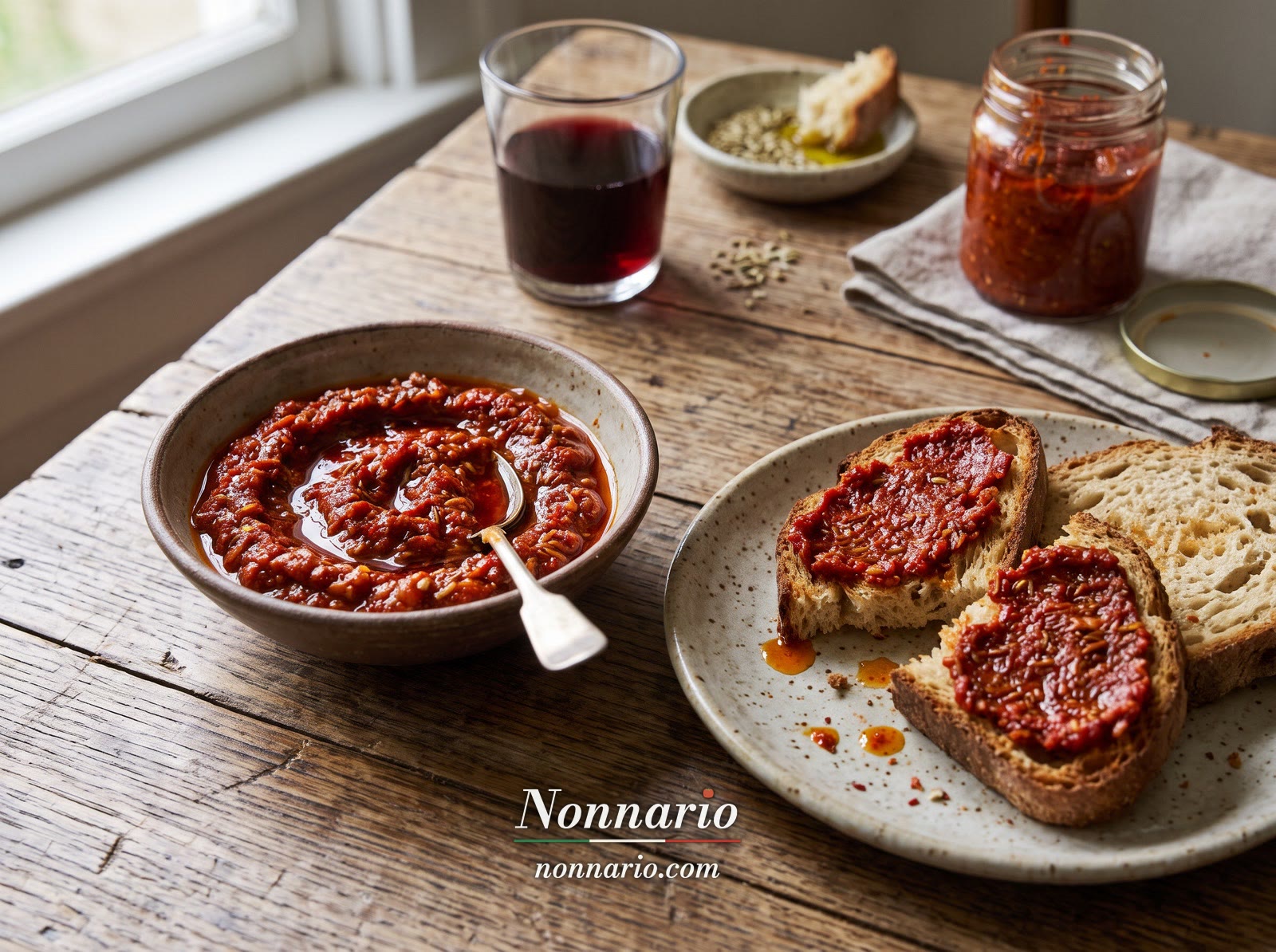
Newborn sardine or anchovy fry, salted, then kneaded with plenty of ground hot chilli, salt and wild fennel seeds into a bright red paste to spread on bread: the sardella of the Crotone coast, on Calabria's list of traditional food products.
- Course
- AntipastiStarters
- Serves
- 20
- Hands-on
- 1 h 1 min
- Cooking
- 0 min
- Plan
- 9 days
In breve
In short
Also called rosamarina, sardella calabrese, sardella crotonese, sardella salata di Crotone, caviale dei poveri, caviale calabrese, Calabrian caviar, poor man's caviar and 'nduja di pesce.
- Neonata, the newborn fry of sardines or anchovies, kneaded with plenty of ground hot Calabrian chilli, salt and wild fennel seeds.
- The fish is washed in a fine sieve, salted there with at least 30 g of salt per kilo, left a few hours, then rinsed.
- Kneaded gently, again and again, until the paste is bright red and creamy.
- Jarred and eaten from 3 or 4 days later. (The safety references we follow: freeze the fish first, keep it in the fridge, 5–6 days at most.)
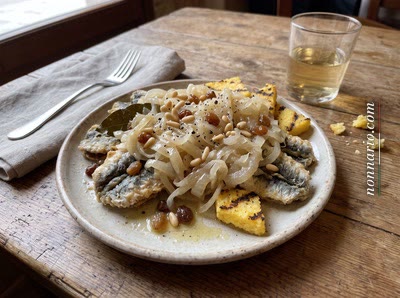
- Served conzata: loosened with extra virgin olive oil, often with thin slices of Tropea onion, on bread or crostini.
La provenienza
Where this recipe comes from
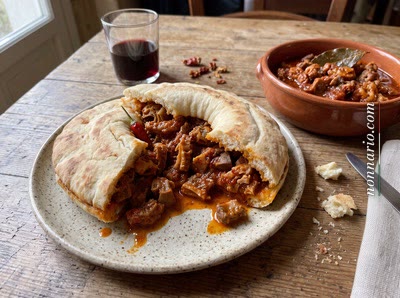
Sardella is a preserve of the Ionian coast of Calabria, made in the province of Crotone and along the upper Ionian coast of the province of Cosenza: newborn fish fry, the neonata or nunnata, worked with salt, dried hot chilli and wild fennel into a fiery red paste that is spread on bread, stirred into pasta or eaten with eggs, and baked into the pitta con la sardella. It is also called rosamarina and the caviale dei poveri, the poor man's caviar; accounts differ on whether rosamarina is another name for the same preserve, used along other stretches of coast, or a similar preserve made with different fish, and the Region of Calabria lists Sardella salata di Crotone and Rosamarina side by side among its traditional food products. Its origin is uncertain; many link it to the garum of ancient Rome. Crucoli calls itself the town of the sardella, while Cirò Marina, Cariati and Trebisacce also claim it, and Crucoli has held its Sagra della sardella every August since 1970. Its De.Co. specification, as it is quoted, defines true sardella as made only of sardine fry about three centimetres long, salted for at least three months, with oven-dried, ground red topepo chilli and wild fennel seeds; in the old cure the fry lay under salt and a weight for months before it was cleaned and kneaded. Since fishing the fry is now restricted, much of the sardella on sale is made with ice fish, imported frozen, and one producer uses grown sardines salted for over a year.
There is no official recipe that can be read: the text of Crucoli's De.Co. could not be found, only quotations of it. We compared fourteen sources and publish the most widely recognised version, the one made at home: the fry washed in a fine sieve, salted there for a few hours, rinsed, then kneaded with ground hot chilli, salt and wild fennel seeds until bright red and creamy, packed in jars and eaten a few days later, dressed with olive oil. The sources agree on the fish fry, the salt, the chilli and the fennel, and on a preserve of the Crotone coast; they differ on how long it cures, from hours at home to months in the barrel, on whether the chilli goes in before or after the cure, and on sweet or hot chilli. The method on this page is that home version, step by step, as its source gives it. Where it falls short of the food-safety references we follow (it starts from fish that has not been frozen, rests it at no stated temperature and says it keeps long, even out of the fridge), a note in brackets gives what they recommend: freezing the fish for four days first, as Italy's Ministry of Health asks for fish eaten raw or marinated, and keeping the sardella in the fridge for five or six days at most, or frozen for longer, following the Italian guidelines on home preserves. The long cure under salt is given among the variants as the sources describe it, with the same notes.
- Provenance
- A regional tradition documented in cookbooks and local practice, with no single official text.
- Defined by
- Calabrian tradition
- Reference
- Compared across 14 sources, listed below; this page publishes the most widely recognised version.
- Sources
- Il Giornale del Cibo, a food magazine published by the catering cooperative CIRFOOD: the Calabrian sardella, its history and how it is made, by Licia Giglio, 2019 (Italian)
- Cookist (Ciaopeople): Calabrian sardella, what it is, how it is made and used, by Martina De Angelis, 2024 (Italian)
- Gambero Rosso: the pitta con la sardella and the sardella of Crucoli, by Annamaria Gnisci, 2024, archived copy (Italian)
- CalabriaMagnifica.it, a Calabrian online newspaper: the Calabrian caviar, sardella or rosamarina, by Annamaria Gnisci, 2019 (Italian)
- Strill.it, a Calabrian online newspaper: the sardella of Crucoli and its 39th sagra, an ANSA report, 2009 (Italian)
- Domani, from its monthly Cibo: Crucoli, the home of the sardella, between ice fish and young sardines, by Natale Ciappina, 2024 (Italian)
- Il Quotidiano del Sud, a regional daily: the Sagra della sardella of Crucoli under scrutiny, by Antonio Anastasi, August 2026 (Italian)
- Regione Calabria, Calabria Straordinaria (the Region's tourism site): the Sardella Crotonese, a story of sea and goodness (Italian)
- Regione Calabria: PDO, PGI and traditional products of Calabria, a brochure (Italian)
- Ministry of Agriculture (MASAF): national list of traditional food products, 25th revision, 2025, Calabria nos. 252 and 255 (Italian)
- EUR-Lex: Regulation (EU) 2019/1241 on technical measures for fisheries, consolidated text of 1 January 2026, Annex IX on the Mediterranean (Italian)
- Ministry of Health: decree of 17 July 2013 on the information owed to buyers of fresh fish, with the rule for fish eaten raw or marinated, Gazzetta Ufficiale no. 187 of 2013 (Italian)
- Ministry of Health and Istituto Superiore di Sanità: guidelines for making preserves safely at home, 2016 (Italian)
- USDA Food Safety and Inspection Service: Leftovers and Food Safety, on keeping food cold and the 2-hour rule (archived copy)
Ingredienti
Ingredients
Makes the sardella from 1 kg of fish, in small jars: 20 servings
For the sardella
To serve
Equipment
- A sealable freezer bag and a freezer that reaches -18 °C (marked with three or more stars)
- A sieve with a very fine mesh and a bowl it sits on
- A large bowl for kneading, and disposable kitchen gloves
- Small glass jars with lids, half a litre at most each, sterilised, or at least perfectly clean and dry
- A fridge thermometer
Preparazione
Method
The method itself takes about 4 hours, most of it waiting for the salt, then 3 or 4 days in the jar. Following the safety references, as the steps do, add at least 4 days in the freezer and a night thawing in the fridge before you start, keep the fish, the paste and the jars in the fridge, and eat it within 5 days of making it; a kilo, enough for about 20 servings on bread, is best shared out, so freeze the jars you will not open in time on the day you fill them. On the day, take out only what you will serve.
- 1 h 1 minhands-on
- 0 mincooking
- 9 daysfrom start to table
Before you start: freezing the fish, as the safety reference recommends
The method follows one source whole, in its own order, step by step. Where it falls short of the food-safety references we follow, a note in brackets says what they recommend. The source starts from the fish as it is bought, straight to the washing. (The food-safety reference we follow for fish eaten raw or marinated, Italy's Ministry of Health, recommends freezing it first for at least 96 hours at -18 °C in a home freezer marked with three or more stars.) The steps of this first phase follow that recommendation; they are not part of the source's method. Sizes, times, checks and tips marked ‘Our guide’ are ours.
-
Hands-on 5 min
Spread the 1 kg of fish in a thin, flat layer in a freezer bag, press out the air, seal it and put it in the freezer at -18 °C or below.
Check The bag lies flat in the freezer and the freezer thermometer or display reads -18 °C or colder.
Tip Our guide: freeze it even if you bought it frozen, and even if it is ice fish: fish eaten raw or marinated must first be frozen for at least 96 hours at -18 °C, in a home freezer marked with three or more stars.
Tip Our guide: buy it from a fishmonger who can tell you what it is and where it was caught, and keep it cold on the way home.
-
Rest 4 days
Leave the fish in the freezer for at least 96 hours.
Check At least 4 full days have passed since the fish was frozen hard.
Tip Our guide: write the date and time on the bag. Count the 96 hours from when the fish is frozen solid, not from when it went in.
-
Rest 12–16 h
Move the bag to the fridge and let the fish thaw slowly overnight.
Check The fish is soft all through the bag, with no ice left, and still very cold.
Tip Our guide: never thaw it at room temperature or in warm water; set the bag on a plate on the lowest shelf. Make the sardella the same day it has thawed.
The salting
-
Hands-on 5 min
Wash the fish carefully in cold water, in a sieve with a very fine mesh.
Check The water runs clear and no sand is left at the bottom of the sieve.
Tip The fry is tiny and delicate and falls apart if it is handled roughly.
Tip Our guide: lift and turn the fish with your fingers under a thin stream of water; never rub it.
-
Rest 10 min
Leave the fish to drain in the sieve.
Check No more water drips from the sieve.
Tip Our guide: set the sieve over a bowl in the fridge while it drains.
-
Hands-on 3 min
Still in the sieve, sprinkle the fish evenly with the 30 g of salt.
Check The salt is spread over all the fish, with no bare patches and no heaps.
Tip Our guide: sea salt, as the Italian guidelines advise for salted preserves. Turn the fish once with your fingers so the salt reaches the lower layers.
-
Rest 3 h
Leave the salted fish to rest for a few hours, in the sieve. (The food-safety reference we follow for home preserves, the Italian Ministry of Health and ISS guidelines, says salted fish must be kept at a low temperature in its first stages, while the salt has not yet worked in: rest it in the fridge, with the sieve over a bowl, at 4 °C (40 °F) or below, the US food-safety reference's figure.)
Check Liquid has dripped into the bowl and the fish feels a little firmer.
Tip Our guide: count about 3 hours. Cover the bowl, and keep it away from cooked food in the fridge.
-
Hands-on 5–10 min
Rinse the fish carefully, then drain it well.
Check The fish no longer feels gritty with salt and has stopped dripping.
Tip Our guide: a quick rinse under cold water in the same sieve, turning the fish gently, then 5 minutes' draining; discard the liquid in the bowl.
The kneading
-
Hands-on 3 min
Put the fish in a large bowl and sprinkle it with ground hot chilli, with part sweet chilli if you want it milder, a little salt and wild fennel seeds.
Check A first even dusting of chilli, salt and seeds covers the fish.
Tip Our guide: wear disposable gloves from here on: the chilli burns the skin and the eyes.
Tip Our guide: go lightly with the salt: the fish has already been salted.
-
Hands-on 10–15 min
Knead gently, then sprinkle on more chilli, salt and fennel seeds and knead again; repeat until the paste is bright red and creamy.
Check The whole paste is an even, bright red, creamy and spreadable, with no pale fish or loose chilli left.
Tip Our guide: add the chilli a little at a time and knead well between additions: it is the colour, not a weight, that tells you there is enough.
Tip Our guide: work quickly and put the bowl back in the fridge if you need to stop.
Into jars
-
Hands-on 10 min
Have small glass jars and their lids sterilised and ready. (The food-safety reference we follow for home preserves, the Italian Ministry of Health and ISS guidelines, notes that at home jars can only be sanitised, not truly sterilised, and that for a cold filling such as this it is enough that they are perfectly clean and dry: washed with detergent, or in the dishwasher, and dried completely.)
Check The jars and lids are either sterilised in boiling water and kept in it until they are filled, or washed and perfectly dry inside.
Tip Our guide: jars of half a litre at most, so that each one is finished soon after it is opened.
-
Hands-on 10 min
Pack the sardella into the sterilised jars, pressing it down with the back of a spoon, and close them.
Check No air pockets show through the glass, the surface is smooth, and each jar is closed and labelled.
Tip Our guide: leave about 1 cm free at the top of each jar, more in the jars you will freeze. Write the date on each jar: the day it is made counts as day one.
-
Rest 3 days to 4 days
Leave the sardella in its jars for 3 or 4 days before eating it; its chilli and salt are said to let it keep long, even out of the fridge. (The food-safety reference we follow for home preserves, the Italian Ministry of Health and ISS guidelines, recommends instead keeping home preparations in the fridge, as briefly as possible and never beyond 5–6 days, and keeping fish for longer at home only by freezing: keep the jars in the fridge, at 4 °C (40 °F) or below, the US food-safety reference's figure, eat the sardella within 5 days of making it (this page counts 5), and put the jars you will not open in time straight into the freezer.)
Check Three or four days have passed with the jars in the fridge at 4 °C or below; the paste is a deep, even red and smells of the sea and of chilli, with nothing sour or off.
Tip It may also be eaten on the day it is made.
Tip Our guide: the coldest shelf is the one just above the vegetable drawers; the door is the warmest place in the fridge.
Tip Our guide: a jar from the freezer thaws in the fridge and may be eaten as soon as it has thawed, within what was left of its 5 days. If it looks, smells or tastes wrong, throw it away without tasting further.
At the table: the sardella conzata
-
Hands-on 5 min
Take out only the sardella you will serve and stir in a little extra virgin olive oil and, if you like, thin slices of Tropea onion.
Check The sardella is loose and glossy and spreads easily.
Tip Our guide: spoon it out with a clean, dry spoon and put the jar straight back in the fridge. Dressed sardella never goes back into the jar.
Tip Our guide: from the moment it leaves the fridge it may stay out for 2 hours at most (1 hour on a day above 32 °C); then put what is left straight back in the fridge, or throw it away, and do not set it out again.
-
Hands-on 5 min
Spread it on toasted bread or crostini and serve.
Check Each slice has a thin, even layer of red sardella.
Tip Our guide: spread it thinly: it is very hot and very salty.
The essentials, for cooks who know the dish. Switch to Detailed for quantities, temperatures, times and checks at every step.
Press “I’m here” on the step you are on, and again when it is done.Tap the pin on the step you are on, and the tick when it is done. Timers keep running while you scroll.
Da sapere
Good to know
- WhenQuando
- It is eaten all year round. Crucoli holds its Sagra della sardella every year on the second Sunday of August, during the mid-August holidays, as it has since 1970. Source
- KeepingConservazione
- Packed into sterilised jars, it is eaten from 3 or 4 days later, and its chilli and salt are said to let it keep long, even out of the fridge. (The food-safety reference we follow for home preserves recommends instead keeping home preparations in the fridge, as briefly as possible and never beyond 5–6 days, and keeping fish for longer at home only by freezing; if it looks or smells wrong, throw it away without tasting it.) Source
- VariantsVarianti
- The long cure under salt: For the sardella of Crucoli: the "sardella vestita", sardine fry grown to 3–4 centimetres, fished from February to April. Wash it, dry it and salt it, laying layers of fry and layers of salt in turn; set a weight on top and leave it to cure for six or seven months. The cure gives a greyish paste: clean it of bones and scales, then knead it with ground hot chilli and wild fennel seeds. (The food-safety references we follow recommend otherwise: the Italian guidelines on home preserves say fish layered under salt can be a health risk, because in the first stages, above all in the lower layers, air is shut out and the salt has not yet worked in, so botulism spores can grow, and the temperature must be kept low in those first stages; Italy's Ministry of Health asks for fish eaten raw or marinated to be frozen first for at least 96 hours at -18 °C in a three-star home freezer.) Source
- Pressed in the barrel: The fish, the topepo peppers (a cherry-shaped Calabrian chilli, more or less hot, dried in the sun or in a wood oven and crumbled), salt and wild fennel flowers, all pressed down hard under a weight in a barrel, where the slow maturing turns them into a hot, spreadable cream. (The food-safety references we follow recommend otherwise: the Italian guidelines on home preserves say fish cured under salt, as here, can be a health risk, because in the first stages, above all in the lower layers, air is shut out and the salt has not yet worked in, so botulism spores can grow, and the temperature must be kept low in those first stages; Italy's Ministry of Health asks for fish eaten raw or marinated to be frozen first for at least 96 hours at -18 °C in a three-star home freezer.) Source
- With ice fish: Most sardella sold today is made with ice fish instead of neonata, with ground chilli and fennel seeds; some hold that it does not match the flavour of sardine fry. Source
- With grown sardines: One small producer of the Crotone coast makes it from Italian sardines above the legal minimum size, salted for 14 months, then filleted and minced to a paste with sunflower oil, salt and Calabrian chilli. Source
- Mild: Traditionally it is hot, but there is also a version made with ground sweet pepper. Source
Errori comuni
Common mistakes
- Rubbing the fry when washing it, or kneading roughly: it is delicate and falls apart.
- Stopping the kneading too soon: it is ready only when bright red and creamy all through.
- Salting heavily in the kneading: the fish has already been salted.
- Spreading it thickly: it is very hot and very salty.
Fuori dall'Italia
Cooking it outside Italy
- Neonata, also bianchetto, is the newborn fry of sardines and anchovies, a little like whitebait; where it cannot be had legally, use ice fish (pesce ghiaccio, Neosalanx), sold frozen, or another small fish that may legally be sold.
- Ground Calabrian chilli is dried hot red chilli, small and round, with stems and seeds removed, ground to a powder; ground sweet chilli is its mild counterpart.
- Wild fennel seeds are the dried seeds of wild fennel (finocchio selvatico).
- Tropea onion is the sweet red onion of the Calabrian coast.
From nonnario.com/recipes/sardella/, where you will find its sources, its story and the step photos. Sources checked in November 2026.