Palermo, Sicilia
Arancine
Sicilian fried rice balls with meat ragù
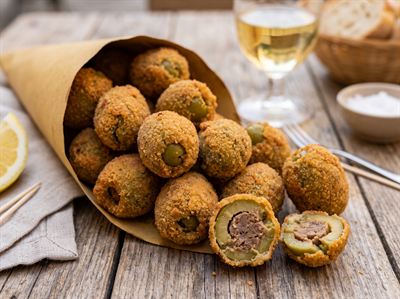
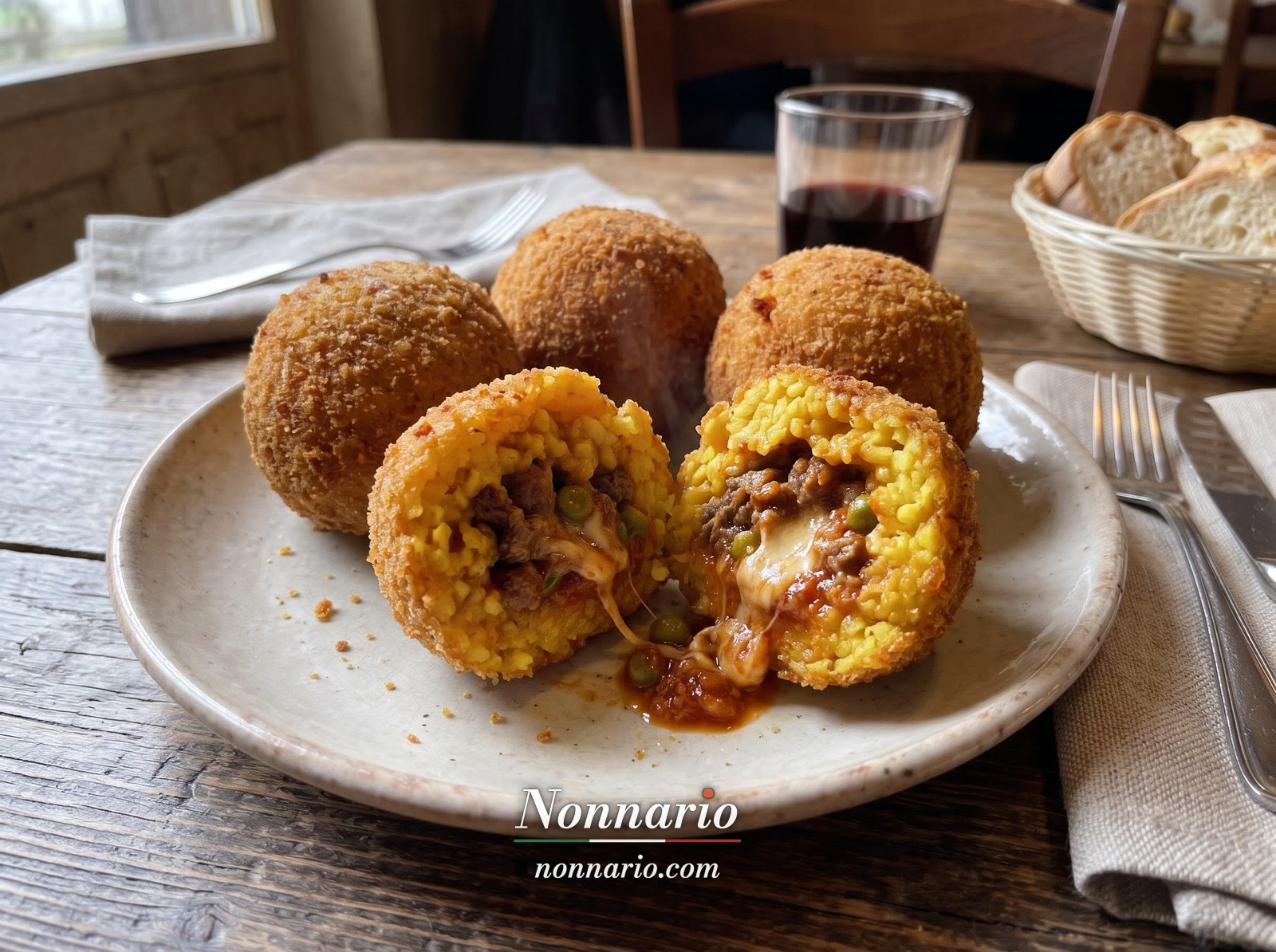
Sicily's fried rice balls in their round Palermo form: saffron rice with butter and caciocavallo wrapped around a ragù of beef and peas, coated in breadcrumbs and listed among Italy's traditional food products as arancini di riso.
- Course
- AntipastiStarters
- Serves
- 12
- Hands-on
- 2 h 5 min
- Cooking
- 1 h 32 min
- Resting
- 2 h 50 min+
The video and the photos of every step are also gathered on a separate page.
In breve
In short
Also called arancina, arancino, arancini, arancini di riso, arancine di riso, arancina al ragù, arancina a carne and Sicilian rice balls.
- Round, the size of a tennis ball: saffron rice bound with butter, grated caciocavallo and egg, around a heart of meat ragù.
- The ragù: minced beef cooked with onion, carrot, celery, white wine, tomato and peas until thick, with cubes of fresh caciocavallo.
- The rice is boiled al dente, drained, dressed while hot and left to cool completely before shaping.
- Coated in beaten egg and breadcrumbs, then fried in plenty of olive oil until golden.
- Arancina in Palermo and the west, arancino in Catania and the east: both names are correct where they are used.
La provenienza
Where this recipe comes from
Arancine are balls of saffron rice wrapped around a filling, coated in breadcrumbs and fried, and they are made all over Sicily. They are often said to go back to the Arabs, who ruled the island from the ninth to the eleventh century and are supposed to have rolled saffron rice in the palm of the hand; that is tradition, not record. No written trace of the dish has been found before the second half of the nineteenth century, and the first Sicilian dictionary to record arancinu, in 1857, describes it as a sweet rice dish shaped like an orange. It probably turned savoury soon after, though when the meat and the tomato came in is hard to say.
The name divides the island. In Palermo and the west it is the arancina, round like the orange (arancia) it is named after; in Catania and the east it is the arancino, smaller and often pointed, a shape some link to Etna, though around Ragusa and Siracusa the feminine is heard too. The masculine follows the Sicilian aranciu, the orange, and the feminine follows standard Italian. Italian dictionaries record arancino, and so does Italy's national list of traditional food products, as arancini di riso; the feminine is in print by 1894, in Federico De Roberto's novel I Viceré. Both names are correct, each where it is used.
There is no official recipe: the regional sheet behind the national list describes the dish only in outline. We compared six sources and publish the most widely recognised version, the Palermo arancina with meat ragù: Arborio rice boiled al dente and dressed hot with butter, grated caciocavallo, egg and saffron, then wrapped around a thick ragù of beef, peas and tomato with cubes of fresh caciocavallo, coated in egg and breadcrumbs and fried in plenty of olive oil. Some cooks make the rice as a risotto in broth, or cook it in just enough water to be absorbed, and some flour the arancine before the egg. Two things here are ours: the cooked rice and ragù go into the fridge within 2 hours and come out only to be shaped and fried at once, and because a cold ball this size is still cool at the heart when its crust is golden, the fried arancine finish in a hot oven until the centre reaches 75 °C.
- Provenance
- A regional tradition documented in cookbooks and local practice, with no single official text.
- Defined by
- Sicilian tradition
- Reference
- Compared across 6 sources, listed below; this page publishes the most widely recognised version.
- Sources
- Accademia Italiana della Cucina: arancine di riso, a Sicilian recipe from its online recipe collection (Italian)
- Regione Siciliana, Department of Tourism (Visit Sicily portal): arancine, with the ragù and the butter versions (Italian)
- Regione Siciliana, Department of Agriculture: the 2021 sheets of Sicily's traditional agri-food products, ‘Arancini di riso’ (archived copy, Italian)
- Ministry of Agriculture (MASAF): the 25th revision of the national list of traditional agri-food products, 2025, with ‘Arancini di riso’ for Sicily (Italian)
- Accademia della Crusca: ‘Si dice arancino o arancina?’, an answer from its language advice service, 2016 (Italian)
- USDA Food Safety and Inspection Service: Leftovers and Food Safety, on cooling, keeping and reheating cooked food (archived copy)
Ingredienti
Ingredients
The original recipe serves 12
For the rice
For the ragù
To coat and fry
Equipment
- Large pot for the rice, holding at least 8 l, and a colander
- Large tray or baking sheet, for spreading the rice to cool
- Heavy pan about 24 cm across for the ragù, a wooden spoon and a shallow container
- Kitchen scale and a small cup
- Two shallow dishes, for the egg and the breadcrumbs, and a tray for the coated arancine
- Deep, heavy pot about 22 cm across and at least 16 cm deep, a frying thermometer, a slotted spoon and a lid within reach
- Oven, a wire rack set over a baking tray, kitchen paper and a thin probe thermometer
Preparazione
Method
Scaled to 12 servings: the amounts in the steps follow. Pot and pan sizes and cooking times are still for the original 12.
About 6 hours of work and waiting in all, best spread over two days. The day before (or at least 3 hours ahead): the rice, about 40 minutes to bring the water to the boil, cook and dress it and 30 to cool before the fridge, and the ragù, about 1 hour 15 minutes to cook and 30 minutes to cool before the fridge. On the day: about 1 hour to shape and coat the 12 arancine, then about 1 hour to fry them three at a time and finish them in the oven. From the moment the rice and the ragù leave the fridge, every arancina must be in the oil within 2 hours, so start heating the oil while you coat.
- 2 h 5 minhands-on
- 1 h 32 mincooking
- 2 h 50 minresting, at least
The rice (the day before, or at least 3 hours ahead)
-
Cooking 20–25 minHeat high
Bring about 6 l of water to the boil in the large pot and salt it.
Check A full, rolling boil.
Tip Our guide: about 10 g of salt per litre. The rice is drained, so it takes up only part of this salt.
-
Hands-on 10 min
While the water heats, cut the 80 g of butter into pieces, grate the 100 g of caciocavallo and beat the egg with the yolk in a small bowl. Keep the spare white, covered, in the fridge for the coating.
-
Cooking 12–14 minHeat high, then medium-high to keep a lively boil
Pour the 750 g of Arborio into the boiling water, stir, and once the water is boiling again cook it uncovered at a lively boil, stirring now and then, until al dente.
Check Taste a few grains at 12 minutes: soft outside, with a small firm core. Arborio needs 16–18 minutes to be fully soft; stop well before.
Tip Our guide: just before draining, take about two tablespoons of the cooking water into the small cup and dissolve the saffron in it, so it colours the rice evenly.
-
Hands-on 3 min
Drain the rice well and tip it back into the empty pot, off the heat. Stir in the butter until it melts, then the grated caciocavallo and the saffron, and last the beaten egg and yolk, stirring quickly so that they coat every grain and bind the rice.
Check The rice is evenly yellow and glossy, with no streaks of egg, and the grains cling together.
Tip Work fast: the egg must meet hot rice to bind it.
-
Rest 30 min
Spread the rice on the large tray in an even layer no deeper than about 3 cm and leave it until it is barely warm.
Check Barely warm when you press the back of your hand to it.
Tip Our guide, for safety: the rice must be in the fridge within 2 hours of draining. A thin layer cools quickly.
-
Rest 1 hTemp 4 °C
Cover the tray and put it in the fridge until the rice is cold and firm, at least 1 hour, or until the next day.
Check Cold right through and firm enough to hold the mark of a finger.
Tip Cold rice holds its shape around the filling; warm rice slumps and splits. Our guide: the 3 days a cooked dish keeps in the fridge count from cooking the rice, and the fried arancine must be eaten within the same 3 days.
The ragù
-
Hands-on 10 min
Chop the onion, carrot and celery very finely, together.
Check Small, even pieces, so that they melt into the ragù.
-
Hands-on 8–10 minHeat medium-low
Heat the olive oil in the heavy pan over medium-low heat, add the chopped vegetables and cook them gently, stirring often.
Check Soft and translucent, just turning pale gold, not browned.
Tip Our guide: about 3 tablespoons of oil.
-
Hands-on 8–10 minHeat medium
Turn the heat to medium, add the 300 g of minced beef and let it colour gently, breaking it up with the wooden spoon so that the pieces stay separate.
Check No pink left, the meat in small, separate crumbs.
-
Hands-on 2–3 minHeat medium
Pour in the white wine and let it bubble until it has evaporated.
Check The sharp smell of wine has gone.
Tip Our guide: about 50 ml, a splash.
-
Hands-on 3 min
Dissolve the tomato paste in about 100 ml of hot water. Add the 150 g of peas, the 200 ml of passata and the dissolved paste to the pan, season with salt and pepper and stir.
Check Everything evenly mixed and just starting to simmer.
-
Cooking 40–50 minHeat moderate, a steady simmer
Cook over a moderate heat, uncovered, stirring now and then. If it catches before the peas are tender, add a little hot water. The ragù must end up thick.
Check The peas are tender and a spoon drawn across the pan leaves a clear track with no liquid running into it.
Tip Our guide: 40–50 minutes. A runny ragù soaks into the rice and splits the arancine in the oil.
Tip Taste and adjust the salt and pepper at the end.
-
Rest 20–30 min
Spread the ragù in the shallow container and leave it until it is barely warm.
Check Barely warm to the touch.
Tip Our guide, for safety: in the fridge within 2 hours of the end of cooking.
-
Rest 1 hTemp 4 °C
Cover it and put it in the fridge until cold, at least 1 hour, or until the next day.
Check Cold and firm.
Tip Our guide: the 3 days count from cooking the ragù, and the fried arancine must be eaten within the same 3 days.
Shaping and coating
Do this in one go, straight from the fridge: from the moment the rice and the ragù come out, every arancina should be in the oil within 2 hours (our guide, for safety). Have the dishes and the tray ready before you start.
-
Hands-on 5 min
In one shallow dish beat the eggs with the spare white; put the breadcrumbs in the other. Set a bowl of cold water beside you, for your hands.
-
Hands-on 5 min
Stir the 100 g of fresh caciocavallo cubes into the cold ragù.
Check The cubes are spread evenly and still whole.
Tip Our guide: cubes of about 1 cm. They go in only once the ragù is cold, so they do not melt into it.
-
Hands-on 10 min
Weigh the cold rice and divide it into 12 equal portions; divide the ragù the same way.
Check Our guide: roughly 160 g–170 g of rice and 55 g–65 g of filling for each arancina.
Tip Weighing is our addition: it makes the arancine the same size, so they fry in the same time.
-
Hands-on 25 min
Wet your hands. Take a generous spoonful of a portion of rice, about two-thirds of it, in one hand and press it flat, making a hollow in the middle. Put the portion of ragù in the hollow, cover it with the rest of the rice and press and turn it between your palms into a firm, round ball the size of a tennis ball, about 7 cm across. Set it on the tray and make the rest the same way.
Check Each ball is smooth and compact, with no cracks and no filling showing, and keeps its round shape when set down.
Tip Wet your hands again whenever the rice starts to stick.
Tip If a crack opens, press a pinch of rice over it.
-
Hands-on 15 min
Roll each arancina in the beaten egg, let the excess drip off, then roll it in the breadcrumbs, pressing lightly so the crumbs cling all over. Put it back on the tray.
Check An even coat of crumbs with no bare patches.
Tip This version is not floured before the egg; some cooks flour the arancine first.
Frying and finishing
-
Hands-on 15 minTemp 170 °CHeat medium-high, then adjust to hold the temperature
Pour the olive oil into the deep pot to about 8 cm deep, no more than half full, and heat it to 170 °C, checking with the thermometer. At the same time heat the oven to 180 °C, with the wire rack set over the baking tray inside.
Check The thermometer reads 170 °C and the oven is hot.
Tip Our guide: the temperature, the depth and the oven are ours.
Tip Never leave hot oil unattended. Keep the pot no more than half full and a lid within reach, lower the arancine in with the slotted spoon, never put water on burning oil, turn the heat off if it smokes, and let the oil cool completely before moving the pot.
-
Hands-on 5–6 minTemp 165 °C–175 °C
Lower three arancine gently into the oil and fry them, turning them carefully, until evenly golden all over. Keep the oil between 165 °C and 175 °C, and let it come back to 170 °C before the next batch.
Check Evenly golden and crisp all over; they darken a little more in the oven.
Tip Our guide: 5–6 minutes a batch, four batches.
Tip Too many at once drop the oil temperature: the crust soaks up oil and turns greasy.
-
Cooking 20–30 minTemp 180 °C
Lift each batch out with the slotted spoon, drain it on kitchen paper for a minute, then set it on the rack in the oven. Give each batch 20–30 minutes there, so that the heat reaches the centre. Once a batch is ready, serve it at once, or move it to a second rack and keep it in the oven. Keep the oven at 180 °C until the probe in the last batch reads 75 °C; only then turn it down to about 90 °C to keep any ready ones hot.
Check Push the probe into the centre of one arancina from each batch: it must read at least 75 °C. If not, give the batch 5 minutes more and test again.
Tip Our guide, for safety: a ball of cold rice this size is still cool at the heart when its crust is golden; the rack keeps the crust crisp.
Tip Our guide: arancine kept waiting must stay hot, at least 60 °C at the centre; serve them within the hour.
-
Hands-on 1 min
Serve the arancine hot.
Tip Our guide: put leftovers in the fridge, covered, within 2 hours, and eat them within 3 days of cooking the rice and the ragù (not of frying), reheated once in the oven until the centre reaches 75 °C and eaten at once.
The essentials, for cooks who know the dish. Switch to Detailed for quantities, temperatures, times and checks at every step.
Press “I’m here” on the step you are on, and again when it is done.Tap the pin on the step you are on, and the tick when it is done. Timers keep running while you scroll.
Da sapere
Good to know
- WhenQuando
- Saint Lucy's day, celebrated by eating arancine, panelle and cuccìa. Source
- KeepingConservazione
- The rice can be made about 12 hours before the arancine are shaped. Source
- VariantsVarianti
- Arancina al burro: The other classic filling: cooked ham, soft cheese in cubes and a very thick béchamel seasoned with nutmeg, made the same way and shaped a little longer than the ragù arancina. For 20–22 arancine, 300 g of ham, 400 g of cheese and 500 g of béchamel. Source
- The eastern arancino: In parts of eastern Sicily they are called arancini and are smaller than in the west, usually shaped like a pine cone; sizes and shapes vary from place to place, and with the filling. Source
- With ham and cheese, or cheese and spinach: The commonest other fillings, in place of the ragù. Source
Errori comuni
Common mistakes
- Shaping warm or soft rice: it does not hold round. Let it cool completely, then chill it.
- A runny ragù: it soaks into the rice and the arancina splits in the oil. Cook it until thick.
- Frying too many at once: the oil cools and the crust turns greasy.
- Trusting a golden crust: a large, cold arancina can still be cold inside. Check the centre with a probe.
- Leaving the cooked rice or ragù out for hours to cool: both go into the fridge within 2 hours.
Fuori dall'Italia
Cooking it outside Italy
- If you cannot find caciocavallo, use primo sale for the cubes, as the recipe allows; one regional description uses Parmigiano in place of grated caciocavallo.
- Passata is sold in the US as strained tomatoes; fresh peas may be called garden or English peas.
From nonnario.com/recipes/arancine/, where you will find its sources, its story and the step photos. Sources checked in November 2026.