Catanzaro, Calabria
Morzello catanzarese
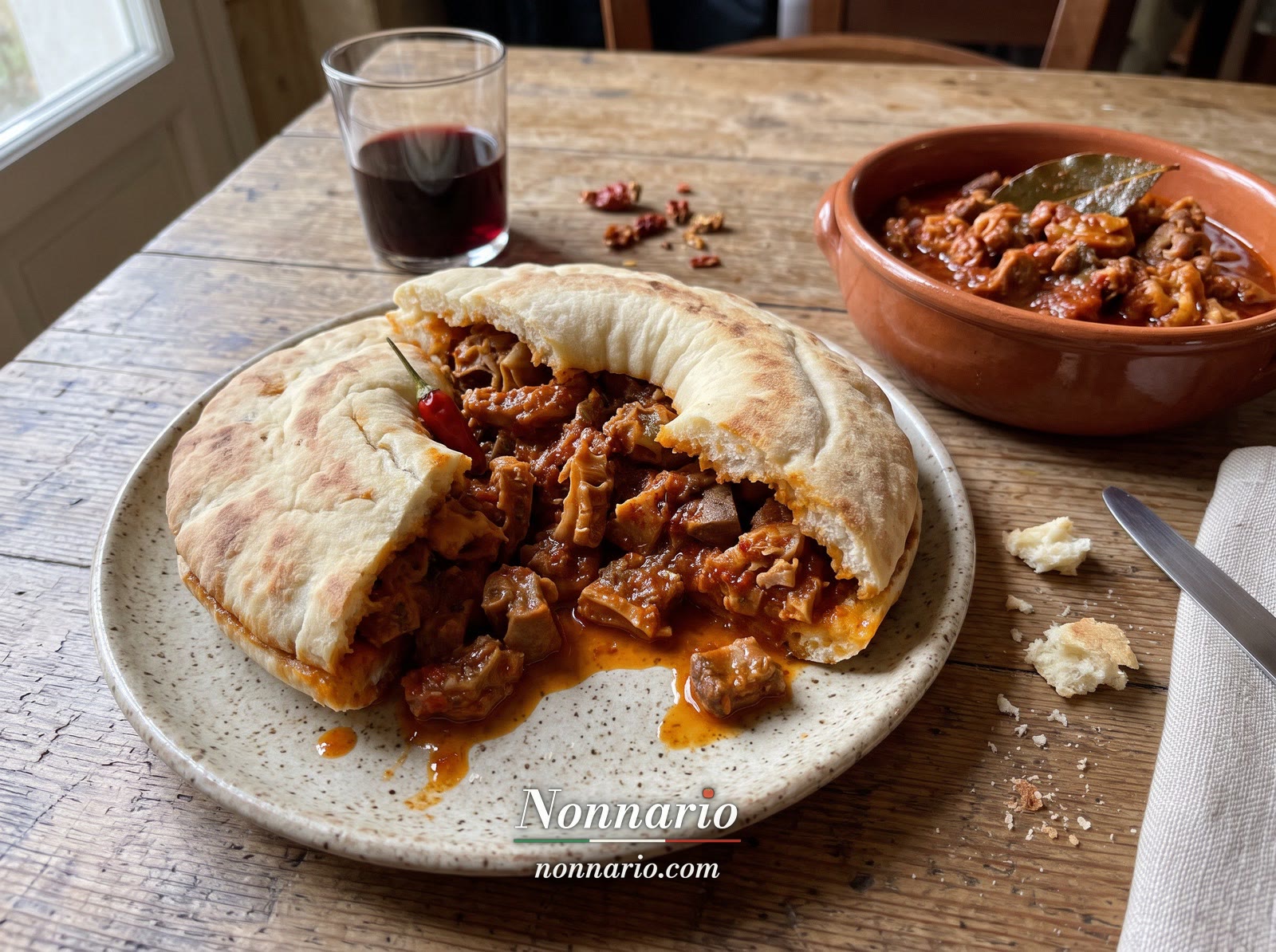
Catanzaro's spiced stew of beef offal in tomato and chilli, eaten in pitta bread
Catanzaro's stew of beef offal (four kinds of tripe, heart, lung, spleen and more), simmered for hours in tomato and pepper concentrate with bay and oregano, finished with fresh chilli and eaten in the pitta; a De.C.O. of Catanzaro, made here to the rules of a certification mark registered in 2024.
- Course
- SecondiMain Courses
- Serves
- 4
- Hands-on
- 2 h 8 min
- Cooking
- 5 h 5 min
- Resting
- 6 h 45 min+
The video and the photos of every step are also gathered on a separate page.
In breve
In short
Also called 'u morzeddhu, morzeddhu, morzello di Catanzaro and Illustrissimo.
- Beef offal only: the four stomachs of tripe, spleen, lung, heart, intestine, sweetbreads, oesophagus and windpipe; never pork.
- Washed, soaked and precooked group by group, then cut small: the tripe in strips of 4 cm by 1 cm, the rest in 1 cm pieces.
- Simmered for 4–5 hours in tomato and pepper concentrate with bay, stirred with a bunch of oregano; never deglazed with wine.
- The spleen is blanched on its own and goes in only for the last 15 minutes, so it does not darken the rest.
- Served piping hot and very spicy in the pitta, Catanzaro's ring bread, its ends first dipped in the sauce.
La provenienza
Where this recipe comes from
Morzello, 'u morzeddhu in the dialect of Catanzaro, is the city's emblem dish: the offal of cattle, the fifth quarter that butchers threw away and the well-off scorned, cut small and cooked for hours in a fiery red sauce. Its origins are argued over. Some trace it to the Saracen rule of the late ninth and early tenth centuries, pointing to Arab flatbreads served under spiced sauces and to the strict absence of pork; others to an old Jewish recipe from the country between Catanzaro, Tiriolo and Taverna. The name may come from the Latin morsicellus, a small bite, or from morzha morzha, in small pieces. A legend told by the Catanzaro poet Achille Curcio gives it to Chicchina, a poor widow who, sent to clean a slaughter yard before Christmas, carried the discarded innards home instead of to the Fiumarella dump, cleaned them and cooked them for her children. Until not long ago the old centre was full of putiche, the taverns where morzeddhari began selling it at ten in the morning to labourers who had already done hours of work. The poet Giovanni Sinatora called the morzello in its pitta the Illustrissimo, and the name has stuck. The pitta, Catanzaro's flat, wheel-shaped bread with little crumb, is on Italy's list of traditional food products for Calabria, and in 2026 the town made it a De.C.O. of its own.
The morzello is a De.C.O. of Catanzaro, the municipal designation of origin the town set up in 2008, and by the Antica Congrega Tre Colli's account it was the first product of the town to receive it. The association, Catanzaro friends who have met to eat it every 28 December since 1984 and who run a school of morzello, filed a national certification mark, Morzello: ricetta originale, in 2023; Italy's patent and trademark office registered it in January 2024. Its rules of use fix the ingredients, the quantities for four or five people and a method in four phases (washing, precooking, cutting and the final cooking), and the association checks the cooks who use the mark at least once a year. The town's own text for the morzello could not be found in any copy issued by the town. So this page follows the mark's rules whole, as the fullest text that can be read, and marks no step as the official text. Other published versions, the recipe on the association's own website among them, use less tripe and simmer for two or three hours, or five or six. A few things are ours: the soaks are in the fridge, the warm water for the sauce and the salt are measured, and a probe checks that the spleen, which cooks for only 15 minutes, reaches at least 71 °C.
- Provenance
- A reference recipe set by a protection consortium or by the town the dish is named after.
- Defined by
- Antica Congrega Tre Colli
- Reference
- De.C.O. (Denominazione Comunale di Origine) of the town of Catanzaro, under the De.C.O. regulation approved by the town council on 28 May 2008 (the town's text for the morzello could not be read); the recipe follows the rules of use of the Antica Congrega Tre Colli's certification mark "Morzello: ricetta originale" (Art. 4, ingredients, recipe and method; Art. 5, service), registered at Italy's patent and trademark office in January 2024
- Sources
- Antica Congrega Tre Colli: rules of use of the certification mark "Morzello: ricetta originale", registered 2024 (Italian, PDF)
- MDPI, Foods: a peer-reviewed review of the morzello, its history, its recipe and its certification mark, written with founders of the Antica Congrega Tre Colli, 2024
- Antica Congrega Tre Colli: the Illustrissimo Morzello, its history, an older recipe and its other versions (Italian)
- Comune di Catanzaro: regulation setting up the town's De.C.O., council resolution no. 28 of 28 May 2008 (Italian, PDF)
- Il Giornale del Cibo (CIRFOOD's food magazine): the morzello catanzarese, its history and a recipe, 2020 (Italian)
- Meraviglie di Calabria (News&Com): the Antica Congrega Tre Colli and the morzello, 2026 (Italian)
- Comune di Catanzaro: the pitta catanzarese recognised as a De.C.O. product, 2026 (Italian)
- Ministero dell'agricoltura, della sovranità alimentare e delle foreste (MASAF), Italy's Ministry of Agriculture: national list of traditional food products, 25th revision, 2025 (Italian)
- USDA Food Safety and Inspection Service: Leftovers and Food Safety
Ingredienti
Ingredients
The original recipe serves 4
The offal (all beef)
The sauce and seasoning
For washing
To serve
Equipment
- Three large bowls, for the three soaks, and room in the fridge for them
- Three pots for precooking, one of them small, for the spleen
- A colander, a slotted spoon and a wide bowl, for the tripe's cooking water
- Trays, for cooling the precooked offal
- A large board and a sharp knife
- A heavy pot of 8–10 litres with a lid
- Kitchen string, to tie the oregano into a bunch
- A whisk and a jug, for the sauce
- A probe thermometer
- A bread knife, for the pitta
Preparazione
Method
Scaled to 4 servings: the amounts in the steps follow. Pot and pan sizes and cooking times are still for the original 4.
A long day, most of it waiting: start about 10 hours before you mean to eat, and buy the offal cleaned by the butcher. First wash everything and set the three soaks going at once, in the fridge; the longest takes 3 hours. Then precook each group, about an hour in all, chilling each one and the tripe's water as soon as they stop steaming. Cut everything, about 45 minutes, and keep the cut offal in the fridge until the fat has set on the tripe's water, 2–3 hours after it went in. Then make the sauce, fry briefly and simmer for 4–5 hours, adding the spleen for the last 15 minutes. The rules count about two portions in the pitta for each of four or five people.
- 2 h 8 minhands-on
- 5 h 5 mincooking
- 6 h 45 minresting, at least
Washing and soaking
The offal is washed in three groups, each with its own soak. Start all three at once: the longest takes three hours. Work with great care for hygiene throughout, as the rules ask.
-
Hands-on 15 min
Rinse the omasum, the reticulum and the rumen, and rub them with salt and lemon.
Check No grit or slime is left between the leaves of the omasum or in the cells of the reticulum, and the tripe smells clean.
Tip Our guide: rub them with a handful of coarse salt and the cut side of a lemon, then rinse under cold running water until it runs clear. Open the leaves of the omasum one by one.
Tip Our guide: a clean board and clean hands, and keep the raw offal away from anything that is eaten raw.
-
Rest 2 h
Leave them to soak in water for two hours, then rinse them.
Check After the last rinse the water runs clear.
Tip Our guide: in a large bowl of cold water that covers them, in the fridge below 4 °C. Raw offal must not stand at room temperature for more than 2 hours.
-
Rest 3 h
Rinse the abomasum and the intestine and leave them to soak in water with salt and lemon for three hours, then rinse them.
Check Inside and out, the intestine is free of slime and smells clean; the water of the last rinse runs clear.
Tip Our guide: start this soak at the same time as the tripe's, in its own bowl in the fridge, with about a handful of coarse salt and the juice of a lemon.
Tip Wash the intestine with particular care. Our guide: buy it already cleaned by the butcher, and rinse it inside too, running water through it.
-
Hands-on 10 min
It is best to cut the heart, the lung and the spleen roughly first, so they stop bleeding sooner. Cut the oesophagus lengthwise, remove its inner membrane and rinse it.
Check The oesophagus lies open, smooth inside, with no membrane left.
Tip Our guide: pieces about the size of an egg. The suet needs no soak: keep it in the fridge until the final cooking.
-
Rest 1 h
Leave the spleen, the lung, the heart, the sweetbreads, the oesophagus and the windpipe to soak in water for an hour, to draw out the last of the blood.
Check The water has turned pink and the pieces look paler.
Tip Our guide: in the fridge, with the spleen in a bowl of its own, since it is cooked apart from the rest.
Precooking, group by group
Each group is precooked on its own, and the times count from the moment the water boils again. Keep the tripe's cooking water: its fat goes into the final pot. Everything cooked goes into the fridge as soon as it stops steaming: nothing cooked stands out of the fridge for more than 2 hours in all.
-
Cooking 20–25 minHeat high, then a steady boil
After a first rough cut, put the omasum, the reticulum and the rumen on to cook with 2–3 bay leaves, for 15 minutes from the boil.
Check The tripe is firmer and paler, and a film of fat floats on the water.
Tip Our guide: pieces about a hand's width, in fresh cold water that covers them by 5 cm. Start the timer when the water boils again.
-
Hands-on 20–30 min
Lift the tripe out with a slotted spoon onto a tray. Pour the cooking water into a wide bowl and let both cool until they stop steaming, then put them in the fridge, the tripe covered: the fat in the water will set on its surface there.
Check Both are in the fridge, no more than 30 minutes after the tripe came off the heat.
Tip The rules let the cooking water cool to gather the fat that sets on its surface. Our guide: in the fridge, not on the worktop, since the fat takes 2–3 hours to set and the tripe must not wait out of the fridge that long.
-
Cooking 10–15 minHeat high, then a steady boil
Put the abomasum and the intestine on to cook with 2–3 bay leaves, for 5 minutes from the boil. At the end rinse both carefully.
Check Both are firmer and rinse clean, with no film left on them.
Tip Our guide: fresh cold water to cover by 5 cm; start the timer when it boils again.
-
Hands-on 12–15 min
Blanch the spleen on its own, so it does not darken the rest, with one bay leaf: twice, changing the water each time, then rinse it.
Check The second water stays clearer than the first, and the spleen is firm on the outside.
Tip Our guide: each time, bring it to the boil in fresh water with the bay leaf, boil for 2 minutes and drain.
-
Cooking 20–25 minHeat high, then a steady boil
Precook the heart, the sweetbreads, the oesophagus and the windpipe together for 5 minutes from the boil; the lung needs 10 minutes more. Then rinse them.
Check Every piece is firm and grey outside; rinsed, the pieces are free of scum.
Tip Our guide: put the lung in first. When it has boiled for 10 minutes, add the rest, wait for the boil and give them 5 minutes more, so they all come out together.
-
Rest 15 min
As each group comes out of its rinse, spread it on a tray until it stops steaming, about 15 minutes, then cover it and put it in the fridge, the spleen in a container of its own.
Check Every group is in the fridge, covered, within 30 minutes of coming off the heat.
Cutting
Take each group out of the fridge only when you cut it, and put it back as soon as it is cut.
-
Hands-on 20 min
Cut the omasum, the rumen and the reticulum into pieces of about 4 cm by 1 cm. The windpipe stays whole.
Check Strips of roughly even size, none much larger than the rest.
Tip By one account the dish takes its name from these small pieces: morzha morzha, in small pieces.
-
Hands-on 25 min
Cut all the other ingredients into pieces of about 1 cm by 1 cm.
Check Abomasum, intestine, heart, lung, sweetbreads, oesophagus and spleen are all in small, even pieces.
Tip Our guide: put all the cut offal, covered, in the fridge until the fat from the tripe's water has set, with the spleen in its own container: it goes into the pot only at the end. Nothing cooked should stand out of the fridge for more than 2 hours in all. Leave the suet in one piece, so whatever does not melt is easy to lift out.
-
Rest 30 min to 1 h 30 min
Leave the tripe's water in the fridge until the fat on top has set firm, 2–3 hours from when it went in, with the cut offal waiting in the fridge too. Then lift the fat off with a spoon and keep it for the pot; the water is not needed.
Check A firm, pale layer of fat that a spoon lifts away in pieces, with clear water beneath.
Tip Our guide: if the fat is still soft, give it another 30 minutes; the cut offal stays in the fridge meanwhile.
The final cooking
-
Hands-on 5 min
Off the heat, mix the 600 g of tomato concentrate, the 2 tablespoons of pepper concentrate and some warm water into a sauce neither too thick nor too runny.
Check Smooth and free of lumps; it pours like a thick passata.
Tip Our guide: about 1.5 l of warm water, added a little at a time while you whisk.
Tip The rules make it while the meat starts its final cooking; making it just before means it is ready to pour.
-
Hands-on 5 minHeat medium
Put all the cut ingredients except the spleen into a large pot, with the fat gathered from the tripe's water and the suet, and fry for a few minutes.
Check The fat is starting to melt and everything sizzles.
Tip Our guide: a heavy pot of 8–10 litres; about 5 minutes, stirring.
-
Hands-on 3 min
Add the sauce, 4–5 bay leaves, salt and a bunch of oregano, which also serves as the spoon to stir the pot, again and again.
Check The pieces are covered by the sauce, with the oregano standing in the pot.
Tip Our guide: about 10 g of salt now; taste near the end and add more if it needs it, since the sauce reduces.
Tip Never deglaze with wine. Stir with the oregano rather than a wooden spoon: in Catanzaro the oregano is the spoon.
-
Cooking 4–5 hHeat low
Leave it all to cook over a low heat for 4–5 hours.
Check The tripe is tender to the bite and the sauce is red and dense, with a strong scent of bay and oregano.
Tip Our guide: the lid ajar and the lowest heat that keeps a few slow bubbles. Stir with the oregano every 20–30 minutes, scraping the bottom. If the sauce sinks below the pieces, add a little hot water.
-
Cooking 15 minHeat low
Add the spleen to the pot 15 minutes before the end of the cooking.
Check The pot is back at a simmer, the spleen is cooked through with no pink, and a probe in a piece of spleen or heart reads at least 71 °C.
Tip Our guide: bring it back to a gentle simmer after adding the spleen, and start the timer then.
-
Hands-on 3 min
At the end of the cooking, or before it falls apart, take out the windpipe together with any of the suet that has not melted.
Check No windpipe and no lumps of fat are left in the pot.
-
Hands-on 2 min
Before serving the morzello piping hot, add a few fresh hot chillies.
Check The chillies are in, and the pot is still steaming hot.
Tip Our guide: whole, or slit open for more heat. How many is up to you: the morzello is meant to be very hot and very spicy.
Serving in the pitta
-
Hands-on 5 min
Cut the pitta into pieces about 18 cm–20 cm long and open them like a book.
Check Each piece opens like a book, still joined along one side.
Tip Our guide: 8 pieces for four, two for each person.
-
Hands-on 3 min
Serve the morzello in the pitta, the pieces first soaked with sauce at both ends.
Check Both ends are red with sauce and the middle is full of offal of every kind.
Tip Fill each piece with some of every kind of offal and plenty of sauce, and eat it at once, starting from the ends so the middle stays hot. The sauce will run: that is part of it.
Tip It may also be served on a plate with the pitta on the side; either way it is served hot.
Tip Whatever is not eaten goes into the fridge within 2 hours, in shallow covered containers, and is eaten within 3 days. Bring it back to the boil before serving.
The essentials, for cooks who know the dish. Switch to Detailed for quantities, temperatures, times and checks at every step.
Press “I’m here” on the step you are on, and again when it is done.Tap the pin on the step you are on, and the tick when it is done. Timers keep running while you scroll.
Da sapere
Good to know
- WhenQuando
- Traditionally eaten mid-morning: the taverns of Catanzaro's old centre began selling it at ten, to labourers who already had hours of work behind them. Source
- VariantsVarianti
- Morzello di baccalà: Made with salt cod in place of the offal, traditionally on Good Friday, since no meat is eaten in Lent and above all on that day. Source
- Morzello di trippa: Made with veal tripe alone. Source
- Morzello minutu: Made with the innards of kid and lamb. Source
- Soffritto di maiale: Made with the meat and innards of the pig. Source
- With less tripe, for about 1 kg: For about 1 kg of morzello, for 4–6 people: 800 g of reticulum, rumen and omasum boiled in plenty of salted water with the beef fat until a fork sinks in easily, with heart, lung, oesophagus and large intestine cooked apart and the spleen, if used, apart again. Cut small, fried in the fat skimmed from the tripe's water, then cooked with two bay leaves, 150 g of tomato concentrate, the tripe's water, a bunch of oregano and hot chilli over a low heat for 2–3 hours, stirred with the oregano. Source
Errori comuni
Common mistakes
- Using pork or a splash of wine: the morzello is beef offal only and is never deglazed with wine.
- Putting the spleen in with the rest: it goes in for the last 15 minutes only, or it darkens the whole pot.
- Cutting the pieces large: the tripe goes in strips of about 4 cm by 1 cm, everything else in 1 cm pieces.
- Cooking it hard: it cooks over a low heat for 4–5 hours, stirred often, or the sauce catches on the bottom.
- Leaving the offal to soak on the worktop: the soaks last up to 3 hours, so they go in the fridge.
- Serving it lukewarm: it is eaten piping hot, in pitta whose ends were first dipped in the sauce.
Fuori dall'Italia
Cooking it outside Italy
- Tripe by its English names: the rumen is blanket or flat tripe, the reticulum honeycomb tripe, the omasum book or bible tripe and the abomasum reed tripe. Tripe sold outside Italy is often already cleaned and blanched: wash, soak and precook it as written all the same.
- Ask the butcher for beef spleen (melt), lung (lights), the top of the heart, large intestine, the salivary glands (which the rules call animelle, sweetbreads), oesophagus and windpipe. Where the other offal cannot be found, a version with tripe alone is made in Catanzaro too.
- Concentrato di peperoni is a concentrated paste made from peppers, the counterpart of tomato concentrate; our guide: look for it in an Italian delicatessen.
- Without a pitta, choose a bread with a soft crust and a firm crumb that holds the sauce.
From nonnario.com/recipes/morzello/, where you will find its sources, its story and the step photos. Sources checked in November 2026.