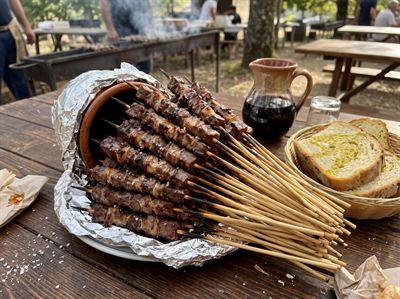
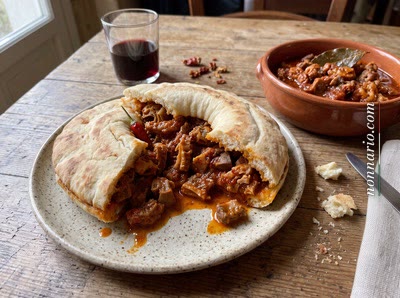
Matera, Basilicata
Cutturiddi
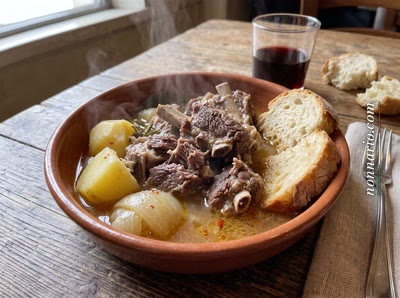
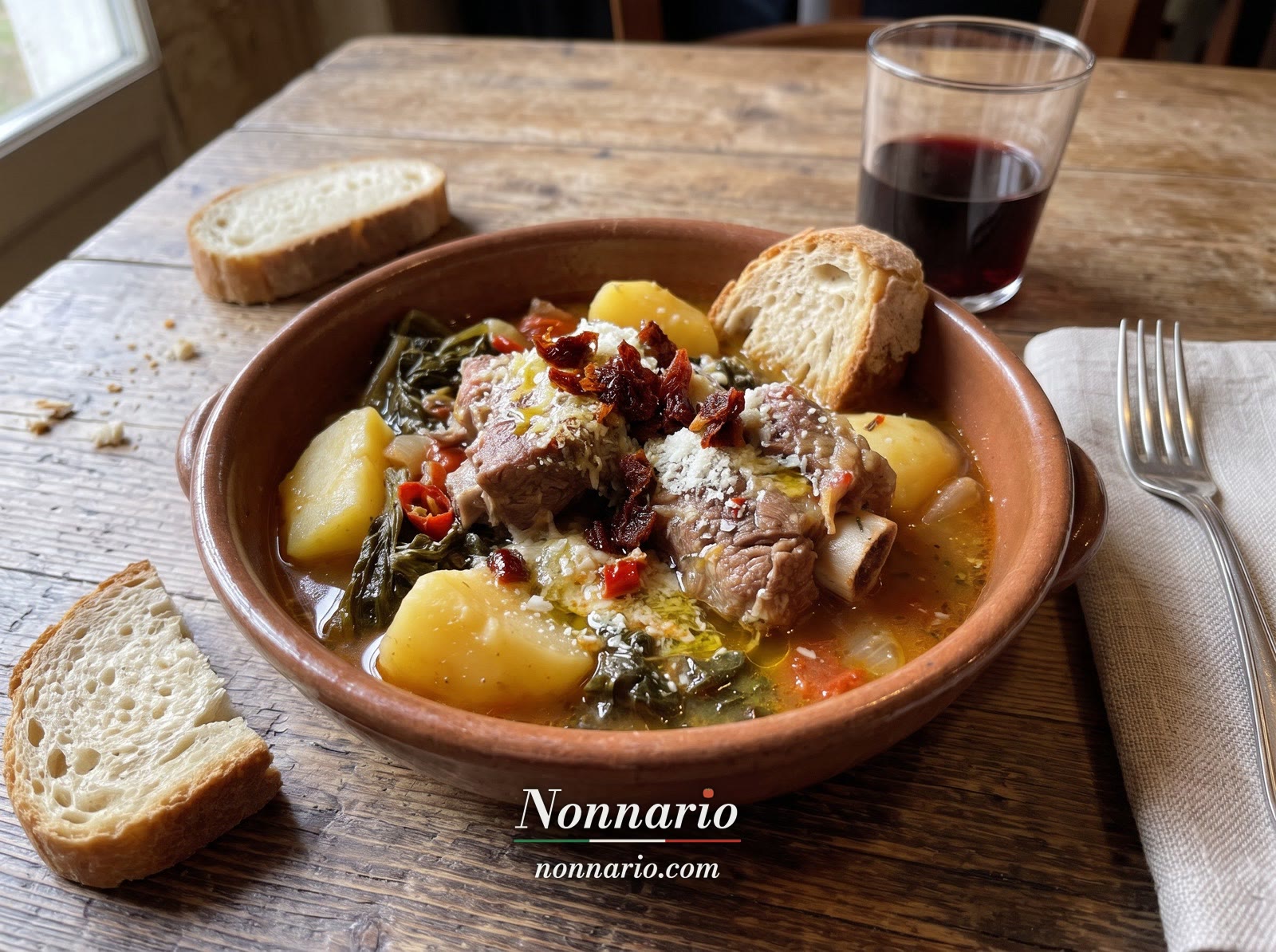
Basilicata lamb stewed slowly in layers with celery, spring onions, tomato and herbs
Lamb shoulder and breast layered raw in a deep pot with celery, spring onions, seeded tomatoes, bay, rosemary and chilli, barely covered with water and simmered slowly, salted only at the end; a Lucanian Easter dish on Italy's list of traditional food products.
- Course
- SecondiMain Courses
- Serves
- 4
- Hands-on
- 37 min
- Cooking
- 1 h 30 min
The video and the photos of every step are also gathered on a separate page.
In breve
In short
Also called Cutturidde, Cutturidd', Cutturidd, Agnello a cutturiello and Aine a cutturieddu.
- Lamb shoulder and breast in regular pieces, not too large, put into the pot raw; in this version nothing is browned and no fat is added.
- Celery, spring onions and seeded tomatoes in three layers with the meat, each with a bay leaf, a little rosemary and a piece of chilli.
- Water only almost to cover the meat, so it cooks in a short, concentrated broth under a lid.
- Brought to a simmer, then about an hour and a quarter over a low heat, until the meat is very soft.
- Salted only at the end, and served with its cooking liquid and slices of durum-wheat bread.
La provenienza
Where this recipe comes from
Cutturiddi is lamb stewed slowly in a deep pot, best of earthenware, with celery, onion, tomato, bay, rosemary and chilli: a dish of Basilicata that comes from the area's old pastoral tradition, and an Easter dish there and in the Murgia of central Puglia across the border. It is on Italy's national list of traditional food products for Basilicata as Cutturidde or Cutturidd', and in Matera it is counted among the city's traditional dishes. There it is described as sheep or lamb with herbs, tubers, mushrooms, a few pieces of pancetta and cheese rinds, sealed in a narrow-necked clay pot and cooked very slowly over the fire in the hearth. Across the border, the towns of the Puglian Murgia have their own versions; in Minervino Murge, where it is made with lamb and cime di rapa, the dish is said to have begun as a way to eat sheep that were no longer productive, sick or attacked by wolves, and lamb has taken their place over time.
There is no official recipe. We compared eight sources and publish the most widely recognised version: the lamb and vegetables go into the pot raw, with water, and cook slowly under a lid until the meat is very soft. Here they go in in layers, with water only almost to cover, and the salt goes in at the end. The recipes agree on lamb, celery, onion and tomato, and most add bay, chilli and rosemary. They differ on whether the meat is first browned in olive oil, or the onion softened in lard with garlic and herbs, on the kind of onion, and on the time, from about 40 minutes after browning to an hour and a half. Ours on this page: the amount of water and salt, the heat for each stage, the sizes of the pieces, and a probe in the thickest piece to check that it has reached at least 71 °C.
- Provenance
- A regional tradition documented in cookbooks and local practice, with no single official text.
- Defined by
- Lucanian tradition
- Reference
- Compared across 8 sources, listed below; this page publishes the most widely recognised version.
- Sources
- La Cucina Italiana: ‘Cutturiddi, agnello in umido’, lamb layered with its vegetables and simmered, for 4, 2016 (Italian)
- La Cucina Italiana: ‘Cutturiddi (agnello in casseruola)’, a recipe from Basilicata with the lamb browned first, for 6, 2015 (Italian)
- Cookaround (Mondadori Digital): ‘Cutturiddi’, a recipe for 4 (Italian)
- Accademia Italiana della Cucina: ‘Agnello a cutturiello’ (aine a cutturieddu), a Basilicata recipe from its collection, for 4 (Italian)
- Il Giornale del Cibo (food magazine published by CIRFOOD): five traditional dishes of Matera, the cutturidd among them, 2018 (Italian)
- Ministry of Agriculture (MASAF): the 25th revision of the national list of traditional agri-food products, 2025, with ‘Cutturidde/Cutturidd'’ for Basilicata (Italian)
- Università degli Studi di Bari: PAT Puglia, its atlas of Puglia's traditional food products, funded by the Regione Puglia, ‘U cutturìdd’ of Minervino Murge (Italian)
- USDA Food Safety and Inspection Service: Leftovers and Food Safety (archived copy of 29 May 2025)
Ingredienti
Ingredients
The original recipe serves 4
Equipment
- A deep pot of about 3 l–4 l with a lid, best of earthenware (with a heat diffuser on a gas or electric hob); a heavy enamelled cast-iron casserole also works
- A sharp knife and a board
- A teaspoon, to scoop out the tomato seeds
- A wooden spoon or a ladle
- Probe thermometer
- Deep plates, and a plate for the bones
Preparazione
Method
Scaled to 4 servings: the amounts in the steps follow. Pot and pan sizes and cooking times are still for the original 4.
About 2–2½ hours from start to table, most of it unattended: about 30 minutes to cut the meat and vegetables and fill the pot in layers, 15–40 minutes to bring it to a simmer (the longer time in earthenware), then about 1 hour 15 minutes of slow cooking, looked at every half hour. Ask the butcher to cut the shoulder and breast through the bone when you buy them.
- 37 minhands-on
- 1 h 30 mincooking
The meat and vegetables
-
Hands-on 10 min
Cut the 1 kg of lamb shoulder and breast into regular pieces, not too large. Set aside the meatiest pieces: they go into the first layer.
Check The pieces are all about the same size, so they cook in the same time.
Tip Our guide: pieces of about 4 cm–5 cm, on the bone. The bone is best cut by the butcher with a saw or a cleaver.
Tip The meatiest pieces are those from the shoulder; the breast is thinner, with more bone and fat.
-
Hands-on 5 min
Halve the tomatoes, scoop out the seeds and break the flesh into pieces.
Check No seeds are left in the tomato pieces.
Tip Our guide: a teaspoon scoops out the seeds and their jelly cleanly; pieces of about 2 cm.
-
Hands-on 5 min
Cut the celery stalk and the spring onions into chunks. Put them with the tomatoes and divide all the vegetables into three equal heaps.
Check Three heaps of mixed vegetables of about the same size.
Tip Our guide: chunks of about 2 cm–3 cm, using the white and pale green part of the spring onions.
-
Hands-on 3 min
Strip the needles from the rosemary and break the chilli into three. Put a bay leaf, a third of the rosemary needles and a piece of chilli beside each heap of vegetables.
Check Each heap has its own bay leaf, a few rosemary needles and a piece of chilli.
Tip Our guide: one sprig of rosemary of about 10 cm and one small dried chilli are enough for the three layers. For a milder dish, shake the seeds out of the chilli.
The layers
-
Hands-on 2 min
Spread the first heap of vegetables over the bottom of a deep pot, best of earthenware, with its bay leaf, rosemary needles and piece of chilli.
Check The bottom of the pot is covered by an even layer of vegetables.
Tip Our guide: a pot of about 3 l–4 l, deep rather than wide, so the meat sits in layers and the water stays above it.
-
Hands-on 2 min
Cover the vegetables with the meatiest pieces of lamb, then spread the second heap of vegetables over them, with its herbs.
Check The meat is covered by the second layer of vegetables.
-
Hands-on 2 min
Put in the rest of the lamb, then the last heap of vegetables with its herbs.
Check Everything is in the pot, with vegetables and herbs on top.
-
Hands-on 2 min
Pour in cold water until it almost covers the meat, then put the lid on.
Check The water stands just below the top layer of vegetables; the meat is almost submerged, not swimming.
Tip Our guide: about 1 l, poured slowly down the side of the pot so the layers stay in place.
Tip Do not add more at the start: the lamb should cook in a short, concentrated broth.
The slow cooking
-
Cooking 15–40 minHeat medium
Put the covered pot on the heat and bring it slowly to a simmer.
Check Lift the lid: small bubbles rise steadily all over the surface.
Tip Our guide: an earthenware pot goes on a heat diffuser and is heated gradually, starting low; never put it cold on a ring that is already hot, or it may crack. It takes longer than a metal pot to come to the simmer.
-
Cooking 1 h 15 minHeat low, a gentle simmer
As soon as it simmers, lower the heat and cook with the lid on for about 1 hour 15 minutes, until the meat is very soft.
Check The meat is very soft and comes away from the bone at a touch of the spoon. A probe in the thickest piece, away from the bone, reads at least 71 °C.
Tip Our guide: look under the lid every 30 minutes; the surface should barely tremble. If the liquid has dropped below half the depth of the meat, add a little hot water.
Tip Our guide: if the meat is still firm after 1 hour 15 minutes, give it 15–30 minutes more and check again.
To the table
-
Hands-on 3 min
Add the salt, about 8 g, and stir it gently into the cooking liquid without breaking up the meat. Wait 2 minutes, then taste the liquid and add more if it needs it.
Check The liquid tastes well seasoned, of lamb, tomato and herbs, mildly hot.
Tip The salt goes in only now, when the meat is soft.
Tip Our guide: lift out the bay leaves and the pieces of chilli, so no one bites into them.
-
Hands-on 3 min
Serve the lamb hot in deep plates with plenty of its cooking liquid and vegetables, and slices of durum-wheat bread on the side if you like.
Check Each plate has meat, vegetables and some of the liquid.
Tip Put out a plate for the bones, and the bread for the liquid.
Tip Whatever is not eaten goes into the fridge within 2 hours of cooking, in shallow covered containers, and is eaten within 3 days of cooking. Bring it back to the boil until it reaches 75 °C at the centre.
The essentials, for cooks who know the dish. Switch to Detailed for quantities, temperatures, times and checks at every step.
Press “I’m here” on the step you are on, and again when it is done.Tap the pin on the step you are on, and the tick when it is done. Timers keep running while you scroll.
Da sapere
Good to know
- WhenQuando
- An Easter dish in Basilicata and in the Murgia of central Puglia. Source
- VariantsVarianti
- Browned first: Diced onion and celery are softened for about 3 minutes in 4–5 tablespoons of olive oil with a sliced chilli and a bay leaf; the lamb is browned over a high heat for 12–15 minutes, salted and cooked covered for 2 minutes more, then the tomatoes in chunks go in with a ladle of water, and it cooks covered over a medium heat for about 40 minutes. Source
- With lard, garlic and herbs: Sliced onions and celery are softened in lard (or olive oil) with three cloves of garlic and a chopping of parsley, thyme and rosemary, and salted; the lamb goes in over a lower heat with blanched, peeled tomatoes and black peppercorns, and boils in a high-sided earthenware pan until very well cooked, the fat skimmed off as it rises. Source
- Sealed in a clay pot, with sheep: Sheep or lamb goes into a narrow-necked earthenware pot with herbs, tubers and mushrooms, a few pieces of pancetta and cheese rinds or the ends of cured meats; the pot is sealed and cooked very slowly over a fire in the hearth. Source
Errori comuni
Common mistakes
- Cutting the lamb into large or uneven pieces: they should be regular and not too large, so they are soft at the same time.
- Leaving the seeds in the tomatoes: they are scooped out first.
- Covering the meat with plenty of water: it goes in only until the meat is almost submerged, so the broth stays short and full of flavour.
- Letting it boil hard: once it simmers, the heat goes down.
- Salting at the start: the salt goes in at the end, when the meat is very soft.
Fuori dall'Italia
Cooking it outside Italy
- Lamb shoulder and breast are sold as such in Britain; in the US breast is also sold as lamb riblets. Ask for both cut through the bone into stewing pieces.
- Spring onions are scallions or green onions in the US. Small onions can replace them: some cooks use them for this dish.
- Any heavy enamelled cast-iron casserole with a lid does the work of the earthenware pot.
- In Matera the dish is also made with sheep. Mutton needs far longer: our guide, start checking it after about 2 hours of simmering, with a little more water.
From nonnario.com/recipes/cutturiddi/, where you will find its sources, its story and the step photos. Sources checked in November 2026.