Potenza, Basilicata
Ciammotta
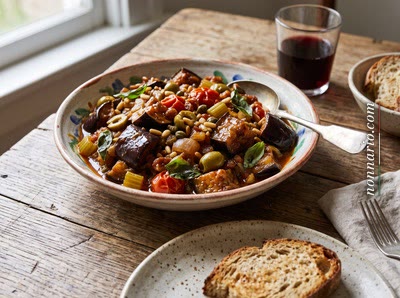
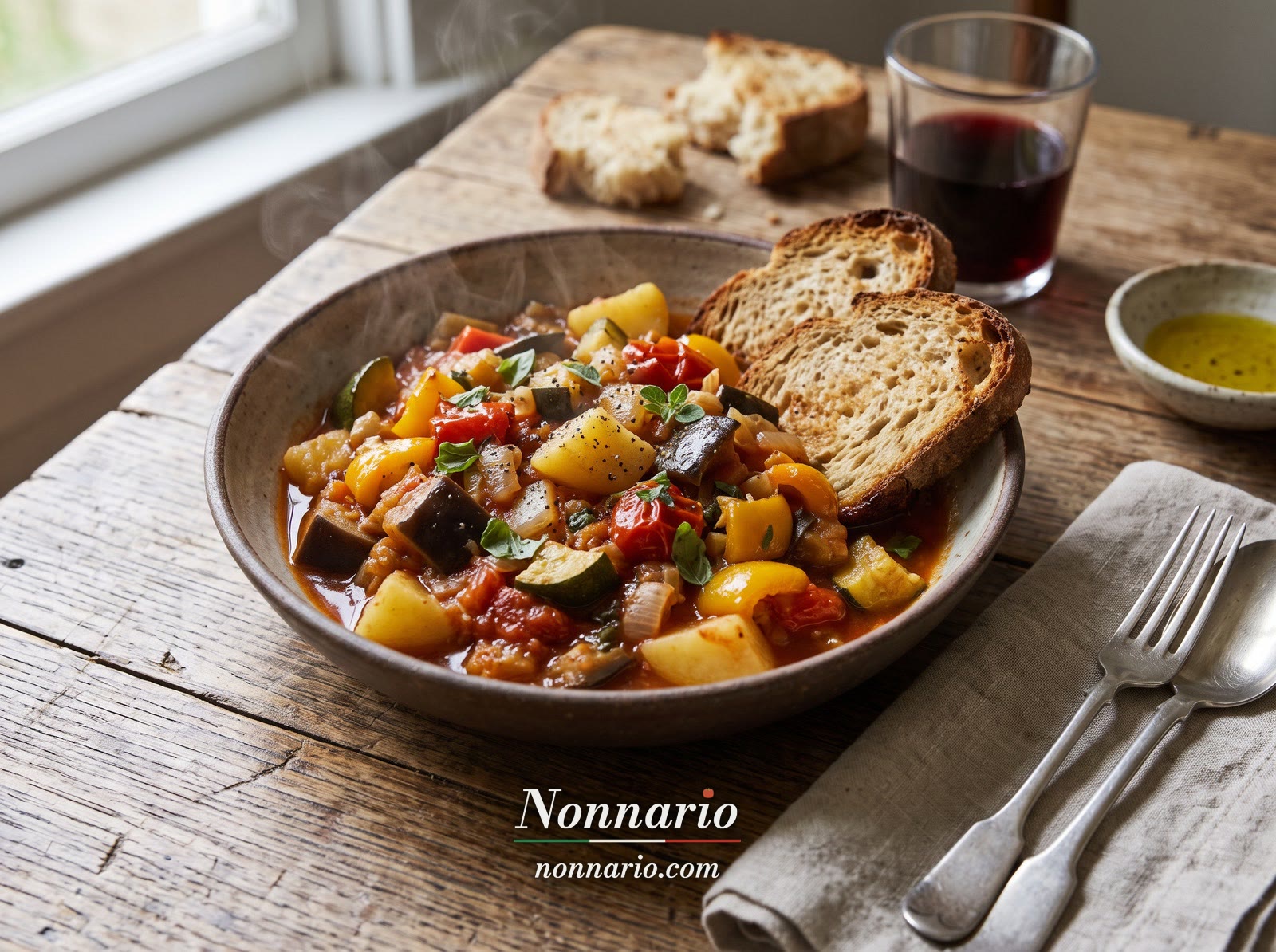
Lucanian potatoes, peppers and aubergines, fried one by one and stewed with tomato
Potatoes, sweet peppers and salted aubergines fried one after another in olive oil, then stewed in a covered pot with fresh tomato and garlic until fairly dry, and served warm or even cold: a vegetable dish of Basilicata.
- Course
- ContorniSide Dishes
- Serves
- 4
- Hands-on
- 1 h 22 min
- Cooking
- 1 h
- Resting
- 50 min+
The video and the photos of every step are also gathered on a separate page.
In breve
In short
Also called ciambotta, ciambotta lucana and Lucanian vegetable stew.
- Vegetarian
- Vegan
- Gluten-free
- Potatoes, sweet peppers and aubergines, each fried on its own in plenty of olive oil, then stewed with fresh tomato and garlic.
- The aubergines are sliced thin, salted for about 30 minutes, then rinsed and dried before they are fried.
- Stewed covered in one pot, terracotta if possible, for about 1 hour over a moderate heat, until fairly dry.
- No more oil goes into the stew: the fried vegetables bring enough.
- Served warm or even cold, in the pot it cooked in; out of the fridge 2 hours at most.
La provenienza
Where this recipe comes from
Ciammotta, also called ciambotta, is a dish of Basilicata in which peppers, potatoes, aubergines and tomatoes are cooked together; by one account it belongs above all to the mountains around Potenza, and Campania makes a similar dish, cianfotta. Basilicata has long been a farming region, and its typical dishes, ciammotta among them, grew out of that country life. Ciammotta is often served as a side dish at banquets and feasts, and it can make a meal on its own with home-made bread and local cheese. One version is spooned into a hollowed loaf, with oregano and a drizzle of oil, and a glass of Aglianico del Vulture is suggested with it.
There is no official recipe. We compared eight sources and publish the most widely recognised version of the dish by this name: potatoes, then peppers, then aubergines that have been salted, rinsed and dried, fried one after another in plenty of olive oil, then brought together in a covered pot, terracotta if possible, with peeled fresh tomatoes, a chopped clove of garlic and a pinch of salt, and stewed for about an hour until fairly dry. Most of the sources agree on peppers, potatoes, aubergines and tomato; they differ on the method. Some cooks stew the vegetables raw on a base of onion instead of frying them first, some add courgettes, and others finish it with beaten eggs and pecorino, or cook it with pork sausage. Ours are the sizes, the frying temperature and batches, the way the tomatoes are peeled, the rest before serving and the fridge rules, which follow food-safety guidance: it is out of the fridge 2 hours at most each time and is eaten within 3 days.
- Provenance
- A regional tradition documented in cookbooks and local practice, with no single official text.
- Defined by
- Lucanian tradition
- Reference
- Compared across 8 sources, listed below; this page publishes the most widely recognised version.
- Sources
- La Cucina Italiana: ciammotta, a Basilicata recipe for 4, 2018 (Italian)
- Cookaround (Mondadori Digital): Basilicata, ciammotta, the Viaggio Italiano tourism campaign's recipe for 4, served in a loaf, 2022 (Italian)
- Italia.it, the Ministry of Tourism's portal: ciammotta, a Basilicata recipe card for 4 from its Viaggio Italiano series, ingredients only (Italian)
- Buonissimo (Italiaonline's food magazine): ciammotta, a Basilicata recipe for 4 with courgettes, 2011 (Italian)
- Accademia Italiana della Cucina: ciambotta, a Basilicata recipe from its recipe collection, with eggs and pecorino, for 4 (Italian)
- Ricette della Nonna (Valica's recipe site): ciambotta lucana, a stewed recipe, 2026 (Italian)
- Il Giornale del Cibo (CIRFOOD): a guide to the typical foods of Basilicata, 2019 (Italian)
- USDA Food Safety and Inspection Service: Leftovers and Food Safety (archived copy of 29 May 2025)
Ingredienti
Ingredients
The original recipe serves 4
For the vegetables
For frying
To finish, if you like
Equipment
- A chef's knife, a vegetable peeler and a large board
- A colander set over a bowl, for salting the aubergines
- A small saucepan of boiling water and a bowl of cold water, for peeling the tomatoes
- A heavy, deep frying pan or sauté pan about 24 cm across and at least 7 cm deep, a kitchen thermometer that reads up to 200 °C, a slotted spoon, and a lid that fits kept within reach
- Kitchen paper and a large tray
- A pot with a lid, of terracotta if possible, about 24 cm across (about 2.5 l), with a heat diffuser if it is terracotta, and a wooden spoon
- A shallow container with a lid, for what is left
Preparazione
Method
Scaled to 4 servings: the amounts in the steps follow. Pot and pan sizes and cooking times are still for the original 4.
About 3 hours from start to table, of which about 1½ hours of work: the aubergines are salted for 30 minutes, and in that time you cut the potatoes and peppers and peel the tomatoes; then the three vegetables are fried one after another, and stewed with the tomato for about 1 hour, which needs only a stir now and then; the ciammotta then rests for 20–30 minutes until warm. From the end of cooking it may be out of the fridge for 2 hours at most, the rest included (1 hour in all on a day above 32 °C). To serve it cold the next day, put it in the fridge within 2 hours of cooking and eat it within 3 days of cooking; once out of the fridge it may stay out 2 hours at most (on a day above 32 °C, 1 hour: serve it straight from the fridge).
- 1 h 22 minhands-on
- 1 hcooking
- 50 minresting, at least
Salting the aubergines, and the other vegetables meanwhile
The quantities and the method follow one recipe whole; the sizes, the salt for the aubergines, the amount of frying oil, the frying temperature, batches and times, the peeling of the tomatoes, the size of the pot, the rest, the checks and the tips marked ‘Our guide’ are ours.
-
Hands-on 8 min
Wash the 250 g of aubergines, trim off both ends and cut them into thin rounds, leaving the skin on. Lay the slices in layers in the colander set over a bowl, sprinkling each layer lightly with the 5 g of fine salt.
Check Even rounds about 5 mm thick, every slice lightly touched with salt.
Tip Our guide: slices of even thickness fry evenly; thick ones stay raw in the middle while the outside colours.
-
Rest 30 min
Leave the aubergines in the colander for about 30 minutes, so that they release their water. Cut the other vegetables meanwhile.
Check Beads of brownish liquid on the slices and a little in the bowl; the slices bend without breaking.
Tip Our guide: the next three steps fit inside this half hour.
-
Hands-on 6 min
Peel the 250 g of potatoes and cut them into small cubes.
Check Even cubes of about 1.5 cm.
Tip Our guide: if they must wait, cover them with cold water so they do not darken, then drain them and dry them thoroughly in a cloth before frying: wet potatoes spit in hot oil.
-
Hands-on 5 min
Cut the stalk off the 250 g of peppers, halve them, pull out the seeds and the white inner ribs, and cut them into strips.
Check Strips about 1 cm wide, with no seeds or pale ribs left.
Tip Our guide: pat the strips dry if you washed them; drops of water make the oil spit.
-
Hands-on 10 min
Bring the small saucepan of water to the boil. Cut a shallow cross in the base of each tomato (200 g in all) and, once the water is at a full boil, lower them in for 20–30 seconds, then lift them into the cold water and slip off the skins. Halve them, press out the seeds and cut the flesh into chunks. Peel and finely chop the garlic clove.
Check The water was at a full rolling boil before the tomatoes went in; skinless, seedless pieces of tomato about 2 cm across, firm enough to hold their shape; the garlic is in fine, even bits.
Tip Our guide: choose tomatoes that are ripe but still firm; soft ones collapse into water in the pot.
-
Hands-on 5 min
Rinse the aubergine slices under cold water to wash off the salt and their bitter water, then dry them well between sheets of kitchen paper.
Check The slices are dry to the touch on both sides and taste only lightly salty.
Tip Our guide: do this before the oil goes on, so the hot pan is never left while you are at the sink.
Frying, one vegetable after another
-
Hands-on 8–10 minTemp 170 °C–175 °CHeat medium-high
Pour the olive oil into the deep frying pan, about 2 cm deep, and heat it to 170 °C–175 °C, checking with the thermometer.
Check The thermometer reads 170 °C–175 °C; the oil shimmers but does not smoke, and a cube of potato dropped in sizzles at once with steady small bubbles.
Tip Our guide: keep the pan no more than a third full. Never leave hot oil unattended, and keep the lid within reach. If the oil starts to smoke, take the pan off the heat. Never put water on hot or burning oil: if it catches fire, turn off the heat and slide the lid over the pan. Let the oil cool completely before you move the pan.
-
Hands-on 16–20 minTemp 170 °C–175 °CHeat medium-high
Fry the potatoes in two batches, stirring now and then with the slotted spoon, until golden and tender right through. Lift each batch out onto kitchen paper on the tray, and let the oil come back to 170 °C before the next.
Check Each batch is golden on all sides after about 8–10 minutes, and a cube cut in half is soft to the centre.
Tip Our guide: lower them in gently, away from you; too many at once cool the oil and they turn greasy instead of golden.
-
Hands-on 8–10 minTemp 170 °C–175 °CHeat medium-high
Fry the peppers in two batches, turning them, until soft and touched with gold at the edges. Lift them out onto kitchen paper beside the potatoes.
Check Each batch is limp and glossy, with a few golden patches, after about 4–5 minutes.
Tip Our guide: peppers spit more than potatoes as their water hits the oil: lower them in away from you, a handful at a time, and stand back for the first seconds.
-
Hands-on 8–12 minTemp 170 °C–175 °CHeat medium-high
Fry the aubergine slices in three batches, without crowding the pan, turning them once, until light golden on both sides. Lift them out onto kitchen paper, then turn off the heat under the oil.
Check Each slice is light golden on both sides and soft right through after about 2–3 minutes, never dark.
Tip Our guide: aubergines drink oil; let the oil come back to 170 °C before each batch, so they fry rather than soak.
Tip Our guide: leave the pan of oil to cool completely where it is before you move it or pour it off.
Stewing with the tomato
-
Hands-on 3 min
Put the fried potatoes, peppers and aubergines into the pot, add the tomatoes and the chopped garlic, season with a small pinch of salt and turn everything over gently with the wooden spoon. Add no more oil: the fried vegetables bring enough.
Check The vegetables are evenly mixed, with pieces of tomato all through, and there is no pool of oil in the pot.
Tip Our guide: be sparing with the salt; the aubergines keep some of theirs. Taste at the end.
-
Cooking 1 hHeat medium-low
Put the lid on, set the pot over a moderate heat and let it stew for about 1 hour, stirring gently from the bottom every 15–20 minutes.
Check It is fairly dry: the tomato has cooked down and coats the vegetables, with almost no liquid left in the bottom of the pot, and the potatoes are soft but still whole.
Tip Our guide: with a terracotta pot, set it on the heat diffuser and bring it up slowly; earthenware cracks on a sudden high heat.
Tip Our guide: a gentle bubble at the edges is enough. If it catches before the hour is up, lower the heat and add a spoonful of water; if liquid is still pooling after the hour, take the lid off for the last few minutes.
Tip Our guide: taste once it is done and add a little salt if it needs it.
Resting and serving
-
Rest 20–30 min
Take the pot off the heat, lift the lid and leave the ciammotta to cool until it is warm rather than hot.
Check A spoonful feels pleasantly warm, not hot, on the tongue, and the juices have settled around the vegetables.
Tip Our guide: from the end of cooking it may be out of the fridge for 2 hours at most, this rest included (1 hour in all on a day above 32 °C).
Tip It is also eaten cold: let it cool within the same 2 hours and serve it, or chill it and serve it from the fridge.
-
Hands-on 2 min
Bring the ciammotta to the table in the pot it cooked in, scattered, if you like, with a pinch of chopped basil or parsley.
Check Each portion has potato, pepper and aubergine, glossy with the cooked-down tomato.
Tip Our guide: chop the herbs at the last moment, so they stay green.
-
Hands-on 3 min
Spoon what is left into the shallow container, cover it and put it in the fridge as soon as the meal is over, within 2 hours of the end of cooking (1 hour on a day above 32 °C).
Check The ciammotta is covered, in the fridge at 4 °C or below, within 2 hours of the end of cooking (1 hour above 32 °C).
Tip Our guide: eat it within 3 days of cooking. Served cold, it may be out of the fridge 2 hours at most (1 hour above 32 °C), then what is left goes straight back in the fridge, or is thrown away, and is not set out again. To serve it warm, heat it in a covered pan over a low heat, stirring gently, until it is steaming throughout and reaches 75 °C at the centre.
The essentials, for cooks who know the dish. Switch to Detailed for quantities, temperatures, times and checks at every step.
Press “I’m here” on the step you are on, and again when it is done.Tap the pin on the step you are on, and the tick when it is done. Timers keep running while you scroll.
Da sapere
Good to know
- KeepingConservazione
- After cooking it may be out of the fridge for 2 hours at most, the rest before serving included (1 hour in all on a day above 32 °C); then it goes into the fridge, covered, in a shallow container, and is eaten within 3 days of cooking. Served cold from the fridge, it is out for 2 hours at most (1 hour above 32 °C), then back in the fridge or thrown away, never set out again. To serve it warm again, heat it, covered and stirring gently, until it reaches 75 °C at the centre. Source
- VariantsVarianti
- Stewed, with eggs and pecorino: The vegetables are not fried first: sliced onions are softened in oil with chopped garlic, parsley and rosemary, seasoned with salt and pepper; after ten minutes skinned peppers in pieces go in, then peeled, seeded tomatoes, then aubergine pieces, while the potatoes are boiled apart until just firm, peeled, cut into large chunks and added. With every vegetable still firm, one egg per person, beaten with grated pecorino, is stirred in with a wooden spoon, and the dish goes to the table as soon as the eggs set. Source
- With sausage and eggs: The vegetables, usually peppers, tomatoes and potatoes, are stewed on a base of garlic and onion softened in oil, often with pork sausage and eggs added. Source
- Stewed in one pot, with courgettes: Onion is softened in olive oil, the raw aubergine, courgettes, potato and peppers are cooked in it for a few minutes over a medium to high heat, then the tomatoes, salt and, if you like, chilli go in with water to cover, and it simmers gently for about 30–40 minutes; served hot, as a side or a starter with toasted bread. Source
- With courgettes, fried in peanut oil: Diced aubergines, diced potatoes and courgettes, and yellow and red peppers in strips are fried one after another in plenty of peanut oil, drained well, then cooked in a terracotta pan with peeled, seeded tomato, salt and a whole clove of garlic over a low heat for 10 minutes. Source
- In a hollowed loaf, with oregano: The aubergines are sliced, salted, dried and fried; the potatoes and peppers are fried, then oregano, the aubergines, peeled, seeded tomatoes and sliced garlic are added, salted and cooked for 15 minutes over a low heat. A loaf is cut open and hollowed out, filled with the ciammotta, finished with fresh oregano and a drizzle of extra virgin olive oil, and closed. Source
Errori comuni
Common mistakes
- Skipping the salting and rinsing: the aubergine slices sit under salt for about 30 minutes, then are rinsed and dried well before frying.
- Frying wet vegetables, or crowding the pan: dry them, fry in batches at 170 °C–175 °C, and let the oil recover between batches, or they spit and turn greasy.
- Adding oil to the pot: the fried vegetables bring enough for the stewing.
- Leaving it wet: after about 1 hour, covered, over a moderate heat, it should be fairly dry, the tomato clinging to the vegetables.
- Leaving it out too long: it is out of the fridge 2 hours at most after cooking, the rest included, and 2 hours at most when served again; 1 hour each time on a day above 32 °C.
Fuori dall'Italia
Cooking it outside Italy
- Aubergines are eggplants; choose firm ones with tight, shiny skin.
- Sweet peppers are bell peppers (capsicums); red and green both work.
- Fry in olive oil; some cooks use peanut (groundnut) oil instead.
- No terracotta pot? Any heavy pan with a lid will do; keep the heat moderate so it does not catch.
From nonnario.com/recipes/ciammotta/, where you will find its sources, its story and the step photos. Sources checked in November 2026.