Palermo, Sicilia
Caponata
Sweet-and-sour Sicilian aubergines with celery, olives and capers
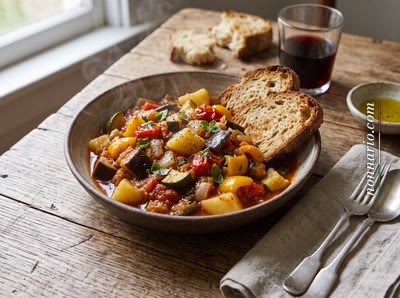
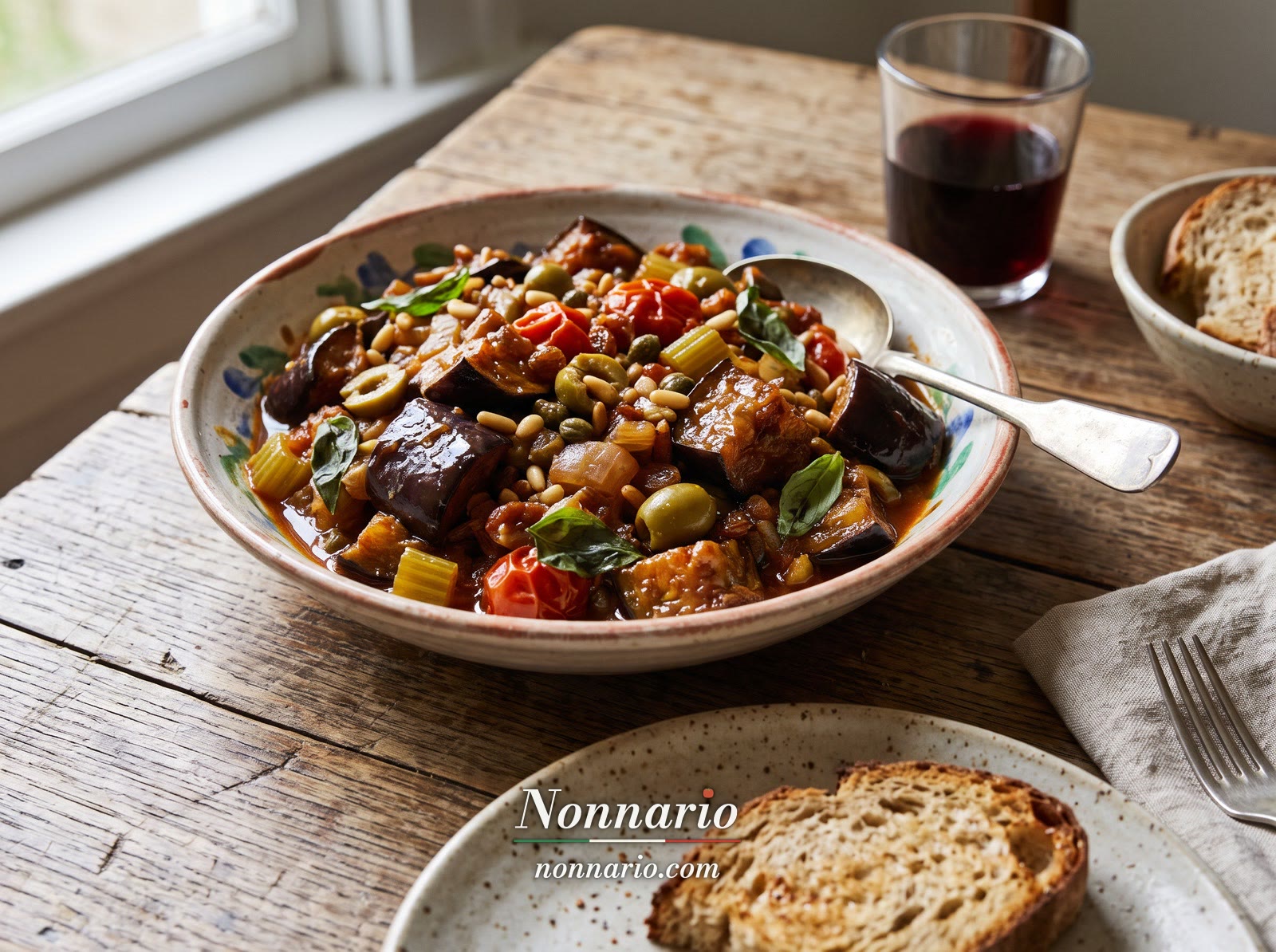
Diced aubergines salted and fried, then stirred into onion, tomato, boiled celery, green olives, capers and pine nuts and finished with vinegar and sugar, served at room temperature: a dish of western Sicily on the national list of traditional food products.
- Course
- ContorniSide Dishes
- Serves
- 4
- Hands-on
- 1 h 19 min
- Cooking
- 35 min
- Resting
- 2 h+
The video and the photos of every step are also gathered on a separate page.
In breve
In short
Also called caponata di melanzane, caponata di melenzane, caponata siciliana, Sicilian caponata, aubergine caponata and eggplant caponata.
- Vegetarian
- Vegan
- Gluten-free
- Aubergines diced, salted in a colander for at least 1 hour to draw out the bitter water, dried, then fried in seed oil.
- Celery boiled for 5 minutes, then fried in a little olive oil.
- Onion, green olives, capers and tomato cooked down into a thick sauce before the aubergines go in.
- Finished with white wine vinegar and sugar, cooked until the sharp smell of vinegar eases.
- Rested until it is at room temperature and served with basil; out of the fridge 2 hours at most.
La provenienza
Where this recipe comes from
Caponata is a Sicilian dish of fried aubergines in a sweet-and-sour sauce of celery, onion, tomato, green olives, capers, sugar and vinegar. The Region of Sicily lists it, as caponata di melanzane, among its traditional food products, made in western Sicily, in delicatessens and at home, and the national list carries it too. The name has several explanations. One links it to the Spanish caponada and to capone, the name in parts of Sicily for the dolphinfish (lampuga), a fish of the aristocracy dressed in a sweet-and-sour sauce; people who could not afford it used aubergines instead and kept the sauce. Others trace it to the Latin caupona, a tavern, or to capon, a word for sailors' ship's biscuits. By one account the dish began in baronial kitchens as fish served with vegetables, and the oldest documented recipe is of ship's biscuits, salted capers, green olives, salted anchovies and tuna, oil, vinegar, honey and salt. Every part of the island has its own: by one count thirty-six documented recipes, by another at least thirty-seven versions, with peppers in Catania, honey and raisins in Agrigento, toasted almonds in Trapani. The version of Palermo is called the simplest and the most classic. In Modica the specification of the town's protected chocolate names caponata among the local dishes made with it.
There is no official recipe. We compared ten sources and publish the most widely recognised version: aubergines salted for an hour and fried in seed oil, celery boiled and then fried, onions softened with capers, green olives and pine nuts, fresh tomatoes cooked down with them, and the whole finished with white wine vinegar and sugar, with no peppers. Most of them agree on the aubergines salted to take away their bitterness and then fried, on celery, onion, tomato, green olives and capers sharpened with vinegar and sweetened with sugar, and on serving it cool rather than hot. They differ on peppers, pine nuts, how the tomato goes in, whether the celery is boiled first and how much vinegar. Ours are the sizes, the frying temperature, the rest until the caponata reaches room temperature, and the fridge rules, which follow food-safety guidance: it is out of the fridge 2 hours at most each time and is eaten within 3 days.
- Provenance
- A regional tradition documented in cookbooks and local practice, with no single official text.
- Defined by
- Sicilian tradition
- Reference
- Compared across 10 sources, listed below; this page publishes the most widely recognised version.
- Sources
- Regione Siciliana, Department of Tourism (Visit Sicily portal): caponata, a recipe for 4, with the local versions (Italian)
- Regione Siciliana, Department of Agriculture: the 2021 sheets of Sicily's traditional agri-food products, ‘Caponata di melenzane’ (archived copy, Italian)
- Ministry of Agriculture (MASAF): the 25th revision of the national list of traditional agri-food products, 2025, with ‘Caponata di melanzane’ for Sicily (Italian)
- Accademia Italiana della Cucina: caponata, a Sicilian recipe from its recipe collection, with peppers and mint, for 4 (Italian)
- Accademia Italiana della Cucina: caponata di Natale, a Sicilian recipe without aubergines from its recipe collection, for 4 (Italian)
- GialloZafferano: caponata, editorial recipe for 6 (Italian)
- Gambero Rosso: caponata siciliana di melanzane, a recipe page (archived copy of 25 September 2023, Italian)
- La Cucina Italiana: caponata, a Sicilian recipe for 4, 2015 (Italian)
- Ministry of Agriculture (MASAF): the production specification of the Cioccolato di Modica PGI, on the chocolate in local dishes (Italian)
- USDA Food Safety and Inspection Service: Leftovers and Food Safety (archived copy of 29 May 2025)
Ingredienti
Ingredients
The original recipe serves 4
For the aubergines
For the sauce
For the sweet and sour
To serve
Equipment
- A chef's knife and a large board
- A large colander set over a bowl, for salting the aubergines
- A saucepan of about 3 l, for boiling the celery, and a clean cotton tea towel
- A wide, deep sauté pan about 28 cm across, for the sauce and for bringing everything together, and a wooden spoon
- A small frying pan, about 20 cm across, for the celery
- A heavy frying pan about 20 cm–22 cm across and at least 6 cm deep, a kitchen thermometer that reads up to 200 °C, a slotted spoon, and a lid that fits kept within reach
- Kitchen paper and a tray
- A wide, shallow serving dish of glass or ceramic
Preparazione
Method
Scaled to 4 servings: the amounts in the steps follow. Pot and pan sizes and cooking times are still for the original 4.
About 3 hours from start to table, of which about 2 hours of work: the aubergines salt for at least 1 hour, and in that hour you boil the celery and cook the onion and tomato sauce; then the aubergines are fried and everything is brought together, and the caponata rests for about 1 hour until it reaches room temperature. From the end of cooking it may be out of the fridge for 2 hours at most, the resting hour included (1 hour in all on a day above 32 °C). To make it ahead, put it in the fridge within 2 hours of cooking, take it out about 1 hour before serving (it may be out 2 hours at most; on a day above 32 °C serve it straight from the fridge and put what is left back within 1 hour), and eat it within 3 days of cooking.
- 1 h 19 minhands-on
- 35 mincooking
- 2 hresting, at least
Salting the aubergines
The quantities and the method follow one recipe whole; the sizes, heat levels, frying temperature, the rest, the checks and the tips marked ‘Our guide’ are ours.
-
Hands-on 10 min
Wash the 1 kg of aubergines, trim off the stalk ends and cut them into dice, leaving the skin on.
Check The dice are roughly even, about 2.5 cm a side.
Tip Our guide: dice of about 2.5 cm hold their shape through frying and the final stirring; much smaller ones turn to mush.
-
Rest 1 h
Put the aubergines in the colander, cover them with the handful of coarse salt and leave them to drain for at least 1 hour, so the bitter water runs out.
Check Brown, bitter liquid has gathered in the bowl, and the dice feel softer and look a little darker.
Tip Our guide: set the colander over a bowl or in the sink, and toss the dice once halfway so the salt reaches them all.
Tip Our guide: make the celery and the sauce during this hour.
The celery and the sauce, while the aubergines drain
-
Hands-on 10 minHeat high
Pull the coarse strings off the outer stalks of the 400 g of celery and cut it into dice. Bring about 2 l of water to the boil in the saucepan with a pinch of salt.
Check The celery is in dice of about 1.5 cm and the water is at a rolling boil.
Tip Our guide: a vegetable peeler takes the strings off the outer stalks quickly.
-
Cooking 5 minHeat high
Put the celery into the boiling water and let it soften for 5 minutes. Drain it and spread it out on the cotton tea towel.
Check The celery is tender but still has a little bite and keeps its colour; it lies in one layer on the towel, steaming off its water.
Tip Our guide: drain it promptly when the timer rings; longer and it goes limp and stringy.
-
Hands-on 8 min
Peel and finely chop the 2 white onions. Cut the 500 g of tomatoes into dice, keeping their juice.
Check The onion is in small, even pieces; the tomatoes are in dice of about 1.5 cm.
Tip Our guide: cut the tomatoes on a board with a groove, or in a dish, so the juice goes into the pan with them.
-
Hands-on 6–8 minHeat medium-low
Heat 3 tablespoons of olive oil in the wide sauté pan and fry the onions gently until soft.
Check The onions are soft and translucent, with no more than a hint of gold at the edges.
Tip Our guide: stir often; if they start to brown, turn the heat down.
-
Cooking 10 minHeat medium
Add the 50 g of capers, the 200 g of olives and the 60 g of pine nuts and cook for 10 minutes over a medium heat.
Check The pine nuts have turned pale gold and the capers and olives are glossy with oil.
Tip Our guide: stir every couple of minutes so the pine nuts colour evenly and do not scorch.
-
Cooking 20–25 minHeat medium-low
Add the tomatoes with their juice and cook for at least 20 minutes, until everything has come together into a thick sauce.
Check The tomato has broken down and the sauce is thick enough that a spoon drawn across the pan leaves a trail that fills only slowly.
Tip Our guide: stir now and then, scraping the bottom. If it catches before it thickens, add a spoonful of water and lower the heat.
Tip Our guide: fry the celery during these minutes.
-
Hands-on 4–5 minHeat medium
Heat 1 tablespoon of olive oil in the small frying pan and fry the celery, stirring.
Check The celery is glossy and touched with gold at the edges, still holding its shape.
Tip Our guide: pat it dry in the towel first, so it fries rather than steams. Set it aside in the pan, off the heat.
Frying the aubergines
-
Hands-on 5 min
Drain the aubergines and dry them thoroughly with kitchen paper or a clean cloth.
Check The dice are dry to the touch, with no salt crystals left on them.
Tip Our guide: shake off and wipe away the salt left on the dice as you dry them; wet aubergines spit in the hot oil.
-
Hands-on 5–8 minTemp 170 °C–180 °CHeat medium-high
Heat the 300 g of seed oil in the heavy frying pan to 170 °C–180 °C.
Check The thermometer reads 170 °C–180 °C; a cube of aubergine dropped in sizzles at once.
Tip Our guide: in a pan 20 cm–22 cm across the oil lies about 1 cm deep: the aubergines are shallow-fried and turned, so a pan this size matters.
Tip Our guide: never leave hot oil unattended, and keep the lid within reach. If the oil starts to smoke, take the pan off the heat. Never put water on hot or burning oil: if it catches fire, turn off the heat and slide the lid over the pan. Let the oil cool completely before you move the pan.
-
Hands-on 20–25 minTemp 170 °C–180 °CHeat medium-high
Fry the aubergines in about four batches, turning them, until golden on all sides. Lift each batch out with the slotted spoon onto kitchen paper.
Check Each batch is golden on all sides and soft right through when pressed with the spoon, after about 4–6 minutes.
Tip Our guide: lower them in gently, away from you, and let the oil come back to 170 °C before each new batch; in oil that is not hot enough they soak up fat and turn greasy.
Tip Our guide: aubergines drink oil. If the pan runs nearly dry, add a little more seed oil and let it come back to temperature before the next batch.
Bringing it together
-
Hands-on 3–4 minHeat medium
Add the fried aubergines and the celery to the sauce and stir them in over a medium heat for 3–4 minutes.
Check Every piece of aubergine is coated in sauce and hot through, and the dice are still whole.
Tip Our guide: fold with a wooden spoon rather than stirring hard, so the soft aubergine does not break up.
-
Hands-on 2–3 minHeat medium
Sprinkle over the 50 g of sugar, pour in the 50 g of vinegar and let it cook off, stirring gently. Then turn off the heat.
Check The sugar has dissolved, the sharp smell of vinegar has eased, and the caponata is glossy.
Tip Our guide: taste once the vinegar has cooked off; the salt from the aubergines, capers and olives is usually enough, but add a pinch if it is needed.
Resting and serving
-
Rest 1 h
Spread the caponata in the serving dish and leave it, uncovered, until it reaches room temperature.
Check The dish feels neither warm nor cold on the underside, and the sauce has set glossy around the aubergines.
Tip Our guide: count about 1 hour. From the end of cooking it may be out of the fridge for 2 hours at most, this hour included: serve it within the next hour. On a day above 32 °C the limit is 1 hour in all: serve it as soon as it has cooled a little and put what is left in the fridge within 1 hour of the end of cooking.
Tip It may also be served straight away, warm from the pan, with the basil; the time out of the fridge counts the same.
Tip Our guide: a wide, shallow dish of glass or ceramic cools it evenly; the vinegar can react with bare metal.
-
Hands-on 3 min
Serve the caponata with fresh basil leaves torn over it.
Check Each portion has aubergine, celery, olives, capers and pine nuts, with sauce spooned over.
Tip Our guide: tear the basil at the last moment, so it stays green.
-
Hands-on 3 min
Cover what is left and put it in the fridge as soon as the meal is over, within 2 hours of the end of cooking (1 hour on a day above 32 °C).
Check The caponata is covered, in the fridge at 4 °C or below, within 2 hours of the end of cooking (1 hour above 32 °C).
Tip Our guide: eat it within 3 days of cooking. On the day you serve it again, take it out about 1 hour before; it may be out for 2 hours at most (1 hour above 32 °C, so serve it straight from the fridge on such a day), then what is left goes straight back in the fridge, or is thrown away, and is not set out again.
The essentials, for cooks who know the dish. Switch to Detailed for quantities, temperatures, times and checks at every step.
Press “I’m here” on the step you are on, and again when it is done.Tap the pin on the step you are on, and the tick when it is done. Timers keep running while you scroll.
Da sapere
Good to know
- WhenQuando
- A summer dish. Source
- KeepingConservazione
- Covered in the fridge, it keeps well and even gains in flavour; eat it within 3 days of cooking. Take it out about 1 hour before serving: once out of the fridge it may stay out for 2 hours at most (1 hour above 32 °C: on such a day serve it straight from the fridge), then what is left goes straight back in the fridge, or is thrown away, and is not set out again. Source
- VariantsVarianti
- With peppers and mint: Aubergines, thick-fleshed peppers, celery and peeled tomatoes all diced, the aubergines salted and pressed first; browned in olive oil one after another, the tomato added to the onion and thickened, then all brought together with capers, green olives, fresh mint, sugar and white vinegar until the vinegar evaporates and the mixture is glossy; served lukewarm or cold. Source
- Catania style: With yellow and red peppers. Source
- Agrigento style: With peppers, honey, garlic, chilli, basil, pine nuts or almonds, and raisins. Source
- Trapani style: With peppers, vinegar and toasted almonds added. Source
- Messina style: Made with peeled tomatoes instead of the tomato sauce of the Palermo version. Source
- Caponata di Natale: A Christmas caponata without aubergines: celery boiled with its leaves, then cooked with green olives, desalted capers and soaked raisins, finished with vinegar and sugar, and served cold with toasted chopped almonds, half stirred in once it has cooled and half scattered over. Source
Errori comuni
Common mistakes
- Skipping the salting: the aubergines stay in the colander under coarse salt for at least 1 hour, so the bitter water runs out.
- Frying wet aubergines, or in oil that is not hot enough: dry them well and keep the oil at 170 °C–180 °C, or they spit and soak up fat.
- Cutting the celery's boil short or long: 5 minutes leaves it tender with a little bite.
- Stirring hard once the aubergines are in: fold them gently, or they break up.
- Leaving it out too long: it is out of the fridge 2 hours at most after cooking, the rest included, and 2 hours at most when served again; 1 hour each time on a day above 32 °C.
Fuori dall'Italia
Cooking it outside Italy
- Aubergines are eggplants; choose firm ones with tight, shiny skin.
- Seed oil here means a neutral frying oil such as peanut (groundnut) or sunflower oil.
- White wine vinegar is the Italian ‘aceto bianco’.
- Capers are often sold packed in salt: rinse and soak them before use. Those in brine need only a rinse.
- Use green olives, pitted.
From nonnario.com/recipes/caponata/, where you will find its sources, its story and the step photos. Sources checked in November 2026.