Palermo, Sicilia
Cannoli siciliani
Sicilian fried pastry tubes filled with sweetened ricotta and dark chocolate
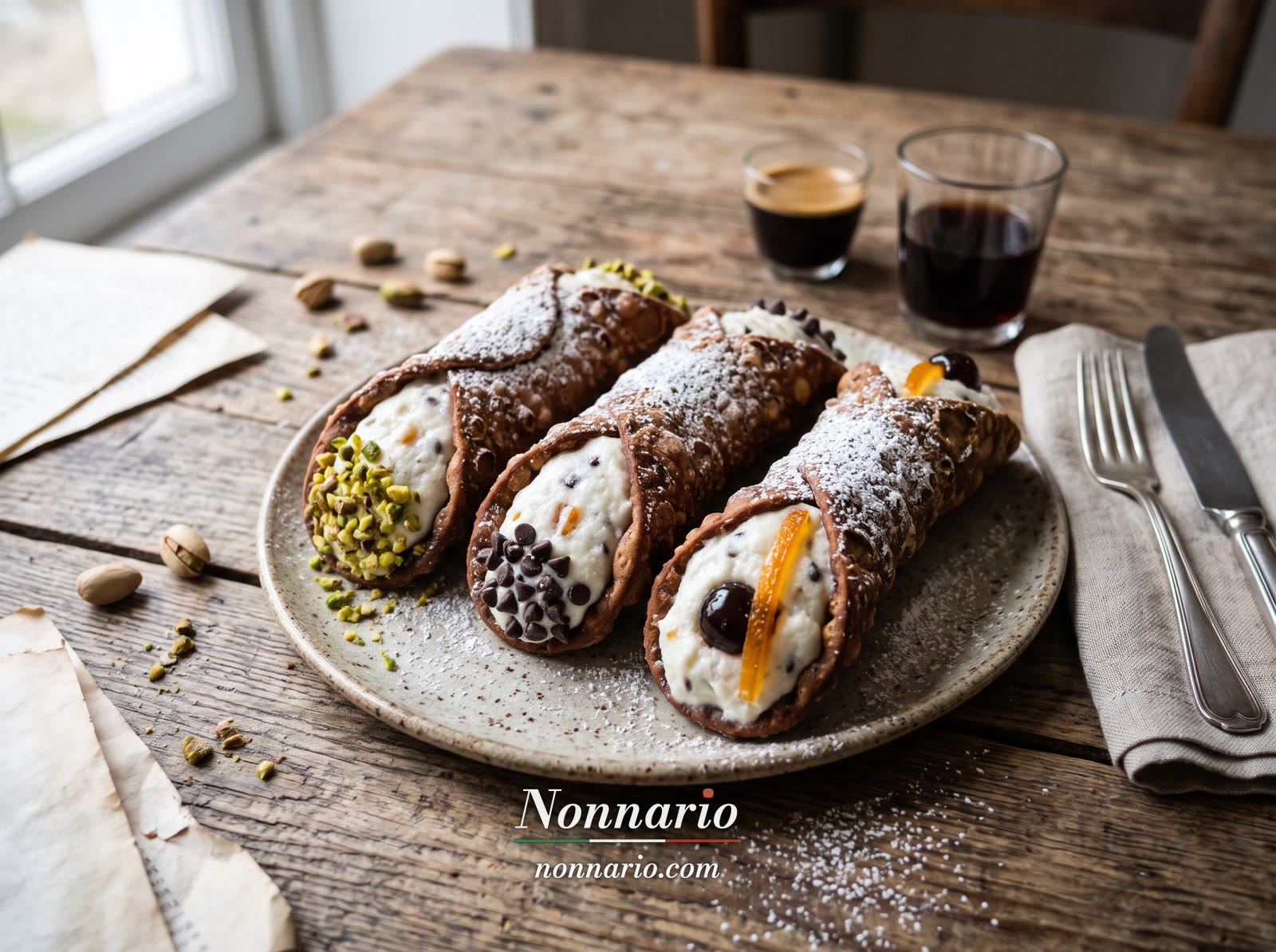
Sicily's fried pastry tubes: a firm dough of flour, lard, a little sugar and cocoa, vinegar or Marsala and white wine, wrapped round tubes and fried deep brown, then filled just before serving with ricotta sieved with sugar and dark chocolate, the ends finished with candied orange or pistachio.
- Course
- DolciDesserts
- Serves
- 12
- Hands-on
- 1 h 37 min
- Cooking
- 15 min
- Plan
- 2 days
The video and the photos of every step are also gathered on a separate page.
In breve
In short
Also called cannolo siciliano, cannolo alla ricotta, cannoli and Sicilian cannoli.
- A very firm dough of flour, a little lard, sugar and cocoa, vinegar or Marsala and white wine, rested 30 minutes and rolled thin.
- Ovals about 15 cm by 12 cm, wrapped loosely along their length round tubes about 3 cm across, the overlap sealed with egg white.
- Fried in plenty of olive oil with a third of lard until deep brown; the tubes come out only when the shells are cold.
- Ricotta and sugar pressed through a fine sieve into a soft cream, with small pieces of dark chocolate stirred in.
- Filled only when served, or the shells soften; the ends finished with candied orange, candied pumpkin or pistachio, and icing sugar.
La provenienza
Where this recipe comes from
Cannoli and cassata are the sweets that define traditional Sicilian pastry. The cannolo is a crisp tube of fried dough filled with sweetened ricotta, and its name comes from the pieces of cane (canna) round which the dough was once wrapped for frying; today the tubes are metal. It began as a Carnival sweet and is now made all year round. Around Trapani it has been a home-made sweet of farming and shepherding families for Carnival and Easter for more than fifty years, and in the Arbëreshë towns of Piana degli Albanesi and Santa Cristina Gela, near Palermo, cannoli were on the Easter and Christmas tables by the late nineteenth century; Piana makes cannoli of unusual size, while Palermo also makes cannulicchi no bigger than a finger. Italy's national list of traditional food products includes cannoli, the cannolo alla ricotta and the cannolo of Piana degli Albanesi, and sheep's-milk ricotta.
There is no official recipe. We compared seven sources and publish the most widely recognised version. They agree on a thin, firm shell of flour, usually with lard, and wine, Marsala or vinegar, fried in lard or oil and left to cool before the tube is drawn out, and a filling of sweetened ricotta, usually sheep's and often sieved, with dark chocolate or candied fruit; most finish the ends with candied orange or pistachio and dust them with icing sugar, and those that say when fill them only just before serving. Some add an egg to the dough, or cocoa, coffee, orange zest or cinnamon; some flavour the ricotta with vanilla, and in Piana degli Albanesi it is sweetened with honey. This version makes the shell of flour, lard, a little sugar and cocoa, vinegar or Marsala and white wine, cut into ovals and fried in olive oil with a third of lard, and fills it with ricotta and sugar pressed through a sieve, with chopped dark chocolate. The recipe it follows gives no frying temperature, sheet thickness or amounts for the wine, the chocolate, the frying fat or the garnish: those are ours, marked as such. Fresh ricotta is perishable, so on this page it stays in the fridge until it is used, and the time filled cannoli spend out of the fridge follows food-safety guidance.
- Provenance
- A regional tradition documented in cookbooks and local practice, with no single official text.
- Defined by
- Sicilian tradition
- Reference
- Compared across 7 sources, listed below; this page publishes the most widely recognised version.
- Sources
- Accademia Italiana della Cucina: cannoli, a Sicilian recipe for 12–15 from its recipe collection (Italian)
- Regione Siciliana, Department of Tourism (Visit Sicily portal): cannoli siciliani, a recipe (Italian)
- Regione Siciliana, Department of Agriculture: the 2021 sheets of Sicily's traditional agri-food products, ‘Cannolo’ and ‘Cannolo tradizionale di Piana degli Albanesi e Santa Cristina Gela’ (archived copy, Italian)
- Ministry of Agriculture (MASAF): the 25th revision of the national list of traditional agri-food products, 2025, with the cannoli of Sicily (Italian)
- GialloZafferano: cannoli siciliani, a recipe for about 30 made for the site by chef Edoardo Dolcimascolo (Italian)
- La Cucina Italiana: cannoli siciliani, a recipe for 15, 2020 (Italian)
- USDA Food Safety and Inspection Service: Leftovers and Food Safety (archived copy of 29 May 2025)
Ingredienti
Ingredients
The original recipe serves 12
For the shells
For the ricotta cream
To fry
To finish
Equipment
- Kitchen scale, measuring spoons and a measuring jug
- A large bowl, a pastry board or worktop, a rolling pin (or a pasta machine) and cling film
- A piece of card cut into an oval 15 cm long and 12 cm wide, as a template, and a small knife or a fluted pastry wheel
- 12–15 cannoli tubes about 3 cm across and at least 15 cm long, and a pastry brush
- A heavy pan about 24 cm across and at least 10 cm deep, a kitchen thermometer that reads to at least 200 °C, kitchen tongs, a slotted spoon and a lid that fits the pan
- A tray lined with kitchen paper
- A fine sieve, a bowl and a spatula, for the ricotta; a fine sieve set over a bowl to drain it, if it is moist
- A piping bag with a plain nozzle about 1.5 cm across, or a teaspoon; a small fine sieve for the icing sugar
Preparazione
Method
Scaled to 12 servings: the amounts in the steps follow. Pot and pan sizes and cooking times are still for the original 12.
If your ricotta is moist, start the day before: it drains overnight in the fridge. On the day allow about 2¾ hours. The dough takes about 15 minutes and rests 30; rolling, cutting and wrapping the shells takes about 30 minutes, heating the fat and frying them about 40, and they need 15–20 minutes to cool before the tubes come out. Make the ricotta cream while the shells cool, about 20 minutes, and keep it in the fridge. Fill and finish the cannoli only when you serve them, about 15 minutes. The recipe makes 12–15 cannoli.
- 1 h 37 minhands-on
- 15 mincooking
- 2 daysfrom start to table
The day before, if the ricotta is moist: drain it
-
Rest 4–12 h
If the ricotta is soft and wet, set it in the fine sieve over a bowl, cover it and leave it in the fridge to drain, overnight if you can. A ricotta that is already firm and dry needs no draining.
Check The ricotta is firm and holds its shape when cut, and no more whey drips into the bowl.
Tip Our guide: at least 4 hours, best overnight (about 12). Throw the whey away.
Tip Our guide, following food-safety guidance: ricotta is perishable. Keep it in the fridge, at 4 °C or colder, until the moment you use it.
The dough
-
Hands-on 3 min
Put the 250 g of flour, the 25 g of lard, the 2 tablespoons of vinegar or Marsala, the 2 teaspoons of sugar, the 2 teaspoons of cocoa and the pinch of salt in the large bowl.
Check Everything in the bowl, the lard rubbed into the flour so that no lumps of it are left.
Tip Our guide: rub the lard into the flour with your fingertips before you add any liquid; it spreads more evenly through the dough.
-
Hands-on 8–10 min
Add the white wine a little at a time and knead, working the dough well, until it is smooth, even and very firm.
Check A smooth, even ball, uniformly brown from the cocoa, that does not stick to your hands and holds the mark of a finger pressed into it.
Tip Our guide: you will usually need about 80 ml of wine. Start in the bowl, then finish on the board, about 8–10 minutes in all. The dough should be very firm, like a stiff pasta dough: add the last of the wine only if dry flour will not come together.
-
Rest 30 min
Wrap the dough and leave it to rest for half an hour.
Check The dough has relaxed: it is supple and no longer springs back when you press it.
Tip Our guide: wrap it in cling film and leave it at room temperature.
The shells
-
Hands-on 10 min
Roll the dough out into a thin sheet.
Check An even sheet about 1.5 mm thick, with no holes, through which the board just shows.
Tip Our guide: about 1.5 mm. Roll half the dough at a time and keep the other half wrapped so it does not dry. A pasta machine, taken down a setting at a time, gives an even sheet.
-
Hands-on 10 min
Cut the sheet into small ovals about 15 cm long and 12 cm wide.
Check 12–15 ovals of the same size, with clean edges.
Tip Our guide: lay the card template on the sheet and cut round it with the knife or the fluted wheel. Press the scraps together, let them rest a few minutes under the cling film and roll them once more.
-
Hands-on 12 min
Lay a tube along the length of each oval, wrap the two sides round it so they overlap, and seal the overlap well with egg white, without pulling the dough tight on the tube.
Check Each shell sits loosely on its tube, the overlap firmly stuck down along its whole length, with no egg white on the metal.
Tip Our guide: beat the egg white lightly with a fork and brush only the edge that goes underneath. On a tube 3 cm across the sides overlap by up to about 2.5 cm in the middle and less towards the ends. Egg white on the metal glues the shell to it, and a shell wrapped tight cannot be slid off.
Tip Our guide: wipe new or uncoated tubes with a very little lard first. If you have fewer tubes than ovals, keep the rest of the ovals under cling film and wrap them only on tubes that are cold again.
Frying
-
Cooking 15 minTemp 175 °CHeat medium, then adjust to hold the temperature
Melt the lard for frying with the olive oil in the heavy pan and heat the fat.
Check The thermometer reads 175 °C, and the fat is not smoking.
Tip Our guide: 175 °C, about 5 cm of fat in a pan 24 cm across and at least 10 cm deep, so it is no more than half full. Hotter darkens the shells before they are crisp; cooler makes them greasy.
Tip Never leave hot fat unattended. Keep the pan no more than half full and a lid within reach, lower the shells in gently, never put water on burning fat, turn the heat off if it smokes, and let the fat cool completely before moving the pan.
-
Hands-on 20–25 minTemp 170 °C–180 °C
Lower the shells, on their tubes, into the fat a few at a time, fully immersed, and fry them until they are a good deep brown.
Check An even, deep brown all over, the surface blistered with small bubbles, firm and crisp when tapped with the tongs.
Tip Our guide: 2 or 3 at a time, for 2–3 minutes, turning them so they colour evenly. Lift them by the end of the tube with the tongs. Keep the fat between 170 °C and 180 °C, and let it come back to 175 °C before the next batch. The cocoa makes them darker than plain fried pastry, so judge by the bubbles and the crispness as well as the colour.
-
Hands-on 1 min
Lift each batch out and drain the shells, still on their tubes, on the tray lined with kitchen paper.
Check No fat dripping from them, and the paper under them no longer wet with it.
Tip Our guide: the tubes are very hot: handle them only with the tongs. When the last batch is out, turn off the heat under the fat.
-
Rest 15–20 min
Leave the shells to cool, then gently remove the tubes once they are cold.
Check The tubes are cold to the touch and slide out, leaving the shells whole.
Tip Our guide: hold the shell lightly in one hand and turn the tube a little as you draw it out. A shell taken off while hot cracks.
The ricotta cream
-
Hands-on 3 min
Take the 500 g of ricotta from the fridge and mix it with the 200 g of sugar.
Check The sugar is spread through the ricotta, with no dry patches.
Tip Our guide: mix with the spatula; an electric whisk or a blender would make the ricotta runny.
-
Hands-on 10 min
Press the ricotta and sugar through the fine sieve into a soft cream.
Check A smooth, soft, glossy cream with no grains of ricotta and little or no grain of sugar left (the rest dissolves as it chills); a spoonful holds its shape.
Tip Our guide: press a little at a time with the spatula and scrape the cream off the underside of the sieve as you go.
-
Hands-on 5 min
Stir the 80 g of dark chocolate, in small pieces, into the cream.
Check The chocolate evenly spread through the cream, with no large lumps.
Tip Our guide: chop the chocolate into pieces of about 3 mm–4 mm, so they pass through the piping nozzle.
-
Cover the cream and keep it in the fridge until you fill the cannoli.
Check The bowl is covered and in the fridge.
Tip Our guide, following food-safety guidance: the cream is perishable. It goes back into the fridge as soon as it is made; the ricotta should have been out of the fridge no more than 2 hours while you made the cream. The time out when you serve is a separate window, given at the finish.
Filling and serving, only when you serve them
-
Hands-on 10 min
Fill the shells with the ricotta cream just before serving.
Check Each shell full from end to end, the cream level with both openings.
Tip Our guide: spoon the cream into the piping bag and fill each shell from one end to the middle, then from the other end. The cream gives about 50 g–65 g for each of 12–15 shells.
Tip Fill only as many as will be eaten at once: within a few hours the shells soften and lose their crunch.
-
Hands-on 5 min
Dust the cannoli with icing sugar and garnish the ends with the candied orange peel (or the candied pumpkin, or the chopped pistachios).
Check A light veil of sugar over each cannolo and both ends finished.
Tip Our guide: sift the icing sugar over through the small sieve, then press a strip of peel, or a pinch of pistachios, into the cream at each end.
Tip Our guide, following food-safety guidance: serve them at once. Filled cannoli stay out of the fridge for 2 hours at most (1 hour above 32 °C), then go back in the fridge or are thrown away, and are never set out again.
The essentials, for cooks who know the dish. Switch to Detailed for quantities, temperatures, times and checks at every step.
Press “I’m here” on the step you are on, and again when it is done.Tap the pin on the step you are on, and the tick when it is done. Timers keep running while you scroll.
Da sapere
Good to know
- WhenQuando
- Once a Carnival sweet, now made all year round. Source
- KeepingConservazione
- Fill them only when you serve them. The ricotta cream keeps for a couple of days in the fridge, and the empty shells for 2–3 days at room temperature, covered with a cloth. Source
- VariantsVarianti
- Cannolo of Piana degli Albanesi: The cannolo of the Arbëreshë towns of Piana degli Albanesi and Santa Cristina Gela. The shell is stone-ground Sicilian soft-wheat flour of the maiorca variety kneaded with Sicilian wine, then lard, rested and rolled 3 mm–5 mm thick; diamonds are cut with the traditional cutter, the tube is laid across the middle and the two shorter ends are overlapped on it and closed. They are fried in a pan of lard that is already very hot: the sheet gives about 250 °C, hotter than lard can safely be heated at home, where it smokes, breaks down and can catch fire; fry at about 175 °C, never smoking, as in the method. They come out brown with a surface of small blisters. The filling is fresh ricotta from the milk of Sicilian sheep, drained of as much whey as possible, sieved and blended with pure honey; flakes of dark chocolate (at least 70% cocoa), cut by hand, go in only just before filling. Each shell takes about 120 g of cream, filled by hand only just before serving, so the shell stays crisp. Source
- With egg and vanilla: The shells: 150 g of type 00 flour, 50 g of sugar, 25 g of lard, 10 g of cocoa, an egg and a tablespoon of Marsala or white wine, kneaded with a little more wine or vinegar until as hard as egg pasta, rested about half an hour under a cloth and rolled thin. Ovals are wrapped round metal tubes, the edges overlapped by a few millimetres and brushed with the egg white left over, lightly beaten, and fried in hot lard or olive oil, then left to dry and cool before the tubes come off. The filling: 500 g of sheep's-milk ricotta pressed through a very fine sieve, with vanilla extract, dark chocolate in flakes and 150 g of sugar; the filled cannoli are finished with candied orange peel and chopped pistachios and dusted with icing sugar. Source
Errori comuni
Common mistakes
- Filling the shells ahead: within a few hours they soften and lose their crunch.
- Using a wet ricotta: the cream runs and soaks the shells. Drain it until firm.
- Beating the ricotta with an electric whisk or a blender: it turns too runny. Press it through a sieve instead.
- Wrapping the dough tight on the tube, or brushing egg white on the metal: the shell sticks and breaks when you try to slide it off.
- Pulling the tubes out while the shells are hot: they crack. Wait until they are cold.
- Frying in smoking fat: the shells darken before they are crisp, and the fat can catch fire.
- Leaving filled cannoli out of the fridge for more than 2 hours: the ricotta is perishable.
Fuori dall'Italia
Cooking it outside Italy
- Plain flour is all-purpose flour in the US.
- Lard is rendered pork fat, sold as manteca in Latin American shops; it is not the same as lardo, which is cured.
- Sheep's-milk ricotta is sold in Italian delis. The recipe asks only for a firm, dry ricotta: whatever the milk, drain it until it holds its shape.
- Marsala is the fortified wine of Sicily; vinegar may replace it, as the recipe allows.
- Cannoli tubes are sold as cannoli forms; look for ones about 3 cm across and at least 15 cm long.
- Candied pumpkin (zuccata) is hard to find outside Sicily: use candied orange peel or chopped pistachios.
- Icing sugar is powdered or confectioners' sugar.
From nonnario.com/recipes/cannoli-siciliani/, where you will find its sources, its story and the step photos. Sources checked in November 2026.