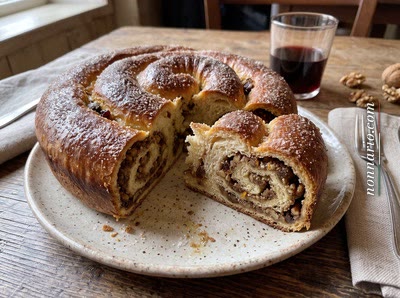
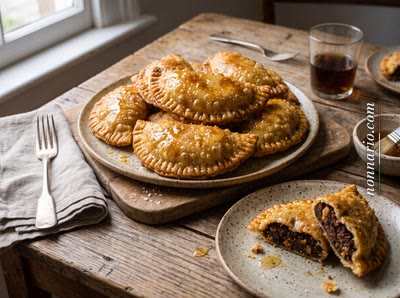
Napoli, Campania
Pastiera napoletana
Neapolitan Easter tart of wheat, ricotta and orange-flower water
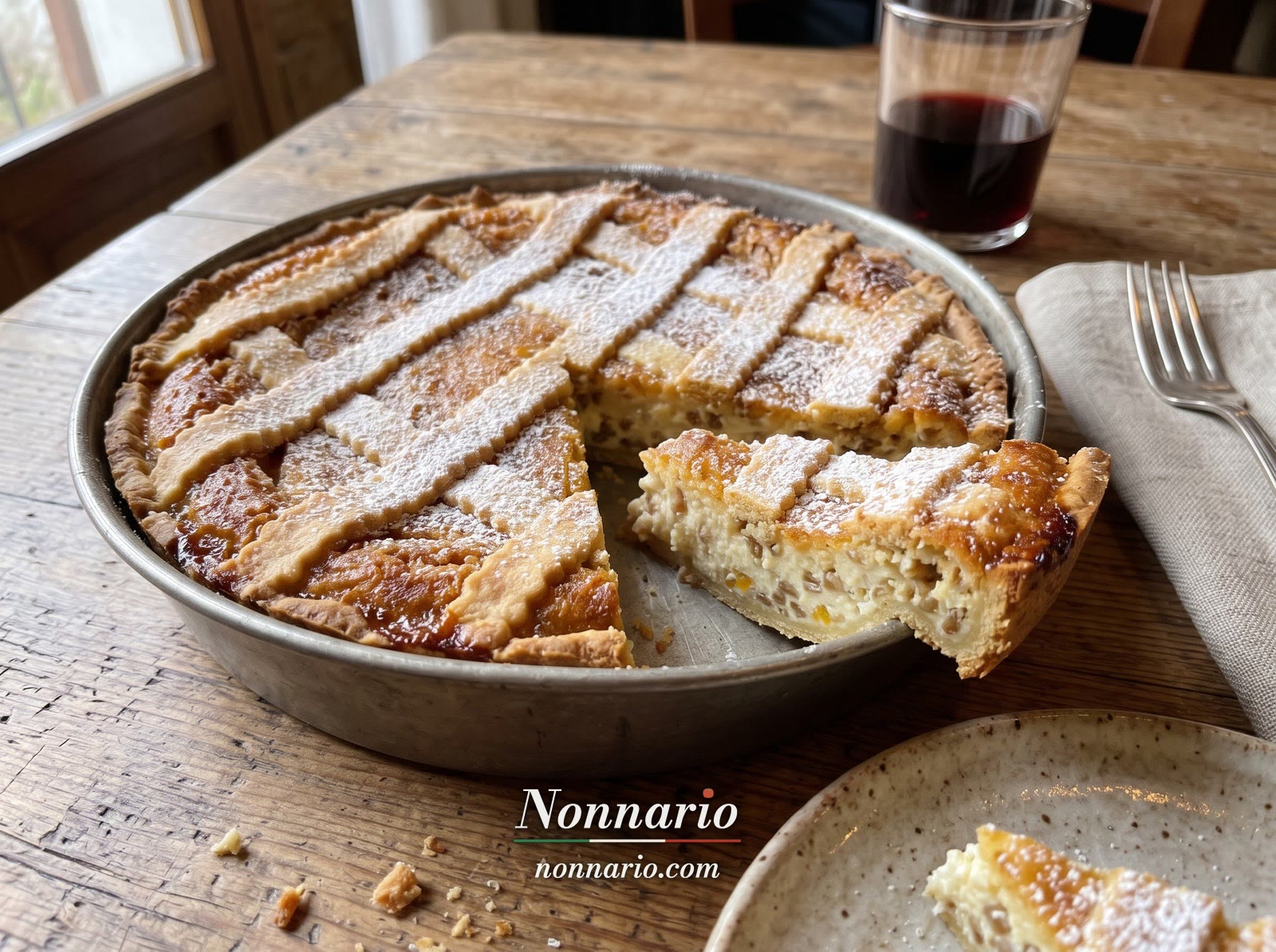
Naples' Easter tart: a lard shortcrust filled with wheat cooked slowly in milk, ricotta, eggs, candied fruit and orange-flower water under a lattice of pastry strips, one of Campania's listed traditional foods.
- Course
- DolciDesserts
- Serves
- 10
- Hands-on
- 1 h 18 min
- Cooking
- 3 h 50 min
- Plan
- 4 days
The video and the photos of every step are also gathered on a separate page.
In breve
In short
Also called pastiera, pastiere, pastiera di grano, Neapolitan Easter pie and Neapolitan wheat and ricotta tart.
- A lard shortcrust filled with wheat cooked in milk, ricotta, sugar, eggs, candied fruit, cinnamon and orange-flower water.
- The wheat is cooked the day before, on low heat for hours, until it is creamy and the grains are soft.
- A lattice of 2 cm pastry strips that leaves lozenges on top; baked slowly at 150 °C until a toothpick comes out dry.
- Baked, cooled and served in its low tin: it is too fragile to turn out.
- Rested at least a night before it is eaten, and dusted with icing sugar.
La provenienza
Where this recipe comes from
Pastiera is the Easter tart of Naples, made in the days before the feast in the low tin pans it is baked, served and even sold in. A legend gives it to the siren Parthenope: the people of the gulf brought her flour, ricotta, eggs, wheat cooked in milk, orange-flower water, spices and sugar, and the gods mixed them into the first pastiera. Its written history begins with the poet Jacopo Sannazaro, who praised the golden colour of pastiere; Antonio Latini, a cook from the Marche who worked in Naples, wrote down a first, mostly savoury recipe in 1692; Vincenzo Corrado described a tart of wheat cooked in broth with lard and orange-flower water in 1773; and Ippolito Cavalcanti's cookbook in Neapolitan dialect of 1837 settled the balance of its ingredients. Tradition credits today's version to the nuns of the convent of San Gregorio Armeno. Campania lists it among its traditional food products.
There is no official recipe, and every family keeps its own proportions. We compared six sources and publish the most widely recognised version. They agree on a shortcrust made with lard, wheat cooked in milk, ricotta, eggs, orange-flower water and candied fruit, a lattice of strips that leaves lozenges, and icing sugar once it has cooled; they differ on whole or separated eggs, on lard in the filling and on the oven, from 150 °C to 180 °C. By custom, still followed across Italy, it is baked by Holy Thursday or Good Friday and eaten on Easter Sunday, resting for days at room temperature. (Because it is made with ricotta, eggs and milk, the food-safety reference we follow recommends putting it in the fridge within 2 hours of baking and eating it within 3 days of cooking the wheat; the plan gives the days for both.)
- Provenance
- A regional tradition documented in cookbooks and local practice, with no single official text.
- Defined by
- Neapolitan tradition
- Reference
- Compared across 6 sources, listed below; this page publishes the most widely recognised version.
- Sources
- Accademia Italiana della Cucina: pastiera as made in Naples, from its recipe collection (Italian)
- Regione Campania, Assessorato Agricoltura: the pastiera among Campania's traditional food products (PAT) (Italian)
- Accademia Italiana della Cucina: a history of the pastiera by Giancarlo Saran, Civiltà della Tavola no. 349, June 2022 (Italian)
- Il Cucchiaio d'Argento: pastiera napoletana, a recipe for 8–10 (Italian)
- La Cucina Italiana: pastiera napoletana, a recipe for 10 (Italian)
- USDA Food Safety and Inspection Service: Leftovers and Food Safety (archived copy of 29 May 2025)
Ingredienti
Ingredients
Makes one pastiera in a tin 28 cm across and 4 cm deep, for 10: 10 servings
For the pastry
For the wheat
For the filling
To finish
Equipment
- Heavy-based saucepan of about 2 l, with a lid, and a wooden spoon
- Shallow container with a lid, for cooling the wheat
- Large bowl, a sieve and a flexible spatula, for the filling
- Clean bowl and an electric whisk, for the egg whites
- Rolling pin, greaseproof paper, a ruler and a sharp knife
- A ruoto: a very low iron or tinned-steel pastry tin 28 cm across and 4 cm deep (or a loose-bottomed tin of the same size)
- A wooden toothpick or skewer, and a wire rack
- Fine sieve, for the icing sugar
Preparazione
Method
Two days of work, then three or more days of rest. The day before: 2–3 hours of slow cooking for the wheat, mostly unattended, then cool it and put it in the fridge overnight. On baking day: about 15 minutes for the pastry and an hour's rest in the fridge, about an hour to make the filling, line the tin and lay the lattice, 1½–2 hours in the oven and 1½–2 hours of cooling; then it rests, wrapped, at room temperature for three or more days, and improves. By custom it is baked by Holy Thursday or Good Friday and eaten on Easter Sunday. (The food-safety reference we follow recommends putting it in the fridge within 2 hours of baking and eating it within 3 days of cooking the wheat: for Easter Sunday, cook the wheat on Holy Thursday and bake it on Good Friday.) If you can buy only dry wheat berries, begin three days before the wheat is cooked: soak about 160 g in plenty of cold water, in a cool place, for 72 hours, changing the water twice a day, and weigh out 230 g once soaked.
- 1 h 18 minhands-on
- 3 h 50 mincooking
- 4 daysfrom start to table
The day before: the wheat
-
Hands-on 3 min
Weigh 230 g of soaked wheat, rinse it in a sieve under cold water and drain it.
Check The grains are plump and whole, with no sour smell.
Tip These quantities are for soaked raw wheat. Dry wheat berries must be soaked first, for 72 hours (see the plan). Jarred cooked wheat is not a like-for-like swap for these amounts.
-
Hands-on 8–10 minHeat medium-low
Put the wheat in the saucepan with the 600 ml of milk, the 2 knobs of lard, 1½ tablespoons of sugar, 1½ sachets of vanillin and the peel of half an orange. Bring it slowly to a simmer over medium-low heat, stirring.
Check Small bubbles break at the edge of the pan; the lard has melted.
-
Cooking 2–3 hHeat lowest, lid ajar
Turn the heat to the lowest setting, set the lid ajar and cook for 2–3 hours, stirring every 10–15 minutes and scraping the bottom, until the mixture is creamy and the grains are soft.
Check A grain pressed between two fingers squashes easily, with no hard core; the milk has almost all been absorbed into a thick cream that coats the spoon.
Tip The milk catches easily on the bottom: if you smell scorching, do not scrape the burnt layer into the rest; move the wheat to a clean pan and go on more gently.
Tip If the milk is going fast, close the lid. If it has all been absorbed before the grains are soft, add a few spoonfuls of hot milk at a time and go on cooking until they are.
-
Rest 8 hTemp 4 °C
Take out the orange peel. Spread the wheat in the shallow container and let it cool, then cover it and put it in the fridge within 2 hours of taking it off the heat. Leave it there until the next day.
Check Cold right through and set into a thick cream.
Tip A shallow layer, no more than about 5 cm deep, cools quickly enough to be in the fridge inside the 2 hours.
Baking day: the pastry
-
Hands-on 10 min
Rub the 400 g of flour, the 200 g of sugar and the 200 g of lard together with your fingertips until they look like coarse crumbs. Add the grated lemon zest and the 4 yolks and gather it all quickly into a ball, without kneading more than needed.
Check A smooth, firm dough with no dry flour left in the bowl; it holds together when pressed.
Tip Keep the whites in a covered bowl in the fridge: 3 of them go into the filling.
Tip The dough is short and rather dry. If it will not hold together at all, work in a teaspoon or two of cold water, no more.
Tip Overworking warms the lard and makes the pastry tough: stop as soon as it comes together.
-
Rest 1 hTemp 4 °C
Flatten the ball into a disc, wrap it in cling film and leave it in the fridge for at least 1 hour.
Check Firm and cool, but it still yields to a fingertip.
Tip Leave the wheat in the fridge meanwhile: it comes out only when it goes into the filling.
-
Hands-on 5 min
Cut the 100 g of candied fruit into small pieces, about 5 mm.
Check Small, even pieces, none stuck together in clumps.
The filling
-
Cooking 20 minTemp 150 °C
Heat the oven to 150 °C, conventional (no fan), with a shelf in the middle.
Tip An oven thermometer is worth it: the low, even heat is what sets the filling without splitting it.
-
Hands-on 5 min
Push the 320 g of ricotta through the sieve into the large bowl and work it with the 230 g of sugar until smooth and creamy.
Check No lumps of ricotta; the cream is soft and glossy.
Tip If the ricotta is watery, drain it in a sieve in the fridge for a few hours first: a wet ricotta makes a loose filling.
-
Hands-on 3 min
Add the 4 yolks one at a time, mixing each in completely before the next.
Check Smooth and evenly yellow, with no streaks.
-
Hands-on 1 min
Mix in one vial of orange-flower water and the cinnamon.
Check The scent of orange flowers is clear when you smell the bowl.
-
Hands-on 3 min
Add the cold wheat and the diced candied fruit and mix well.
Check The wheat is spread evenly through the cream, with no firm lumps of it left.
Tip Break up the cold wheat with the spatula as you mix: it sets firm in the fridge.
Lining the tin
-
Hands-on 2 min
Grease the ruoto, base and sides, with a little lard.
Check A thin, even film everywhere, into the corner.
-
Hands-on 8 min
Cut off two thirds of the pastry and roll it out between two sheets of greaseproof paper to about 2 mm thick, into a disc about 38 cm across. Keep the other third in the fridge.
Check Even all over, about 2 mm, and wide enough to cover the base and the sides of the tin.
Tip If it cracks or sticks, it is too cold or too warm: let it soften a few minutes, or chill it for 10 minutes, and go on.
-
Hands-on 5 min
Peel off the top sheet, turn the pastry into the tin, peel off the second sheet and press the pastry gently into the corner and up the sides. Trim it level with the rim and add the trimmings to the pastry kept for the strips.
Check No holes or thin patches; the pastry reaches the rim all round.
Tip Patch any tear with a scrap of pastry pressed well in: the filling is loose and finds every gap.
The whites and the lattice
-
Hands-on 4 min
Whip the 3 egg whites in the clean bowl to stiff peaks.
Check The peaks stand up straight when the whisk is lifted, and the whites do not slide when the bowl is tipped.
Tip Bowl and whisk must be clean and dry, with no trace of yolk or fat, or the whites will not stiffen.
-
Hands-on 3 min
Fold the whites into the filling with the spatula, turning it over from the bottom upwards. When it is all combined, smell it: if the orange-flower scent is faint, add the second vial.
Check No streaks of white left; the filling is light and soft, and smells clearly of orange flowers.
Tip Be generous rather than mean: part of the scent fades in the oven.
-
Hands-on 2 min
Pour the filling into the lined tin and level the top with the spatula.
Check A flat surface, with the filling a little below the rim of the pastry.
-
Hands-on 5 min
On a sheet of greaseproof paper, roll the remaining pastry into a rectangle as long as the tin is wide, 28 cm, about 3 mm thick. With a knife, mark it along its length into strips 2 cm wide.
Check At least six strips, each 2 cm wide and 28 cm long.
-
Hands-on 2 min
Cut along the marks right through the paper, so that each strip of pastry lies on its own strip of paper.
Check Each strip lifts cleanly on its paper without breaking.
-
Hands-on 1 min
Lift one strip, turn it over, pastry side down, and lay it across the centre of the tart, where it is widest. Peel the paper off gently.
Check The strip lies straight across the middle, unbroken.
Tip Peel the paper back low and slowly along the strip, holding the pastry down with a finger.
-
Hands-on 2 min
Lay a second and a third strip the same way, parallel to the first, one on each side of it, 3 cm away.
Check Three parallel strips with even 3 cm gaps.
-
Hands-on 3 min
Lay three more strips the same way across the first three, at a slant, the central one first, so that the lattice leaves lozenges of filling uncovered. Trim the ends level with the rim and press them on to the edge of the pastry case.
Check A lattice of six strips with diamond-shaped gaps, every end sealed to the rim.
Baking
-
Cooking 1 h 30 min to 2 hTemp 150 °C
Bake on the middle shelf at 150 °C until a toothpick pushed into the filling comes out dry and the pastry is golden, about 1½–2 hours.
Check A toothpick pushed into the filling between the strips comes out dry; the strips and the rim are an even golden colour; the filling has set and trembles only slightly when the tin is nudged.
Tip Test first at 1½ hours, then every 10 minutes.
Tip If the pastry colours well before the filling is set, lay a sheet of foil loosely over the top.
Cooling, resting and serving
-
Rest 1 h 30 min to 2 h
Set the tin on the wire rack and leave the pastiera to cool at room temperature. Do not try to turn it out.
Check The tin is no longer warm to the touch.
Tip It is fragile and is served from its tin: turned out, it would break.
-
Rest 3 days
Wrap the pastiera, still in its tin, and leave it at room temperature for three or more days: it improves as it rests. By custom it is baked by Holy Thursday or Good Friday and eaten on Easter Sunday. (The food-safety reference we follow recommends putting it in the fridge, wrapped, within 2 hours of taking it out of the oven, and eating it within 3 days of cooking the wheat, the day before baking included: for Easter Sunday, cook the wheat on Holy Thursday and bake it on Good Friday.)
Check Firm right through; the flavours have blended.
Tip Kept in the fridge, it needs at least a night there for the flavours to blend.
-
Hands-on 3 min
Just before the pastiera goes to the table, sift icing sugar over the top, then cut it in its tin into 10 slices.
Check The sugar sits white on the lattice.
Tip If it has been in the fridge, take it out about an hour before serving, and put what is left back in the fridge, covered, no more than 2 hours after you took it out (about an hour after serving).
The essentials, for cooks who know the dish. Switch to Detailed for quantities, temperatures, times and checks at every step.
Press “I’m here” on the step you are on, and again when it is done.Tap the pin on the step you are on, and the tick when it is done. Timers keep running while you scroll.
Da sapere
Good to know
- WhenQuando
- Easter. It is made a few days ahead, no later than Holy Thursday or Good Friday, so that it rests and its flavours blend. Source
- KeepingConservazione
- Wrapped, at room temperature, it improves over three or more days. (The food-safety reference we follow recommends the fridge within 2 hours of baking, wrapped, and eating it within 3 days of cooking the wheat, the day before baking included: for Easter Sunday, the wheat on Holy Thursday and the bake on Good Friday.) Source
- VariantsVarianti
- Pastiera di riso (pastiero): Made with rice in place of the wheat, in the province of Salerno. Source
- Pastiera salata: A savoury pastiera with cured meats and cheese, an old version kept in the province of Caserta. Source
- Pastiera di ferellini: Made with ferellini, thin capellini of long pasta, at Torre del Greco. Source
- With a smooth filling: The filling blended to a smooth cream instead of keeping the whole grains and the pieces of candied fruit. Source
Errori comuni
Common mistakes
- Hurrying the wheat: it needs hours on the lowest heat to turn creamy, and grains that are hard in the pan stay hard in the tart.
- Adding warm wheat to the filling: cook it the day before and use it cold.
- Stirring the whipped whites in hard: fold them from the bottom up, or the filling loses its lightness.
- A hot oven: at 150 °C the filling sets slowly and stays moist; a hot oven splits it and browns the pastry before the centre is done.
- Turning it out of the tin: it breaks. Bake it, cool it and serve it in the same tin.
- Serving it the day it is baked: it needs to rest so that its flavours blend. By custom it is baked by Holy Thursday or Good Friday for Easter Sunday, and it improves over three or more days, wrapped, at room temperature. (The food-safety reference we follow recommends the fridge within 2 hours of baking, and eating it within 3 days of cooking the wheat.)
Fuori dall'Italia
Cooking it outside Italy
- Grano bagnato is raw wheat already soaked, sold in Naples before Easter, and this page's quantities are for it. Where only dry wheat berries are sold, soak them first for 72 hours (see the plan). Jarred cooked wheat (grano cotto) is not a like-for-like swap for these amounts.
- Strutto is pure rendered pork lard; in the UK and the US, buy plain lard.
- Italian orange-flower water often comes in small vials (fialette). With bottled orange-flower water, whose strength varies, add it a teaspoon at a time and smell the filling as the recipe says.
- Vanillin comes in small Italian sachets; outside Italy, the seeds of a vanilla pod are used in pastiera too: about half a pod.
- Without a ruoto, use a loose-bottomed tart tin or a springform 28 cm across, filled only to 4 cm deep, and serve it on the tin's base.
From nonnario.com/recipes/pastiera-napoletana/, where you will find its sources, its story and the step photos. Sources checked in November 2026.