Napoli, Campania
Spaghetti alle vongole
Neapolitan spaghetti with clams, without tomato
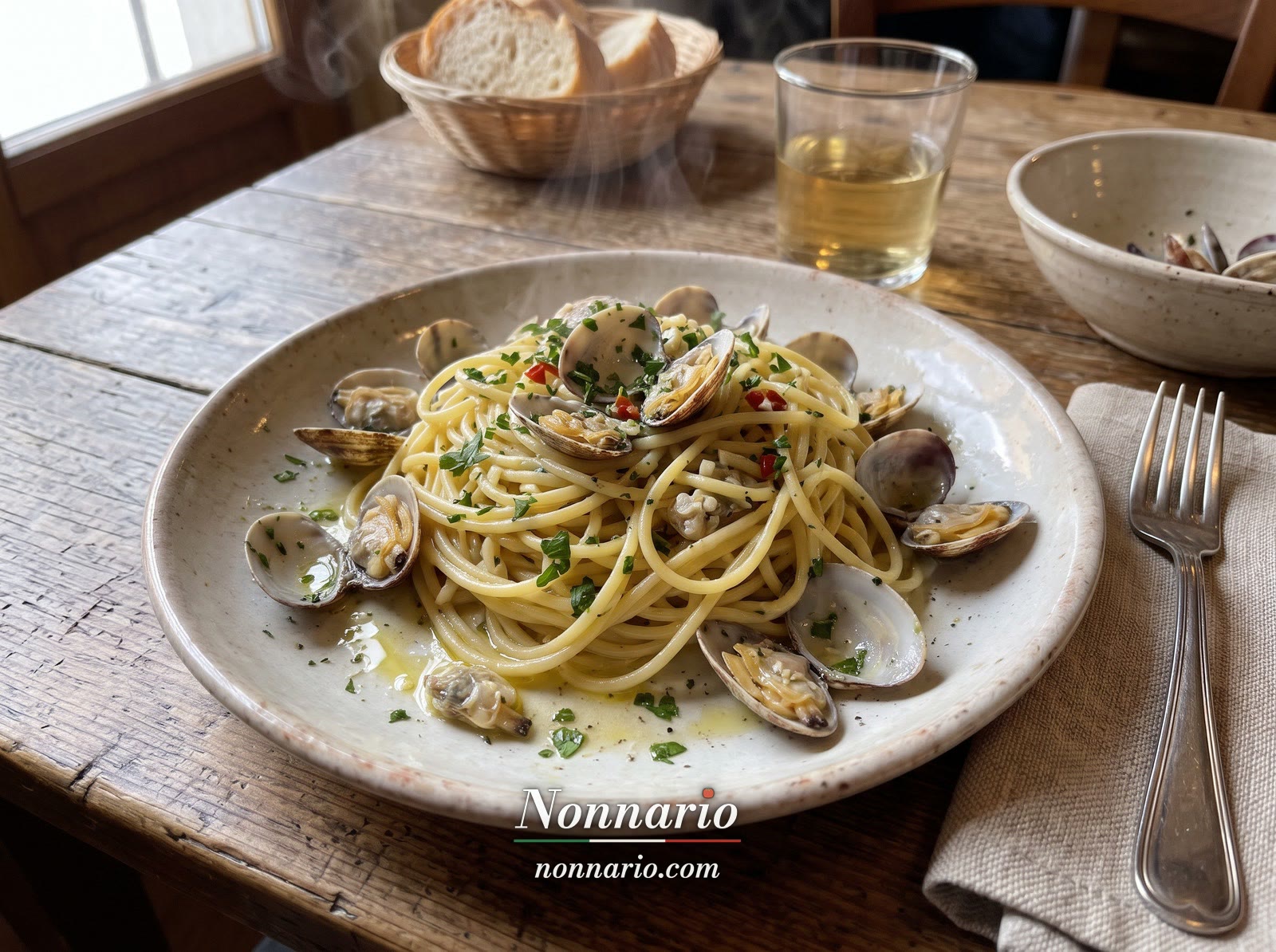
Spaghetti finished in the pan with live clams opened in their own liquid, olive oil in which garlic was browned and then lifted out, parsley and black pepper: the Neapolitan version in bianco, without tomato.
- Course
- Primi & RisottiPasta & Rice
- Serves
- 4
- Hands-on
- 38 min
- Cooking
- 28 min
- Resting
- 2 h+
In breve
In short
Also called spaghetti con le vongole, spaghetti alle vongole in bianco, spaghetti with clams and Neapolitan clam spaghetti.
- Live clams, spaghetti, extra virgin olive oil, garlic, parsley and black pepper; made in bianco, with no tomato.
- Broken clams, and open ones that do not close when tapped, are thrown away; the rest are purged of sand in cold salted water.
- The clams open in a covered pan over a high heat, and their liquid, filtered through a fine cloth, becomes the sauce.
- The garlic is browned in the oil and lifted out; the clams and their liquid go in for a single boil.
- The spaghetti are drained very al dente and finished in the pan, with parsley and pepper at the end.
La provenienza
Where this recipe comes from
Pasta with clams was already in print in Naples in 1847: the fifth edition of Ippolito Cavalcanti's Cucina teorico-pratica, printed there that year, cooks tagliarelli in the strained broth of the clams with oil, lard or butter, pepper and parsley, and vermicelli in a tomato purée made with the clams' water; its section in Neapolitan dialect sets 'tagliariell' e boncole', with clams, parsley and good oil, on the menu for Holy Thursday. Today the dish is made both with tomato and without, in bianco, which is the version on this page, and in Campania it is a fixture of the Christmas Eve dinner.
Spaghetti alle vongole has no official recipe. We compared four serious recipes and publish the most widely recognised version, the Neapolitan one in bianco, with its quantities and method from one of them. They agree on what matters: the clams cleaned of their sand, opened in a wide pan (covered over a high heat in most of them), their liquid filtered, garlic browned in olive oil, parsley and pepper, and the spaghetti drained al dente and finished with the clams. They differ on white wine, on whether the clams stay in their shells, and on how the clams are purged. Ours are the handling of the clams: how to buy and sort them, purging in cold salted water in the fridge, and five more minutes over the heat once they have opened, which Italian public-health guidance advises for bivalves; the clams come out a little firmer, and safer.
- Provenance
- A regional tradition documented in cookbooks and local practice, with no single official text.
- Defined by
- Neapolitan tradition
- Reference
- Compared across 9 sources, listed below; this page publishes the most widely recognised version.
- Sources
- Accademia Italiana della Cucina: spaghetti con le vongole all'uso di Napoli, from its recipe collection, with the version in bianco, for 4 (Italian)
- Giallo Zafferano: spaghetti alle vongole, its house recipe, on a page sponsored by a pasta maker (Italian)
- La Cucina Italiana: spaghetti alle vongole, the magazine's recipe, 22 April 2018 (Italian)
- Gambero Rosso: spaghetti alle vongole, its recipe (Italian; archived copy)
- Gambero Rosso: spaghetti alle vongole fujute, an article on the Neapolitan dish made without clams, 20 September 2025 (Italian; archived copy)
- Ippolito Cavalcanti: Cucina teorico-pratica, fifth edition, Naples 1847, the Wellcome Library copy at the Internet Archive (Italian and Neapolitan)
- Istituto Zooprofilattico Sperimentale delle Venezie: Molluschi bivalvi, frutti del nostro mare, a public-health leaflet on buying, keeping and cooking bivalves, 2nd edition 2020 (Italian)
- US Food and Drug Administration: Selecting and Serving Fresh and Frozen Seafood Safely, on buying, storing and cooking live clams
- USDA Food Safety and Inspection Service: Leftovers and Food Safety, on cooling, keeping and reheating cooked food (archived copy)
Ingredienti
Ingredients
The original recipe serves 4
For the clams
For the pasta and the sauce
Equipment
- A large bowl that holds the clams and about 2 l of water, ideally with a colander that sits inside it, and a clean damp cloth
- A fridge thermometer, to be sure the fridge is at 4 °C or below
- A wide frying pan or sauté pan about 30 cm across, with a lid that fits
- A slotted spoon, a bowl for the opened clams and a jug for their liquid
- A fine sieve lined with a piece of muslin (cheesecloth) or a double sheet of kitchen paper
- A large pot of about 6 l with a lid, tongs and a mug for pasta water
- A kitchen scale and a measuring jug
Preparazione
Method
Scaled to 4 servings: the amounts in the steps follow. Pot and pan sizes and cooking times are still for the original 4.
Start about 2¾–4 hours before you eat: sorting and salting take about 15 minutes, then the clams purge of their sand for 2–3 hours in cold salted water in the fridge, and they stay in the fridge from the moment you bring them home until they go into the pan. Buy them no more than 2 days ahead. When they come out of the purge, put the pasta water on: the clams open, cook on and are filtered while it heats, and the sauce is made while the spaghetti cook, about 30–35 minutes from water on to table. The dish is eaten as soon as it is made.
- 38 minhands-on
- 28 mincooking
- 2 hresting, at least
Buying and keeping the clams
The quantities and the method follow one recipe whole. The handling of the clams, the sizes, heat levels, times, checks and tips marked ‘Our guide’ are ours, after the public food-safety guidance listed in the sources.
-
Hands-on 5 min
Buy 1 kg of live clams from a fishmonger or a supermarket, in a sealed net or tray with its label, or loose from a labelled pack. Buy them no more than 2 days before you cook them.
Check The shells are closed and whole, the clams resist when you try to open one, they smell lightly of the sea, and the label gives the packing centre and the packing date.
Tip Our guide: leave clams that are sitting in water at the counter, or that have no label: live clams must never be kept in water for sale, and a seller of loose clams keeps the label of the pack they came from, so ask to see it.
Tip Our guide: in Italy vongole veraci may not be sold under 2.5 cm along their longest side.
-
Hands-on 2 min
At home, put the clams straight into the fridge, at 4 °C or below, in their net or in an open bowl covered with a damp cloth, until you purge them.
Check The fridge thermometer reads 4 °C or below and the clams are in the fridge within a few minutes of coming home.
Tip Our guide: never close them in a sealed bag or leave them in a bowl of tap water: live clams need air, and fresh water kills them.
Tip Our guide: on a hot day, carry them home in a cool bag; perishable food should never be out of the fridge for more than 2 hours (1 hour above 32 °C).
Purging the sand, 2–3 hours ahead
Purging lets the clams breathe out the sand they carry. They purge in the fridge, so they stay cold until they are cooked.
-
Hands-on 5–8 min
Tip the clams into the empty bowl and go through them one by one. Throw away any with a cracked or broken shell. Tap any open clam against the board or another clam: if it does not close within about a minute, throw it away. Then tap each closed clam firmly on the board: a shell full of sand falls open, and goes too.
Check Only whole clams are left, all of them closed or closing when tapped.
Tip Our guide: a clam that stays open when tapped is dead and must not be cooked.
Tip Our guide: wash your hands, the board and the sink with soap and hot water after handling the raw clams.
-
Hands-on 3 min
Stir 70 g of coarse salt into 2 l of cold water, 35 g per litre, until it has dissolved. Set a colander in the bowl, put the clams in it and pour the salted water over them.
Check The salt has dissolved completely and the clams are covered by about 2 cm of water.
Tip Our guide: 35 g per litre is about the saltiness of the sea. Use cold water, never lukewarm.
Tip Our guide: the colander keeps the clams above the sand they release, so they do not take it in again.
-
Rest 1 h
Put the bowl in the fridge, uncovered or loosely covered with the damp cloth, and leave the clams to purge for 1 hour.
Check The bowl is in the fridge at 4 °C or below. After the hour there may be sand on the bottom and some clams slightly open with their siphons out; if there is little or no sand and the clams stay shut in the cold, that is normal: carry on.
Tip Our guide: purging in the fridge keeps the clams within the cold chain; left out at room temperature for 2–3 hours, they would pass the 2 hours that seafood may spend out of the fridge.
-
Hands-on 3 min
Lift the colander out of the bowl, pour away the water and sand, rinse the bowl and fill it with fresh salted water in the same way: 70 g of coarse salt in 2 l of cold water. Put the clams back in.
Check Fresh, clear salted water covers the clams.
-
Rest 1–2 h
Put the bowl back in the fridge for 1–2 hours more, 2–3 hours in all.
Check Little or no new sand on the bottom of the bowl at the end.
-
Hands-on 3 min
Lift the clams out of the water by hand, or in the colander, leaving the sand behind, and rinse them well under cold running water, rubbing the shells together. Tap any that have opened: throw away any that do not close.
Check The shells are clean, with no grit on them, and every clam is closed or closes when tapped.
Tip Our guide: never tip the clams and their water into a colander together: the sand pours over them again.
Tip Our guide: cook them at once; if you must wait, put them back in the fridge, under the damp cloth, not in water.
Opening the clams
-
Cooking 15–20 min
Bring 4 l of water to the boil in the large pot, covered.
Check A full, rolling boil. If it is ready before the clams are, turn it down and let it wait.
-
Hands-on 3 min
While the water heats, pick the leaves from the parsley and chop them finely.
Check A small heap of finely chopped green leaves, with no stalks.
-
Hands-on 3–6 minHeat high
Put the clams in the wide pan with 1 tablespoon of oil, cover, and cook over a high heat, shaking the pan now and then, until the clams open and no more are opening.
Check Nearly all the shells have opened, there is liquid bubbling in the pan, and no new clam has opened for about a minute.
Tip Our guide: keep the lid on: the steam opens the clams. Shake the pan by its handle with the lid held down.
-
Hands-on 1 min
Take the pan off the heat for a moment, lift the lid and pick out with tongs every clam that is still shut, and throw it away. Put the lid back at once.
Check Only open clams are left in the pan.
Tip Our guide: never force a shut clam open: it is not safe to eat.
Tip Our guide: this is why the shut clams go now: the next 5 minutes count from when the shells opened, so a clam that opened only later would not have had them.
-
Cooking 5 minHeat medium
Put the pan back over a medium heat and keep the clams cooking, covered, for 5 minutes, shaking the pan once or twice.
Check 5 minutes have passed since the last clams opened, and the liquid is still bubbling under the lid.
Tip Our guide: this step is ours, for safety. Italian public-health guidance for bivalves holds that 5 minutes of cooking from the moment the shells open guards against any microbiological hazard, including germs that routine checks on clams do not yet look for. Many cooks take clams off the heat the moment they open, which leaves them more tender; with the 5 minutes they are a little firmer.
Tip Our guide: lemon or vinegar does not make undercooked clams safe.
-
Hands-on 3–4 min
Take the pan off the heat and lift the clams out with the slotted spoon into the bowl, throwing away any that smells unpleasant. Pour the liquid left in the pan slowly through the sieve lined with muslin or kitchen paper into the jug, leaving the last spoonful, where any grit settles, in the pan. Cover the clams with a plate and keep them and their liquid beside the hob. Wipe the pan clean.
Check The liquid in the jug is clear, with no grains of sand at the bottom.
Tip Our guide: if a few clams still have grit inside, rinse them quickly in some of the filtered liquid, then pour it back through the sieve.
The spaghetti and the sauce
-
Cooking 8–10 min
Salt the boiling water lightly, about 5 g per litre, add the 400 g of spaghetti and stir. Cook them very al dente, about 2 minutes short of the packet time, since they finish in the pan. Before draining, keep back a mug of the pasta water.
Check Bite a strand: still firm, with a thin white thread at the centre.
Tip Our guide: salt the water only lightly: the clam liquid is salty.
-
Hands-on 2–3 minHeat medium-low
When the spaghetti have about 5 minutes left, put the 100 ml of oil and the 2 lightly crushed garlic cloves in the wiped wide pan over a medium-low heat and let the garlic colour slowly, then lift it out and throw it away.
Check The garlic is pale gold and the oil smells of it; the garlic is out of the pan.
Tip Our guide: take it out as soon as it is golden: dark garlic makes the oil bitter.
Tip Our guide: the wide pan lets you toss the spaghetti in the sauce.
-
Hands-on 1–2 minHeat high
Pour the filtered liquid into the oil, standing back, add the clams, turn the heat up to high and bring it just to the boil once, then turn off the heat until the spaghetti are ready. Taste the liquid: add salt only if it needs it.
Check The liquid has come to the boil and the clams are hot.
Tip Our guide: the liquid spits when it meets the hot oil: pour it in slowly, holding the jug low.
Tip Our guide: it rarely needs salt.
Bringing it together
-
Hands-on 2 minHeat medium-low
Lift the spaghetti out of the pot with the tongs straight into the pan, set it over a medium-low heat and toss them with the clams and their liquid for about 2 minutes, until they have taken up most of the liquid and finished cooking.
Check The spaghetti are tender with a slight bite, glossy, and a little liquid still coats the bottom of the pan.
Tip Our guide: if the pan looks dry before the spaghetti are done, add a splash of the pasta water you kept.
-
Hands-on 2 min
Off the heat, scatter over the chopped parsley, grind over black pepper, toss once more and serve at once, very hot, sharing out the clams.
Check Every plate has spaghetti glossy with the sauce, clams in their shells and flecks of parsley.
Tip Our guide: put a bowl on the table for the empty shells.
The essentials, for cooks who know the dish. Switch to Detailed for quantities, temperatures, times and checks at every step.
Press “I’m here” on the step you are on, and again when it is done.Tap the pin on the step you are on, and the tick when it is done. Timers keep running while you scroll.
Da sapere
Good to know
- WhenQuando
- In Campania a Christmas Eve dinner is not complete without spaghetti alle vongole. Source
- KeepingConservazione
- Eat it as soon as it is made. Leftovers go into the fridge in a shallow closed container within 2 hours of cooking and keep for a day at most; reheat them until piping hot right through (75 °C). Source
- VariantsVarianti
- With tomato: The garlic browned in the oil, then peeled tomatoes, seeded and cut in pieces, salted and cooked with the filtered clam liquid; the clams go in at the last moment, only to come back to the boil, and the spaghetti, drained very al dente, finish in the sauce. Source
- With telline: About 400 g of shelled telline, small wedge clams, added to the version in bianco for more flavour. Source
- With white wine: A splash of dry white wine added to the garlic oil with the clam liquid, before the clams go back in. Source
- With chilli: A chopped chilli added to the garlic as it browns, for heat. Source
- With shelled clams: The clams taken out of their shells once open, all but a dozen kept whole to garnish, and seasoned with plenty of pepper in the filtered liquid; the spaghetti, drained very al dente, finish cooking in it over the lowest heat for a couple of minutes. Source
- Spaghetti alle vongole fujute: The clams that ‘ran away’: a Neapolitan dish with no clams at all, only their memory. Garlic is browned slowly in olive oil, chopped fresh parsley and sometimes a pinch of chilli go in, and the spaghetti, drained al dente, are tossed hard in it. Some older versions used lard instead of oil and finished it with Parmigiano. It owes its fame to the actor and playwright Eduardo De Filippo. Source
Errori comuni
Common mistakes
- Cooking a clam that is broken, or open and does not close when tapped: throw it away before cooking.
- Eating a clam that stayed shut after cooking: throw it away, and never force it open.
- Purging in lukewarm water at room temperature: purge in cold water with 35 g of salt per litre, in the fridge.
- Tipping the purged clams and their water into a colander: the sand goes back over them. Lift them out.
- Skipping the filter: the clam liquid carries grit, so pass it through a fine cloth.
- Salting the pasta water heavily or the sauce before tasting it: the clam liquid is salty.
- Cooking the spaghetti through in the pot: drain them very al dente so they finish in the pan with the clams.
- Letting the garlic go dark: it makes the oil bitter.
Fuori dall'Italia
Cooking it outside Italy
- Vongole veraci are carpet-shell clams. Wherever you buy clams, buy them alive and with their label, never already open.
- Italian parsley is the flat-leaf kind.
- An Italian kitchen glass holds about 200 ml, so half a glass of oil is about 100 ml.
From nonnario.com/recipes/spaghetti-alle-vongole/, where you will find its sources, its story and the step photos. Sources checked in November 2026.